
First Digital USD (FDUSD) reaps big as Binance cease BUSD support

  • Binance aims to stop support for BUSD by February 2024.
  • The Binance USD stablecoin was being issued by Paxos before the New York Department of Financial Services ordered it to stop.
  • Paxos has also indicated that it will stop support of the Binance stablecoin by February 2024.

With plans to discontinue support for Binance USD (BUSD), the Binance cryptocurrency exchange has urged users to begin converting their BUSD holdings into FDUSD, a newly listed stablecoin.

Binance confirmed earlier rumours that it will gradually remove support for BUSD by February 2024 in a statement on August 31. This decision is in line with Paxos’ plans to stop BUSD redemption at that time.

Binance’s official statement comes after multiple customers uploaded photos of a pop-up announcing the upcoming support suspension on their mobile app.

Converting BUSD to First Digital USD (FDUSD)

In the statement, Binance is encouraging its users who still have BUSD in their wallets to exchange or convert their BUSD balances for First Digital USD (FDUSD), a new stablecoin that was introduced in June by the Hong Kong-based trust company First Digital Group and made its debut on Binance in late July.

Binance delisted eight BUSD pairings on August 30 and added BUSD to the list of currencies for which transactions and conversions are free. On the other hand, the exchange previously announced zero-fee Bitcoin (BTC) and Ethereum (ETH) FDUSD trading pairings to encourage customers to utilize the stablecoin.

Binance’s move to stop supporting BUSD appears to be in response to the Securities and Exchange Commission of the United States alleging in a wells notice it sent to Paxos on February 13 that BUSD was an unregistered security.

Paxos was told to stop issuing BUSD by the New York Department of Financial Services on the same day the SEC sent the wells notice.

The post First Digital USD (FDUSD) reaps big as Binance cease BUSD support appeared first on CoinJournal.
Key US data to move the cryptocurrency market this week

  • The US dollar is at an inflection point
  • Core PCE data today is key
  • The NFP report might miss expectations

Today marks the last trading day of the month. As usual, it means that volatility in financial markets will increase, especially during the London and North American sessions.

The US dollar’s volatility was a main driver for the cryptocurrency market this year. For instance, the dollar weakened since last October, as reflected by the EUR/USD bouncing from 0.95 and rallying to 1.12. At the same time, Bitcoin rallied too.

But as the EUR/USD could not hold above 1.12, nor did Bitcoin and other cryptocurrencies hold at their 2023 highs. In some cases, some cryptocurrencies reversed all of their gains against the dollar – and some more.

Therefore, it is clear that what happens with the US dollar also moves the cryptocurrency market. This week, despite having just two trading sessions left, the US dollar might move aggressively on two pieces of economic data:

  • Core PCE Price Index m/m
  • August NFP report

Core PCE Price Index

The PCE data is the Fed’s favorite way of interpreting inflation. It shows the change in the price of goods and services purchased by consumers but leaves out food and energy prices. The data will be released later today in the North American session.

The market expects it at 0.2% MoM, but the risk is that it will be lower. Jerome Powell, the Fed Chair, stated at the Jackson Hole this August that he believes inflation has peaked. If that is the case and the PCE data confirms it, the dollar might take a hit.

August NFP report

The second part of the Fed’s mandate deals with job creation. For the Fed to stop hiking the funds rate, it must see a softening labor market.

So far this week, both the JOLTS report and the private employment have disappointed. Therefore, the bias is that the NFP report will also come on the soft side. In such a case, the dollar’s weakness should accelerate.

The post Key US data to move the cryptocurrency market this week appeared first on CoinJournal.

Polygon price forecast: Will it hold above $0.5?

  • Polygon erased all of its 2023 gains
  • The technical picture is bearish
  • Only a move above parity will change the bearish bias

What a ride it has been for Polygon investors. Since its inception, the cryptocurrency rallied strongly, only for the move to be faded.

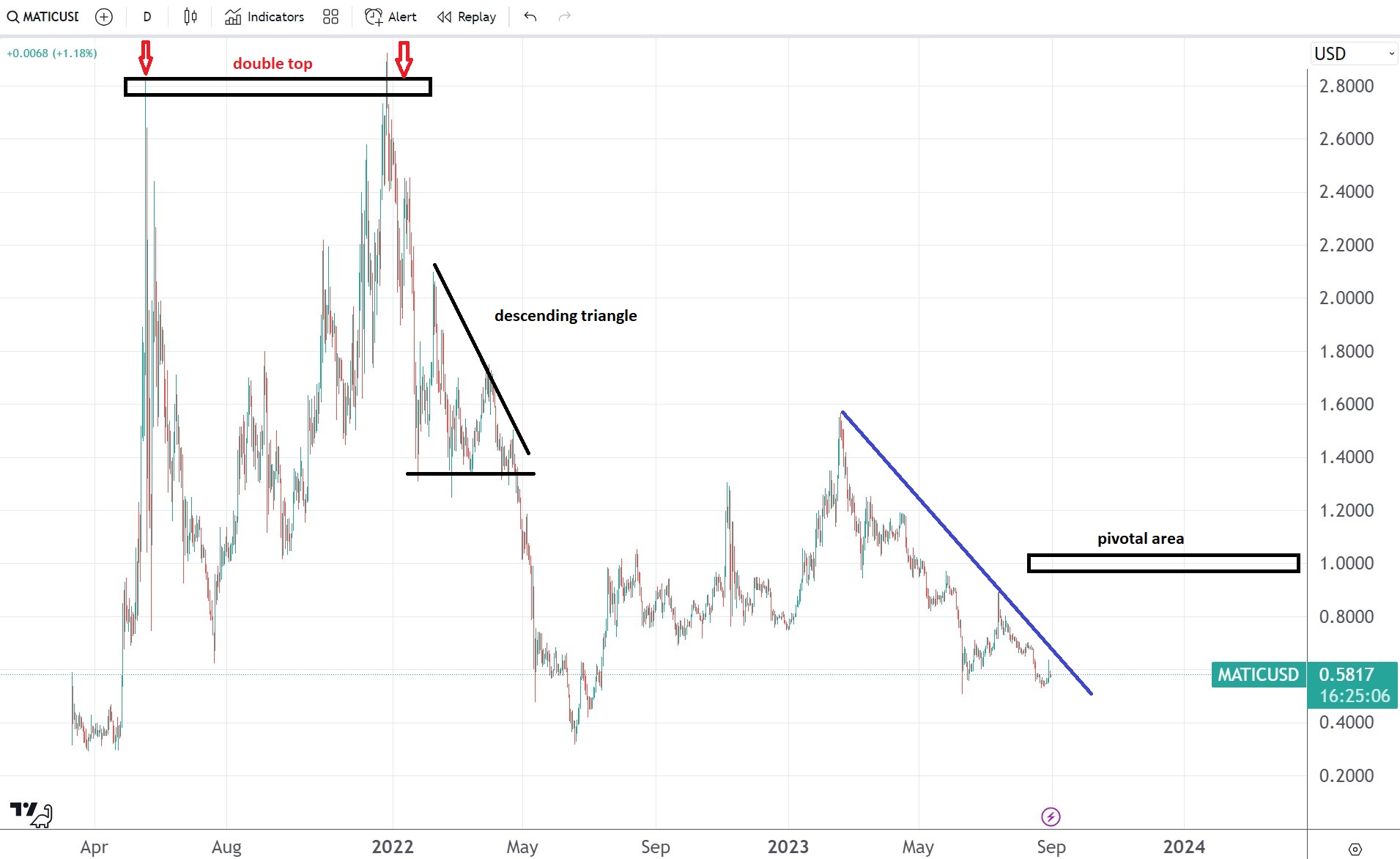
Twice, it had tried at the $2.8 area, failing both times. The market has put a double top pattern there, as it was unable to break above the horizontal resistance area.

Following the double top, it all went wrong for Polygon investors. Another bearish pattern formed, a descending triangle, with a scary measured move for those that bought at the top.

The measured move sent the market all the way down to $ 0.4 before bouncing in the last part of 2022.

When cryptocurrencies rallied at the start of 2023 on the back of Bitcoin’s move higher, optimism emerged again. Polygon rallied, too, trading above $1.4, but those gains are long gone. However, Bitcoin still holds on most of its 2023 gains, which spells trouble for Polygon investors.

Polygon chart by TradingView

Polygon remains bearish while below $1

For the bearish bias to end, the market needs two things. First, it must break the bearish trendline on the chart above. Ideally, it should also break the series of lower highs.

Second, it must trade above parity with the dollar. That is a pivotal level; holding there builds energy for further advances.

The post Polygon price forecast: Will it hold above $0.5? appeared first on CoinJournal.

Judge rules in favour of Uniswap in class action lawsuit

  • A US court has dismissed the class action lawsuit against crypto platform Uniswap.
  • The suit alleged Uniswap users lost money in scam tokens on the platform,but the judge ruled you cannot sue software of provider of the software for crimes committed by third parties.

Judge Katherine Polk Failla of the US District Court for the Southern District of New York has thrown out a class action lawsuit filed against Uniswap. 

The judge ruled that Uniswap Labs and its CEO cannot be sued for providing the software, when its third-party users who committed alleged scams.

No identifiable defendant

The lawsuit filed in April 2022 alleged that the plaintiffs lost money in scam tokens bought via the DEX platform. Judge Failla, who is also the judge assigned to the Coinbase/SEC case, wrote that there is no “identifiable defendant” to sue as the identity of the scammers was unknown to either party.

“Due to the Protocol’s decentralized nature, the identities of the Scam Token issuers are basically unknown and unknowable, leaving Plaintiffs with an identifiable injury but no identifiable defendant,” read part of the judge’s ruling.

The class action lawsuit had also named Uniwap founder Hayden Adams and VC backers Andreessen Horowitz and Paradigm as defendants. Other than the allegation that Uniswap listed the Scam Tokens, the suit also claimed that the decentralised exchange platform sold unregistered securities.

Commenting on the court’s decision, Uniswap’s chief legal officer Marvin Ammori said via X:

“Another huge victory for the crypto world & software devs. SDNY court tossed out a class action against us, deciding that the “self-driving” Uniswap protocol has primarily *lawful* use & protocol devs aren’t liable when others misuse it. The trend in courts is obvious.”

Judge Failla’s ruling is the latest in a series of court decisions that reflect on the broader crypto ecosystem and the highly crucial question of clarity. Recent high profile wins for crypto companies include that of Ripple Labs and that of Grayscale Investments, both involving the US Securities and Exchange Commission (SEC).

The post Judge rules in favour of Uniswap in class action lawsuit appeared first on CoinJournal.

Bitcoin spot ETF? Experts say SEC has “very little wiggle room”

  • ETF analyst Eric Balchunas and James Seyffart say the odds of a Bitcoin spot ETF approval this year are 75%.
  • The Bloomberg ETF analysts say the SEC has “very little wiggle room” and that denying spot ETFs further would be “politically untenable”.
  • The SEC has suffered both legal and PR loss after Grayscale’s win.

The US Securities and Exchange Commission (SEC) has “very little wiggle room” now and will soon have to approve the first Bitcoin spot ETF for the US market.

That’s Bloomberg ETF analysts Eric Balchunas and James Seyffart’s take after yesterday’s court decision that granted a review petition filed by Grayscale Investments. The odds are up from 65%.

Experts say odds of spot ETF have increased

Balchunas shared his and Seyffart’s prediction of when the SEC could approve the ETF, noting a 75% probability it happens in 2023 and 95% by the end of next year. Noting that the SEC’s loss in the Grayscale lawsuit had increased odds of a spot ETF finally being approved, the senior ETF analyst said via a post on X:

According to the ETF experts, the SEC has suffered a double loss that leaves further denials “politically untenable.” Other than the legal blow that comes with Grayscale’s win, the US regulator is looking at a PR loss that has a far greater impact in terms of setting narratives and changing minds. Mainstream’s coverage of the story and what it implies doesn’t help the agency, Balchunas noted.

“We think the legal and PR loss will combine to make denial politically untenable,” Balchunas wrote.

While the SEC could delay upcoming ETF decisions – or even deny them – the analysts say the regulator will find it difficult to deny the one by crypto asset management firm Hashdex.

The SEC recently delayed a decision on the Ark 21Shares Bitcoin ETF proposal, while soft deadlines for several filings including for BlackRock, Fidelity and others are coming up.

The post Bitcoin spot ETF? Experts say SEC has “very little wiggle room” appeared first on CoinJournal.