Optimism brings native USDC to OP Mainnet

  • Optimism and USDC issuer Circle have announced native support for USDC on OP Mainnet.
  • The partnership is expected to spur institutional on and off-ramps for Optimism.

Optimism will soon have native support for USDC, the stablecoin issued by Circle. The development follows a partnership between the Ethereum layer 2 blockchain network and Circle, per details of the announcement.

USDC liquidity to boost Optimism ecosystem

USDC’s native access on the Optimism blockchain becomes the official form of the stablecoin for the network. This form of USDC liquidity will eventually replace the Ethereum-bridged USDC, which will in the meantime be labelled as USDC-e on block explorers.

According to Circle, the launch of its stablecoin natively on the Optimism mainnet allows users to access a dollar-backed token “that’s fully reserved and always redeemable 1:1 for US dollars.” It also brings to users institutional on and off-ramps, a factor likely to boost the broader Optimism ecosystem. Circle helped achieve the same with native USDC launch on Arbitrum in June, and recently on Base.

Price reaction to the news has largely been muted, with OP trading near $1.48 and down 0.5% in the past 24 hours. At the time of writing, data from CoinGecko showed OP price has fluctuated between $1.41 and $1.59 in the past week, currently down 5.3% during this timeline.

The post Optimism brings native USDC to OP Mainnet appeared first on CoinJournal.
Coinbase and PayPal join hands to offer crypto transactions in Europe

  • European users will now be able to purchase cryptocurrencies on Coinbase using PayPal.
  • So far Coinbase users from the US, Canada, UK and Europe can use PayPal to purchase crypto.
  • Coinbase recently got the green light from the National Futures Association to provide cryptocurrency futures to qualified US clients.

The world’s largest online payment company, PayPal, has teamed with Coinbase, a prominent cryptocurrency exchange. This collaboration seeks to make the procedure of purchasing cryptocurrencies for crypto aficionados in Germany and the UK as simple as possible.

According to Coinbase, purchasing cryptocurrencies should be as simple as making any other purchase. However, conventional banking techniques, such as wire transfers, can cause the process to lag. This partnership promises a smoother transactional experience for clients thanks to PayPal’s extensive knowledge and technology investments ensuring safety and transparency.

Purchasing crypto using PayPal on Coinbase

Coinbase is now accessible to those in Germany and the UK that have a PayPal account. The increased security is one of this integration’s most notable benefits. Users of Coinbase no longer have to trust the cryptocurrency exchange with their financial information because they can now rely on PayPal’s advanced security system.

Users who are making a purchase on Coinbase first choose their favourite cryptocurrency, then the payment method, and finally “Add a payment method.” When customers click this, they are redirected to PayPal where they can create an account, choose or add their bank account or debit card, and set up for future purchases. The combined best features of both platforms result in a smooth procedure.

Beyond simple usability, Coinbase offers modern security features including encryption and diligent fraud monitoring.

Coinbase will extend this feature to more European nations over the coming months. Currently, PayPal users in countries including the US, UK, Canada, and the EU can now deposit cash directly into their accounts.

The news adds to Coinbase’s August achievements that saw the crypto exchange get permission from the National Futures Association to provide cryptocurrency futures to qualified US clients.

The post Coinbase and PayPal join hands to offer crypto transactions in Europe appeared first on CoinJournal.

LTC/BTC bearish trend continues, as Bitcoin outperforms

  • LTC/BTC has been in a bearish trend for the last five years
  • Bitcoin’s outperformance is likely to continue
  • A descending triangle keeps the bearish bias intact

One of the most interesting markets to trade are cross pairs. Crosses are less liquid than major pairs and often move in tight ranges. This is a general rule for the classic currency market but also valid for cryptocurrency.

LTC/BTC is such a cross. It moves based on the differences in the prices of Litecoin and Bitcoin.

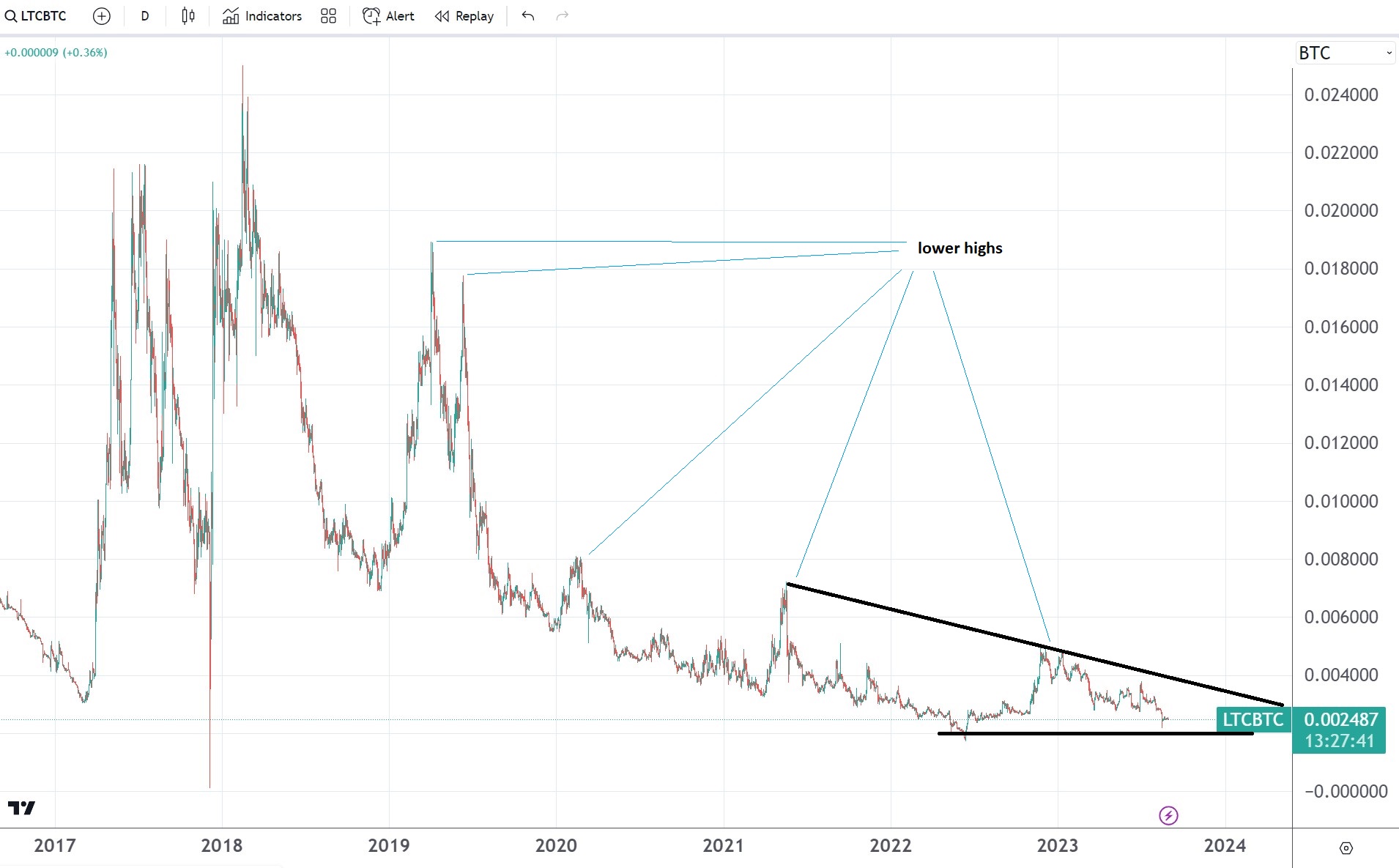
Since 2018, the market has been in a bearish trend. It means that Bitcoin has quite outperformed Litecoin in the past five years.

Litecoin chart by TradingView

The chart above shows that the cross formed a series of lower highs and lower lows – characteristic in bearish triangles. Also, the bearish bias remains strong due to the presence of a descending triangle.

A descending triangle is a bearish continuation pattern. Its measured move equals the size of the longest segment of the triangle, projected from the horizontal base.

Therefore, traders may want to wait for the triangle to break lower before shorting the cross with a stop at the previous lower high.

What moves a cross?

Other rates influence a cross pair’s movements. In this case, the LTC/BTC cross pair reflects the differences between the LTC/USD and BTC/USD pairs.

Because the cross is in a bearish trend, Bitcoin outperformed Litecoin in the last five years. In other words, it means that Bitcoin was a better investment than Litecoin. Given the bearish bias for the cross, Bitcoin’s outperformance should continue.

The post LTC/BTC bearish trend continues, as Bitcoin outperforms appeared first on CoinJournal.

Elon Musk’s X platform has payments licenses in seven US states

  • The most recent payment license that X obtained was from Rhodes Island.
  • Some of the US states that X has received clearance for payment processing include Arizona, Maryland, and Georgia.
  • Elon Musk has previously hinted that X would support crypto payments in addition to fiat currency transactions.

The social media site X, owned by Elon Musk and formerly known as Twitter, has been granted payment licenses by a number of American states, including a currency transmitter license in Rhode Island which the company received earlier this week.

Elon Musk has hinted at supporting crypto on X, even briefly replacing the old Twitter bird logo with dogecoin’s dog before its rebranding to X last month. It is however not clear if the obtained licenses allow for crypto payments despite the fact that the licenses allow for broader payment services to be offered on the platform.

Plans to support payments processing on X

So far, the money transmitter licenses obtained are from Arizona, Maryland, Georgia, Michigan, Missouri, and New Hampshire. The move indicates the tech billionaire may have plans to support nationwide payment processing similar to Venmo or PayPal, a company he co-founded.

Musk has stated that he plans for X to expand beyond social media posts and become an “everything app.”

The most recent Payment processing license that X obtained was from Rhodes Island. The Department of Business Regulation (DBR) of Rhode Island stated in a frequently asked questions document that businesses needing clearance “include those transmitting money for its customers, including traditional wire transfers (like Western Union) and electronic transfers (like PayPal)” needed to obtain the currency transmission license.

The state’s currency transmission license is also necessary for businesses looking to conduct cryptocurrency exchange and custody business. Fintechs are only exempt in “very rare cases” where the company “is registered as a true ‘agent’ of the Rhode Island licensed currency transmitter… and money transmission is not the core profit-making business of the fintech.”

In New Hampshire, “money transmission’ means engaging in the business of selling or issuing payment instruments or stored value, or receiving currency or monetary value for transmission to another location.” The state’s laws also say “an administrator or exchanger that accepts and transmits a convertible virtual currency or buys or sells convertible virtual currency for any reason is a money transmitter under federal regulations”

The post Elon Musk’s X platform has payments licenses in seven US states appeared first on CoinJournal.

DOT/USD price forecast: A descending triangle keeps bulls at bay

  • DOT/USD is in a triangular consolidation
  • The bias remains bearish
  • Conservative traders might want to wait for the market to move first

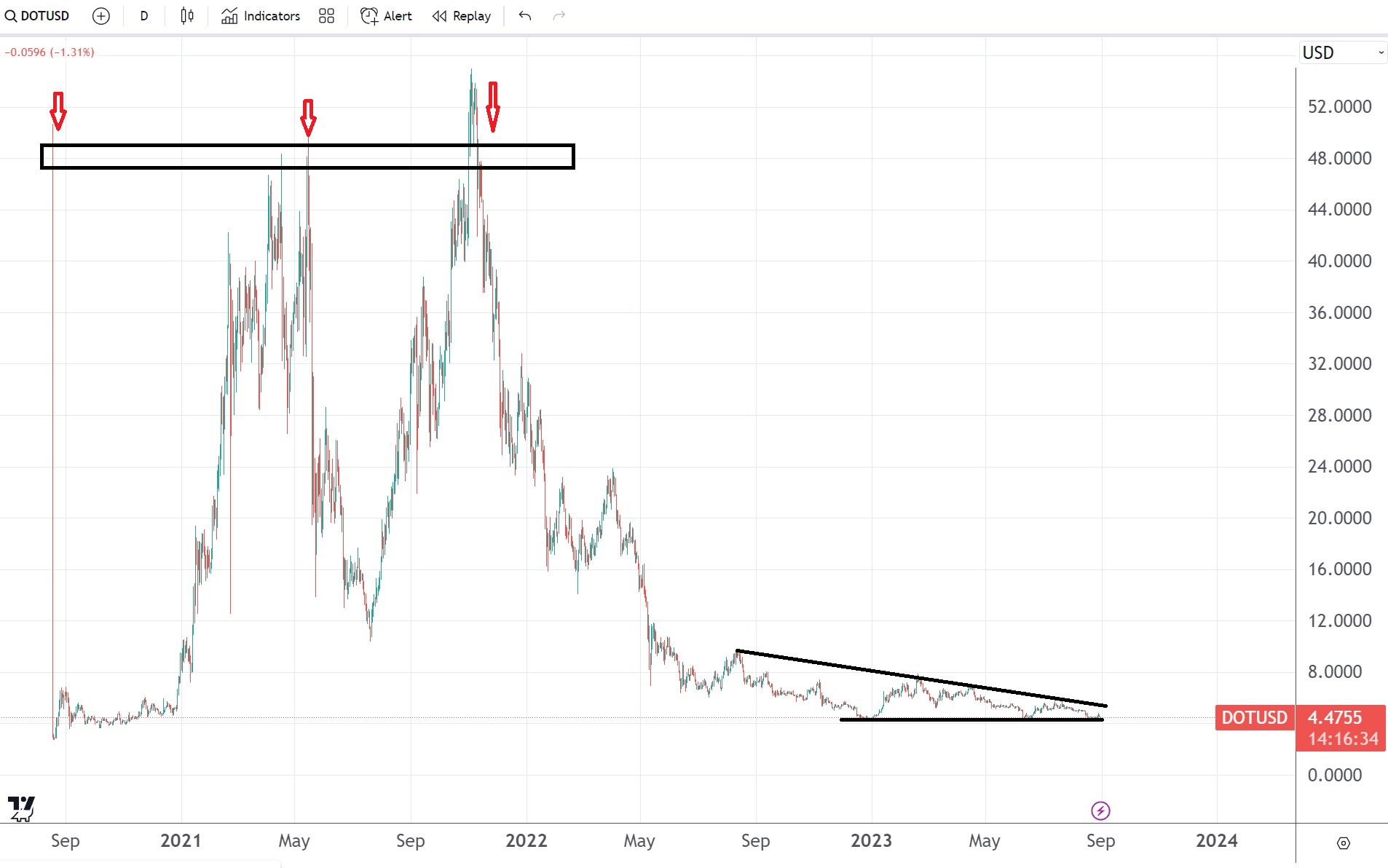
There is nothing positive in the DOT/USD chart for bulls. The price action remains constrained by a triangular pattern that formed in the last twelve months.

Sure enough, the triangle may break in either direction. But the bias is bearish while Polkadot’s price action holds inside the pattern.

Polkadot’s price collapsed after the triple failure at the $50 area. The dollar’s strength was one reason, but surely some other factors contributed to the selloff.

Not even the renewed optimism in the cryptocurrency market that was seen in 2023 was enough. After a small bounce, Polkadot gave away all of its 2023 gains as the market was (and still is) unable to break the lower highs series. At the same time, it pushes for another lower low – a bearish development.

Polkadot chart by TradingView

The bullish case for Polkadot

The only way to construct a bullish case for Polkadot is to wait for the market to move first simply. For a “proof of life,” if you want.

Such proof that the market turned bullish will appear only if the price moves above $8. And, if it holds there.

It would mean that the previous lower high is broken, and the bias turned bullish. Until such a move is seen on the daily chart, buying DOT/USD is risky.

The bearish case for Polkadot

It is easier to build a bearish case because of the descending triangle mentioned earlier. If the market makes a new lower low, the triangle’s measured move points to a drop toward the $1 area.

The post DOT/USD price forecast: A descending triangle keeps bulls at bay appeared first on CoinJournal.