Ankr’s (ANKR) bearish outlook continues as the coin struggles to escape major resistance

Ankr (ANKR) continues to show bearish signs and could remain on the downside for weeks. The coin is suppressed below several crucial resistance zones. It will take time and a significant change in sentiment for this overall bearish outlook to reverse. Here are some points:

  • ANKR was largely exposed to the UST collapse about a week ago.

  • UST’s recovery in recent days has however failed to translate into gains for ANKR.

  • The coin lost nearly 5% in the last 24 hours.

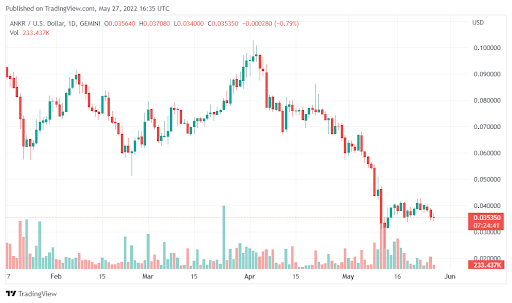
Data Source: TradingView

Will ANKR recover in 2022?

The long-term outlook for ANKR has always been positive. However, there is still a long way to go before the coin reaches any meaningful milestones. First, the biggest challenge will be to overcome the $0.041 resistance zones. At the moment, ANKR is roughly 15% away from this. 

However, we don’t see the token testing of $0.041 in the coming days. In fact, owing to the broader weakness in the crypto market, ANKR will likely retreat by at least 10% by the end of the week before its next leg up. This will push the token towards its next support of around $0.031. 

Now, here is where things might get interesting. If indeed ANKR consolidates above $0.031 for a few days, it may reverse the downtrend and test $0.04. But if bulls fail to hold that, then ANKR will likely bottom at $0.023 by the end of June.

Is ANKR worth buying?

Despite the price decline over the last few weeks, ANKR still retains very good fundamentals. In fact, the project recently announced a major partnership with the Tron Network. 

So, for the long term buyer, ANKR is a decent buy. However, wait a few weeks for the price action to retreat further. That way, investors can get an even bigger discount as they await a long term ANKR recovery.

The post Ankr’s (ANKR) bearish outlook continues as the coin struggles to escape major resistance appeared first on CoinJournal.

Litecoin (LTC) breaks below crucial support – What to expect next

should I buy litecoin

After days of trading sideways and showing very little appetite for trending upwards, Litecoin has finally broken below a crucial support zone. The coin is now facing a major downside and could crash over the coming days. Here are the main takeaway points:

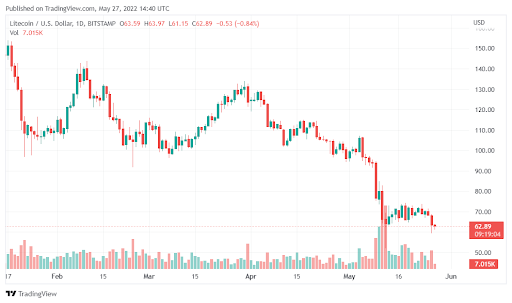
  • LTC has broken below the crucial $64.34 support.

  • The coin is exposed to a 30% downswing as a result of this.

  • However, so far LTC is yet to decisively drop and could still regain this support this week.

Data Source: TradingView 

LTC price analysis: What to expect Next

At the moment, it doesn’t seem like LTC will crash. If anything, the bulls are trying to regain the $64 mark. The coin will need to gain around 5% over the next 24 hours to reclaim the support. However, although this may look like a simple thing, LTC has actually remained suppressed below that price for most parts of the day. 

We do not think there is enough buying activity in the market to push LTC above $64. As a result, we expect the coin to remain closer to the price at the end of the day but ultimately, LTC will not close above this price. 

This will trigger a decisive sell-off over the coming days that could see LTC drop by nearly 30%. The altcoin will eventually settle at around $51 in this bearish cycle before it tries to find its next run. But if more weakness follows and LTC loses $51, it could crash to $40.

How to trade this set-up?

The downside risk for LTC is significant right now. The best you could do is to wait a few days to see if bulls can regain $64 and keep the price action above it. 

But if you are looking to buy LTC for the long term, there will be an opportunity to get it cheap when it tanks to $51 or thereabout.

The post Litecoin (LTC) breaks below crucial support – What to expect next appeared first on CoinJournal.

STEPN (GMT) drops by 37% in minutes – Here is why

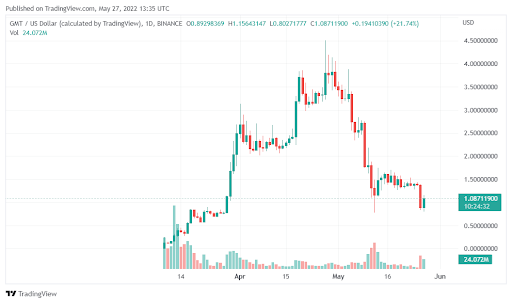
STEPN has dominated the news cycle in crypto over the past few weeks. The coin is one of the most popular lifestyle web3 projects that pays users to move. However, its native token GMT fell sharply today in minutes. Here are some of the details:

  • STEPN dropped by over 37% in just a few minutes after news it was withdrawing from China

  • The project cited regulatory hurdles as the reason for the withdrawal

  • GMT stabilised later in the day and managed to recover some of those losses

Data Source: TradingView 

STEPN (GMT) – Price analysis and prediction

STEPN has developed a unique web3 lifestyle approach. This has made the project and its native GMT token quite popular in recent days. However, news of the Chinese withdrawal appeared to rattle investors. GMT saw 37% of its value vanish in just a few minutes. At one point the coin even lost the $1 price and was trading at around $0.7. 

Despite this, the GMT token managed to recover. In fact, GMT regained the $1 mark shortly after the mini-crash. Even though the token is now down 8% over the last 24 hours, it has managed to keep the price action above the $1 mark.

Based on this, it is clear that the initial shock of the Chinese withdrawal has abated. Investors have already priced in any possible disruption and as such, GMT will likely consolidate at $1 before it tries to move up again.

Why is STEPN a good investment?

Built on Solana, STEPN markets itself as a web 3 lifestyle app. The project has created a metaverse where users earn rewards when they get out of the house and move. Users must buy NFT backed sneakers and integrate GPS into their phones to earn. 

Over the last few weeks, GMT, the native governance token for the STEPN metaverse, has seen immense growth. The project is by far one of the most innovative applications of web3 concepts in real life.

The post STEPN (GMT) drops by 37% in minutes – Here is why appeared first on CoinJournal.

What’s happening with Waves’ rollercoaster 2022 price action?

Rollercoaster is a term frequently used in cryptocurrency. It’s certainly the first bit of vocabulary that comes to mind when looking at the Waves chart. The coin gained 240% in March 2022, yet has given back all those gains and more, and now trades 70% below where it opened on New Year’s Day.

It’s currently ranked 81st on CoinMarketCap. Back in 2017, it was in the top 20, before competitors such as Solana, Matic and Polkadot surged onto the scene.

So what’s going on here?

First, what is Waves?

A multi-purpose blockchain capable of supporting various decentralised applications and smart contracts, Waves’ summary reads as an alternative to Ethereum, really. Most popularly, it grants users the ability to create and trade custom crypto tokens at ease. No extensive smart contracts are needed, rather the currencies can be run via scripts off user accounts built on the Waves blockchain.

Why the crazy price action?

The chart below, plotting the market cap of WAVES since the start of the year, requires only a glance to realise how unusual the price action here has been.

The March boom was caused by a few variables. Anticipation over the Waves 2.0 upgrade. The announcement of a $150 million fund to boost applications and protocols running on its blockchain. Additionally, the below tweet re-affirming Waves’ founder Sasha Ivanov as Ukrainian seemed to also provide some impetus.

But why the staggering fall since, down 93% from the peak? The most concerning was analysis circulating on Twitter that the team were involved in manipulating the price of its native token through its own DeFi lending protocol Vires.finance. It is important to note that Ivanov dismissed these as false, instead laying the blame on Alameda for manipulating price while simultaneously launching a hostile media campaign to induce panic selling in the markets.

USDN De-Pegging

Either way, the debate quelled enthusiasm for the token, which was reflected in the price. That all got worse when, and stop me if this sounds familiar, a stablecoin started de-pegging. USDN is the coin in question, and works similarly to Waves as UST did to Luna.

Measures by Ivanov to fight back against a de-pegging event were controversial – reducing liquidation thresholds, limiting borrowing and instilling max APRs. Amid the furore, the Waves token has continued to fall, however, while the liquidity in the Vires.finance protocol has done the same.

Now, the team has released a proposal to revamp the approach and recover faith in USDN following the de-pegging, down to as low as 75 cents last month, and still trading below 97 cents at the time of writing.

Revamp

USDN is currently backed by roughly 40 million WAVES which are leased to two generating nodes. Half of the generated WAVES leasing profit is sent as rewards to USDN stakers and the other 50% gets sent to the smart contract to increase the USDN reserves.

The team is striving to decentralise and solidify the peg control mechanism, and therefore seeking crypto investors and community members “who are willing to run their own nodes for the needs of Neutrino to improve the reliability of the system and make their own interest”.

  • The addition of participants will be gradual and on a one-by-one basis.
  • Maximum participants cannot exceed 80.
  • To begin, each participating node will get 1 million WAVES in leasing, with this amount changing in the future with the possibility of additional participants.
  • Participants will be combined in groups of 10 addresses to simplify the management of the leased amounts.

Phase two of the program will provide the community the chance to govern the decentralisation through voting.

Conclusion

Whether this will re-instil confidence among the community following the de-pegging remains to be seen. The meltdown of the UST stablecoin obviously sent shockwaves through the entire space, but with USDN possessing so many parallels, the pain was more pronounced here than elsewhere.  On the bright side, the Waves team recognised there was action required and is now acting accordingly. If they can learn from Terra’s errors and make the necessary adjustments, there could be a rebound. If not, all bets are off. 

It will be an interesting one to follow.

The post What’s happening with Waves’ rollercoaster 2022 price action? appeared first on CoinJournal.


Terra 2.0 launch delayed to 28 May as major exchanges announce LUNA airdrop support

Terra 2.0 will now launch its mainnet on 28 May 2022, the team behind the blockchain has announced.

While the announcement made via its official Twitter account did not specify the reasons for the delay, it expects the chain’s version two to go live at 6:00 AM UTC (tomorrow 28 May).

“Block 1 of the new chain will be produced following a supermajority of interconnected validators running simultaneously,” the team shared in the thread. 

As for what the community should look forward to, Terra says:

Top crypto exchanges announce LUNA aidrop support

Weeks after a brutal crash of the TerraUSD (UST) stablecoin and the LUNA token, the Terra team is getting ready for reincarnation. This time, there will be no UST.

And despite the controversy, criticism and anger around Terra’s collapse, and opposition to forking the blockchain, a governance vote initiated on May 18 was passed to give way to the new chain.

An airdrop for LUNA, the native token of the new chain will also take place at the genesis block. Binance, KuCoin, and FTX, all support the airdrop.

Other major crypto exchanges to announce support include Bitfinex, ByBit, Huobi, Bitrue, LBank Crypto.com, HitBTC, and Gate

Also expected is the migration of dApps built on what is set to be the old chain Terra Classic (LUNC). However, individual projects will choose when to do so, according to today’s communication.

The post Terra 2.0 launch delayed to 28 May as major exchanges announce LUNA airdrop support appeared first on CoinJournal.