Polkadot could still hit a bull run despite uncertainty

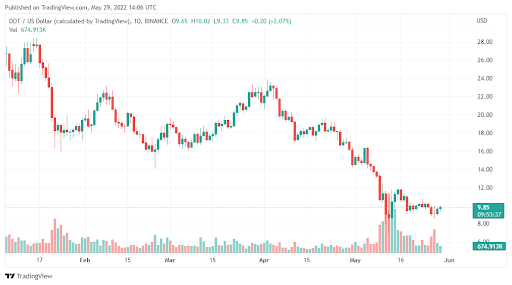
Polkadot (DOT) has finally managed to stop its prolonged correction. The price appeared to have settled a bit after bottoming at around $7.35. DOT now has a good opportunity to reverse the downtrend and could rally significantly despite growing uncertainty in the market. Here are some points:

  • DOT is testing the $10 which could be significant in any bull run

  • It’s the first time the coin has reported gains after 4 days of retreat

  • Crossing the $10 could trigger a rally towards $13 or thereabout
Data Source: TradingView 

Polkadot price analysis and prediction

The most important thing for DOT bulls is that the downtrend appears to have slowed. The coin had reported losses in 4 straight sessions, and there were fears it could actually fall below $5 for the first time this year. But it seems the price action started to consolidate at around $7.35. 

Eventually, DOT was able to trigger a run and is now trying to cross above $10. If indeed this happens, we could see the token rally towards $13 or beyond. This will represent an upswing of around $30 from this price. However, despite this bullish outlook, there are still several uncertainties in the market.

For example, we have not seen enough trading volume to suggest DOT is going bullish. It is possible that DOT may in fact get rejected at the $10. This will push it downwards toward its previous bottom price of $7.35. But if bulls are not able to keep the price above $7.35, there will be more downside to come.

How to trade DOT in this setup?

The first entry would be above $10. If DOT is able to cross above this price, then you can buy and exit at $13. 

However, if the price action remains suppressed below $10, then wait for it to bottom at around $7 before you buy. But there is a risk that a drop towards $7 could continue until DOT hits $5.

The post Polkadot could still hit a bull run despite uncertainty appeared first on CoinJournal.

Avalanche v Solana – Which one is a better buy?

After the Terra collapse, increased risk perception could see AVAX outperform SOL.

Key Points:

  • Avalanche is a platform blockchain that can handle 4500 transactions per second. While it has a fast-growing ecosystem of Dapps, AVAX’s price has been affected by the correction in the broader crypto market. 

  • Solana is one of the most scalable platform blockchains in the market today. While adoption is growing, SOL price has been weighed down by the correction in the broader market. 

  • While both Avalanche and Solana will do well long term, AVAX could outperform SOL in the short to medium term. This has a lot to do with SOL’s frequent network outages in 2021 and the risk awareness that Terra’s collapse has triggered amongst investors. 

Avalanche (AVAX)

The decentralized applications space is on a growth trajectory, and launch platforms are growing in demand. Avalanche is one of those that have recorded fast growth in a very short time. While it is only three years old, Avalanche now has one of the largest and fastest-growing ecosystems of Dapps in crypto. This is due to its strong core metrics. They include low fees and high throughput – up to 4500 transactions per second. Despite the fast-growing Dapps ecosystem, Avalanche’s price has taken a nosedive in 2022. This has a lot to do with the bearish nature of the broader cryptocurrency market. 

Solana (SOL)

Like Avalanche, Solana is a launch platform for Dapps and has seen a significant level of adoption in the last 2-years. This is due to its scaling capabilities and super-low fees. Solana can handle up to 50k transactions per second, and its fees go as low as $0.001 per transaction. In 2022, there has been an upsurge in investments in the Solana NFTs ecosystem running into 100s of millions of dollars. 

Which one is a better buy?

Due to the fast-growing nature of their ecosystems, both Avalanche and Solana have strong odds of growth going into the future. Now that their prices are at record lows from their last all-time highs, the chances are that once the broader market makes a comeback, these two could perform well. However, Avalanche is more likely to outperform Solana in the next bull run. 

This has a lot to do with the history of the two networks. Avalanche has been consistently stable since it launched. On the other hand, Solana has suffered several network outages in the recent past that put its reputation at risk. After the recent Terra collapse, the chances are that many investors will be a lot more conscious of the risks associated with the cryptocurrencies they invest in. This could disadvantage SOL over AVAX in the short to medium term. 

Conclusion 

While both AVAX and SOL are good long-term investments, the odds favor AVAX in the medium term. The collapse of Terra LUNA has driven up investor awareness of cryptocurrency risks, and SOL has more perceived risks than AVAX.

The post Avalanche v Solana – Which one is a better buy? appeared first on CoinJournal.

Shiba Inu v Dogecoin – Which one is a better buy?

Shiba Inu’s deflationary tokenomics give it a clear edge over Dogecoin

Key Points:

  • Both SHIB and DOGE have strong prospects for growth. They are trading at massive lows while their core fundamentals are getting stronger. 

  • Shiba Inu recently launched a Metaverse and a layer-2 scaling solution. 

  • Many top organizations now adopt Dogecoin for payments, including Tesla. 

  • While the two are likely to perform well long-term, SHIB’s deflationary tokenomics give it an edge over DOGE. 

Shiba Inu (SHIB)

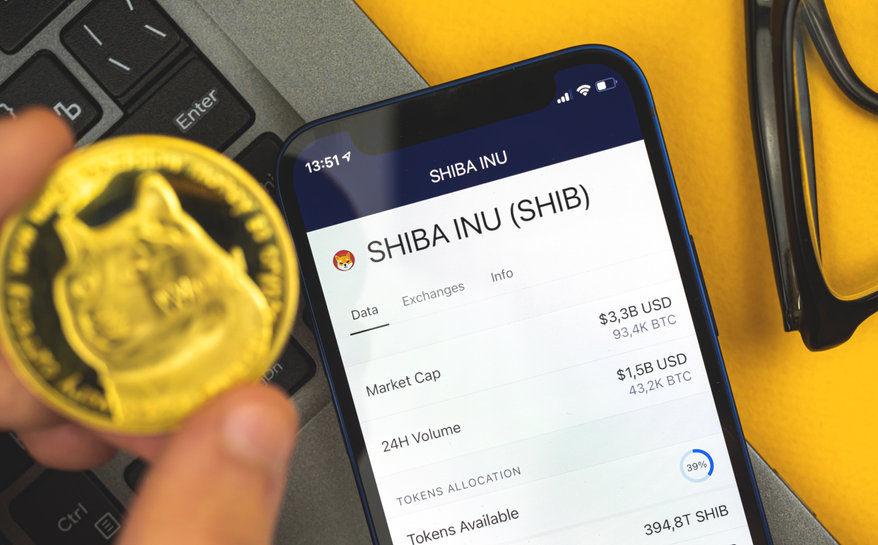
Shiba Inu made history in 2021 as one of the best-performing cryptocurrencies ever. Shiba Inu launched in August 2020, and by November 2021, it was up by 48,000,000%. However, for most of 2022, things have not been rosy for Shiba Inu. Shiba Inu is currently down by over 80% from its November 2021 highs. 

Despite the price crash mainly being a function of the broader cryptocurrency market, the Shiba Inu ecosystem is growing fast. For instance, Shiba Inu recently launched a Metaverse and a layer-2 solution to help scale and cut down on transaction costs. Adoption of SHIB for payment is growing too, which points to Shiba Inu’s potential as a cryptocurrency likely to rebound once the bear market ends. 

Dogecoin (DOGE)

Dogecoin is the oldest meme coin. While it was created as a joke coin, Dogecoin has maintained its position as one of the top cryptocurrencies by market cap since 2013. However, Dogecoin only started making headlines in 2020 after Elon Musk got interested. His tweets about Dogecoin saw it pump and record gains of 12,000% by April 2021. 

Since then, Dogecoin has been in a correction and has struggled to retest its all-time highs. That aside, Dogecoin adoption continues to grow, and many large corporations now accept Dogecoin payments. These include the Dallas Mavericks and Tesla, which now sell some of their low-cost merchandise in Dogecoins. 

As adoption grows, Dogecoin has a good chance to perform well once the market turns bullish again. The fundamentals are getting better, and Dogecoin in 2022 is miles ahead of where it was in 2020. 

Which one is a better buy?

Both Dogecoin and Shiba Inu are among the best meme coins to bet on in the long term. However, in terms of absolute gains, the odds favor Shiba Inu as the likely winner of the two. That’s because of its deflationary tokenomics. SHIB also has a more robust ecosystem that includes a Metaverse. 

Conclusion

While both Shiba Inu and Dogecoin have the potential for long-term growth, SHIB could perform better. It has a more extensive ecosystem, and its deflationary tokenomics favor long-term value growth.

The post Shiba Inu v Dogecoin – Which one is a better buy? appeared first on CoinJournal.

Tether launches its USDT stablecoin on the Polygon network

Tether, the world’s largest stablecoin company, has launched its USDT stablecoin on the Polygon network bringing its utility to the over 19,000 decentralized applications (dApps) running on Polygon.

Polygon, a layer 2 (L2) scaling solution for the Ethereum network, allows cheaper and faster transaction costs using ZK rollups and optimistic rollups technologies. Its dapps have been created by more than 8k developer teams from 3k in October.

Tether has a variety of tokens backed by assets with a more “stable” value like the commercial paper and US treasury bills. These assets keep Tether tokens pegged to one dollar each. Besides, Tether had recently announced a new stablecoin, MXNT, launch that will be pegged on Mexican Peso.

Advantages of stable assets

Stable assets are very important as they help to increase the rate of trade in the market as well as cubbing all the risks involved in the DeFi ecosystem in terms of market volatility.

Polygon is now the 11th blockchain to host USDT. Other blockchains that host USDT are; Solana, Ethereum, Avalanche, Omni, Kusama, Algorand, EOS, Bitcoin Cash’s Standard Ledger Protocol, and Tron.

Paolo Ardoino, Tether CTO said:

“We’re excited to launch USD₮ on Polygon, offering its community access to the most liquid, stable, and trusted stablecoin in the digital token space.” 

Notably, USDT had faced some turbulence after TerraUSD (UST) collapsed. This could not be dealt with since UST was an algorithmic stablecoin that was backed by unstable crypto instead of direct dollars.

However, Tether’s recovered its peg quickly and reassured its holders that their reserves were fully backed.

The post Tether launches its USDT stablecoin on the Polygon network appeared first on CoinJournal.

STEPN (GMT) price surges 20% a day after STEPN said it’ll block GPS services in China

STEPN, the most popular fitness-focused Move-to-earn game, shared an official announcement stating that they will block geolocation (GPS) services for users in China mainland starting on July 15.

Following the announcement, the price of STEPN (GMT) dropped by 5.29% to a low of about $0.83 before bouncing back by 20.67% to trade at $1.05 at the time of writing.

What is STEPN?

After its launch in late 2021, STEPN gained popularity in the world gaining over $20M profit in Q1 of 2022. Currently, the game has over 580K global players, however, it’s not clear how many players are in China.

Since the company will be blocking all the China-based IP addresses, local users have been given up to July 15 to make arrangements themselves for their virtual assets before the change becomes effective. 

STEPN uses the GPS concept to track the movement and steps of the players who purchased the virtual NFT sneakers. The virtual NFT sneakers are then converted to in-game utility tokens.

What caused STEPN to block GPS services in mainland China?

The move to block GPS services in mainland China is mainly due to regulatory issues.

Although STEPN did not explain the reason why the team decided to take that stand, their Twitter thread has hinted at regulatory policies compliance.

The post noted:

“STEPN has always attached great importance to compliance obligations and always strictly abides by the relevant requirements of local regulatory agencies. We also remind users to beware of scams.”

However, the Chinese government is known for its strict policies against digital recording technologies it has not provided and also the fear of foreign surveillance.

Last year, the Chinese government banned the use of Tesla cars by its state officials due to their facial recognition cameras saying that they can be used to spy and gather state information.

Earlier this year, China’s general prosecutor added the level of inspecting non-fungible tokens (NFTs) and the Metaverse. Besides, the officials in the country have been warned against financial crimes like illegal fundraising and money laundering carried out through the Metaverse and NFTs. Related crimes will not be tolerated and will attract severe punishment

The post STEPN (GMT) price surges 20% a day after STEPN said it’ll block GPS services in China appeared first on CoinJournal.