
Coinbase stock could sink all the way back to $60 – analyst says

  • Piper Sandler downgraded Coinbase Global Inc on Wednesday.
  • Analyst Patrick Moley cited regulatory uncertainty for dovish view.
  • Coinbase stock has gained close to 60% over the past thirty days.

Coinbase Global Inc has been an absolute delight for shareholders over the past thirty days but a sharp downturn is likely moving forward, as per a Piper Sandler analyst.

Avoid Coinbase stock due to regulatory uncertainty

On Wednesday, Patrick Moley downgraded the crypto exchange to “neutral” and lowered his price target as well to $60 that signals a 25% downside from here.

The analyst turned dovish primarily because the U.S. Securities and Exchange Commission sued the Nasdaq-listed firm last month for operating as an unregistered exchange (read more).

In a research note today, he attributed the recent surge in Coinbase stock to prominent asset managers filing for a Spot Bitcoin ETF and the consequent benefit to crypto prices but said:

Rising crypto prices have not translated to increased trading volumes for COIN in recent quarters and the timing of a Spot Bitcoin ETF approval is anyone’s guess.

Coinbase Global will report a weak second quarter

Moley expects the crypto company to report monthly transacting users and trading volumes at a two-year low in its second financial quarter.

The Piper Sandler analyst agreed that Coinbase Global will eventually emerge as a major player within the crypto space but said:

We’d like to see more progress on regulatory front and a convincing turnaround in underlying fundamentals of the business before becoming more positive on Coinbase stock.

Despite the regulatory crackdown, though, Coinbase increased its market share last month to a new high since January 2023, as per data from Kaiko – a digital assets data provider.

The post Coinbase stock could sink all the way back to $60 – analyst says appeared first on CoinJournal.
Bitcoin Cash price moved to a bear market: Buy the dip?

  • Bitcoin Cash price has moved to a bear market after falling by 22%.

  • The coin has more short-term downside as it moves from the overbought zone.

  • Some investors believe this is a good time to dollar cost average (DCA)

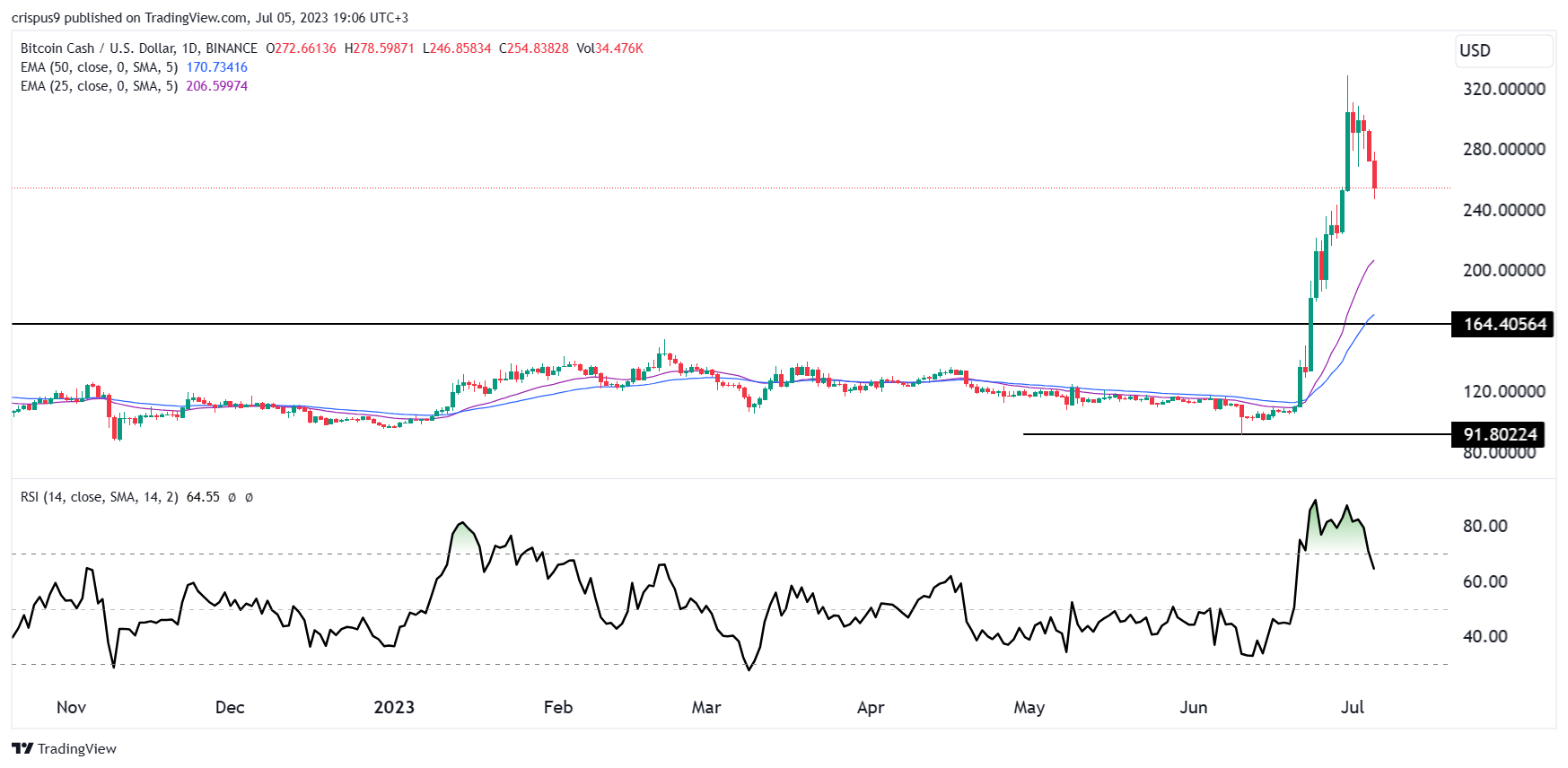
Bitcoin Cash price has moved into a bear market as investors start taking profits after the spectacular performance in June. The coin retreated to a low of $250 on Wednesday, about 22% below the highest level in June. 

BCH enters a bear market

Bitcoin Cash had one of the best period in June as investors moved to proof-of-work cryptocurrencies after the SEC lawsuit on Binance and Coinbase. Investors believe that coins like BCH, Verge, and Litecoin will benefit if the SEC decides to move to war against crypto tokens like Solana and Cardano.

Bitcoin Cash price has now moved into a bear market by falling by over 20% from its highest level in June. This decline is mostly because of profit-taking since BTC was up by more than 250% between the lowest and highest points in June. 

Historically, investors tend to exit an asset after rising sharply in a certain period. When it drops, the so-called Fear of Missing Out (FOMO) situation reverses and people who bought during the uptrend starts to exit.

BCH price also retreated as Bitcoin price struggled to move above the upper side of the bullish flag pattern that has been forming. BTC is hovering at $30,300 and there is a possibility that it will move below $30,000 soon. 

Further, BCH also dropped as American stocks retreated after the Independence Day holiday. The Dow Jones index retreated by 50 points while the Nasdaq 100 fell by about 20 points.

Bitcoin Cash price forecast

On the daily chart, we see that the BCH price has retreated in the past few days. This retreat started after the coin moved to the extreme greed zone. The coin has now formed three black crows pattern, which happens when three red candles follow each other.

Bitcoin Cash remains much higher than the 50-day and 100-day moving averages while the Relative Strength Index (RSI) moved below the overbought level. Therefore, I suspect that Bitcoin Cash price has some more downside in the near term before making an eventual comeback.

This pullback will likely see it drop to the next key support at $210, which is the 25-day moving average. Therefore, dollar cost averaging, where a trader buys the coin as it drops could be a good idea since it will ultimately bounce back.

How to buy Bitcoin Cash

eToro

eToro is a multi-asset investment platform with more than 2000 assets, including stocks, ETF’s, indices, commodities and Cryptoassets. eToro offers over 60+ Cryptoassets to invest or invest in their CryptoPortfolio where investors can benefit from the accumulated growth of Bitcoin, Ethereum, XRP, Litecoin and other leading cryptocurrencies. eToro users can connect with, learn from, and copy or get copied by other users.

Buy BCH with eToro today

Bitstamp

World’s longest-standing crypto exchange. Since 2011 Bitstamp has been providing a secure and reliable trading venue to over four million individuals and a range of institutional partners.

Buy BCH with Bitstamp today

The post Bitcoin Cash price moved to a bear market: Buy the dip? appeared first on CoinJournal.

Australian regulator searched Binance Australia’s offices

Key takeaways

  • Australian Securities and Investments Commission searched Binance Australia’s office on Tuesday.

  • The cryptocurrency exchange maintains that it is focused on complying with rules. 

ASIC searched Binance Australia’s offices

The offices of Binance Australia, the Australian arm of Binance, were searched on Tuesday by the country’s financial markets regulator.

This latest cryptocurrency news comes as governments around the world are scrutinising the cryptocurrency exchange’s activities.  

According to a Bloomberg report, the Australian Securities and Investments Commission searched several Binance Australia locations on Tuesday. The search was part of an ongoing investigation into the cryptocurrency exchange’s now-defunct derivatives business, sources close to the matter revealed to Bloomberg. 

Binance has been experiencing crackdowns from governments in Europe and the United States. Last month, the US SEC sued Binance and its CEO, Changpeng Zhao, for breaking securities laws. 

On June 22nd, Brazilian authorities revealed that they were investigating Binance for suspected pyramid schemes. Binance is also being investigated for helping customers get around a restriction on crypto derivatives investments in Brazil.

A few days later, Binance dropped its licence application in Austria after the German regulators denied its application to operate in the country. 

External pressure is hurting Binance, says CZ

At a Twitter Space on Wednesday, Binance CEO, CZ, admitted that the external pressure is hurting the company. He stated that;

“Many of those things are outside of our control, but short term, they have negative impacts on our business.”

Despite the pressure, Binance remains the number one cryptocurrency exchange in the world. However, its global share of crypto spot trading fell for a fourth consecutive month in June. Data obtained from CCData showed that Binance now controls 42% of the global crypto spot trading volume, a 10-month low for the company. 

The ASIC investigation comes after Binance Australia announced in April that it would wind down the local derivatives exchange while keeping its spot platform open. 

At the time, Binance said it closed the derivative positions of numerous Australian users because they were falsely classified as wholesale investors.

A spokesperson for ASIC stated that

“We are unable to confirm or deny any operational detail such as possible searches. ASIC’s review of the company is ongoing.”

The cryptocurrency exchange said it is working with local authorities, and its sole focus is to meet local regulatory standards in order to serve its Australian users in a fully compliant manner.

The post Australian regulator searched Binance Australia’s offices appeared first on CoinJournal.

Crypto spot trading volume rose 16% to $575 billion in June: CCData

  • Spot trading volume across centralised exchanges rose 16.4% to $575 billion in June, the first time volumes rose in three months.
  • Derivatives trading volume on CEXs also rose, with the month seeing a 13.7% spike to $2.13 trillion.
  • Binance saw a decline in both spot and derivatives volumes as OKX registered an increase.

According to the latest “Exchange Review” report by research and data platform CCData shows that the spot volumes jumped 16.4% to $575 billion in June as the crypto market experienced increased volatility over the month.

Meanwhile, the combined CEX volumes across spot and derivatives markets hit $2.7 trillion. The monthly trading volume for the two metrics rose 14.2%, while it was 13.7% for derivatives as volumes hit $2.13 trillion – the first increase for derivatives trading volume in three months.

Positive news fuel crypto trading activity

The spike in volatility was fueled by the US Securities and Exchange Commission (SEC)’s lawsuit against leading exchanges Binance and Coinbase. 

Also key to this was the positivity that greeted the filing of spot Bitcoin exchange traded funds (ETFs) by major Wall Street asset managers BlackRock and Fidelity, and the launch of Citadel backed crypto exchange EDX Markets.

“The increase in the market share of spot trading volume hints at the healthy accumulation of crypto following recent positive news in the markets,”CCData researchers note in the report.

This outlook was indeed visible in the market. Increased trading activity saw Bitcoin price shoot to a new year-to-date high above $31k, while altcoins like Litecoin and Bitcoin Cash rode the optimistic outlook to break above critical resistance levels. [Read more]

Binance’s spot and derivatives volumes decline

Despite the above increases, the quarterly spot trading volumes on CEXs still hover near “historically low levels.” For instance, quarterly spot volumes for Q2, 2023 were the lowest since the fourth quarter of 2019.

Also notably, the spot market share of Binance declined 41.6% in June to see the leading exchange record a fourth consecutive month of declines, and its lowest market share since August 2022. And although Binance continues to dominate the crypto derivatives trading market with $1.21 trillion, it fell 56.8% in June.

OKX, which is the world’s second-largest derivatives exchange, recorded a 44.9% increase in its trading volume to hit $416 billion in June. The crypto exchange’s market share has now grown to 19.5%, its highest level since April 2022.

The post Crypto spot trading volume rose 16% to $575 billion in June: CCData appeared first on CoinJournal.

Saxo Bank ordered to dispose of crypto holdings by Denmark’s DFSA

  • The DFSA ordered the Saxo Bank to dispose of its own holdings in crypto.
  • The Financial regulators in Denmark have said that local banks are not allowed to hold crypto to hedge against trading risks.
  • DFSA’s order concerning Saxo Bank’s crypto holdings will have little impact on the bank’s business.

Local investment bank Saxo Bank has received a formal order from the Danish Financial Supervisory Authority (DFSA) directing it to dispose of its own cryptocurrency holdings.

According to the regulator, Saxo Bank’s cryptocurrency activity “lies outside of the legal business area of financial institutions,” citing section 24 of the Danish Financial Business Act.

Cryptocurrency service providers in Denmark

Danish financial regulators are going after cryptocurrency service providers, saying that local banks are not allowed to hold cryptocurrencies as a form of risk management.

Pinpointing why it singled out Saxo Bank, the DFSA claims that Saxo Bank gives its customers the option to trade a variety of cryptocurrencies on its platform. The regulator stated that the company also provides a number of exchange-traded funds and exchange-traded notes that are linked to cryptocurrencies, adding that “it is possible to speculate on crypto assets.”

The DFSA also noted that Saxo Bank has its own portfolio of bitcoin assets, which is kept as a hedge to counteract the market risk connected to the bank’s cryptocurrency products. The regulator cited Annex 1 of the Financial Business Act in stating that dealing in crypto-assets does not appear to be under the lawful business scope of Danish financial institutions.

Based on the above reasons, the DFSA stated:

“Based on the above, Saxo Bank’s trading in crypto assets for its own account is found to be outside the legal business area of financial institutions. On this basis, Saxo Bank is ordered to dispose of its own holdings of crypto assets.”

It will be interesting to see how Saxo Bank will move ahead with its crypto offering seeing that their customers do not own underlying cryptocurrencies but instead buys financial products that follow the price of cryptocurrencies.

The post Saxo Bank ordered to dispose of crypto holdings by Denmark’s DFSA appeared first on CoinJournal.