BlackRock CEO Larry Fink: ‘crypto is digitalising gold in many ways’

  • BlackRock CEO Larry Fink was all praise for BTC in a recent interview.
  • The asset manager refiled for a Spot Bitcoin ETF earlier this week.
  • Bitcoin is currently up close to 90% versus the start of the year.

Bitcoin made a new 52-week high this morning after Larry Fink – the Chief Executive of BlackRock Inc agreed that it was a valuable international asset.

Fink is now constructive on Bitcoin

Fink had once dubbed the BTC an index of money laundering. But in a recent interview with Fox Business, he was all praise for the world’s largest cryptocurrency by market cap.

I do believe the role of crypto is digitalising gold in many ways. Instead of investing in gold as a hedge against inflation or the onerous problem of any one country.

Earlier this week, the asset manager refiled for a Spot Bitcoin ETF after the U.S. Securities and Exchange Commission asked for more clarity on its initial application.

BlackRock Inc currently has about $9.5 trillion worth of assets under management.

Is a Spot Bitcoin ETF coming soon?

Note that BlackRock has a history of getting regulatory approval for nearly every exchange-traded fund it has ever filed for.

That’s important considering many experts forecast a Spot Bitcoin ETF to unlock further upside in Bitcoin. The digital currency is already up close to 90% for the year at writing.

BlackRock has already made money investing in BTC and expects the crypto asset to grow further moving forward. According to CEO Larry Fink:

The foundation of BlackRock is about hope. You have for retirement because you believe tomorrow is better than today.

The post BlackRock CEO Larry Fink: ‘crypto is digitalising gold in many ways’ appeared first on CoinJournal.

Stay away from Grayscale Bitcoin Trust despite discount narrowing to 10-month low


Key Takeaways

  • The Grayscale Bitcoin Trust (GBTC) has persistently traded at a discount to its net asset value
  • The discount has narrowed to its lowest mark since September off hope the fund is more likely to be converted to an ETF
  • The entire GBTC debacle represents the mess that is the institutional regulatory climate in the US
  • Spot ETFs are a question of when rather than if, and such investment vehicles will then be a thing of the past
  • That won’t assuage frustration of GBTC investors, who have been caught badly as alternative Bitcoin investment vehicles have come online and demand for the trust has dried up

Among the interesting aspects of the fallout from the slew of recent spot Bitcoin ETF filings is how it affects the controversial Grayscale Bitcoin Trust (GBTC). 

The trust has been flying, up 56% in the three weeks since Blackrock’s ETF filing was announced. 

Notably, this means it has significantly outpaced its underlying asset, Bitcoin. That sounds like a good thing, but it really summises the problem with this investment vehicle that has done nothing but frustrate investors in recent years, but we will get to that in a moment. 

I have plotted the movement of the GBTC against Bitcoin itself in the next chart, highlighting the outperformance the Trust has had since the ETF filing, with Bitcoin itself up “only” 21%. 

Grayscale discount to net asset value narrowing but still enormous

The trust’s discount to net asset value has also narrowed to its smallest mark since September, now below 30%. This comes as investors bet the trust is now more likely to finally be allowed to convert to an ETF.
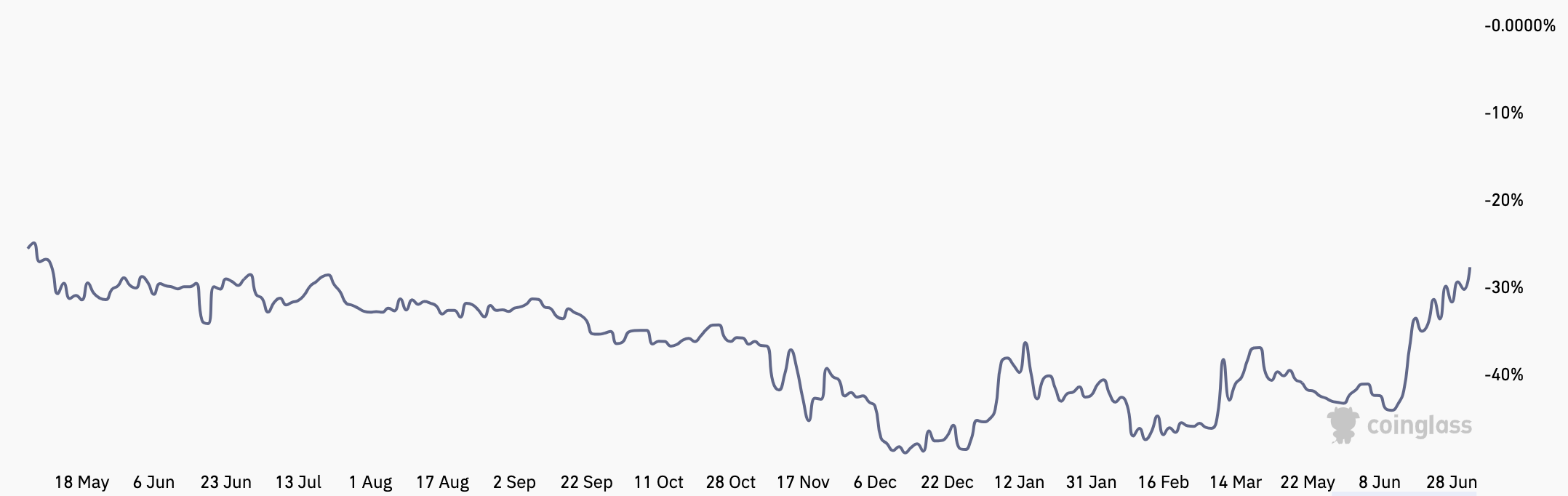
 Should this conversion occur, the discount would narrow to near zero, as funds would then be allowed to flow in and out of the vehicle without affecting the underlying assets. For the time being, while it remains a trust, there is no way to get Bitcoin out of GBTC. This, coupled with steep fees (2% annually) means that a heavy discount has persisted. 

In truth, the very existence of the Grayscale trust is a black mark on the sector. The discount it trades at is farcical – even following the recent narrowing, a 30% delta is an enormous chasm, one that is hurting investors. 

The outsized assets under management – essentially trapped due to the closed-fund nature – feels like a throwback to the days when anyone and everyone wanted to get exposure to Bitcoin through whatever means necessary. Grayscale was the only shop in town, and such was the demand for Bitcoin, coupled with that monopolistic power, that it even traded at a premium for much of its early history.

However, as more mediums through which Bitcoin exposure can be had have come online, the premium has flipped to a discount, and that discount has become large. It is probably fair to say that investors displayed a lack of due diligence for how the fund works, another throwback to the up-only bull market of days gone by. 

Without donning a captain hindsight outfit, there was always going to be competitor firms coming online and the premium was bound to come under pressure. An investment in GBTC essentially amounted to two things: a bet on Bitcoin, and a bet that the trust would be converted into an ETF quickly. 

But at that, perhaps sympathy can be shown to investors. Investment management firm Osprey Funds has a similar product, and earlier this year sued Grayscale, alleging that its competitor misled investors about how likely it was that GBTC would be converted into an ETF. This, they allege, is how they captured such a share of the market. 

“Only because of its false and misleading advertising and promotion has Grayscale been able to maintain to date approximately 99.5% market share in a two-participant market despite charging more than four times the asset management fee that Osprey charges for its services”, the suit alleges. 

Whether Grayscale knew of the regulatory difficulty it would face or not, it has tried and failed for years to convert the vehicle into an ETF. Last year, it sued the SEC itself, declaring the latest rejection “arbitrary”.

Institutional climate turning

My thoughts on the trust overall remain the same. I believe it represents a terrible investment (obviously), and its mere existence is only a byproduct of the regulatory travails that the sector has struggled with. There is no reason to even consider buying this unless there is quite literally no other vehicle through which to gain Bitcoin exposure. 

There will come a day when all this squabbling over trusts and ETFs will likely be nothing but a throwback of a more uncertain time. But time is a luxury that many investors don’t have, and Grayscale has been a horrendous investment, typical in a lot of ways of the travails the space has had in bridging the gap to become a respected mainstream financial asset. 

Not only is the discount jarring as it is, but it widened beyond 50% in the aftermath of the FTX collapse as it emerged that crypto broker Genesis was in deep trouble. Genesis’ parent company is Digital Currency Group (DCG), the same parent company of Grayscale. Genesis eventually filed for bankruptcy in January. 

This sparked concern around the safety of Grayscale’s reserves, something which they company did not exactly comfort investors about when it refused to provide on-chain proof of reserves, citing “security concerns”.  

While the furore over reserves has quietened down, the episode is yet another stark reminder of the oft-repeated (but perhaps not often enough) phrase: “not your keys, not your coins”. 

The problem for institutions to date is that they have had trouble accessing Bitcoin directly for a variety of reasons, primarily regulatory-related. While spot ETFs will also technically violate the “not your keys” mantra, with prudent regulatory oversight and a strong custodian, this should be a safe way for institutions to gain exposure to Bitcoin. 

That would end all this nonsense (and that really is the right word) such as trusts trading at 30% discounts, and give investors a secure avenue through which to put their views on Bitcoin into conviction. That may still be a long way off, but if demand for these products remains, it’s only a matter of time.

The post Stay away from Grayscale Bitcoin Trust despite discount narrowing to 10-month low appeared first on CoinJournal.

Cronos partners with Filecoin’s Protocol Labs to boost Web 3 adoption

  • Cronos Labs has announced a partnership with Protocol Labs.

  • Protocol Labs is the creator of Filecoin and IPFS.

Cronos Labs announced a major partnership with Protocol Labs, the creator of Filecoin, the popular decentralized storage platform. The deal will see the two companies provide finances and other tools to companies building in their ecosystem.

Creators in the Cronos Accelerator Program will receive mentorship and technical support from the two companies. Cronos is now implementing the third cohort of the accelerator program. In the first one, winners received $30,000 upfront and access to another $300k in funding. In a statement, Ruben Amenyogbo of Protocol Labs said:

“This partnership has tremendous potential to provide robust support and empowerment to the current and future cohorts of blockchain startups, fostering the growth of decentralized finance, GameFi, SocialFi, and web3 infrastructure projects. By pushing boundaries and spearheading computing breakthroughs, we aim to shape the future of the web and create a transformative impact.”

Cronos and Protocol Labs are both major players in the industry. Filecoin has built a leading decentralized storage platform that is used by many developers. It recently launched the Filecoin Virtual Machine (FVM), which is slowly gaining traction.

At the same time, the developers recently launched Filecoin Web Services, which provides tools like Kubernetes and containers to developers. 

Cronos Labs, on the other hand, is the 11th biggest DeFi chains in the world with over $416 million in total value locked (TVL). Some of the top dApps in the ecosystem are Tectonic, VVS Finance.and MM Finance among others. Cronos Labs is backed by Crypto.com, one of the biggest crypto exchanges in the world.

How to buy Filecoin

eToro

eToro is a multi-asset investment platform with more than 2000 assets, including stocks, ETF’s, indices, commodities and Cryptoassets. eToro offers over 60+ Cryptoassets to invest or invest in their CryptoPortfolio where investors can benefit from the accumulated growth of Bitcoin, Ethereum, XRP, Litecoin and other leading cryptocurrencies. eToro users can connect with, learn from, and copy or get copied by other users.

Buy FIL with eToro today

Binance

Binance has grown exponentially since it was founded in 2017 and is now one of, if not the biggest cryptocurrency exchanges on the market.

Buy FIL with Binance today

The post Cronos partners with Filecoin’s Protocol Labs to boost Web 3 adoption appeared first on CoinJournal.

Crypto services provider Matrixport predicts Bitcoin to $125k by the end of 2024

Key takeaways

  • Matrixport believes that Bitcoin could rally to $125k by the end of next year.

  • The crypto services provider points out that Bitcoin has already touched its bottom after rallying to the $31k level last month. 

Bitcoin could hit $125k by the end of next year

Bitcoin, the world’s leading cryptocurrency by market cap, is up by more than 50% since the start of the year. However, some market experts believe that Bitcoin could rally higher over the next 12-18 months.

Crypto services provider Matrixport believes that Bitcoin could rally as high as $125,000 by the end of 2024. 

Matrixport’s forecast is based on its data that indicates a multi-month bull market, resulting in a massive rise in the market value of Bitcoin and other leading cryptocurrencies. 

According to Matrixport, Bitcoin reaching the $31k level indicated the end of the bear market. 

While speaking with CoinDesk, Markus Thielen, head of research and strategy at Matrixport, stated that

“On June 22, 2023, bitcoin made a new one-year high, marking the first time in a year. This signal has historically indicated the end of bear markets and the start of new crypto bull markets. If history is any guide, bitcoin prices could climb by +123% over twelve months and by +310% over eighteen months – based on the average return of the signals triggered in 2015, 2019 and 2020. That would lift prices to $65,539 in twelve months and $125,731 over eighteen months.”

Thielen described the 2012 signal and the subsequent 5,285% price rise in 2013 as an unusual bull market. 

Bitcoin Surged By 50% YTD

Bitcoin has surged by more than 50% since the start of the year. It started the year trading just around the $15k level, with the price of Bitcoin now at $31,192 per coin. 

Matriport’s forecast will coincide with the fourth halving. The next halving will see the reduction in the new coins paid per block to 3.25 BTC from 6.5 BTC and will take place in March/April 2024. 

The post Crypto services provider Matrixport predicts Bitcoin to $125k by the end of 2024 appeared first on CoinJournal.

CEL falls after Celisus Network and its former CEO found guilty

  • The United States Commodity and Futures Trading Commission (CFTC) has concluded investigations into Celsius Network.
  • The CFTC has found the former CEO and Celsius Network guilty of breaking several rules before the company collapsed.
  • The price of CLE, the native cryptocurrency of Celsius has lost 10% in value after the revelation.

After investigations, the United States Commodity Futures Trading Commission (CFTC) has concluded that cryptocurrency lender Celsius Network and its former CEO Alex Mashinsky broke US laws before it collapsed. 

According to the CFTC report, the findings indicate that Celsius deceived investors and neglected to register with the CFTC. The CFTC may file a lawsuit in federal court within the month if the majority of its commissioners concur with these findings.

New York Attorney General already sued Celsius

Letitia James, the attorney general of New York, has already filed a lawsuit following the demise of Celsius Network. James alleged that Mashinsky misrepresented the company’s financial situation and made false claims about the platform’s security.

James’ lawsuit charges Mashinsky with defrauding millions of investors, including more than 26,000 residents of New York, in a lawsuit that was filed in January. It states that Mashinsky made “false and misleading representations” in order to persuade clients to deposit enormous sums of money with the crypto lender.

What really happened to Celsius?

Celsius was founded in 2017 and it shot into the limelight during the Covid-19 pandemic when it introduced loan offerings and tempting interest rates for cryptocurrency deposits.

Mashinsky frequently presented these products as less risky options compared to those provided by conventional banks. However, the Celsius market boom did not last long since the demise of Terra’s algorithmic stablecoin UST and a slump in the cryptocurrency market had disastrous effects on its business.

Although Celsius initially denied making losses after the Terra Luna collapse, it faced a wave of customer withdrawals. Withdrawals were eventually frozen in June 2022, and a month later, bankruptcy protection was sought.

The Securities and Exchange Commission (SEC) and federal prosecutors in Manhattan are, however, also looking into Celsius in accordance with its bankruptcy filings.

In March this year, the court allowed Celsius withdrawals to resume and in June the crypto lender was allowed to convert its altcoin holdings into Bitcoin (BTC) and Ethereum (ETH).

The post CEL falls after Celisus Network and its former CEO found guilty appeared first on CoinJournal.