
Huge anticipation as Shiba Memu clocks nearly $1.7M in presale

  • New meme sensation Shiba Memu has raised $1.697 million

  • Shiba Memu gears to be a sustainable meme cryptocurrency

  • The token has a huge potential of up to 50x

There is a lot of enthusiasm around the launch of a new meme cryptocurrency, Shiba Memu. The lovely puppy of a cryptocurrency has caught the eye of investors looking for a meme out of the ordinary. Unlike its siblings like Shiba Inu, Shiba Memu is an AI-led meme cryptocurrency. As such, it has greater capabilities, making it a worthy rival with huge potential. That partly explains the fast-selling presale, which has raised $1.697 million in a few weeks.

Leveraging the power of AI through Shiba Memu

Shiba Memu is unique to other meme cryptocurrencies in that it incorporates AI. AI enables Shiba Memu to maintain momentum and be a sustainable project. That’s due to the fact that Shiba Memu doesn’t rely on human-led PR to increase popularity. It can sniff out the best creative ideas in advertising, generate hype and drive growth. 

Shiba Memu also grows and becomes better each day. As an autonomous marketing machine, Shiba Memu can learn from its successful marketing interventions. It can also improve its own strategies and apply marketing strategies that align with new trends. 

But Shiba Memu can also forecast trends and tailor its marketing. It does it through its predictive analytics capabilities, which make the puppy move with time. As you may be aware, the meme landscape generates a lot of online chatter and sentiment. Shiba Memu can use its sentimental analysis to distinguish between important and unimportant messages. This way, it can craft objective responses to keep its community informed.

Finally, Shiba Memu can build positive interactions with users. It does so through an AI dashboard. Users can ask questions, provide feedback, and get informed on the latest in creative advertising. The engagement could drive hype for the project and allow Shiba Memu to remain sustainable. 

The unique Shiba Memu presale

Forget those endless weeks or months of presale. Shiba Memu’s presale occurs in eight weeks. After this, the presale will close with whatever amount is raised and tokens released to the holders. 

However, the best part is that the price of SHMU increases daily at 6 PM. By the end of the presale, the price will be $0.0244, up from the initial $0.011125. With this price dynamic, Shiba Memu generates value for investors daily.

What is the price potential of Shiba Memu?

Given the early subscription for the project, it is interesting to think about the potential of Shiba Memu. As a snapshot, meme cryptocurrencies rose from a valuation of $0 in early 2020 to $20 billion in early 2022. Investors see them as vehicles for quick gains, a task they have delivered.

Shiba Memu enters the meme space, riding on the momentum that started in 2020. In the past, meme cryptocurrencies have risen by up to 1000% in a few days after going live. Shiba Memu stares at a similar potential once it launches on exchanges. 

But Shiba Memu could go the extra mile. AI is fast growing and is hype in itself. Shiba Memu could ride on the meme and AI hype to become an overnight sensation. 

There is also the question of the future potential of which other meme cryptocurrencies have fallen short. With the capability of AI, Shiba Memu could tap into more use cases to sustain growth. This means the potential for Shiba Memu to become a 50x investment is nearly an expectation.

Should you invest in Shiba Memu now?

A lost opportunity to invest in a good project could haunt. As we saw with the meme tokens of the past, procrastination always brings lamentation. These tokens have returned big to its early movers.

Any ideal investment like Shiba Memu is best taken when the project is launching. This is when the price is low and demand is locked. Thus, investing in the meme token could be right now than when the token has been listed.

The post Huge anticipation as Shiba Memu clocks nearly $1.7M in presale appeared first on CoinJournal.
Aptos Labs taps into Microsoft’s AI infrastructure to accelerate Web3 adoption

  • Aptos Labs has partnered with Microsoft to expand global access to Web3.
  • Developers building on the blockchain network will leverage Microsoft’s Azure OpenAI Service to streamline and scale dApps.
  • Aptos price rose 18% to highs of $7.92 after the news.

Aptos Labs, a layer 1 blockchain launched in the aftermath of Meta’s discontinued Diem project, has announced a major partnership with Microsoft as it looks to expand its blockchain infrastructure across the Web3 space.

The Aptos token surged following the news, rising to highs of $7.92 with an uptick of 18% in early afternoon trading on Wednesday.

Aptos and Microsoft partner on AI initiative

On August 9, the Aptos team revealed via a press release that it would be tapping into Microsoft’s artificial intelligence (AI) expertise to accelerate global adoption of Web3.  

Aptos will use Microsoft’s infrastructure, including its Azure OpenAI Service to power new AI and blockchain based products tailored to make it easy for developers building on the platform to release revolutionary applications.

“Artificial Intelligence and blockchain technologies are quickly converging for one important reason: they are both generational breakthroughs that profoundly impact the evolution of the internet and shape society,” said Mo Shaikh, co-founder and CEO of Aptos Labs. He added:

“Together with Microsoft, our shared vision is to ensure that this technology is accessible to more people and organizations than ever before.”

Among the new AI-powered tools will be Aptos Assistant, a chatbot that is set to streamline access to information about the Aptos ecosystem. Aptos will also integrate its native programming language dubbed Move into Github’s AI-powered Copilot service.

Leveraging these tools, Aptos network developers will access useful data and resources necessary for the deployment of smart contracts and dApps.

“By fusing Aptos Labs’ technology with the Microsoft Azure Open AI Service capabilities, we aim to democratize the use of blockchain enabling users to seamlessly onboard to Web3 and innovators to develop new exciting decentralized applications using AI,” said Rashmi Misra, the General Manager, AI & Emerging Technologies at Microsoft.

Aptos’ partnership with Microsoft comes amid increased integration of AI technology across the blockchain space. The strong AI narrative driven by huge forecasts in the mainstream tech sector have also seen new crypto projects looking to leverage the technology emerge.

The post Aptos Labs taps into Microsoft’s AI infrastructure to accelerate Web3 adoption appeared first on CoinJournal.

What will happen to Ethereum’s staking yield?


Key Takeaways

  • Ethereum completed its long-awaited Merge upgrade in September 2022
  • Stakers are currently earning approximately 4% APY from their Ether tokens
  • 19% of the total Ether supply is staked, the lowest ratio of any of the leading coins
  • Staking rewards are divided among stakers, meaning the APY earned decreases as more users stake
  • Demand on the network increases gas fees and ultimately contributes to more APY, meaning there are several factors at play when trying to assess where the yield may land
  • All in all, it remains up for debate as to where the yield is headed, despite many analysts predicting basement-level yields of 1%-2% are inevitable


The fundamentals of Ethereum were entirely transformed in September 2022 when the Merge went live, the blockchain officially becoming a proof-of-stake consensus. The implications for this are many, however one of the more fascinating aspects is that investors can now earn a yield from staking their Ether tokens.

Let’s dive into how popular staking has been, where it’s trending going forward, and speculate about where the all-important APY may land.

Ethereum stakers are increasing

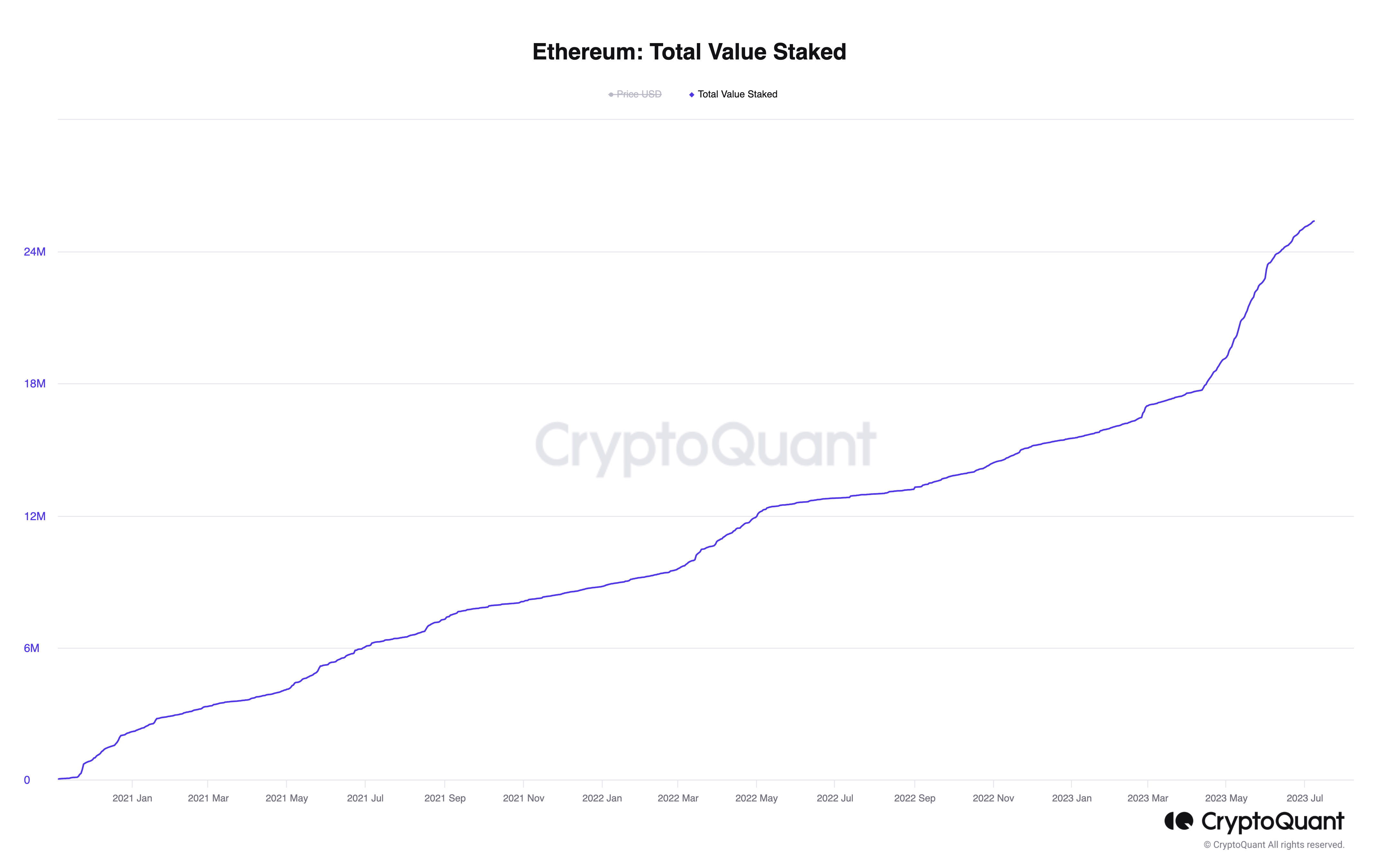
Ethereum staking has proved wildly popular. There is currently almost 18.75% of the total supply staked. The below chart from CryptoQuant shows that not only has the increase been consistent, but the rate of increase has steepened noticeably since the Shapella upgrade in April.

Shapella finally allowed staked Ether to be withdrawn, with some early stakers having had tokens locked up since Q4 of 2020. There was hence some concern that Ether would be withdrawn en masse once the Shapella upgrade went live, the subsequent sell pressure bound to dent the price. Not only has this happened, but staking has only become more popular since the upgrade.

Despite the popularity of Ethereum staking, and the lack of withdrawals sparked by Shapella, the network’s staked tokens as a percent of the total supply still pale in comparison to other proof-of-stake blockchains.
The chart below highlights Ethereum in yellow, its 19% ratio far below the other major proof-of-stake coins. Assessing the rest of the top 10 by staked market cap, these coins average a 53% stake ratio, with only BNB Chain remotely close to Ethereum, sitting at 15%.

If we then shift the chart to assess the total market cap of the staked portion of coins, Ethereum’s dominance is clear. Its 19% staked tokens carry a value of $43 billion – more than the other nine cryptos’ staked market caps combined.

Ethereum’s low staked ratio implies that it should have more, at least if other coins can be used as a benchmark. This is especially true when considering recent bullish developments on the Ethereum network which suggest it may be solidifying its place as the market-leading smart contract platform. Most notable of these could be discussion around potential Ether futures ETFs, as well as the announcement that PayPal is launching a stablecoin on the network this week.

So, what happens to the staking yield if the amount of staked Ether does indeed continue to increase? Remember, the total annual yield paid out to stakers is calculated as follows:

[(gross annual ETH issuance + annual fees*(1-% of fees burned)]

These total staking rewards are then divided by the average ETH staked over the year to commute the APY.

In other words: The amount of ether staked is in the denominator of the fraction. So as the amount staked gets bigger, the APY shrinks. This effect can already be seen in what has happened to date. Analysts had predicted a yield of 10%-12% ahead of the Merge, however today it is closer to 4%.  And that is 4% with its staking ratio completely out of whack compared to other proof-of-stake coins, as mentioned above.

What happens next?

With the amount of Ether staked increasing incessantly, is the yield therefore primed to collapse?

Some analysts believe it is headed towards 1%-2%; some even think less. The reality is that nobody really knows because, as always, demand relies on a variety of factors.

We need to remember, as we often say in these columns, that speculating on the future of crypto is so difficult because we have such little data to work with. This is true for Ethereum as a whole, which only launched in 2015, but especially so regarding the yield, as the Merge has only been live since September (or since April if you count the “true” completion date as post-Shapella).

Hence, it is a challenge to forecast the staking yield going forward. We have focused on the impressive growth of staking thus far, and while this will drive the yield down, demand on the network will increase the numerator of the aforementioned formula and kick the yield up.

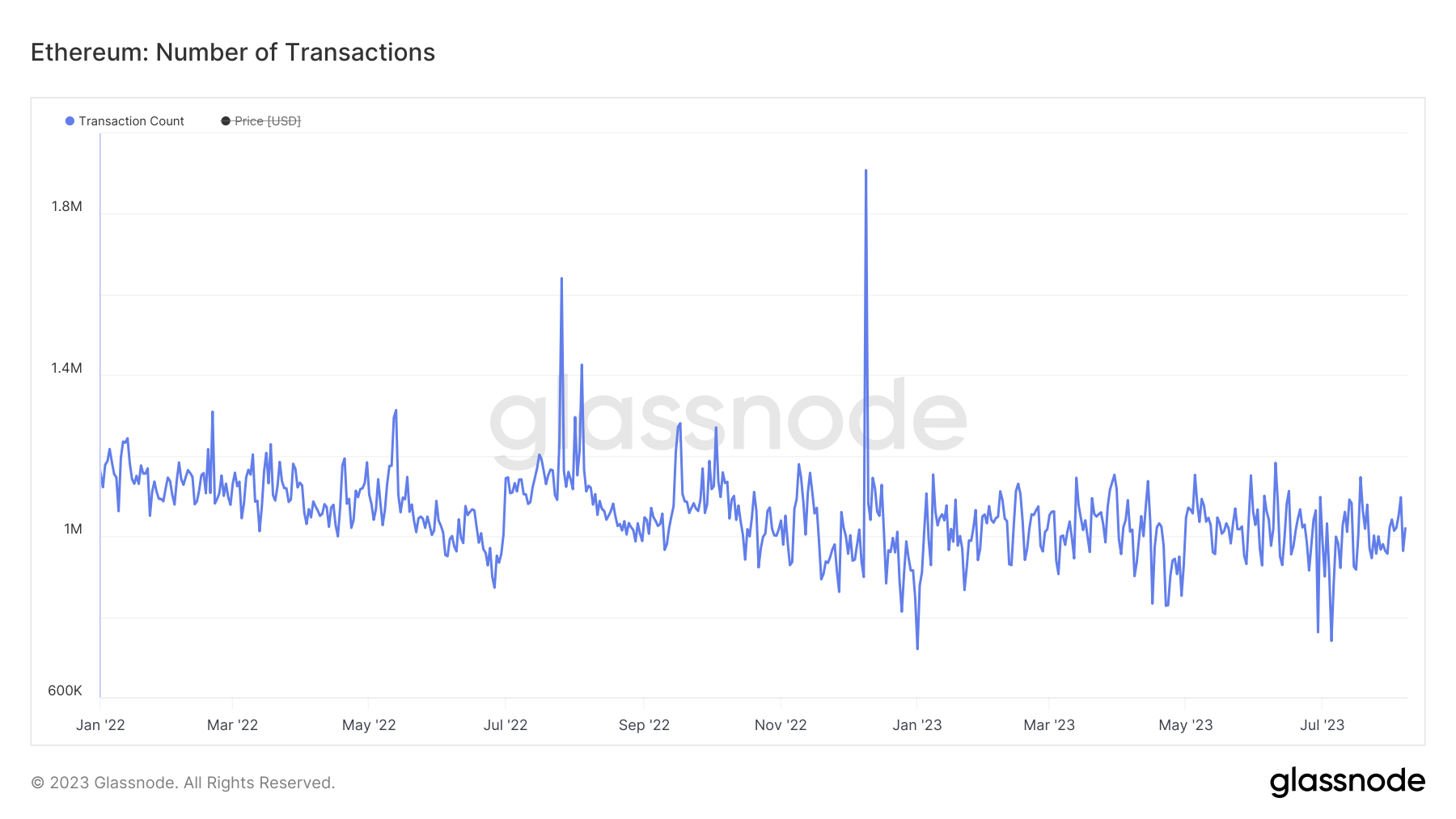
Indeed, looking at total transactions, the rate has been quite resilient throughout the last eighteen months, despite the bloodbath in the sector last year.

Then again, crypto is changing quickly. It remains difficult to foresee how regulation, infrastructural development (restaking and Eigeanlayer spring to mind as an example) and the macro landscape, just to name a few factors, will affect the climate going forward.

Speaking of macro, there is also the matter of trad-fi yields. Currently, the Fed funds rate is 5.25%-5.5%, having been near-zero prior to March 2022. Backing out probabilities from Fed futures implies the market is expecting the end of the cycle is near. Not to mention, with the mammoth amount of debt in the current system, rates cannot stay high forever.

Could falling trad-fi yields affect demand for staking yield? Perhaps – while it is hard to separate the overall liquidity drain and suppressing of risk assets that occurs out of hiked rates, the superior (and risk-free) return is definitely a key reason why capital has flooded out of DeFi in the last year. While previously-dizzying DeFi yields have collapsed, trad-fi yields have rocketed as the Federal Reserve has scrambled to rein in rampant inflation.

Furthermore, if yield does fall down towards 1%-2%, stakers could begin to pull out and search elsewhere for income. This would therefore create a reflexive relationship with regard to the yield.

All in all, it remains too early to speculate about where the Ethereum staking yield is ultimately headed, at least with any degree of confidence; it depends on too many factors and the sample space is too brief to date. It does seem likely, if not inevitable, that the yield will decline to some degree, but the question of how much is a difficult one to answer. While many are adamant the APY will cascade downwards to uber-thin levels – and for the avoidance of doubt, it may do – we have presented here at least some points of consideration as to why the situation may not be as clear cut.

The post What will happen to Ethereum’s staking yield? appeared first on CoinJournal.

How a frog-themed token shapes Ethereum gas fees in 2023

We all know the cryptocurrency world is attached to memes and entertainment. From the Dogecoin meme coin that got the interest of Elon Musk to the Shiba Inu cryptocurrency that tried overcoming it, memes are catchy and thriving in the crypto market. Most of them are built within the Ethereum ecosystem, as the community is one of the most united, so if you’re looking for the best way to buy Ethereum, you’ve got plenty of support. 

The latest and funniest coin is Pepe, which reached the crypto sector after becoming a famous meme a few years ago. The cartoon-based drawing is used as a mood for almost any emotion, so Matt Furie used Ethereum to launch the Pepe coin. The creator aims to increase the popularity of meme coins. 

However, what makes this cryptocurrency unique, and why does it influence Ethereum gas prices? 

Image source: https://pixabay.com/ro/illustrations/ethereum-de-aur-cripto-criptomoned%c4%83-7084736/ 

What’s so special about Pepe?

The deflationary meme coin is unique as it enhances the meme culture spread among communities similar to cryptocurrency. However, the currency offers something only a few cryptocurrencies do: rewarding long-term stalkers and incentivizing holders for longer periods to increase the chances of the coin’s success. At the same time, the no-tax policy encourages holders to boost Pepe since a wider audience can access and use it.

The burning method of Pepe is also unique because, despite the 420,690,000,000,000-maximum supply, a portion of the coins are frequently removed from circulation to maintain scarcity and help users commit to the project.

Pepe is secured through the Ethereum blockchain by the PoS consensus mechanism, where decentralized validators stake ETH to secure the network and process transactions.

What’s the deal with Pepe and Ethereum gas fees?

The pepecoin has surged in popularity since its launch in April. This caused the median gas price to increase to more than 50% in the last 12 months, reaching 150 gwei (one gwei is a billionth of an ether). The demand for pepecoin has changed the network drastically, affecting even liquidity pools. It has been disclosed that Pepecoin transactions have burned around $10 million of gas since the launch.

Although similar meme coins have seen this success in the past market capitalization, such as CHAD and DINO, this time, things are different. While Ethereum is fighting to lower gas prices, the increased demand for a particular cryptocurrency is against the upgrade efforts. The latest Ethereum update, Shanghai, is supposed to contribute to diminished gas fees as it gets more difficult for miners and investors to get ether. At the same time, as the network struggles with scalability, a suddenly increasing number of transactions usually leads to network congestion.

How does Ethereum mitigate challenges?

The latest completed update on Ethereum was Shanghai, whose primary purpose was to allow users to withdraw their staked ether. The next target is to address scaling concerns to make transactions faster and cheaper, considering Ethereum’s high fees.

At the same time, developers will benefit from lower costs through the EIP-3855 and EIP-3860 updates in an effort to encourage activity on the blockchain regarding creating DApps. Many other minor updates will contribute to lowering gas fees while maintaining network productivity.

Why should Ethereum gas fees remain low?

Gas prices are usually affected by network congestion and the complexity of actions made on the blockchain. Although Ethereum created the EIP-1559 program to make fees more predictable and help investors not be hit by sudden price changes, when a coin increases in demand, it’s challenging to keep the base fee at a decent limit. And gas fees can’t be considerably lowered because they’re used to compensate stakers for their efforts to maintain the network, which is essential for providing data security.

However, gas prices have become so high that many people prefer to stop mining or investing, as the cost overtakes the profit, which is the case for such a prominent cryptocurrency and network. Besides the updates mitigating smaller costs, there are some ways for users to minimize fees and save money.

Are meme coins important? Or safe to invest in?

Regardless of the coin type on the blockchain, keeping lower gas fees and maximizing transactional time will win over any other feature. However, blockchains should be used for various cryptocurrencies to truly put them to work, which is why discussing the importance of meme coins is necessary.

The blockchain sector is all about communities and groups of people with similar interests who put their efforts into gaining cryptocurrencies and increasing the value of the ones they invest in. Meme coins help build these communities easier, as memes always bring people together for entertainment. Since there’s already one formed, it’s easier for the crypto sector to be linked with something with a base. That’s because this type of community also takes the initiative to keep the audience engaged and interested in the common purpose of the network. That’s why Ethereum has one of the strongest communities, whose interests include developing the ecosystem, bringing more updates, and offering support to beginners and users interested in investing.

Still, when investing in meme coins, certain dangers are linked to their stability. Let’s take the example of Doge, whose popularity drastically increased after Elon Musk tweeted about it a few times. However, the coin doesn’t necessarily hold a significant purpose during regular times.

Like in the case of Pepe, who’s just starting to become viral as a cryptocurrency, the risk of holding this coin is that it can increase in value overnight and then drop down dramatically in the following hours, and so on. Its value depends on the hype from social media created by its holders. After that, we can’t say that Pepe or another meme coin will have the same course as Bitcoin or Ethereum, which underwent different challenges over the years and remained reliable.

Bottom line

Pepe the Frog is a famous meme recently introduced in the blockchain sector as a cryptocurrency. Its value surged so drastically that it led to increased gas fees, an issue for which Ethereum is taking action now.


The post How a frog-themed token shapes Ethereum gas fees in 2023 appeared first on CoinJournal.

Ethereum remains top dog, but woes persist in the DeFi sector


Key Takeaways

  • DeFi has seen massive capital outflows in the last year as token prices have collapsed
  • Trad-fi yields have also spiked while DeFi yields have fallen
  • Ethereum has underperformed Bitcoin notably since the Merge

The third quarter of 2020 became known as “DeFi Summer” within crypto, such was the speed at which the nascent sector of decentralised finance took the industry by storm. 

Fast forward three summers and it is safe to say that the 2023 edition will not be given the same moniker. After a torrid year in 2022, crypto has rebounded strongly thus far this year; however, DeFi has been left out in the cold, the summer sunshine nowhere to be seen. 

The below chart shows the TVL across the space. From a peak of nearly $180 billion in November 2021, it currently sits at $40 billion, representing a drawdown of nearly 78%. 

Ethereum remains the home of DeFi

Let’s dig into Ethereum specifically. The network has undergone some important milestones in the last year. The most meaningful was the Merge in September, which transitioned Ethereum to proof-of-stake from proof-of-work. This was then followed up with the Shapella upgrade in April, finally allowing all staked ETH to be withdrawn and closing the book on the biggest (and highly successful) network event since its launch in 2015. 

Both before, during and after these changes, Ethereum has remained the king of DeFi with a chunky 57% of TVL in the space, Tron a distant second with 14%. 

However, Ethereum has not been immune to the outflows which have ravaged DeFi. While market share has remained high, TVL itself has fallen akin to what has been seen across the ecosystem. It is also important to note that the previous outflow of TVL was described in dollar terms. This is despite the fact that much of the TVL in DeFi is denominated in non-fiat currencies, such as ETH itself or myriad ERC-20 tokens.

Hence, even if no withdrawals took place, the TVL in dollar terms would have plummeted by virtue of crypto prices cascading downwards last year. Even after the bounceback in 2023, Ether is currently trading at $1,800, 63% off its all-time high. Yet displaying the withdrawals in terms of Ether below shows that the downward trend is visible regardless of denomination. 

This begs the question, why? Well, the obvious answers are plenty. Namely, crypto has been put through the wringer over the past couple of years, from Terra to FTX to the SEC and everything in between. While many of the transgressions have centred on CeFi rather than DeFi – indeed, one could argue that DeFi performed exactly as it meant to do (Terra aside…) – crypto has been hurt immensely overall, nobody spared. 

Having said that, DeFi has recently suffered a little bit of a wobble…

Although the reasons for capital flight run deeper than crypto. The macro environment has flipped to a staggering degree. Following years of uber-low interest rates, the Federal Reserve was forced into a series of relentless interest rate hikes as inflation spiralled. While it has begun to come down and the market has bounced off the hope that we are nearing the end of the cycle, DeFi has been squarely caught in the crossfire. 

Not only do higher interest rates suck liquidity out of the economy and cause investors to retreat back on the risk curve, hence crashing crypto prices, but they also offer investors an alternative method of earning yield. 

We are now in a situation where the Fed funds rate is above 5%, having been close to zero only eighteen months ago. At the same time, yields that were previously sky-high within crypto have proven unsustainable as token prices have dropped, meaning that DeFi yields have collapsed while trad-fi yields have soared. It’s not a surprise, therefore, to see capital flow out at such a scale. 

Positive signs remain

This is all rather negative, but there is light amid the darkness. Ethereum has fared far better than many of its rivals. Take Solana, once deemed the most notorious “ETH-killer”, its associations with Bankman-Fried, repeated outages and various other struggles ultimately kneecapped it to the tune of a 97% peak-to-trough decline (it remains 91% off its all-time high). While Solana is the most glaring example, Ether has been resilient by comparison to many of its rivals. 

Additionally, the aforementioned Merge came and went smoothly, a phenomenal undertaking by the developers and a win for the community at large. Adding in the recent slew of applications for an Ether futures ETF and, if the regulatory climate finally starts to clear up, there could be more reasons to be optimistic for DeFi and Ethereum. 

However, there is no denying that it has been an eye-opening period for many in the DeFi space, some of whom speculated that Ether would flip Bitcoin as the world’s largest cryptocurrency by market cap. Quite the contrary. In fact, Ethereum has underperformed Bitcoin immensely since the Merge last September, notable despite the crypto market trending upwards since Q4. 

A market heading north has generally meant that Bitcoin underperforms, however the precedent has been different this time, as discussed here (in short, regulation driving a wedge between Bitcoin and the rest of the market, the spot ETF applications, the scale of the damage within crypto, and the fact that we tend to draw far too much from past performance in a sector that has so little data to work with). 

Unquestionably, it has been the toughest year in DeFi’s brief existence so far. And yet, Ethereum trucks on, eagerly striving to tokenise real world assets and start generating real world value. Its place at the top among the smart contract blockchains appears secured. It just needs to hope DeFi makes a comeback, and that the summer of 2020 was not a once-off event. Time will tell. 

The post Ethereum remains top dog, but woes persist in the DeFi sector appeared first on CoinJournal.