
CleanSpark reports a 47% annualised growth in quarterly revenue

  • CleanSpark narrowed its loss in its fiscal third quarter.
  • The bitcoin mining company had a blockbuster July.
  • CleanSpark shares are up over 150% YTD at writing.

Bitcoin miner CleanSpark Inc is trading slightly up in extended hours after reporting a narrower-than-expected loss for its fiscal third quarter.

CleanSpark Q3 financial highlights

Lost $14.2 million versus the year-ago $29.3 million

Per-share loss also narrowed from 40 cents to 12 cents

Revenue jumped 47% year-on-year to $45.5 million

Consensus was 17 cents loss on $45.7 million revenue

Ended the quarter with $125 million of cash and bitcoin

The bitcoin mining company now has assets worth more than liabilities on its balance sheet. Gary Vecchiarelli – the Chief Financial Officer of CleanSpark said today in the press release:

I like the flexibility of our balance sheet and our operational performance. We have all pieces in place to extend our strong track record of growth and operational excellence.

CleanSpark had a blockbuster July

CleanSpark had its Georgia location go live in July that added more than 15,000 miners and 50 megawatts of power, as per the press release.

The Nasdaq-listed firm trailed only Marathon Digital and Core Scientific in terms of the number of bitcoin mined last month. According to its CEO Zach Bradford:

We have fully funded our growth to 16 EH/s, including miners, facilities, and other infrastructure. We continue to build on our track record of executing on commitments.

The hash rate improved to 9 EH/s in its recently concluded quarter. At writing, shares of CleanSpark Inc are up more than 150% versus the start of 2023. Its peer Marathon Digital also reports its quarterly update earlier this week (read more).

The post CleanSpark reports a 47% annualised growth in quarterly revenue appeared first on CoinJournal.
Taraxa (TARA) price is up 800% this past week: Why is TARA pumping?

  • Taraxa (TARA) has pumped more than 35% in the past 24 hours.
  • TARA, native to the BlockDAG-powered smart contracts platform, has outperformed by over 800% in the past one week.

Taraxa (TARA) is one of the trending cryptocurrencies today, with its price hitting intraday highs of $0.014 on Wednesday. 

The outperformance seen on the day dwarfed most altcoins in the top 500 by market cap list, with the intraday pump including over 35% in the past 24 hours.

What’s next for TARA price after monstrous gains?

Taraxa, an EVM-compatible smart contract platform that launched via an ICO in March 2021, traded to the all-time high of $0.07 that month. However, with the crypto winter, the blockDAG-based platform’s native token plummeted to near $0. It remained constrained around $0.001 until August 1 when it suddenly exploded.

TARA’s upside over the past week comes as the community responded to the potential of AI integration with an efficient BlockDAG-powered layer-1 blockchain. Usage and adoption across social analytics, dApps development and multi-layered IP licensing look to be aiding the positive outlook for the token.

A recent AMA by the team also looks to have shone some spotlight on the token.

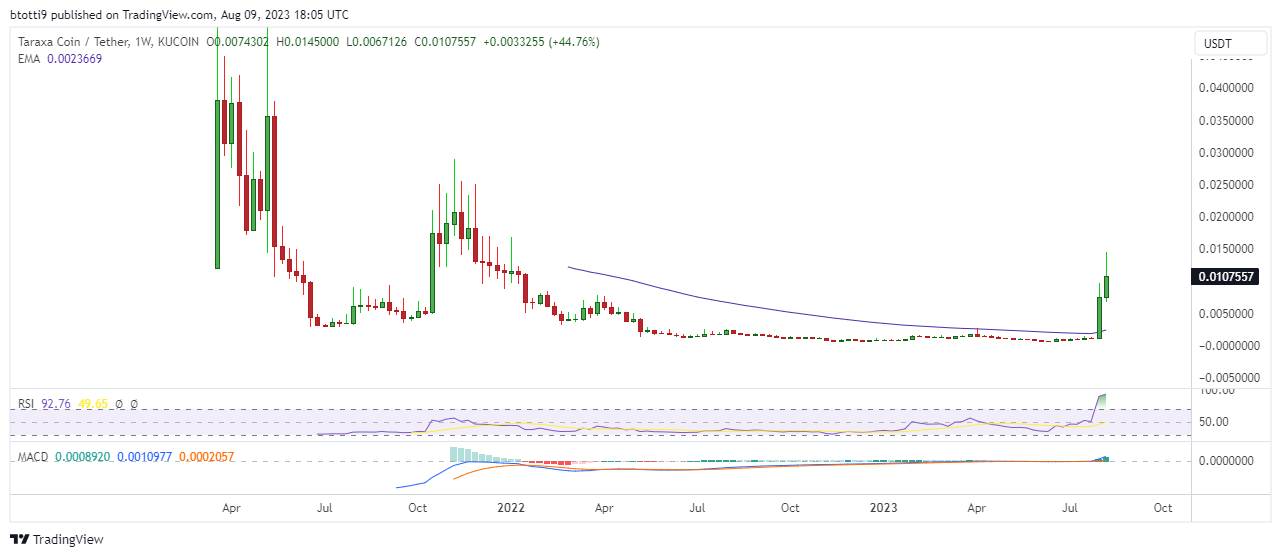
According to data from CoinMarketCap, Taraxa’s daily trading volume rose nearly 200% to over $12.46 million as bulls tested the price level last seen in December 2021. The gains have TARA trading more than 800% up in the past week, with performance over the past 30 days accumulating to 1,021% at the time of writing.

TARA price chart. Source: TradingView

From a technical perspective, TARA is firmly in overbought territory as suggested by the overextended RSI on the weekly chart. This suggests immediate term profit-taking weakness is likely. The weekly MACD however shows there’s still room for further strengthening, which could allow for a move to $0.02.

The downside nonetheless presents the past of least resistance and a retreat to support at the $0.006 mark could open up a bearish flip to $0.002.

The post Taraxa (TARA) price is up 800% this past week: Why is TARA pumping? appeared first on CoinJournal.

Maple Finance’s one-month US Treasury yields get SEC exemption

  • The exemption will allow Maple Finance to offer the Treasury yields to US institutional investors
  • Previously, the Maple Finance Treasury pools were not available to US investors.
  • Institutional crypto hedge fund Room40 Capital is currently Maple Finance Treasury Pools’ sole borrower.

To offer its one-month US Treasury yields to accredited investors in the United States, the institutional capital marketplace on blockchain Maple Finance has obtained an exemption from the United States Securities and Exchange Commission.

Previously, the Maple Finance Treasury pools were only accessible to accredited investors outside of the United States.

Through the SEC Regulation D Rule 506(c) Exemption, a company may provide investment products to US-based individual investors without the need for prior registration if their annual income is greater than $200,000 ($300,000 if their spouse is included) or their net worth exceeds $1 million, excluding the value of their primary residence. Such investment products may also be sold by a company to accredited US organisations, like banks.

21M USDC already deposited into the pools

According to information from Maple Finance, over 21 million USD Coin USDC have been deposited into the Treasury pool, which has an annualised yield of 4.76% right now. There are no outbound or incoming fees apart from a 0.50% annualised management fee deducted from the yield.

The Maple Finance Treasury pools are quite easy to join with onboarding taking 15 minutes, and Lenders being able to download monthly interest statements whenever they want. According to information found on the Maple website, withdrawals are processed in a maximum of 48 hours.

The post Maple Finance’s one-month US Treasury yields get SEC exemption appeared first on CoinJournal.

Coinbase’s Base mainnet, featuring 100+ dApps, opens to the general public

  • The Base Network is built on Optimism’s software stack called OP Stack.
  • It is a Layer 2 solution that aims to offer dApps an alternative to Ethereum.
  • Base offers lower transaction fees and higher transaction speeds.

Base mainnet, a blockchain network developed by Coinbase cryptocurrency exchange, has officially opened to the general public. The Base Network currently features over 100 dApps and service providers as part of its ecosystem.

According to Jesse Pollak, the lead for protocols at Coinbase, users can investigate these dapps and gain from lower transaction fees and quicker transaction speeds compared to Ethereum.

The Base Network has integrated with a wide range of cryptocurrency projects including DeFi protocols, wallets, bridges, oracles, and both analytics and infrastructure providers since its developer-only release in July and the testnet launch in February.

Offering an alternative to Ethereum

Base Network is developed on Optimism’s software stack called OP Stack. The network is a Layer 2 solution that operates as a rollup network. It is a scaling solution to process transactions off the main Ethereum blockchain, thereby offering a more affordable alternative for dApps.

Base is expected to become the default network for Coinbase’s on-chain products.

Both developers and users had transferred assets valued at over $100 million to the Base network in the lead-up to the mainnet launch. And in celebration of the mainnet launch, users will have the option to mint a unique “Base, Day One” NFT.

The official Base launch has coincided with the “onchain summer” event that is scheduled to run for several weeks. The event emphasizes promoting Base’s mainnet partner dApps in the realms of gaming, digital art, and music.

The post Coinbase’s Base mainnet, featuring 100+ dApps, opens to the general public appeared first on CoinJournal.

13 banks to participate in Russia’s CBDC pilot program

  • The pilot program will start on August 15, 2023.
  • 13 Russian banks will participate in the pilot program being conducted by the Bank of Russia (BoR).
  • During the test, users will be able to use digital rubles to make purchases at 30 retail locations spread across 11 Russian cities.

Less than a month after Vladimir Putin signed the digital rubles bill into law, the Bank of Russia (BoR) has announced that it will start using digital rubles for the project’s operational testing phase of Russia’s central bank digital currency (CBDC). The testing will start on August 15.

According to a statement made by the Bank of Russia, 13 banks and a small number of their clients will take part in the pilot tests.

The first deputy governor of the Bank of Russia Olga Skorobogatova claimed that the project’s pivotal stage will be the start of pilot operations using actual digital rubles. This step makes it easier to examine the functionality of the digital ruble platform in an industrial setting, fine-tune key procedures in consultation with clients, consider potential process changes, and guarantee a user-friendly and understandable client experience.

CBDC starting to be fully operational by 2025

The bank’s strategy, according to Skorobogatova, is to introduce the digital ruble into widespread use, based on the results of gradual testing and subject to the successful completion of extensive trials covering all potential operational uses for the digital ruble. The deputy governor stated that it is anticipated that beginning in 2025, individuals and organisations will be able to actively use the national digital currency upon their own initiative.

According to the announcement, the pilot program’s first stage will concentrate on streamlining fundamental procedures, such as the creation and funding of digital ruble accounts (also known as digital wallets), digital ruble transfers between people, simple automated payments, and the use of QR codes for transactions involving goods and services.

Participants in the pilot programme will be able to use digital rubles to make purchases at 30 retail locations spread across 11 Russian cities. By the end of 2023, it is planned to increase the number of pilot participants to include both individuals and companies.

The post 13 banks to participate in Russia’s CBDC pilot program appeared first on CoinJournal.