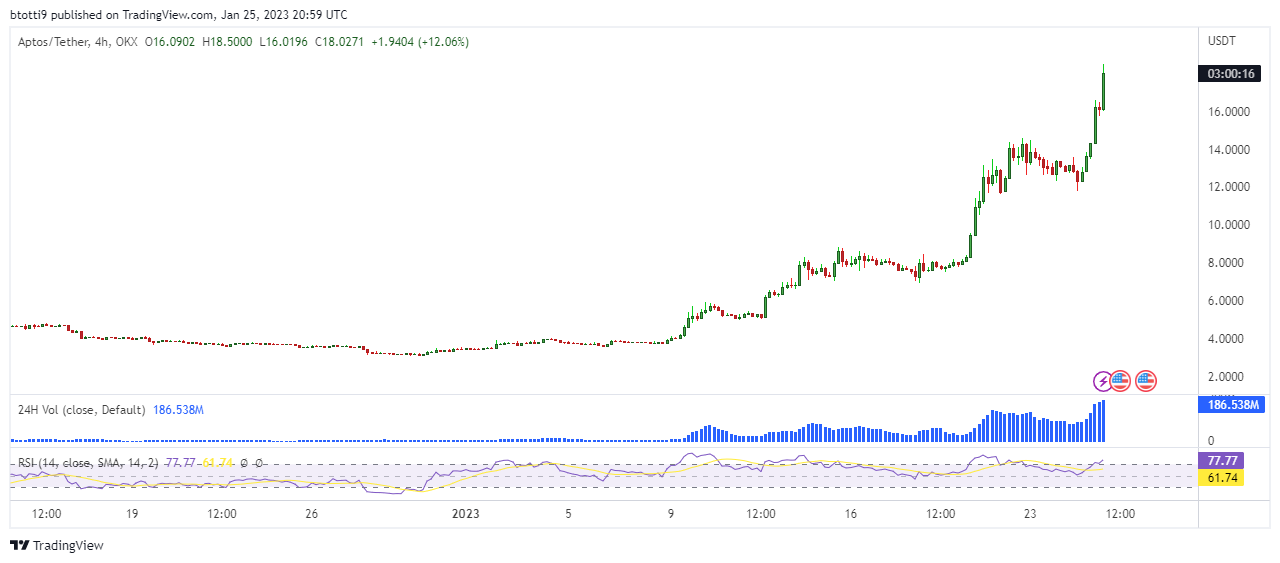
Aptos (APT) hits new all-time high above $18 after 400% rally

  • Aptos price rose 44% to hit an all-time high of $18.50 on OKX.
  • The Layer 1 blockchain launched in October last year, and its native token has soared more than 400% in the past 30-days.
  • Analysts suggest APT price could pare some of the gains as suggested by negative funding rates.

The Aptos (APT) token has hit a new all-time high amid fresh buying pressure for the layer 1 blockchain platform’s native token.

Aptos shines amid crypto market rally

Aptos, whose mainnet launch was in October last year, is a cryptocurrency platform developed by two ex-Meta Platforms staff. The smart contracts-enabled blockchain had somewhat a rough start, with controversy surrounding its token distribution. 

However, its native token has enjoyed one of the best runs in recent weeks, outperforming the leading cryptocurrencies by market cap amid a broader rally across the digital assets market.

On Wednesday, the price of Aptos rose more than 44% to push the token to above $18.00 across major exchanges. Indeed, the token hit an all-time high of $18.50 on OKX. 

Chart showing Aptos price on OKX. APT surged to highs of $18.50 on the exchange. Source: TradingView

In reaching the new peak, the APT token had rallied more than 136% in the past week. According to data from CoinGecko, the token had surged more than 400% over the past 30 days, with APT having changed hands around $3.69 on 25 December 2022.

Aptos’ total market cap has jumped to over $2.7 billion and APT currently ranks as the 28th largest cryptocurrency project.

What next for Aptos token price?

Can APT price continue its vertical movement? It is likely the coin could still test new highs as the optimism around Bitcoin and some of the top altcoins drive market speculation. However, on-chain data suggests there is a chance the price begins to fall sharply amid profit booking.

One suggestion that bulls may give up some of the gains is the negative funding rates. Pseudonymous crypto trader HornHairs pointed this out earlier Wednesday.

Another crypto trader Altcoin Sherpa thinks APT may provide a great short opportunity later, suggesting that shorting the coin at current levels might not be the safer bet. Instead, he points to a scenario where there is a lower high in play.

The post Aptos (APT) hits new all-time high above $18 after 400% rally appeared first on CoinJournal.

MarketAcross named Web3 media partner of Europe’s premier blockchain event

  • MarketAcross will help market the upcoming European Blockchain Convention worldwide.
  • EBC 2023 is set for 15-17 February in Barcelona and will bring together industry heavyweights, including from Aave and Bittrex.
  • MarketAcross is a leading blockchain PR and marketing firm, also tapped as the official media partner for the upcoming Paris Blockchain Week conference in March.

MarketAcross, a leading Tel Aviv-based blockchain and fintech marketing firm, will be the main Web3 media partner at this year’s European Blockchain Convention (EBC) convention. The event organisers confirmed the collaboration today.

The Web3 event, set for 15-17 February at the Hyatt Regency in Barcelona, is expected to welcome over 2,500 participants. The annual event launched in 2018 and will be held in-person this year.

Notably, MarketAcross previously acted as official media partner of the Korea Blockchain Week last June, and as web3 media partner during the Future of Crypto conference held on 7 December 2022 in New York City. 

The media group is similarly set to be this year’s Paris Blockchain Week’s official media partner, with the event scheduled for March 2023.

Marketing Europe’s blue chip Web3 event

As a global leader in blockchain PR and marketing, MarketAcross has been tapped to spearhead all pre and post-event EBC 2023 marketing efforts. The experienced firm is expected to leverage its global reach, through prominent thought leaders and speakers to help highlight the Barcelona event to the world.

Itai Elizur, COO and Partner at MarketAcross, said the firm was hyped about the upcoming event and looked forward to making it “the best one yet.”

“We are thrilled to join EBC as the main media partner, especially this year, as the speaker list will showcase a lot of exciting personas and projects,” Elizur noted in a press releas shared with CoinJournal.

MarketAcross’s strategic partnership with the EBC comes as Europe’s most influential blockchain event bids to bring, yet again, some of the world’s top industry players together. Expected at the three-day event are Bittrex CEO Oliver Linch, Solana co-founder Stephen Akridge and Aave founder Stani Kulechov, among others.

Like in previous events, EBC 2023 will bring together a diverse audience cutting across decentralised finance (DeFi) non-fungible tokens (NFTs), blockchain gaming and Web3.

Organisers have also planned an inaugural EBC Blockchain Awards, which will recognise Europe’s top 100 early-stage startups. Ten finalists will have a chance to pitch their projects to a panel of investors.

The post MarketAcross named Web3 media partner of Europe’s premier blockchain event appeared first on CoinJournal.

Marinade Finance looks to boost liquid staking on Solana

  • Marinade Finance will reward Solana holders who stake SOL via its liquid protocol.
  • The incentive program will run for the next 12 months and see the plaform offer up to 160 million native Marinade tokens.
  • The goal is to grow Solana TVL by 40 million SOL, and liquid staking is key to that.

Marinade Finance, a liquid staking platform that supports the Solana blockchain, is looking to bring more liquidity to the Solana ecosystem via a major incentive program.

The protocol noted in an announcement that the program “Open Doors” is designed to incentivise Solana builders, validators and wallets into increasing the blockchain platform’s asset liquidity. 

Accordingly, Marinade is looking to offer rewards in the form of its tokens to users who contribute to growing the total value locked (TVL) of Solana on the protocol.

Marinade Finance’s 12-month incentive program for Solana

Over the next 12 months, users have a chance to earn some of the 160 million Marinade (MNDE) tokens when they deposit SOL for mSOL, the liquid staking token they will get in exchange. The target is to get 40 million SOL staked for mSOL, – a scenario that could significantly increase the ecosystem’s liquidity and help with decentralisation.

Currently, only 2-3% of SOL is reportedly in liquid staking, which makes the plan to have more brought into the ecosystem crucial for Solana. This is because staked SOL doesn’t contribute to Solana’s DeFi TVL. However, mSOL’s liquid stake does as it flows across different protocols. 

As for decentralisation, Marinade supports hundreds of validators staking through its delegation strategy.

“For Solana DeFi to rebound stronger, more $SOL (LOTS MORE) must be made liquid. Those who contribute this through $mSOL, on their protocols, or via the referral program will be rewarded with direct Marinade ownership,” the Marinade team said.

According to data from DeFiLlama, the Solana chain has about $278 million in TVL as of 25 January 2023, down from over $10 billion in November 2021. More than 53% of the total TVL on this chain is on Marinade Finance, while Lido’s liquid staking accounts for the second-largest share.

The post Marinade Finance looks to boost liquid staking on Solana appeared first on CoinJournal.

Crypto exchange Digital Surge to pay back creditors after bailout

  • Digital Surge lost about $33 million in the collapse of FTX.
  • The exchange froze customer funds on November 16.
  • The exchange had passed into voluntary administration in December.

After about two months of anguish, crypto exchange Digital Surge creditors can now smile after news that the exchange will pay back its creditors.

The news came after confirmation that the Australian exchange will receive a 1.25 Australian dollars bailout from an associate business. This was after the creditors approved a long-term recovery plan for the company.

Digital Surge woes

The woes of the Digital Surge crypto exchange started after the collapse of the FTX crypto exchange in November. In total Digital Surge lost about $33 million that it held on FTX.

The Australian exchange immediately swung into action by freezing the digital assets of its more than 22,000 customers. The assets remain frozen to date.

As the situation deteriorated, the exchange passed into voluntary administration (management handed over control to licensed insolvency practitioners to independently assess its financial situation) in December 2022. KordaMentha, a Melbourne-based investment firm, was the licensed insolvency practitioner that Digital Surge appointed for this process.

Rare turn of events

In a rare turn of events, the Digital Surge cryptocurrency is not going to become insolvent after reports that the exchange was going to receive a loan of 1.25 Australian dollars from Digico, which is an associate business. This means the exchange is going to survive the devastating crypto contagion that wiped out $1 trillion across the industry and resulted in several major crypto companies including Genesis filing for bankruptcy.

Following the developments, Digital Surge will pay back its creditors with customers who had $250 in their accounts being repaid in full immediately with the rest receiving 45% of their balance in 5 years.

The post Crypto exchange Digital Surge to pay back creditors after bailout appeared first on CoinJournal.

The global crypto meltdown: Is it the end or just a new start?

  • Cryptocurrency, volatility and the risks therein.
  • What’s crypto’s long-term viability, including the impact of decentralised finance (DeFi).
  • Are Central Bank Digital Currencies (CBDCs) evidence that crypto is here to stay?

Since the introduction of the first cryptocurrency transactions and digital tokens in the 1990s following their democratisation in the 2010s, the current crisis in the cryptocurrency market is unprecedented.

In late 2020, Bitcoin took a massive dive from which it has yet to recoup. This precipitous fall is being discussed with the concerning demise of some “stablecoins,” which were meant to be less unpredictable.

This is exacerbated by the decline of once-prominent cryptocurrencies, especially after being accused of fraud, as in the FTX controversy. Among all the leading trading platforms, FTX has been ranked third as it served a population of one million at the peak of its career. 

Its aftermath has had a significant impact on investors, and this, according to experts, would certainly restrict the rate of adoption of crypto assets over the next few seasons.

The clock of volatility is ticking 

Tokens that may be exchanged for digital currency are one type of crypto asset (i.e. cryptocurrencies such as Bitcoin and Ethereum). Security tokens are used to invest in a company through trade assistance bots like bitcoin bank, giving the holder a stake in that company, whereas utility tokens are exchanged for access to a finished good or service once they have been created.

Unlike other cryptocurrencies, stablecoins are backed by something other than a digital ledger of transactions, such as the U.S. dollar, a commodity like gold, or an investment vehicle like a bank deposit (e.g. a stock or a bond). 

The daily news is littered with articles about the decline of Bitcoin. While this isn’t the first time its value has dropped, it is the largest loss since late 2020, therefore it deserves special attention. 

Investors fled these riskier investments when interest rates rose, which contributed to the crash. Bitcoin may be on the mend, but it has a long way to go before it reaches its former glory.

The media attention that cryptocurrencies have received recently has fanned many people’s fears about their long-term viability. The unregulated markets of the latter are notorious for their high levels of volatility and are often linked to speculation.

In fact, the BBC just reported a 30% increase in bitcoin laundering in 2021. Investors lost over $1 billion worth of cryptocurrency to scam schemes in 2021, according to the U.S. Federal Trade Commission, whose job is to protect consumers. Those who lost money due to fraud have, unsurprisingly, seen very little return on their investments.

Crypto serving as the trading lifeline for a billion users 

Still, the business use of cryptocurrencies is rising, albeit slowly. Many publicly traded corporations, including Starbucks and McDonald’s, have begun accepting Bitcoin as payment, according to specialists studying the implications of this trend for corporate social responsibility. 

This is especially true in their El Salvador locations since Bitcoin has been recognised as a legal tender there.

Even though Japan is not actively pursuing the adoption of Bitcoin as a currency, certain companies, including the Japanese e-commerce behemoth Rakuten, have decided to accept cryptocurrencies instead. 

They claim to be motivated by the need to broaden the range of payment methods available to their clientele.

The number of people using cryptocurrency increases each year. Exchange platform Crypto.com, for instance, predicted that by the end of 2021, over 295 million users would have participated in the cryptocurrency market. As of December 2022, the platform anticipated having one billion users.

In addition, those whose traditional banking options are unreliable or insecure can use cryptocurrencies to gain access to a decentralised financial system. Among the justifications, the Governor of El Salvador offered for recognising Bitcoin as legal cash was to provide an alternative banking system for the country’s less well-off citizens.

Crypto to witness a sporty oscillation 

Cryptocurrencies’ long-term viability is impacted by a number of factors, including rising interest in decentralised finance (DeFi) and the maturation of the metaverse. Stablecoins are frequently used to facilitate the running of decentralised financial systems. 

Similarly, the metaverse, a collection of interconnected 3D simulated realities, accepts cryptocurrency payments for goods and services.

Despite the recent meltdown in the crypto asset market, industry experts are certain that decentralised finance, especially in the form of products backed by cryptocurrencies, will survive. This is due to the market existence and competition present.

In addition, they believe that although the recent precipitous drop in cryptocurrency-related markets has eliminated some participants, this is in fact a positive development.

These participants argue that a significant decline in the value of crypto asset marketplaces is not only inevitable but also beneficial because it will help to restore market equilibrium.

The silver lining: Crypto is the dark horse

Another piece of evidence that digital currencies are here to stay is the introduction of coins by central banks in the form of blockchain and digital currencies (CBDCs). The Bank of Canada is, in fact, developing plans to establish a CBDC. 

CBDCs, if released by the Bank of Canada, would be “official digital money (that) would keep their dollar amount in Canadian dollars since they are authorized by the Bank of Canada, exactly like bank notes,” the institution claims.

The Sand Dollar of the Bahamas and the Naira of Nigeria are only two examples of countries that have produced similar currencies (eNaira). CBDCs are distinct from privately produced digital currencies (like Bitcoin or Ethereum) since they are not designed for speculation or prediction but rather for use in everyday commerce. In terms of utility, they are on par with cash.

Aside from making fiscal and monetary policies easier to implement in the issuing countries, another goal of CBDCs is to increase financial inclusion among those who lack access to the regular banking system.

Cryptocurrency will be here to stay thanks to developments in the realm of digital currencies both in the metaverse and with the advent of the CBDC.

Because of their resilience, crypto asset’s physical manifestations will change over time in step with the underlying technology that enables them (principally blockchains) and the cyclical fluctuations in demand from end-users and/or financial backers.

The post The global crypto meltdown: Is it the end or just a new start? appeared first on CoinJournal.