
EOS expands into East Asia markets with regulatory approval in Japan

  • The EOS received a whitelist approval from the Japan Virtual and Crypto Asset Exchange Association (JVCEA).
  • EOS will start trading on BitTrade in Japan in mid-September.
  • Crypto-asset providers in Japan are monitored and regulated by the JVCEA and FSA under the Payment Services Act.

The EOS Network Foundation has announced that the Japan Virtual and Crypto Asset Exchange Association (JVCEA) has approved the EOS cryptocurrency for inclusion on its whitelist. The accomplishment opens the door for EOS to be traded in Japan on authorized cryptocurrency exchanges against the yen.

By giving the EOS Network more exposure and accessibility to a wider spectrum of Japanese end users, developers, and investors, the JVCEA’s approval represents a significant advancement for EOS. Midway through September, EOS will start trading on BitTrade, a renowned cryptocurrency exchange authorized and governed by the nation’s Financial Services Agency (FSA).

Japan’s strict crypto regulations

Japan’s strict regulatory regime controlling digital tokens is well known for its thoroughness and sturdiness. The Payment Services Act mandates a detailed pre-screening procedure for new digital assets, and the JVCEA and FSA closely monitor and regulate crypto-asset providers. The EOS Network’s adherence to these strict rules demonstrates its dedication to openness, security, and innovation.

With the successful extension of Upland, built on EOS and one of the largest metaverses in the business, to encompass Tokyo, the network is already experiencing a rise in popularity and usage in the Japanese market.

EOS has a solid reputation among blockchain fans and developers thanks to its five years of uninterrupted mainnet operation and its top-tier Ethereum Virtual Machine, which offers unrivalled performance.

This endorsement shows that the EOS Network’s dependability and performance have been acknowledged, opening the door for further development and acceptance in East Asian markets. As one of the top blockchains globally, EOS is well-positioned for ongoing progress in the area thanks to strong collaborations and a successful track record.

The post EOS expands into East Asia markets with regulatory approval in Japan appeared first on CoinJournal.
Digital asset investment products record largest outflows since March

  • Digital assets investment products saw outflows of $168 million last week, $146 million of which was for Bitcoin.
  • It’s the largest weekly outflows total since March 2023, according to a report by CoinShares.

CoinShares’ latest weekly report on digital asset investment flows shows that the market witnessed its largest funds outflows in nearly six months last week. The outflows come as sentiment across cryptocurrency dips amid recent sell-off.

Crypto sees $168 million in outflows

According to the report, outflows totaled $168 million over the week to mark the largest outflow from crypto products since March 2023 when the US Securities and Exchange Commission (SEC) started its regulatory crackdown on major exchanges.

The outflows in the week ended August 25 saw the monthly outflows stand at $278 million as sentiment continued to trend negative amid “exceptionally low trading volume.” Indeed, CoinShares data shows the investment products market traded $1.3 billion last week, about 16% off the year’s average.

“This negative sentiment we believe is due to the increasing acceptance that a spot-based ETF for Bitcoin in the US is likely to take longer than many expect, with recent delays being announced by the SEC,” said James Butterfill, head of research at CoinShares.

Bitcoin continues to lead

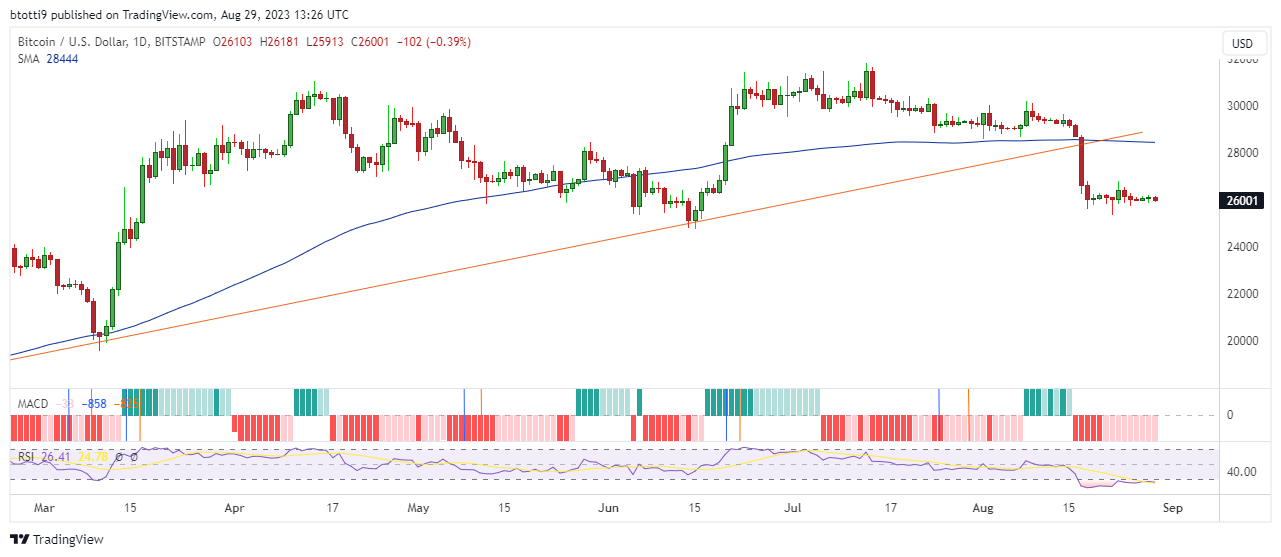
The crypto market recently witnessed a sharp sell-off for Bitcoin, the benchmark cryptocurrency falling to lows of $25,350. The struggle to strengthen above $26k has illustrated the market jitters permeating the broader risk assets sector, with this shown in outflows from Bitcoin investment products.

Bitcoin price chart

However, while outflows totaled $149 million last week, the flagship crypto asset’s flows are net positive for the year at roughly $265 million. Meanwhile, investors are increasingly selling their short positions, with $4 million in outflows registered last week for an 18-week streak of outflows. 

Data shows shorts outflows are currently 89% of the total AuM.

In the altcoin market, Ethereum recorded outflows of $17 million, while XRP and Litecoin had minor inflows of $0.5 million and $0.44 million, respectively.

The post Digital asset investment products record largest outflows since March appeared first on CoinJournal.

Bitcoin miner Canaan’s mining revenue rose 43% in Q2

  • Canaan Inc. (NASDAQ: CAN) has released its Q2 financial report showing an increase in mining revenue.
  • The Bitcoin miner’s total revenue rose to $73.9 million, increasing by 33.7% compared to Q1, 2023.
  • Canaan reportedly held 1125 bitcoins as of June 30, 2023.

Canaan Inc. (NASDAQ: CAN), one of the leading Bitcoin mining companies, has reported its unaudited financial results for Q2, 2023. According to the report, revenue from BTC mining jumped 43.3% quarter-on-quarter, from $11.1 million to $15.9 million.  

Meanwhile, total revenues rose to $73.9 million in the quarter, 33.7% up on Q1 revenues of $55.2 million. However, with the crypto market still heaving from the bear market impact, Canaan’s second quarter revenue is significantly lower compared to the $245.9 million reported in Q1, 2022.

Commenting on the financial results, Canaan CEO Nangeng Zhang, said in a press release: 

“We navigated the challenges in the second quarter of 2023, surpassing our topline guidance to achieve $73.9 million in revenue. Despite the relatively stagnant bitcoin price in the second quarter, our endeavor to drive sales across various fronts, including major clients, channels, and retail, yielded encouraging results. This effort propelled our total computing power sold to a remarkable 6.1EH/s, up 44% sequentially.”

Canaan held 1,125 bitcoins

According to Mr. Zhang, the company benefited from its collaboration with channel clients, and saw its online retail store attract new clients from across the globe.  The firm has recently looked to cement its footprint in the sector, setting up mining ventures in Africa and South America.

As noted above, Canaan sold 6.1 million Thash/s – this up from 4.2 million Thash/s in Q1, 2023. The company had sold a total of 5.5 million Thash/s in Q1, 2022.

CFO James Jin Cheng stated: “In the second quarter of 2023, we observed improvement in both our sales and mining activities, which contributed to our better-than-expected revenue performance. Despite a decrease in average selling price, our product sales grew by 31.3% quarter over quarter, driven by increases in total computing power sold.”

While the company expects Q3 revenue to decline to $30 million owing to the market conditions, net loss in Q2 was $110.7 million, compared to $84.4 million in Q1. The company had seen a net income of $90.1 million during the same quarter in 2022.

Per the report, Canaan held 1,125 bitcoins worth $28.8 million as of June 30, 2023. The company owned 747 of these bitcoins, while 378 BTC was from customer deposits. Impairment on the crypto in Q2 was $2.4 million, compared to $0 in Q1 and $4.5 million in Q2, 2022.

The post Bitcoin miner Canaan’s mining revenue rose 43% in Q2 appeared first on CoinJournal.

Genesis and DCG reach in-principle agreement to recover creditors’ funds

  • Digital Currency Group (DCG) moving toward resolving the financial challenges of its crypto lending subsidiary, Genesis.
  • The agreement could possibly lead to a fair recovery for creditors.
  • The agreement is still subject to several handles, but Genesis expects the agreement to be completed in the coming weeks.

According to a document submitted on Monday to the US bankruptcy court in the Southern District of New York, Digital Currency Group (DCG) and Genesis Global’s creditors have struck an in-principle agreement to settle the claims that surfaced during the crypto lender’s bankruptcy proceedings.

Genesis Global Holdco, LLC, Genesis Global Capital, LLC, and Genesis Asia Pacific Pte. Ltd. voluntarily filed petitions under Chapter 11 of the US Bankruptcy Code in January 2023.

Genesis creditors to get refunds in US dollar

Genesis, the crypto lending subsidiary of Digital Currency Group (DCG), had almost $3.5 billion in debt to its top 50 creditors, one of them being Gemini, according to the bankruptcy documents. Gemini and Genesis collaborated to give its users the option to lend Genesis their cryptocurrency holdings in return for the promise of interest payments through the now-defunct Genesis Earn program.

The recently reached in-principle agreement indicates that unsecured creditors may receive a recovery of between 70% and 90% in US dollar equivalent, potentially settling lingering disputes and securing a fair recovery for creditors.

Depending on the value of the digital assets involved, the recovery on an in-kind basis is anticipated to be between 65% and 90%.

Existing Digital Currency Group liabilities

The resolution of DCG’s current obligations, which total about $630 million in unsecured loans due in May 2023 and $1.1 billion under an unsecured promissory note due in 2032, is one of the agreement’s essential components.

According to the agreement, the payback will take place in two stages: an initial repayment of about $328.8 million with a two-year maturity and a second repayment of $830 million with a seven-year maturity.

DCG has also agreed to make a further $275 million payment, which will be made in four equal installments. These payments, which will take care of the maturing debts connected with the unsecured loans due in May 2023, are scheduled to be made after the partial repayment agreement date.

Notably, neither the Ad Hoc Group of Genesis’ lenders nor Gemini support the in-principle agreement.

The post Genesis and DCG reach in-principle agreement to recover creditors’ funds appeared first on CoinJournal.

Akropolis (AKRO) up 441%: here’s why the crypto is rising

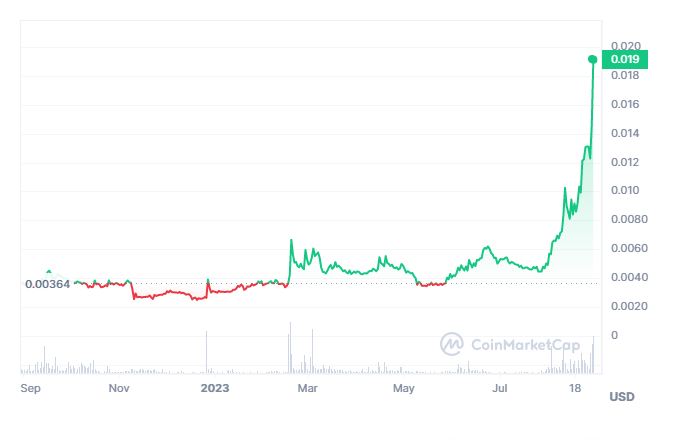
  • The price of Akropolis (AKRO) cryptocurrency has risen by 441% over the past year.
  • In the past 24 hours, the coin has surged by 30% to trade at $0.0192.
  • Akropolis is one of the best-performing cryptocurrencies in 2023.

The native token of Akropolis, a decentralized finance (DeFi) protocol focusing on under-collateralized loans, has been on steroids since the beginning of the year. Akropolis (AKRO) price has risen by 441% since the beginning of the year, marking a splendid growth of the DeFi token.

While those who invested in AKRO early are enjoying their profits, new investors are hesitant since the cryptocurrency could be heading into the overbought region after such a magnificent price surge. However, that can be only determined by understanding what is causing the token to rise.

Here is why the Akropolis (AKRO) price is rising

The main reason why the Akropolis (AKRO) price is going up is the increased activity on Akropolis, especially after the recent update.

The Akropolis Protocol is a collection of Ethereum-based DeFi aggregation and automation initiatives. Akropolis seeks to offer DeFi equivalents of essential financial services like access to credit with lenient terms and insurable savings (variable and fixed rate savings deposits). The platform is integrated with Yearn, MCDEX, Liquity, Maker, Fulcrum, Aave, Compound, Curve, and dYdX.

The Akropolis Protocol team concentrates on and creates a user-friendly portfolio of portable, borderless, trust-minimized DeFi products for financial operations and decision-making. The Sparta product, which focuses on undercollateralized loans, and Delphi, which focuses on automated passive mixed investing/income products, are constructed on top of the AkropolisOS, which is the main building block.

The Delphi beta was carefully placed on the Ethereum mainnet on August 12, 2020, and a bug bounty was run before a full launch on August 24, 2020. With the Akropolis Delphi Token (ADEL) token, the Akropolis Protocol further introduced Sparta v2, the DeFi yield re-balancing module, the crypto/fiat on-off ramp, support for new stablecoins, UI/EX upgrades, and the liquidity mining incentives feature.

Users can now pay in currencies other than ETH through integrations with OpenGSN. The protocol also has insurance protection from Nexus Mutual/Opyn to guard against hacking and programming flaws.

In August 2023, Akropolis made several updates among them the POC-Polkadai bridge, a Parity Substrate Blockchain bridge for self-transfers of DAI Token (ERC20) to sDAI (ERC20 representation).

The post Akropolis (AKRO) up 441%: here’s why the crypto is rising appeared first on CoinJournal.