AI to disrupt all industries as AltSignals token sale raises over $1M

  • Officials at OpenAI believe that artificial intelligence will disrupt all industries. 

  • The Chief Operating Officer expects the tech to lead to major layoffs.

  • AltSignals has raised over $1M in its highly successful token sale.

Artificial intelligence is one of the most disruptive industries of our time. Some analysts are comparing it with the innovation of the smartphone while others believe it is equivalent to the introduction of the internet. In a statement, Brad Lightcap the COO of OpenAI, warned that the industry will likely lead to substantial job losses in the future. He said this as AltSignals raised over $1 million in a token sale.

AI will disrupt all industries

Analysts believe that the artificial intelligence industry will disrupt all sectors of the economy. Today, many brand new cars have incorporated AI that help people improve their driving skills and reduce accidents. Companies like Tesla and General Motors use AI and machine learning to power their self-driving vehicles.

Similarly, news organizations like BuzzFeed are using AI to write content while Grammarly is helping content writers identify mistakes. It is also possible to write quality content using AI platforms like Bard and Bing. 

In a statement, the Chief Operating Officer (COO) of OpenAI, the creator of ChatGPT said that he believes that many jobs will be eliminated as companies embrace AI. He said:

“Every large company has an army of people that read and review contracts for revenue recognition purposes, for example. You may not have that job. That may not be a job of the future.”

Studies believe that the AI industry will be worth trillions of dollars in the next few years. Data compiled by Statista shows that the industry was generally valued at $95.2 million in 2021 and that it will hit over $1.8 trillion by 2030. Today, several AI companies like C3 and Nvidia have become multi-billion dollar entities.

AltSignals to disrupt finance

Another area that will see disruption is in the financial services industry. In fact, the sector is already seeing disruption with many hedge funds now using the technology to conduct analysis and implement orders.

AltSignals is one of the upcoming projects that seeks to leverage the technology to boost its business. For starters, AltSignals is a company that provides technical analysis and signals to customers from around the world.

Its current business model involves conducting technical analysis and identifying trading opportunities. It uses indicators like moving averages, Relative Strength Index (RSI), and the MACD.

While its trading signals are accurate, the management believes that embracing AI will make them better. According to its white paper, the technology will combine machine learning with natural language processing. Other technologies are regression and predictive modeling.

ASI token sale continues

As part of this development, the creators are running a token sale where users can participate in the project. Anyone can buy the ASI token for just 0.015 USDT. In the next stage, the price will jump by 25%. A lot of people have already bought the token. As you can see here, the token sale has raised over $1.011 million, which is equivalent to 93.68% of all tokens. 

The ASI token will power the AltSignals ecosystem. While it will be centralized initially, the developers hope to decentralize it in the future. This means that holders will be able to vote for the ecosystem’s growth and share the profits.

The post AI to disrupt all industries as AltSignals token sale raises over $1M appeared first on CoinJournal.
Dogecoin price prediction: rare pattern points to a 20% DOGE dip

– Dogecoin price has moved sideways in the past few days.

– The coin has formed a bearish flag pattern on the daily chart.

– There is a likelihood that it will soon have a bearish breakout.

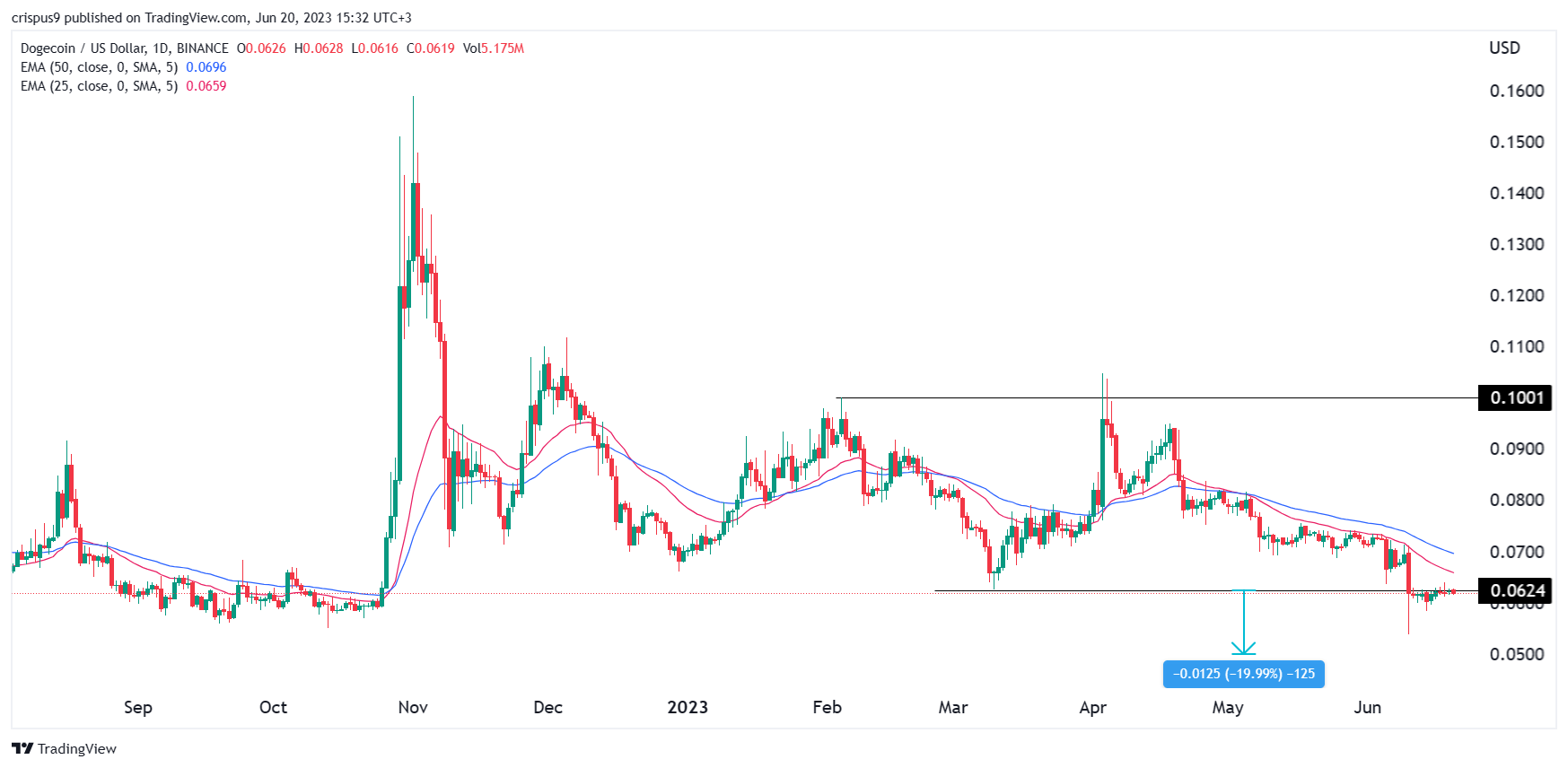
Dogecoin price has moved sideways in the past few days as the recent sell-off eased. The DOGE coin was trading at $0.061, where it has been at in the past few days. This price is sharply lower than the year-to-date high of $0.1052.

Regulations and monetary policy

Dogecoin price has been flat recently as investors assess several important events. First, there are concerns about the regulatory status in the US and other Western countries. The SEC has already sued companies like Binance and Coinbase, as we wrote here. 

Other countries are cracking down on crypto exchanges. For example, Binance recently announced that it was exiting its Netherlands operations. The UK and France are also investigating the company. As such, there is a likelihood that the industry will see more outflows in the coming months.

Dogecoin seems to be safe during all this since the SEC has not declared it as a financial security. Instead, because of how it works, the coin could be classified as a commodity. Unlike Shiba Inu, Dogecoin is a proof-of-work coin that has no staking features.

Therefore, there is a likelihood that Dogecoin will benefit if exchanges decide to delist tokens that are seen as securities.

Dogecoin price is also reacting to the latest monetary policy news. The Federal Reserve decided to leave interest rates unchanged last week. With inflation falling, there is a likelihood that the bank will continue pausing for the rest of the year.

Meanwhile, the recent news that Blackrock has applied for a Bitcoin spot ETF is a positive thing for Dogecoin price. It is positive news because it is helping to ameliorate the recent regulatory challenges in the industry. 

Dogecoin price prediction

The daily chart shows that DOGE price has been in a strong bearish trend in the past few weeks. As it dropped, the coin remained comfortably below the important 25-day and 50-day exponential moving averages. 

Dogecoin is now sitting at an important support level, which was the lowest level on March 10th of this year. It has also formed a bearish flag pattern, which is usually a bearish sign. Therefore, there is a likelihood that the coin will continue falling as sellers target the next key support level at $0.05, which is about 20% below the current level.

How to buy Dogecoin

eToro

Buy DOGE with eToro today

LiquidityX

Buy DOGE with LiquidityX today

The post Dogecoin price prediction: rare pattern points to a 20% DOGE dip appeared first on CoinJournal.

Gold and Bitcoin – the perfect portfolio combination

  • A diversified portfolio with gold and Bitcoin makes sense as Bitcoin’s trading volume rises
  • Gold’s stability offsets Bitcoin’s volatility
  • This way, investors may participate in Bitcoin’s upside potential without compromising on risk parameters

Portfolio management deals with managing risk. All risk cannot be avoided, and a risk-averse investor would not want to take no risk.

Instead, a risk-averse investor would like higher risk-adjusted returns. Naturally, the higher the potential return, the higher the risk.

Investors build portfolios of different assets to find the best possible risk-adjusted returns. Ideally, the assets have a negative correlation, thus bringing diversification benefits to the investor.

But it also makes sense to build a portfolio with correlated assets. While the portfolio is riskier, some other asset properties may appeal to investors willing to take a bigger risk.

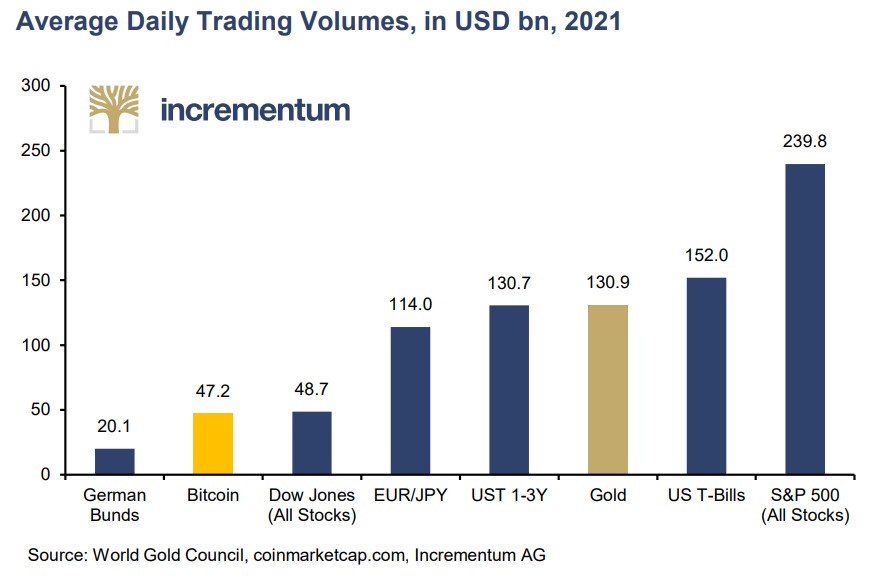
As Bitcoin’s average daily trading volume rises, such a diversified portfolio may contain gold and Bitcoin.

Why to add gold and Bitcoin to a portfolio?

Diversified portfolios spread the risk across uncorrelated assets. A portfolio manager’s challenge is finding that diversification level beyond which diversification brings no benefits anymore.

Traditionally, gold’s role in a portfolio is to bring stability. By adding Bitcoin to a portfolio, one may participate in the cryptocurrency’s upside potential and, at the same time, mitigate the risk associated with Bitcoin’s volatility by combining it with gold.

The post Gold and Bitcoin – the perfect portfolio combination appeared first on CoinJournal.

Report: 33 straight days of net withdrawals from crypto exchanges


Key Takeaways

  • Regulators are clamping down hard on the US crypto industry, with recent lawsuits announced against Binance and Coinbase
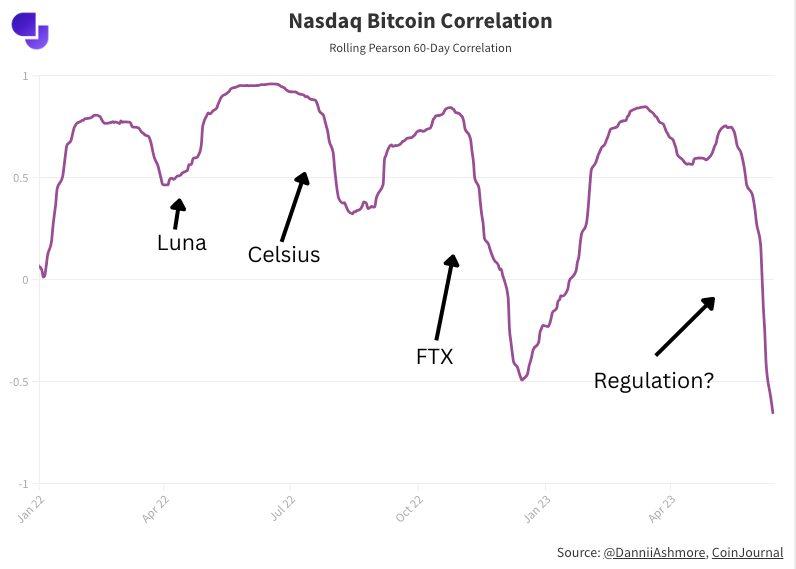
  • Bitcoin’s correlation with stocks is at a 5-year low, with the latter soaring but Bitcoin’s price suppressed by concerns around future of industry in US
  • Exchanges have seen net outflows for 33 days in a row, but size of withdrawals are not particularly notable
  • Binance is seeing the largest withdrawals, 7.3% of its balance heading for the exit doors
  • Allegations against Binance go beyond securities violations which most centralised companies are facing

Binance’s war with the SEC goes on. As does Coinbase’s. As does, well, the entire cryptocurrency space, which suddenly faces a regulatory threat that feels existential for the crypto industry in the US. 

The market has responded, unsurprisingly, by selling. Bitcoin dipped below $25,000 for the first time in three months last week, before bouncing back to where it currently trades at $26,500. 

More notable, however, was that this came amid a time when the stock market is soaring. As I detailed in depth last week, the correlation between stocks and Bitcoin is now at a 5-year low. This is similar to the dip in correlation we saw in November when FTX collapsed while the stock market surged off softer-than-expected inflation numbers. 

In such a way, while Bitcoin’s price decline seems minor on the face of things, it is underperforming relatively as the rest of the market is red hot.
Bitcoin on exchanges

But beyond price, how are markets reacting? Are people again concerned about storing their assets with these centralised exchanges?

Well, looking at the total amount of Bitcoin sitting in these exchanges, there has been net outflows for 33 days in a row. That is the longest streak since November 2022 amid the FTX scandal. 

The scale of withdrawals is not the same, however. Back in November, the last time we saw a consistent stream of net withdrawals, FTX was exposed as insolvent (and fraudulent) with $8 billion of customer assets gone. Fear was extreme and the entire market panicked, concerned that other exchanges could follow. Bitcoin ran for the exit doors, much of it sent straight to cold storage (or sold for cash). 

While the current developments are concerning for crypto in their own way, there appears to be no fear that customer assets are in danger. This is not a repeat of FTX, and the market reaction is also significantly more muted. 

Indeed, if we look at the total balance of Bitcoin across exchanges, we can see that the recent dip does not stand out in the context of the steep downtrend we have seen since the start of 2020. 

Is Binance different?

But what about Binance? Accusations levelled at the world’s biggest crypto exchange are certainly more sordid than merely securities violations. Binance and CEO Changpeng Zhao have been accused of trading against customers, manipulating trade volume, failing to implement adequate money laundering procedures, encouraging US customers and VIPs to circumvent location-based restrictions, and commingling customer funds. 

It is the latter accusation which is the headline one and throws up painful memories of FTX. While I have been critical of Binance for operating in an incredibly opaque manner (they have always refused to reveal their liabilities), there has been no evidence to date that customer funds have been misappropriated as they were in the FTX case. Again, this really has little in common with the FTX situation. 

On Saturday, a US court even approved an agreement between Binance and the SEC that would dismiss a temporary restraining order to freeze all Binance.US assets. 

“We are pleased to inform you that the Court did not grant the SEC’s request for a TRO and freeze of assets on our platform which was clearly unjustified by both the facts and the law,” Binance.US said on Twitter.

This appears to have assuaged the doomsday scenario, whatever chance there was of that to begin with. In looking at the flows on Binance specifically, however, it has seen more outflows than any other major exchange. 7.3% of its Bitcoin balance was withdrawn in the two weeks since the lawsuit was announced on June 5th.  That equates to 52,000 Bitcoin, or about 0.3% of the total circulating supply. 

For context, when Binance came under fire for its lack of transparency around reserves after FTX collapsed, 13.3% of its Bitcoin balance was withdrawn in a similar two-week period – evidently bigger as seen on the above chart, nearly double the flows of what have been seen thus far amid this SEC case. 

What does this all mean? Not very much, really. Binance has long operated in the shadows, and as I wrote here upon the SEC’s case being announced, it was a day that had long been coming. But there should not be a sudden uptick in concern around the safety of customer funds, and that is reflected in the relatively small flow of funds out of the platform. 

Nonetheless, the allegations against Binance are far more than merely selling unregistered securities, which is the main sticking point across the industry (and what Coinbase is being sued for). It is for this reason that funds have moved out of Binance at a faster pace than other exchanges, even if the size of these is no reason for alarm.

All in all, the reaction is not surprising. Nor were the news of these lawsuits, really.

The post Report: 33 straight days of net withdrawals from crypto exchanges appeared first on CoinJournal.

XRP/USD price prediction: bullish triangle favors a move to $0.8

  • XRP/USD keeps failing at the $0.55 area
  • As long as the market holds the higher lows series, the bias remains bullish
  • A bullish triangle’s measured move points to $0.8

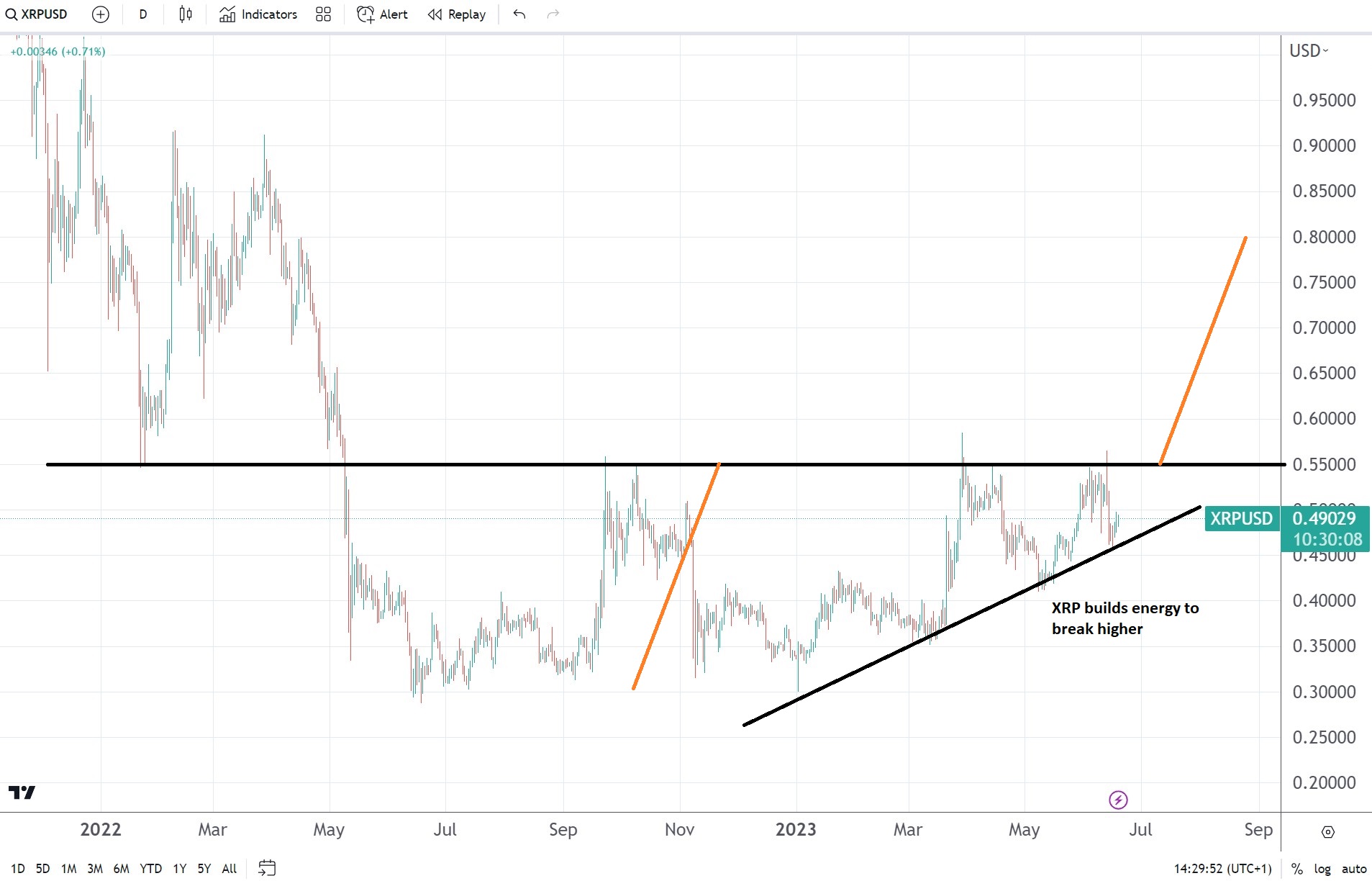
The cryptocurrency market is in consolidation following the strong rally since the start of the year. For example, Ripple (XRP) rallied against the US dollar in the first four months of the year as it jumped from $0.3 to almost $0.6 following the overall bullish cryptocurrency market trend.

But then, a consolidation followed. Since trading close to the $0.6 level, XRP/USD failed to make a new high for the year. In fact, it was constantly rejected by horizontal resistance.

However, this rejection, while bearish short term, also tells something different. As long as the price action keeps the series of higher lows intact, it builds energy before another try at the resistance level.

In other words, the bias remains bullish for the XRP/USD if the price is above $0.4. If the level holds, XRP/USD may be close to finishing a bullish reversal triangle with a measured move pointing to much higher levels.

XRPUSD chart by TradingView

Ripple finds support at $0.3

The cryptocurrency market’s bearish trend ended in the last part of 2022. In the case of XRP/USD, one can see a double bottom pattern at the $0.3 level – a bullish reversal pattern.

But that is not the only bullish sign. The fact that the market formed a series of higher highs while failing at horizontal resistance tells us that it is building energy to break higher.

More precisely, the price action resembles a bullish triangle. On a close above $0.6, the market should keep advancing toward the $0.8 area because such a triangle has a measured move equal to the length of its longest segment.

The post XRP/USD price prediction: bullish triangle favors a move to $0.8 appeared first on CoinJournal.