
Bitcoin mining stocks are far riskier than Bitcoin itself


Key Takeaways

  • Bitcoin mining stocks have underperformed Bitcoin heavily over the last year

  • Greater competition among miners and higher amounts of energy required means margins are thinner

  • Rising electricity costs and lower value of Bitcoin have also hurt miners immensely 

  • Greater number of variables beyond merely the price of Bitcoin means mining stocks have been trading with greater volatility

It’s a tough time to be a Bitcoin miner. This piece will succinctly break down how and why, as well as delving into why I believe mining stocks are far riskier than just investing in Bitcoin itself. Let’s get to it. 

Mining competition is higher than ever

Firstly, the competition within mining is higher than ever before. The beauty of the blockchain is that we can see all sorts of statistics regarding the Bitcoin network in real-time. One of these is the difficulty adjustment. For the uninitiated, the difficulty adjustment is a mechanism by which the difficulty of mining changes to ensure the new supply of Bitcoin released via mining remains consistent (at approximately ten-minute intervals).

In other words, as more miners join the network, the difficulty increases so that Bitcoin is released at the same pace as prior. The same holds true the other way around – difficulty falls if miners stop operating. 

As the below chart shows, Bitcoin mining difficulty recently smashed through the 50 trillion hash mark for the first time ever. Only three years ago, that number sat at 14 trillion.  

This is great for the Bitcoin network: the more miners, the more secure the network. For the miners themselves, however, that means greater energy amounts are needed to complete this now-more-difficult assignment of validating transactions on the network. 

Oh, and there is a double whammy. As you may realise if you have turned on a light, charged your phone or boiled a kettle in the last year, the price of electricity has skyrocketed around the world. The next chart shows the rise in electricity costs in the US, which according to the Cambridge Electricity Consumption Index, has the highest amount of miners (the nation is responsible for 38% of the network’s hash rate). 

This means that higher amounts of energy are needed to mine, and the cost of that energy has also increased drastically. 

People are using Bitcoin less 

So, we know costs have risen. But the bad news isn’t over yet. 

Bitcoin’s volumes have collapsed throughout the bear market. Perhaps the best barometer of this is to look at the trading volume on centralised exchanges, which fell 46% in 2022 compared to 2021. 

Looking at Bitcoin fees shows a similar pattern, with fees far down on the heyday of the pandemic bull market. This was briefly interrupted in May when the Bitcoin Ordinals protocol sparked a revival in network activity. However, the below chart shows that fees have been falling for five consecutive weeks since (although they are still up significantly on the start of the year), giving up most of those gains. 

Much like the cost side, which saw an increase in inputs required (greater demands via the difficulty adjustment) as well as an increase in the per-unit costs of those inputs (rising electricity costs), the revenue side for miners is also suffering from a brutal double whammy. 

Not only is volume way down from the bull market and hence less fees (revenue) are recouped, but miners’ revenue (fees and the block subsidy award) is received in Bitcoin, which has also fallen in value. This means that, after earning Bitcoin by battling with the greater competition and toiling over increased costs, the value of that Bitcoin (revenue) on the market is substantially less – still 60% off its peak from November 2021. 

Mining stocks are more volatile than Bitcoin

So let’s think about these four variables:

  1. The amount of energy needed
  2. The cost of that energy (electricity)
  3. The fees and block rewards received (i.e. revenue)
  4. The value of those fees and block rewards (the Bitcoin price)

Therefore, not only are mining companies dependent on the price of Bitcoin (variable number four), but it also depends on several other factors (admittedly variables 1 and 3 are heavily dependent on the price of Bitcoin too. In truth, economic incentives will drive mining to a certain price point, but I will discuss in another article). 

Therefore, for the time being at least, the risk is greater with mining stocks than a direct investment in Bitcoin. As with all things, greater risk can mean greater reward, and there have been periods of mining stocks outperforming Bitcoin as a result. 

However, over the last year or so, mining investors are in an even worse state than Bitcoin investors (who themselves are licking their wounds). I’ll let the below mining ETF, launched in February 2022, illustrate this:

All this goes to show how tough mining has been. And that is without even mentioning the big bad wolf that is regulation. The regulatory crackdown in the US has been ferocious, and while Bitcoin has thus far been relatively unaffected, miners are more vulnerable (especially those that are publicly listed in North America) than Bitcoin itself, which is a decentralised asset theoretically immune to regulation (directly, at least). 

This is not meant to be a pro-Bitcoin or anti-mining piece. It is just comparing the two as investments and showing why mining stocks tend to be more volatile. And when you’re more volatile than Bitcoin, that is really saying something.        

The post Bitcoin mining stocks are far riskier than Bitcoin itself appeared first on CoinJournal.
3 reasons why Litecoin price has risen for 7 days straight

  • Litecoin price has drifted upwards in the past seven days straight. 

  • The coin has more than doubled from its lowest point in 2022.

  • Litecoin halving countdown is continuing.

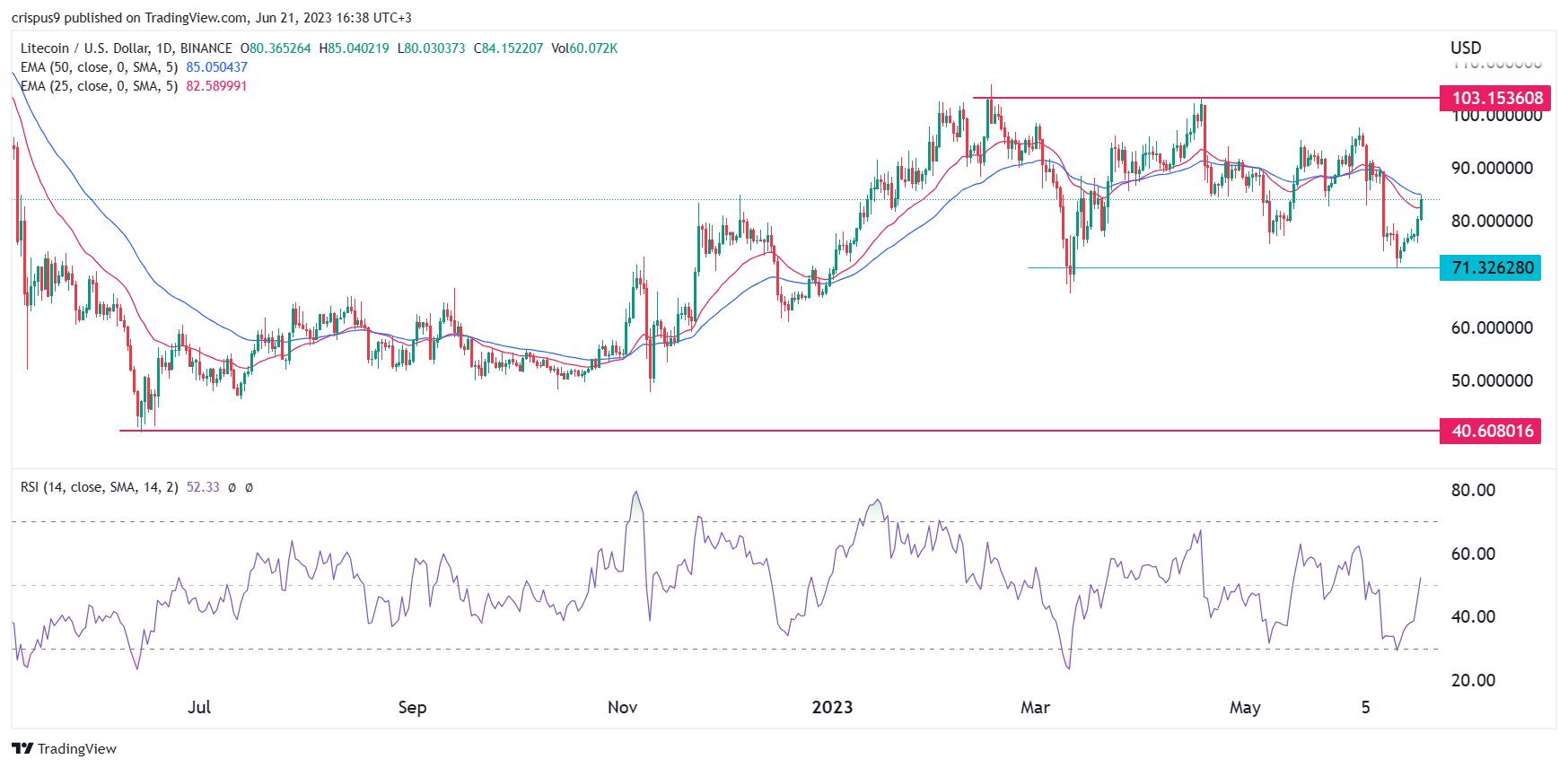
Litecoin price has not been left behind in the ongoing recovery of cryptocurrencies. LTC has risen in the past seven days straight and is now trading at $84.57, the highest point since June 10th. It has jumped by more than 17% from the lowest point this month.

Litecoin is not a security

There are three main reasons why LTC price is surging. First, Litecoin is getting ready for the upcoming halving event, which is scheduled for August 2nd of this year. Halving is a situation where the total rewards offered to miners are reduced by half. 

For Litecoin and Bitcoin, the halving event happens after every four years. And in most periods, Bitcoin and Litecoin prices tend to rally ahead of a halving event, which explains why LTC has jumped by over 105% from the lowest level in 2022.

Second, Litecoin price is rising after a new Wall Street-backed crypto exchange included the coin in its offerings. EDX Markets, which is backed by Citadel Markets, Schwab, and Fidelity, was launched on Tuesday. Unlike other exchanges, it is offering four coins: Bitcoin, Litecoin, Ether, and Bitcoin Cash. It also offers non-custodial services, meaning that it does not handle or store cryptocurrencies.

Third, LTC price is rising because of the recent moves by Blackrock and Deutsche Bank. Last week, Blackrock announced that it had filed for the iShares Bitcoin Trust, which will be the only spot BTC ETF. Other companies like WisdomTree and VanEck have also expressed interest in the fund.

Deutsche Bank, on the other hand, announced that it had filed for crypto custodial license. This is notable since this is the biggest bank in Germany and the 9th biggest one in Europe. Therefore, this crypto news have helped to ameliorate the recent worries on regulations.

Litecoin price prediction

The daily chart shows that the LTC price has risen in the past seven straight days. This recovery started when the coin dropped to the key support level at $71.32, which was slightly above the lowest point on March 11th.

Litecoin remains below the 25-day and 50-day moving averages while the Relative Strength Index (RSI) has moved above the neutral point of 50. Therefore, I believe that the coin has some more upside until it becomes overbought. This means that it could rise to the next resistance point at $90. A move above $90 will see it rise to the next level at $100.

How to buy Litecoin

eToro

Buy LTC with eToro today

Plus500

Buy LTC with Plus500 today

The post 3 reasons why Litecoin price has risen for 7 days straight appeared first on CoinJournal.

DOT/USD price forecast: bears have a compelling case

  • Polkadot made a new low for the year
  • All 2023 gains are gone as bears keep selling DOT/USD
  • If Jerome Powell delivers a hawkish speech today, a descending triangle points to further downside for the DOT/USD pair

The cryptocurrency market rallied at the start of the year. Following a bearish 2022, investors saw the start of the new year as the beginning of a new bull market.

Bitcoin led, and other cryptocurrencies followed. But not all coins managed to close near their yearly highs.

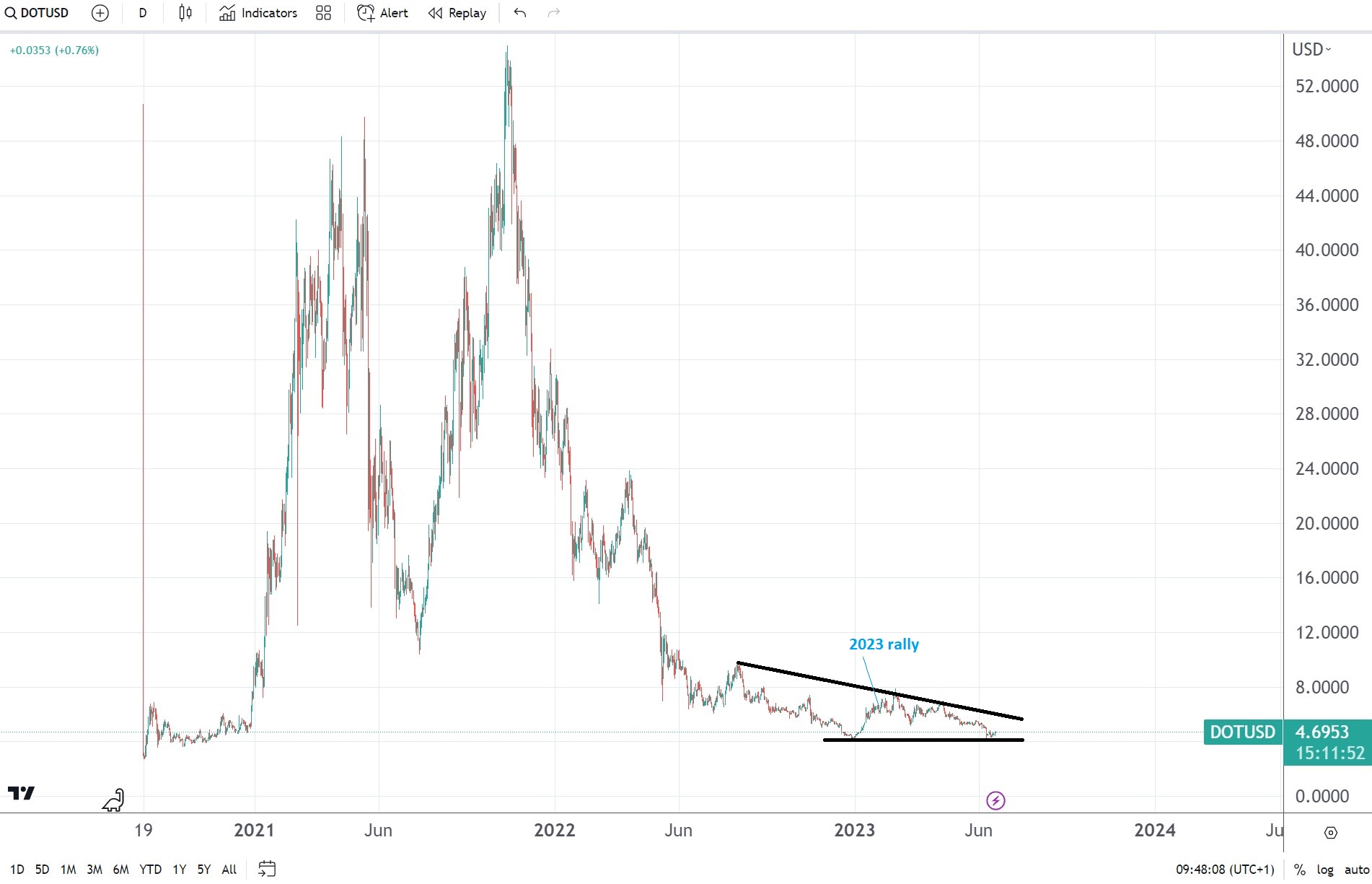
For example, Polkadot made a new low for the year. More precisely, the DOT/USD pair gave back all of its 2023 gains, and things do not look good for investors.

That is particularly true ahead of the Fed’s Chair Jerome Powell’s testimony due today. He will testify about the semi-annual monetary policy report in front of the Senate Banking Committee in Washington, D.C., later today, and markets are eager to find out what he’s going to say about the future funds rate.

Any hawkish commentary should send the U.S. dollar higher across the board. Not only fiat currencies will react – but the crypto ones too.

Coupled with the technical analysis picture, the bias is bearish, as pointed out by a descending triangle.

Polkadot chart by TradingView

A descending triangle spells trouble for DOT/USD

A descending triangle is a bearish continuation pattern. Hence, the price action following the pattern should continue in the same direction as the main trend traveled.

The main trend is bearish, given the fact that DOT/USD dropped from above $52 at the peak of 2021 to the current $4.7.

To confirm the bearish pattern, the market should travel a distance equal to at least the longest segment of the triangle. Calculating it does not make sense, as it points to almost 0.

I’m not saying that Polkadot will go to 0. I do state that before buying cheap coins, one should be better off looking at the bigger picture and looking for the obvious on a chart. In this case, as 2023 gains are gone, bulls are trapped. Add the descending triangle, and the bias remains bearish, not bullish.

The post DOT/USD price forecast: bears have a compelling case appeared first on CoinJournal.

Blackrock, Deutsche Bank embrace crypto as AltSignals raises $1M

  • Blackrock is seeking approval to launch the iShares Bitcoin Trust.

  • Deutsche Bank applied for a new crypto custodian license in Germany.

  • AltSignals has raised over $1 million in its token sale.

Large financial services companies are embracing cryptocurrencies even as the Securities and Exchange Commission (SEC) and other regulators fight key companies in the industry. This explains why most cryptocurrencies have staged a strong recovery in the past few days. Bitcoin price is approaching $29,000 while Ethereum has jumped to $1,830. AltSignals, on the other hand, has raised over $1 million from investors.

Blackrock and Deutsche Bank crypto ambitions

The most important crypto news of this month was the decision by the SEC to sue Coinbase and Binance, the two biggest companies in the industry. The SEC made several allegations such as offering unregulated securities and commingling of customer funds.

The impact of these lawsuits could be dire for the industry. For example, if the SEC wins against Coinbase, the company will have to stop offering staking products. Instead, developers of staked products will need to first get a license from the agency.

Meanwhile, there are signs that many large companies are embracing cryptocurrencies. As we wrote here, Blackrock has applied for the iShares Bitcoin Trust. If accepted, this will be the first spot ETF in the crypto industry.

The fund will make it possible for people to have an exposure with Bitcoin without holding the real coin. It will also enable them to hold the coin without using exchanges like Coinbase and Binance.

It is still unclear whether the SEC will allow the spot ETF since it has rejected others in the past. The main difference is that Blackrock has added some measures to prevent price manipulation in its ETF filing.

The other important cryptocurrency news was the official launch of EDX Markets, a non-custodial crypto exchange. This was a crucial development since the exchange is backed by Wall Street companies like Schwab, Fidelity, and Citadel Securities. All these firms have a major role in the US, with Citadel being the biggest market maker.

Meanwhile, Deutsche Bank confirmed that it had applied for a crypto custody license to Bafin. The company hopes to provide crypto banking services to affluent people in Germany. If the company gets the license, it will be a good thing for the market.

AltSignals token sale raises $1 million

Further, AltSignals, a fintech company that provides trading signals, has raised over $1 million from investors through a token sale. The ASI token is going for $0.015 in the first stage of the token sale and the developers hope to boost its price by 25% in the next stage.

For starters, AltSignals is a company that aims to leverage concepts of artificial intelligence (AI) to provide better signals to its customers. The developers aim to use the funds to help them develop the project. 

In future, AltSignals will become a fully-decentralized platform where ASI token holders will be able to vote for key decisions. 

AltSignals is a good investment for three main reasons. First, the token is extremely cheap, meaning that you can make a lot of money without risking much. Second, the company is already profitable even before it embraces AI. And finally, it is disrupting an industry that is valued at billions of dollars.

The post Blackrock, Deutsche Bank embrace crypto as AltSignals raises $1M appeared first on CoinJournal.

Bitcoin touches $29k for the first time since May: Why is Bitcoin price up today?

Key takeaways

  • Bitcoin briefly touched the $29k level on Wednesday after rallying by more than 6% in the last 24 hours.

  • The rally comes after BlackRock filed for a Bitcoin ETF and Fidelity, Schwab, and Citadel backed a crypto exchange.

Institutional interest pushes Bitcoin higher

Bitcoin has been performing well since the start of the week and set a new milestone a few hours ago. The leading cryptocurrency touched the $29k level for the first time since May after adding more than 6% to its value over the last 24 hours.

At press time, the price of Bitcoin stands at $28,834 per coin. Bitcoin reached a daily high price of $29,110 a few hours ago before retracing to currently trade above $28,800 per coin.

The rally comes as institutional interest in the cryptocurrency market increased in the last few days. 

Earlier this week, BlackRock, the world’s largest asset management firm with nearly $10 trillion in assets under management, applied with the US Securities and Exchange Commission (SEC) to launch a Bitcoin exchange-traded fund (ETF). 

The SEC has rejected all the spot Bitcoin ETF applications filed over the years. However, market participants are optimistic that the SEC could approve BlackRock’s application due to the company’s standing.

A few hours ago, EDX Markets, a crypto exchange backed by Fidelity, Schwab, and Citadel, also went live. 

The increased interest in the crypto market by traditional financial institutions fueled Bitcoin’s rally over the last 24 hours. 

Bitcoin Eyes $30k

Bitcoin could be looking to break past the $30k psychological level in the near term if the current market momentum is maintained. The technical indicators currently show that Bitcoin is bullish.

If the Bulls can maintain the current market sentiments, Bitcoin could rally toward the $30k level in the next few hours. 

The total cryptocurrency market cap surged past the $1.1 trillion mark a few hours ago as Bitcoin and the other leading cryptocurrencies rallied. 

The post Bitcoin touches $29k for the first time since May: Why is Bitcoin price up today? appeared first on CoinJournal.