Bitcoin jumps on Grayscale news, but what happens with the USD is more important

  • Grayscale won a landmark ruling against US regulators
  • The SEC was wrong to reject Grayscale’s application to transform the Bitcoin trust into an ETF
  • Bitcoin’s price jumped, but it is more relevant what happens to the US dollar next

Grayscale is a leading crypto asset manager. It enables traders and investors to gain exposure to the cryptocurrency market through a Bitcoin trust.

The trust now has over $17 billion in assets under management, and the eligible shares of Grayscale Bitcoin Trust are quoted on OTCQX under the symbol GBTC.

Yesterday, Grayscale won a landmark decision from a US court that ruled against the Securities and Exchange Commission over Grayscale’s Bitcoin ETF.

Grayscale wants to convert the Grayscale Bitcoin Trust into an ETF (Exchange Traded Fund), but the SEC did not allow it. However, the federal court ruled that the SEC was wrong.

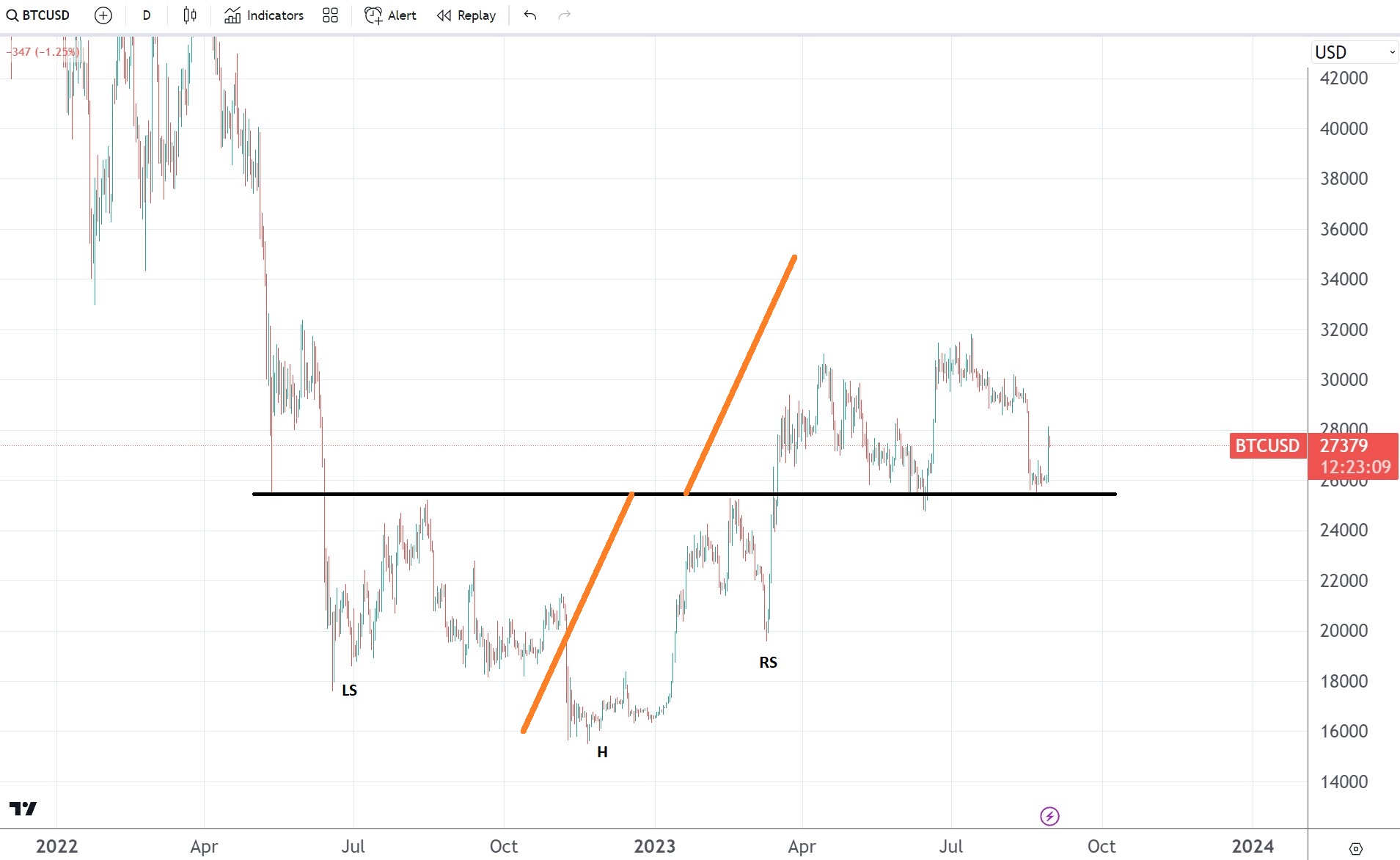
As a result, Bitcoin price jumped above $27k. While Grayscale’s news is positive for the industry, for Bitcoin, it is more relevant what happens to the US dollar.

Bitcoin chart by TradingView

Bitcoin bounces from support as the US dollar weakens

At the same time, when the US federal court ruled in favor of Grayscale, news came out that the labor market in the United States softened. Major stock market indices advanced as the dollar lost ground.

This is a trend to watch in the future.

Because the Fed is convinced that inflation has peaked, the focus sits now on the labor market. If jobs data this week confirms the soft path, expect Bitcoin to gain some more.

From a technical standpoint, Bitcoin bounced from horizontal support given by the neckline of an inversed head and shoulders pattern. The neckline is often retested, and now the focus shifts (again) to the measured move that points to $35k and beyond.

The post Bitcoin jumps on Grayscale news, but what happens with the USD is more important appeared first on CoinJournal.

Ripple back under pressure, bears eye major support area

  • Ripple erased all the gains following the July federal court ruling
  • Dynamic resistance held
  • All eyes are now on the major support area seen at $0.3

Crypto investors cheered Ripple’s price reaction in July following news that the XRP token is not a security when sold to the general public. The price spiked from the $0.4 area to close to $1, and finding a single bearish trader following the news was impossible.

But markets often mislead traders.

As it turns out, the SEC (Security and Exchange Commission) wants to appeal the federal court ruling in Ripple’s case. Investors did not wait and sold, sending the XRP/USD rate back to where it was before the July news.

The round trip was completed recently when Ripple fully retraced the move following July’s announcement.

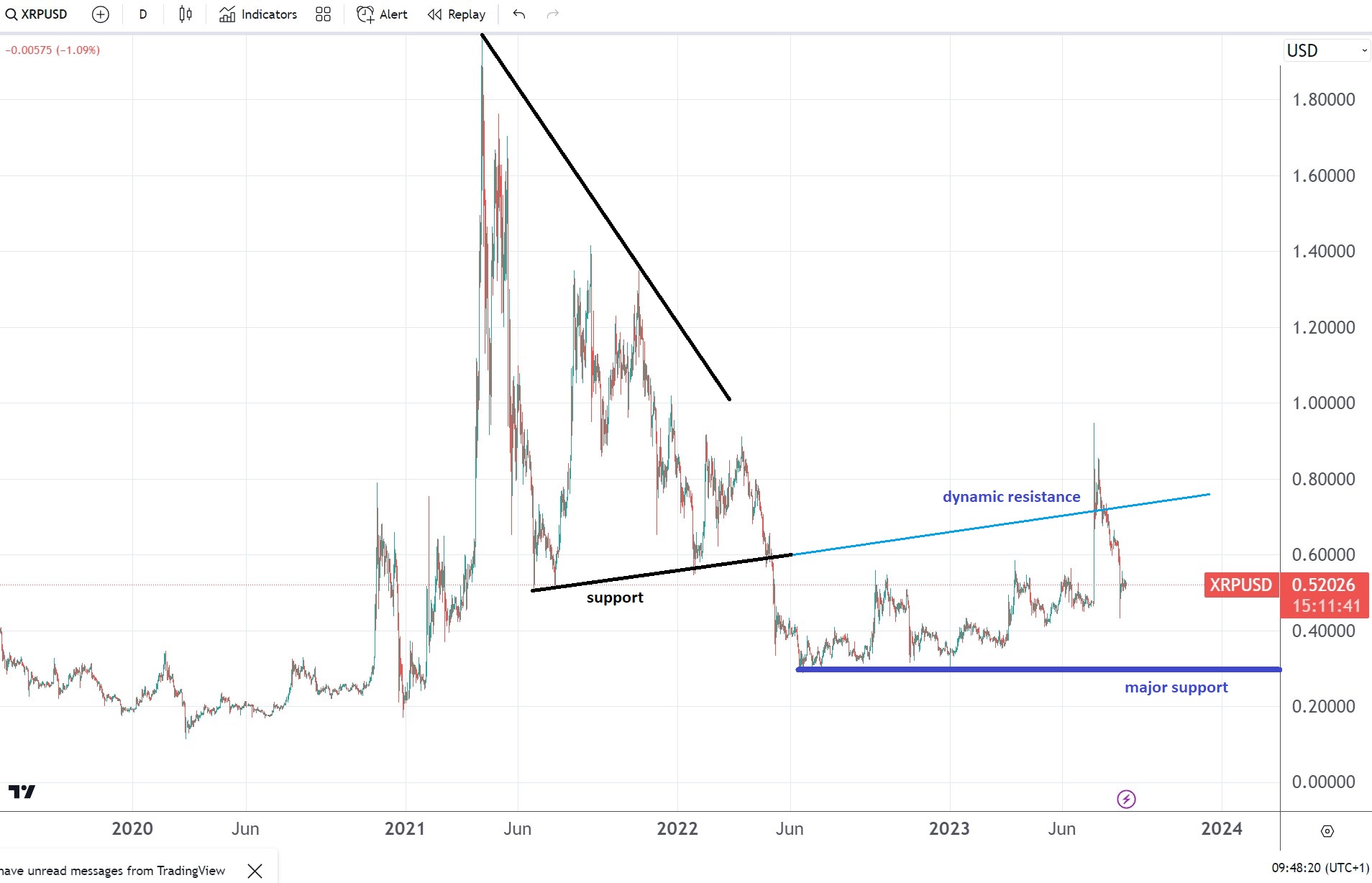
One can build both a bullish and a bearish case for Ripple by looking at the technical picture. But the main thing is that Ripple is back in the range, unable so far to break above or below major resistance and support areas.

Ripple chart by TradingView

The bullish case for Ripple

In 2021, Ripple’s price surged to over $1.8 as investors hurried to get exposure to the cryptocurrency market during the COVID-19 pandemic. But sellers quickly emerged, and a bearish triangle formed.

The triangular consolidation held until 2022. In the first half of that year, Ripple’s price broke lower. It did so by breaking support given by the lower edge of the triangle, and since then, it has not looked back.

Until this July.

Previous support turned out to be dynamic resistance. It is this resistance that kept bulls at bay following the July news.

However, despite the rejection, one can build a bullish case for Ripple. The $0.3 area acted as a major support in 2022, and the market has built a series of higher highs and higher lows ever since. As long as it holds above support, Ripple’s price might recover and attempt to break and hold above dynamic resistance again.

The bearish case for Ripple

On the other hand, the recent selloff alone has scared many traders. Optimism vaned, and with it, capital fled, too. If Ripple’s price drops below $0.4, the momentum then builds for further downside toward the major support area seen at $0.3. A break there, and it is game over for bulls that were so sure that Ripple’s time has come.

The post Ripple back under pressure, bears eye major support area appeared first on CoinJournal.

Avalanche price prediction: Brace for more AVAX dilution

  • Avalanche’s token has been in a strong bearish trend in the past few months.

  • The token will remain under pressure ahead and after the latest token unlock.

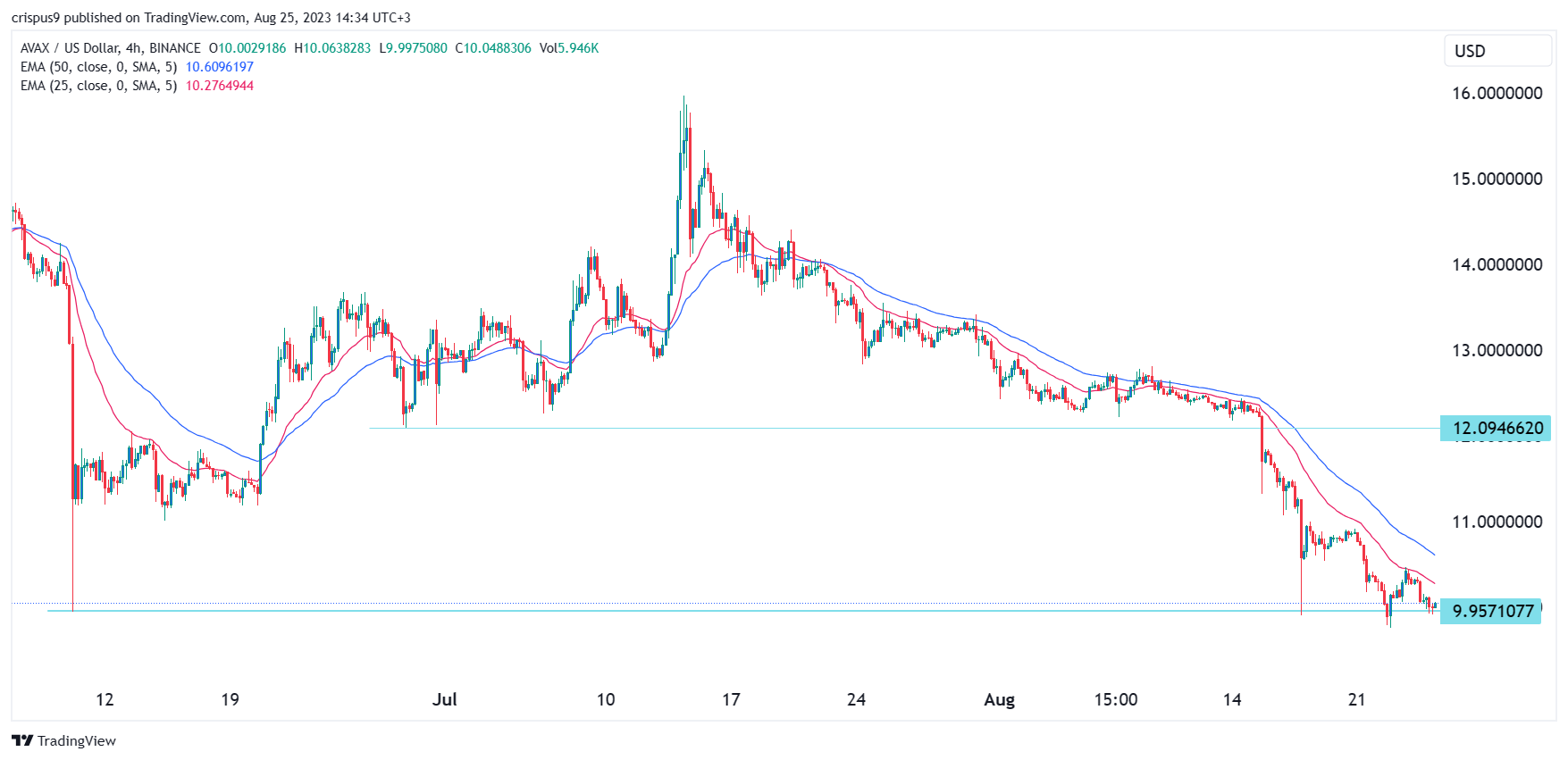
Avalanche price came under intense pressure ahead of the token unlock event scheduled for Friday. The AVAX token was trading at $10 on Friday, a few points above this week’s low of $9.78. It has dropped by more than 37% from the highest level in July.

AVAX token unlocks

Avalanche, the Ethereum alternative, will be in the spotlight on Friday as the developers are set to unlock millions of tokens to the market. Precisely, they are set to unlock more than 9.7 million tokens that are valued at over $95 million. These tokens represent about 2% of the network.

Token unlocks are popular features in the crypto industry. They happen in line with a network’s tokenomics, which set aside the vesting process. In Avalanche’s case, the vesting process will end in July 2030.

According to TokenUnlocks, there are 380 million tokens that are currently in circulation with 339 million being locked. As a result, the current market cap of all unlocked AVAX tokens stands at $3.45 billion while the diluted cap is over $7.2 billion. Therefore, AVAX holders can anticipate more dilutions in the coming years.

The challenge for Avalanche is that its ecosystem is not growing. For example, data compiled by DeFi Llama shows that the Avalanche ecosystem has over 151 million in total value locked (TVL). At its peak, it had over 362 million tokens in the market. 

In dollar terms, Avalanche has a TVL of about $1 billion, with the biggest dApps being Wonderland, AAVE, Benqi, GMX, and Trader Joe. 

Avalanche price forecast

The 4H chart shows that the AVAX crypto price has been in a strong bearish trend in the past few months. It recently moved below the important support level at $12.10, the lowest level on June 18th.

Avalanche price has dropped below the 50-day moving average. It is now hovering at the lowest swing on June 10th. The Relative Strength Index (RSI) and the Stochastic Oscillator have moved to the oversold level.

Therefore, the outlook for the token is bearish, with the next psychological level to watch being $8. The stop-loss of this trade will be at $10.50.

How to buy Avalanche

eToro

eToro offers a wide range of cryptos, such as Bitcoin, XRP and others, alongside crypto/fiat and crypto/crypto pairs. eToro users can connect with, learn from, and copy or get copied by other users.

Public

Public is an investing platform that allows you to invest stocks, ETFs, crypto, and alternative assets like fine art and collectibles—all in one place.

The post Avalanche price prediction: Brace for more AVAX dilution appeared first on CoinJournal.

How correlated is MicroStrategy stock to the Bitcoin price?


Kay Takeaways

  • 1 in every 127 Bitcoins are owned by MicroStrategy
  • The stock price tracks the price of Bitcoin remarkably well
  • Despite price correlation, there are additional risks to the stock, while it violates the “not your keys, not your coins” mantra
  • For investors unable to purchase Bitcoin directly, however, it does provide an alternative means of Bitcoin exposure
  • With 0.79% of the circulating supply owned by the company, it also throws up concern about a centralisation of wealth

Google “MicroStrategy” and Wikipedia will tell you that it is “an American company that provides business intelligence, mobile software, and cloud-based services”.That may technically be true, but in reality it has become a Bitcoin investment vehicle. 

MicroStrategy, under the borderline-religious leadership of Michael Saylor, currently owns 152,800 Bitcoin. That is 0.79% of the circulating supply; in other words, 1 in every 127 Bitcoin is now owned by MicroStrategy. When omitting the portion of the Bitcoin supply which is lost (for which estimates generally come in at about 1.5 million), the company owns 1 in every 118 coins.

What’s more, since MicroStrategy’s first Bitcoin purchase on August 8th, 2020, there have been just over one million coins created. This means MicroStrategy’s stash equates to 15.3% of the total coins created since they started buying. 

Clearly, no matter what way you swing it, MicroStrategy own an enormous stash of Bitcoin. Here, we will assess how it affects their stock price.

https://twitter.com/saylor/status/1686468084574412800

Performance vs Bitcoin

The place to start is, unsurprisingly, MicroStrategy’s correlation with the Bitcoin price. On the next chart, we can see that the correlation has picked up markedly since the company began buying up the supply. Bar a brief dip in August last year, the relationship has been extremely strong since late 2021. 

This is not surprising when one looks at the numbers. MicroStrategy has averaged $497 million of revenue over the last three years, with an average EBITDA of $50 million. And yet these numbers are dwarfed by its Bitcoin supplies – it owns approximately $4 billion worth of Bitcoin at the time of writing, purchased for $4.53 billion.

The market cap of the company is only marginally more than the value of its Bitcoin, coming in at $4.7 billion. 

If we plot the performance of the company against the performance of Bitcoin since the first purchase in August 2020, both assets have trodden an extremely similar path.

There are currently 11.834 million shares of MicroStrategy outstanding. With the company holding 152,800 Bitcoin, that implies that each share equates to owning 0.0129 Bitcoin. With the current share price of $329, this means that a $1000 investment in MicroStrategy nets you 0.0392 Bitcoin. 

In contrast, a $1000 investment in Bitcoin directly at the market price of $26,100 would net you 0.0383 Bitcoin.

Obviously, this is simplistic and looks beyond a whole host of variables on the MicroStrategy side (not to mention the extreme volatility of both assets). Bitcoin enthusiasts will also decry the fact that purchasing MicroStrategy stock is nowhere near the same thing as buying and holding your own Bitcoin – “not your keys, not your coins”.  

And they would be absolutely correct. These are completely different investment vehicles. However, with no spot Bitcoin ETF currently approved in the US, many institutions and other large entities have difficulty investing in the cryptocurrency for regulatory and compliance reasons. If an institution seeks exposure to Bitcoin, therefore, it is often required to pursue alternative options.

MicroStrategy may not be the real thing, and carries plenty of risks which direct purchases of Bitcoin do not. However, in terms of price exposure alone, it is a viable backup option.

Companies that are locked out of purchasing Bitcoin for the aforementioned reasons, but gained exposure through MicroStrategy, have benefitted well. The next chart plots its performance against the Nasdaq – it displays similar outperformance to what we have seen from Bitcoin over the time period. 

Centralisation

While this is all well and good, it would be remiss not to mention the fact that there do exist downsides here for the Bitcoin ecosystem. Sure, offering exposure to investors who, at least over the last couple of years, have not been in a position to purchase Bitcoin directly is a good thing. 

On the flipside, however, this is an asset built upon the principles of decentralisation. We are now in a position where one company owns an enormous chink of the supply, and does not seem as if it will curtail its buying anytime soon, as its stash creeps close and closer to 1%. 

Speaking of 1%, most of the world’s wealth is already in the hands of the top 1%. While Bitcoin often paints a romantic image of a democratisation of wealth, and a means of pulling oneself out of financial tyranny, the reality is that there will also be a 1% who own a massive slice of the pie. It will be no different to any other asset in this regard. 

We put out a piece in March assessing the wealth breakdown of Bitcoin, mentioning a study by the National Bureau of Economic Research outlining that the top 10,000 Bitcoin investors control one-third of the total supply. 

The anonymous Satoshi Nakamoto owns an estimated 1 million coins alone (or as a group, depending on what you believe regarding his/her/their identity), equivalent to over 5% of the supply. Nakamoto’s large holdings were even mentioned in Coinbase’s S-1 filing when it went public in 2021 as a source of risk to the business. 

“The identification of Satoshi Nakamoto, the pseudonymous person or persons who developed Bitcoin, or the transfer of Satoshi’s Bitcoins” was outlined as a risk to Bitcoin and, by extension, Coinbase’s business. 

While speculating on Nakamoto’s identity is a fool’s game, and these coins could easily be lost forever, it is easy to see how Coinbase listed this as a risk in its filing. The fact is that one entity or person holds 5.2% of the supply, and nobody has any idea who. 

We know who MicroStrategy are, and Michael Saylor is often lauded in the space for being a visionary (not to mention the fact the tidal wave of buying pressure serves to help boost the price now and again). But for an asset built upon the concept of decentralisation, it does provide pause for thought. 

Having said that, Bitcoin does remain the closest thing to decentralisation that the world has right now in the monetary sphere, even if it is not perfect. There will always be a 1%, because that is how life works – and Bitcoin is no different in this regard. 

The post How correlated is MicroStrategy stock to the Bitcoin price? appeared first on CoinJournal.

Maker (MKR) price regains momentum as Spark Protocol inflows rise

  • Maker’s MKR price has staged a strong recovery in the past few days.

  • Spark Protocol is seeing strong inflows because of its higher rates.

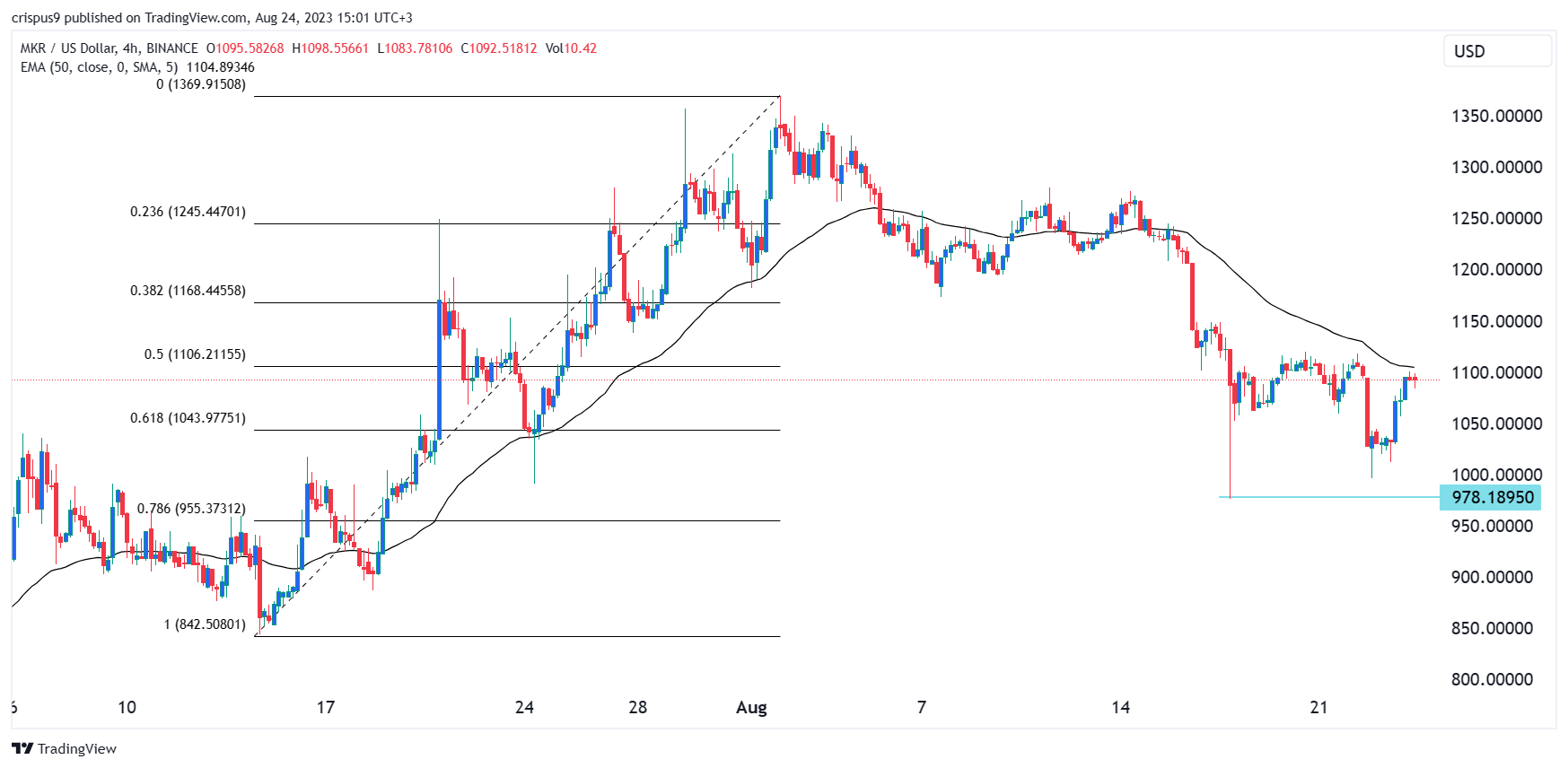
Maker (MKR) crypto price jumped on Thursday as investors cheered the rising demand for the Dai stablecoin. The coin jumped to a high of $1,100, which was much higher than last Friday’s low of $978. Its recovery also coincided with the strong comeback of tech stocks following Nvidia’s earnings.

Dai demand jumps

MakerDAO is one of the biggest players in the blockchain industry. Data compiled by DeFi Llama lists its total value locked (TVL) at over $5.12 billion, making it the third DeFi player after Lido DAO and AAVE.

MakerDAO is known for the Dai stablecoin, the 12th-biggest cryptocurrency and the third-biggest stablecoin in the world.  Dai’s market cap has jumped by more than $1 billion in the past few weeks, giving support to MKR’s token.

Dai is thriving thanks to Spark Protocol, a rival to AAVE that was launched by MakerDAO a few months ago. Spark is a DeFi protocol that makes it possible for people to earn returns by simply depositing cryptocurrencies like ETH and Dai.

Spark also allows people to borrow Dai against their collateral and swap other coins without slippage. Data shows that depositors are earning a return of as much as 8%. Like AAVE, it generates these funds by lending in the platform. Spark has grown so much such that its total value locked has jumped to over $578 million.

MakerDAO and other DeFi protocols are facing the challenge of high-interest rates since money market funds are now generating a higher rate, thanks to the relatively higher interest rates by the Federal Reserve. Some funds are returning as high as 6%.

Maker price forecast

The 4H chart shows that the MKR price dropped sharply last week as cryptocurrencies plunged. It dropped to the important support level at $978. The coin still remains below the 50-day moving average and is slightly below the 50% Fibonacci Retracement level.

Therefore, there is a likelihood that the MKR price will likely continue rising as buyers target the key resistance level at $1,150. A drop below the support at $1,050 will invalidate the bullish view.

How to buy Maker

eToro

eToro is a multi-asset investment platform with more than 2000 assets, including stocks, ETF’s, indices, commodities and Cryptoassets. eToro offers over 60+ Cryptoassets to invest or invest in their CryptoPortfolio where investors can benefit from the accumulated growth of Bitcoin, Ethereum, XRP, Litecoin and other leading cryptocurrencies. eToro users can connect with, learn from, and copy or get copied by other users.

Binance

Binance has grown exponentially since it was founded in 2017 and is now one of, if not the biggest cryptocurrency exchanges on the market.

The post Maker (MKR) price regains momentum as Spark Protocol inflows rise appeared first on CoinJournal.