
XLM outperforms XRP as top altcoins eye fresh bounce

  • XLM price rose by 26% to lead the top 100 cryptocurrencies and outshine XRP’s 9% gains in the past 24 hours.
  • Stellar has had a series of positive developments, including its partnership with Bitso announced on Wednesday.
  • XLM could bounce to $0.20 if today’s momentum continues.

Stellar (XLM) is currently the top performing altcoin among the top 100 cryptocurrencies by market cap.

According to data from CoinGecko, XLM price has spiked more than 26% in the past 24 hours as of 2 pm ET on July 19. Stellar’s native token was trading above $0.16, with a short term bullish outlook that suggests bulls could have a fresh go at the $0.20 supply wall.

Stellar’s XLM outpaces XRP

In recent days, its been Ripple’s XRP token that led the market in an upward push following its market-defining win against the US Securities and Exchange (SEC). Stellar rode that wave to hit highs of $0.19 last week. [Read more].

But while XRP remains above prices it traded at prior to Judge Analisa Torres’ ruling that XRP was not a security, its XLM that is outshining the rest of the top 100 coins today.

XRP is trading near $0.83 at the time of writing, roughly 9% up in the past 24 hours. Meanwhile, XLM has jumped from lows of $0.14 to an intraday peak above $0.16. On Tuesday, XLM/USD rebounded off the demand zone near $0.12 to give bulls new impetus seen today.
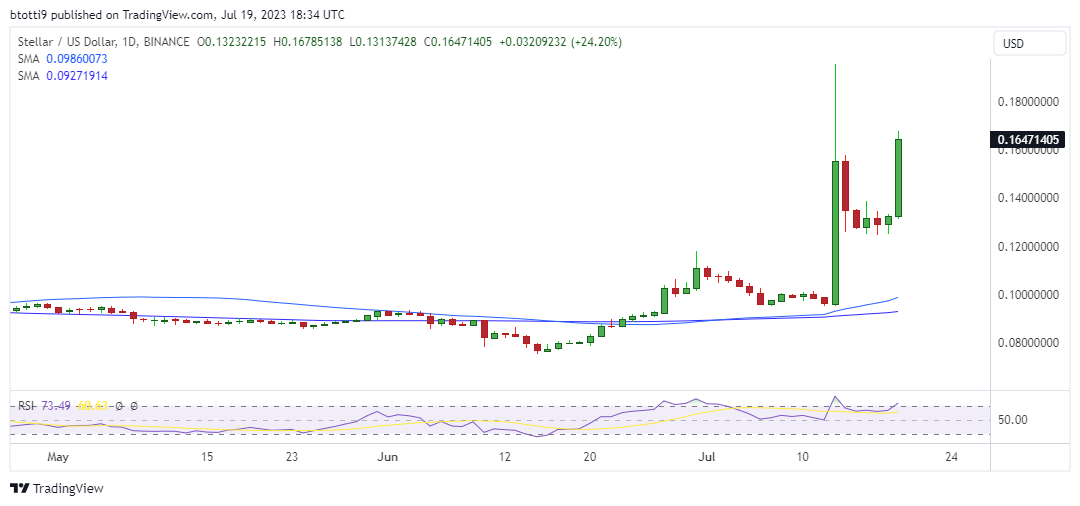
Stellar XLM price movement on the daily chart. Source: TradingView

XLM/USD is looking for a buffer at the resistance zone near $0.15. If the price holds above this level, it is possible buyers would go for the aforementioned primary target or higher. The bullish outlook is largely helped by the technical picture and the sentiment catalysed by Stellar’s recent series of great news.

Why is Stellar price up today?

As CoinJournal highlighted earlier today, Stellar has partnered with Latin American crypto firm Bitso to bolster international payments to Colombia, Argentina and Mexico using USDC.  This came after Stellar and crypto platform fonbnk1 teamed up to help millions of unbanked across Africa to tap into the blockchain benefits via their prepaid SIM cards.

Stellar also recently announced a partnership with Honeycoin App to enable users across Kenya, Uganda, Tanzania, Nigeria, Ghana and the UK to cash out using their USDC balances at any MoneyGram location in these countries.

The post XLM outperforms XRP as top altcoins eye fresh bounce appeared first on CoinJournal.

Elon Musk’s tweet causes Dogecoin to pop

  • At press time, Dogecoin (DOGE) was trading at $0.07018 up 3.13% in the last 24 hours.
  • Elon Musk today mentioned “doges” in a tweet.
  • Besides Dogecoin, Musk’s tweet also caused Shiba Inu to a daily high of  $0.00000784.

Well-known dog-themed meme coin Dogecoin (DOGE) today surged to a daily high of $0.07121 after Elon Musk mentioned “Doge” in one of his tweets today.

Musk’s post caused the price of DOGE to surge from $0.069 to $0.07121 in seconds before quickly giving up some of the gains afterwards.

Elon Musk’s history with meme coins

Besides Dogecoin, Elon’s tweet also caused the price of Shiba Inu (SHIB) to also pop.

This is not the first time the crypto markets are reacting to Elon Musk’s tweets. The markets have a long history of responding quickly to Elon Musk’s public comments about cryptocurrencies in general and Dogecoin in particular.

When Musk unveiled an AI-focused company last week to compete with ChatGPT, a well-known chatbot, it caused tokens related to artificial intelligence to soar.

Given his particular interest in DOGE, there is speculation in the cryptocurrency community that Musk could be a significant DOGE holder. Musk’s interest in DOGE came to the limelight when he appeared on “Saturday Night Live” in May 2021, and devoted some time to the meme coin causing its price to surge to its all-time high price of 73 cents.

Today’s tweet mentioning doge came ahead of Tesla (TSLA) second-quarter earnings report expected to be released later Wednesday afternoon.

The post Elon Musk’s tweet causes Dogecoin to pop appeared first on CoinJournal.

Stellar and Bitso partner to facilitate international USDC payments

  • Stellar and Bitso are collaborating to promote international USDC payments to Latin America.
  • Bitso will use Stellar’s Anchor Network to facilitate cross-border payments and remittances to Argentina, Mexico and Colombia.
  • Stellar recently partnered with HoneyComb and Coinme for similar USDC transactions.

Bitso, a Latin American crypto-powered financial services platform and crypto exchange, has announced a partnership with Stellar in an effort that will see the two collaborate in advancing international payments.

The partnership will see Bitso integrate Stellar’s Anchor Network to allow companies from across the world make USDC payments across Latin America, starting with Mexico, Colombia and Argentina.

According to Bitso, supported transactions are from US dollars via Circle’s USDC stablecoin, with this enabled through the crypto exchange’s direct connection with the local banking system.

The alliance means companies worldwide will be able to make international payments to the region without the need of an intermediary. Leveraging blockchain technology in such transactions greatly improves the settlement speed and overall costs of cross-border payments and remittances, Bitso SVP of Institutional Product Santiago Alvarado said.

Stellar’s push in USDC payments

Stellar’s collaboration with Bitso comes on the back of increased adoption of its technology in cross-border remittances.

Earlier this month, the Stellar Foundation Development announced it had partnered with crypto ATM provider Coinme to allow users send and receive USDC on Stellar. The service will be available across all Coinme platforms.

On July 17, Stellar revealed another collaboration for USDC, this time partnering with cross-border remittance app HoneyComb to enable anyone across Kenya, Uganda, Tanzania, Nigeria, Ghana, and the UK to withdraw cash with USDC balances. The service will be available at all supported MoneyGram locations in these countries.

XLM, the native Stellar token, was up 13% in the past 24 hours at $0.14 following the news and as Ripple’s XRP pumped by 8% to above $0.80.

The post Stellar and Bitso partner to facilitate international USDC payments appeared first on CoinJournal.

Solana Labs unveils Solang to enhance Ethereum compatibility

Key takeaways

  • Solana Labs has unveiled its Solang compiler.

  • Solang will make it easier for Ethereum Virtual Machine (EVM) developers to transition to the Solana ecosystem.

Solang compiler goes live

Solana Labs has announced the launch of  Solang, a new compiler designed to smooth the transition for Ethereum Virtual Machine (EVM) developers into the Solana ecosystem.

In a blog post on Wednesday, Solana Labs said developers familiar with Solidity can use Solang to write apps on the Solana network. Solidity is Ethereum’s primary smart contract programming language.

This latest cryptocurrency news comes a few hours after Neon EVM’s release of a similar tool. Solang seeks further to bridge the gap between the Solana and Ethereum ecosystems. 

Solang is compatible with Ethereum Solidity V0.8

Solana Labs revealed that Solang has numerous features. One of its core features is that it is compatible with Ethereum Solidity version 0.8.

Other features of Solang include; 

  • Ability to call other Solana smart contracts

  • Supports Solana SPL tokens

  • Supports program-derived addresses

  • Enables development with Anchor

  • Builds native Solana smart contracts

  • Access to native Solana built-in functionality

Solana Labs explained that Solana development had been centered around using languages like Rust or C for scripting smart contracts. However, they added that development was evolving toward greater accessibility via Solidity and EVM.

With Solang, developers can now build on Solana with Solidity, a new compiler that helps bridge the gap between EVM developers and the Solana ecosystem.

SOL, the native coin of the Solana ecosystem, has been performing well so far today. At press time, the price of Solana stands at $26.146, up by more than 2% in the last 24 hours. 

The post Solana Labs unveils Solang to enhance Ethereum compatibility appeared first on CoinJournal.

US Senate introduces bill seeking to regulate DeFi like traditional banks

  • The bill aims at ensuring DeFi protocol operating in the US imposes strict controls on their users.
  • The controls proposed in the bill resemble those that apply to traditional banks.
  • The bill also places identity verification requirements on crypto kiosks.

The US Senate is prepared to attempt to regulate the cryptocurrency industry once more with a new bill that aims at imposing strict anti-money laundering (AML) requirements on decentralised finance (DeFi) protocols.

According to the description of the bill, the Crypto-Asset National Security Enhancement Act of 2023 would mandate DeFi protocols to impose bank-like controls on their user base. According to the briefing document, the bill aims “to combat the rise in crypto-facilitated crime and close off avenues for the evasion of money laundering and sanctions measures that are critical to our national security.”

Vetting and collecting information on customers,

Anyone with a cryptocurrency wallet can use DeFi protocols, which are financial applications that allow borrowing, lending, and trading digital currency using smart contracts.  They use of permissionless blockchains making them more difficult to regulate than centralised crypto businesses like Coinbase.

The proposed legislation aims to deal with the problem of regulating DeFi protocols by imposing obligations on “anyone who ‘controls’ a DeFi protocol or makes available an application to use a DeFi protocol.” This is most likely refers to organisations like Unswap Labs that create complex smart contracts for streamlined frontends for protocols like the Uniswap decentralized exchange.  

According to the bill’s briefing document, “if nobody controls a DeFi protocol, then—as a backstop—anyone who invests more than $25 million in developing the protocol will be responsible for these obligations.”

These controlling entities would have to screen and compile data on their clients, keep anti-money laundering programmes up to date, alert the authorities to any suspicious activity, and prevent those who have been sanctioned from using their protocol.

The post US Senate introduces bill seeking to regulate DeFi like traditional banks appeared first on CoinJournal.