
Bitcoin’s correlation with gold sinks to two-year low, a warning for investors


Key Takeaways

  • Bitcoin’s correlation with gold is at a two-year low
  • Divergence highlights yet again that Bitcoin remains a risk-on asset
  • This may change in the future, but for now, Bitcoin resides on the long-end of the risk spectrum 
  • With full effects of tight monetary policy still to come, market should not get ahead of itself

Bitcoin’s correlation with gold continues to fall, highlighting the oft-repeated goal of achieving a store-of-value status akin to digital gold remains a long way off for now. 

We looked into this last month, when the correlation between gold and Bitcoin fell to the lowest value since the FTX collapse in November, an event which sparked mayhem in the crypto markets while the rest of the financial world traded quite placidly, including gold. 

Since then, the correlation has continued to fall. Indeed, looking at the more volatile 30-day Pearson correlation metric, the relationship is approaching a near-perfect negative one over the past thirty days. The last time it dipped this close to -1 was over two years ago (it nearly hit this level post-FTX also). 

While the prior metric is a little noisy and bounces around a lot due to the rolling 30-day window sample size, the next chart displays the same indicator but over a 60-day rolling window. Outside of the FTX collapse in November, the 60-day correlation is the lowest it has been in eighteen months, when Russia invaded Ukraine in February 2022 and sparked extreme volatility in the financial markets.

What does this tell us? Not much, really, beyond what we already know: Bitcoin trades like a risk-on asset. That much has been clear over the past two years or so, as one of the fastest rate hiking cycles in recent history has pulled the rug out from risk assets. The Nasdaq shed a third of its value last year in what was the worst year for stocks since 2008. Bitcoin was far from immune, falling down to a low of $15,500 in the aftermath of the FTX collapse. 

While the question over whether Bitcoin can decouple from risk assets in the long term remains one of the most intriguing, the numbers make it blindingly obvious that this has not happened to date. The pullback during last year’s bear market also emphatically strikes down any assumption that Bitcoin’s days of violent drawdowns were behind it (we are most definitely not in a “supercycle”), with the fall of over 75% from peak to trough being the fourth-worst in the last decade. 

The recent dip in correlation follows a turbulent period in the crypto markets. The SEC sued both Binance and Coinbase, the two biggest exchanges on the planet, in the first week of June. Last week, Ripple secured a big win when a (partial) ruling on its two-year battle with the SEC seemed to imply it is not a security (although ambiguity does remain and there will likely be an appeals process). 

These developments are obviously specific to the crypto markets, and with crypto not yet having a tangible impact on traditional finance markets, the turbulence did not carry over. 

Additionally, the decoupling of gold and Bitcoin pours cold water on the theory that Bitcoin had already obtained its “hedge” status, which was spoken in some quarters as the asset rose amid the banking wobbles in March. In reality, while this price action was intriguing, it was likely more to do with the market pricing in a lower chance of future interest rate rises, as we discussed here. 

“In a lot of ways, Bitcoin’s correlation with gold can be viewed as a progress tracker on the path to achieving the holy grail: an uncorrelated store of value for investors”, says Max Coupland, director of CoinJournal. “With this correlation dipping to a two-year low, it is clear there is a long way to go yet. Bitcoin remains highly susceptible to the whims of the stock market and the macro economy, and that is worth bearing in mind for investors amid the recent rise in crypto valuations”. 

Remember, last year represented the first time in Bitcoin’s history that it observed a pullback in the stock market. Prior to that, it was humming along in the longest and most explosive bull markets in history, kicked off almost to the day when Bitcoin was launched (the stock market bottomed in March 2009, two months after the genesis block was mined). 

All in all, Bitcoin is still trading like a risk asset, and it has experienced the pain of that label in the past eighteen months as interest rates have spiked aggressively. While it is up over 80% thus far in 2023, it remains 56% off its peak from November 2021. 

Nonetheless, things are undoubtedly brighter today than they were nine months ago, when FTX collapsed and the world seemed destined for a gruesome recession. While that recession still may come (and indeed the prospect of lagged effects of tightened monetary policy loom large), economic indicators have been remarkably resilient while hopes of a soft landing have risen. 

Personally, I fear the market may be getting ahead of itself, but what do I know? The sheer scale of rising from a zero-rate environment to a climate where T-bills are paying north of 5% is ferocious, and won’t be shrugged off lightly. Indeed, looking at previous cycles throughout history, the stock market has tended to pull back further after hikes have ended. 

While past performance is never indicative of the future, it certainly should provide food for thought, as phrases such as “meme stock”, “altcoin” and “robinhood” creep back into the vernacular. 

But whatever happens, the charts are clear: Bitcoin is still a risk-on asset. That means if the blood does hit the streets, gold will strongly outperform its digital cousin. Maybe that will change one day, but for now, the numbers don’t lie. 

If you use our data, then we would appreciate a link back to https://coinjournal.net. Crediting our work with a link helps us to keep providing you with data analysis research.

The post Bitcoin’s correlation with gold sinks to two-year low, a warning for investors appeared first on CoinJournal.

Should you buy Ethereum as it diverges from Bitcoin?

  • Ethereum’s price lags behind rival cryptocurrencies
  • If Ethereum follows Bitcoin, a new yearly high might be in the cards
  • Next week’s Federal Reserve meeting is key for the US dollar

The cryptocurrency market bounced strongly in 2023. Following a disappointing 2022, bulls are back as Bitcoin and other leading cryptocurrencies rallied hard.

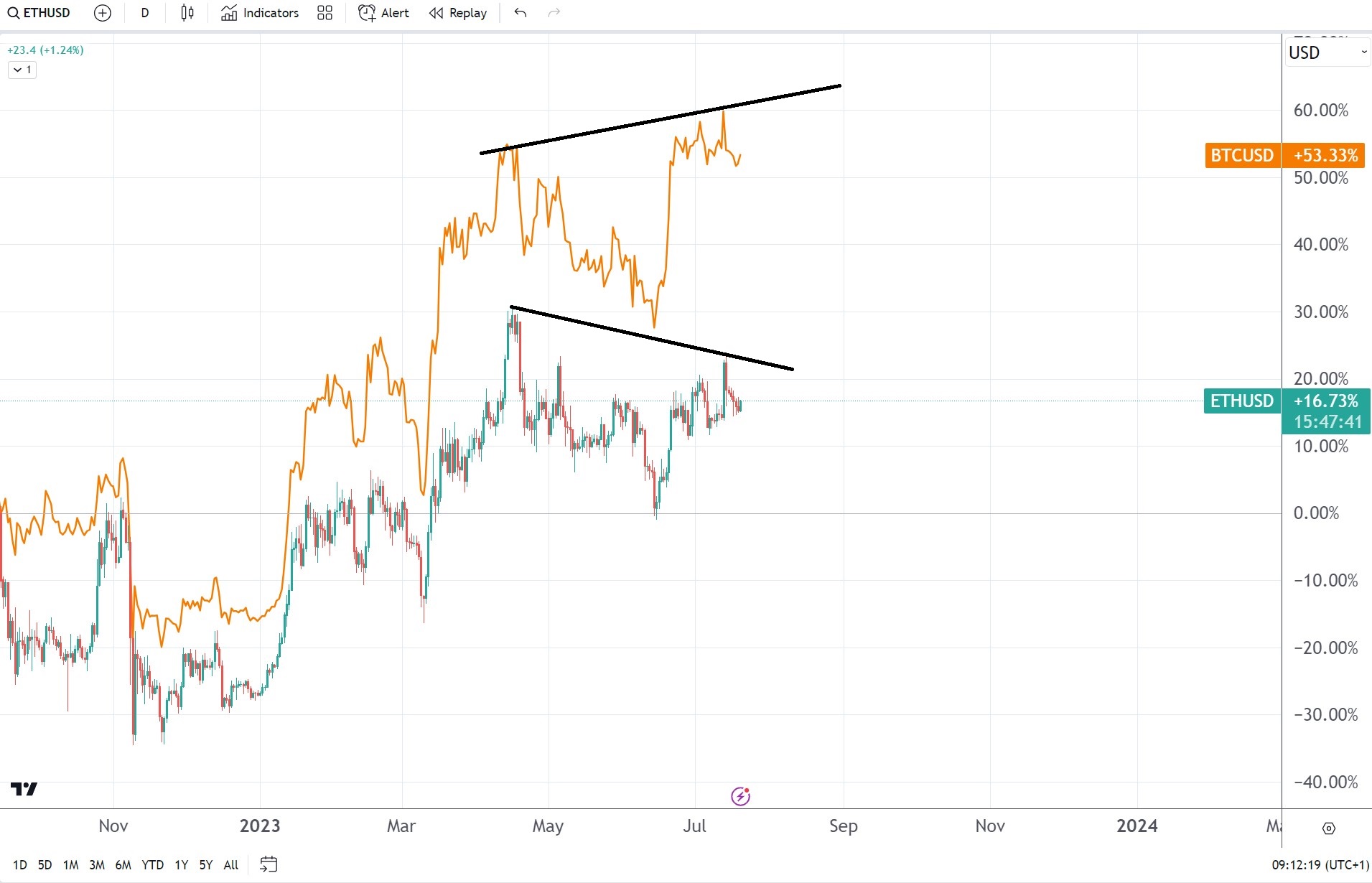
For example, Bitcoin gained 81.86% YTD while Ripple rose as much as 137.53%. Compared with the two, one might say that Ethereum price lags, up “only” +58.37% this year.

In other markets, such returns are deemed literally impossible. Not in the cryptocurrency market, though, where fortunes are made (and lost) practically overnight.

So can one buy Ethereum because of the lack of momentum compared to its peers? Moreover, following Bitcoin’s steps, will Ethereum make a new high for the year?

Ethereum chart by TradingView

Federal Reserve to hike the funds rate again next week

Next week will be decisive for the short and medium-term perspective on the US dollar. The Federal Reserve of the United States is due to set the monetary policy next Wednesday, and the probability of a hike is close to 100%.

Never in history did the Fed ignore what the market has already priced in, so a rate hike is certain.

But the Fed may easily turn the tables around during the press conference that follows the FOMC Statement.

If the Fed Chair, Jerome Powell, hints at the terminal rate being hit, then the market will try to anticipate when the first rate cut will be delivered.

Hence, while a rate hike next week is hawkish the dollar, the Fed may deliver a dovish message during the press conference. If that is the case, expect Ethereum to make a new high for the year.

The post Should you buy Ethereum as it diverges from Bitcoin? appeared first on CoinJournal.

US Senate’s new bill proposes “unworkable obligations for DeFi”, Crypto Council says

  • The Crypto Council for Innovation says the new AML bill provides no workable framework for illicit finance in DeFi.
  • According to the crypto alliance, the bill’s proposals go “in the opposite direction” to what the proper approach should be.
  • The CCI says legal obligations highlighted in the bill are “arbitrarily placed on persons”.

A bill introduced in the US Senate on anti-money laundering and other illicit finance activities in the decentralised finance (DeFi) space “fails to provide a workable framework”, the Crypto Council for Innovation has said.

The bill was introduced by Senators Jack Reed (Rhode Island) Mike Rounds (South Dakota), Mark Warner (Virginia) and Mitt Romney (Utah). Its proposals include the application of AML obligations to DeFi protocols and crypto ATMs.  

CoinJournal reported on the new DeFi bill’s proposals earlier today.

Legal obligations are arbitrarily placed on persons

The CCI, which represents a group of industry leaders and players committed to advancing the crypto industry, has released a statement noting that the bills’ proposals, including the proposed requirements aimed at backers and facilitators of DeFi fall short of a “workable framework.”

Although it notes that illicit finance is a legitimate national security concern, the council faults the bill’s framers for going “in the opposite direction” with regard to the DeFi sector.

“Illicit finance is a legitimate national security concern, and while its volume is tiny in crypto compared to TradFi, leveraging the transparency & programmability inherent in blockchain systems to derive appropriate compliance measures unique to crypto is a good idea. Unfortunately, this bill goes the opposite direction. It places legal obligations arbitrarily on persons who have no actual way to influence protocols once they are deployed, and completely fails to account for the unique attributes of blockchain-backed systems,” the Council said.

One of the issues the CCI points out from the bill is the obligation put on supposed “Digital Asset Protocol Backers.” Per the bill, this would be any person holding more than $25 million worth of a DeFi protocol’s governance token or has invested $25 million or more into the protocol’s development. 

It also places obligations on so-called “Digital Asset Transaction Facilitators”, who would be any person deemed to have control over the protocol or offers access to an application that facilitates transactions on the said crypto protocol.

The Council says these proposals are not only “weird”, but advance vagueness with regard to the definition of “facilitators.” More than that, the group says the bill contains “unworkable obligations” and offers “no actual guidance.”

 “The proposal offers no actual guidance on technical ways for decentralised protocols to comply with BSA reporting requirements. It is not feasible to collect personal identification information from such protocols, and the bill neither tackles this technical complexity nor provides solutions on how to address this limitation.” the Crypto Council noted.

As part of its input on the issue of DeFi regulation, the CCI says it’s collaborating with industry experts, regulators both in the US and from elsewhere to draft a framework for the appropriate regulation of the sector.

“We are consulting with industry experts and regulators in the U.S. and other leading jurisdictions to develop a technologically sound approach to mitigating illicit finance in DeFi,” the statement reads in part.

While its strong-worded statement highlighted what’s not right with the bill, the CCI acknowledges that it is still in the early stages and that its authors are open to dialogue on best way forward. The expectation is that the bill will see “plenty of edits” going forward.

The post US Senate’s new bill proposes “unworkable obligations for DeFi”, Crypto Council says appeared first on CoinJournal.

Bitcoin may be near its next leg up – analyst says

  • Canaccord Genuity analyst sees upside in Bitcoin to over $38,000.
  • Javed Mirza explained his bullish view in a research note today.
  • Bitcoin is already up about 80% versus the start of the year.

It’s a suitable time for long-term investors to build their positions in Bitcoin as the chart suggests it may be about to start a new cycle, says Javed Mirza – a Canaccord Genuity analyst.

Recent price trends signal further upside

Bitcoin remains around the $30,000 level even after peer Ripple announced a big win against the U.S. Securities & Exchange Commission.

Still, Mirza remains bullish on price trends that he says support further upside. In his research note today, the analyst told investors:

Utilise pending near-term weakness to add exposure near important technical support at its 50-day moving averages.

The 50-day MA currently sits at about $28,700 for Bitcoin. Mirza has a similar view on Ethereum as well.

Bitcoin could beat the $38,000 level

Mirza sees potential for a 28% rally in Bitcoin to over $38,000 level as long as it’s holding the aforementioned key support.

In his note this morning, he also pointed to the four-year moving average that the world’s largest cryptocurrency has recently reclaimed.

This confirms the long-term trend is now up, a strong technical positive, and is consistent with a four-year cycle taking hold in cryptocurrencies.

Note that the total supply of BTC is scheduled to halve in April or May of 2024 that typically tends to be a tailwind for its price. On top of that, BlackRock and several other asset managers have recently filed for a Spot Bitcoin ETF that signals institutional interest in cryptocurrencies.

The post Bitcoin may be near its next leg up – analyst says appeared first on CoinJournal.