
Klaytn Blockchain to focus on demand and value of KLAY token in 2023: roadmap

  • Klaytn is a public blockchain platform developed by South Korean internet giant Kakao Corp.
  • The blockchain plans on establishing KLAY as a deflationary asset.
  • It also wants to provide more tools for developers who want to launch products on the network.

The latest technology and developer roadmap released by Klaytn developers earlier this week emphasized that the Klaytn blockchain intends to increase the demand and value for KLAY tokens.

Klaytn also recently passed a governance proposal to burn about 50% of KLAY’s supply. The move aims at making KLAY more valuable going by the demand and supply principle.

Klaytn 2023 roadmap

The recently released Klaytn roadmap states that Klaytn would find crypto infrastructure services, like decentralized oracles, where the KLAY token can be used, to increase the token’s transactional utility. This would also result in more gas burns.

Klaytn also plans on launching a permissionless pilot network on its Cypress mainnet in the second half of 2023. The pilot network will test the automation of the entry and exit of validators or entities on any blockchain that is responsible for verifying transactions.

The blockchain also intends to initiate several governance initiatives including establishing community governance council selection and sacking processes. Klaytn intends to transfer its decision-making authority to the community allowing KLAY token holders to have a say on who sits on the governance council, which is a group of network participants that oversee the governance of the Klaytn Network.

While the price of the KLAY token is currently in the red, Klaytn expects the value of the token to considerably rise once it starts implementing the milestones in the roadmap. 

The post Klaytn Blockchain to focus on demand and value of KLAY token in 2023: roadmap appeared first on CoinJournal.
Pro expects BTC and Nasdaq 100 to be more correlated moving forward

  • Stockton discussed correlation of BTC and Nasdaq 100 on CNBC.
  • She says bitcoin has to break above $25,000 to look attractive.
  • Bitcoin is currently up about 40% YTD; Nasdaq 100 about 11%.

So far, bitcoin has meaningfully outperformed the Nasdaq 100 this year – up roughly 40% at writing versus a significantly narrower 11% gain in the tech-heavy index.

Katie Stockton’s remarks on CNBC

Interestingly, BTC remained resilient in the back half of the current month even after the U.S. Bureau of Labour Statistics said inflation was up more than expected in January.

Nonetheless, Fairlead Strategies’ Katie Stockton says bitcoin and the Nasdaq 100 index will likely be more correlated again moving forward.

We suspect that with equities now declining again, we’ll get back into that higher correlation mode between bitcoin and Nasdaq 100 and other risk assets.

A day earlier, CoinShares data confirmed that short-bitcoin funds secured inflows of $10 million last week.

Bitcoin needs to break above a key resistance

According to Stockton, bitcoin is still trading below a strong resistance around the $25,000 level and has to break above it to look attractive. On CNBC’s “Squawk Box”, she said:

It needs to clear that level in order to look better and because that would resolve a trading range to the upside and tell us that range is more likely a reversal pattern versus a continuation pattern.

Stockton is keeping neutral both on yields and the U.S. dollar for the next several months, she also confirmed.

BTC last week was briefly seen trading just above the said price – a move that analysts at Bitfinex said could indicate a possible bottom.

The post Pro expects BTC and Nasdaq 100 to be more correlated moving forward appeared first on CoinJournal.

Visa, Mastercard halt crypto partnerships amid market uncertainty: Reuters

  • Visa and Mastercard are slamming brakes on respective crypto products and pausing new partnerships.
  • A Reuters report published on Tuesday says the payment giants are citing uncertain market and regulatory conditions.
  • The companies will however continue to focus on blockchain technology, according to sources. 

Visa and Mastercard, the world’s leading payment card companies, have reportedly put brakes on their respective crypto-related products, Reuters reported on Tuesday.

The payment giants are taking this step as a result of the recent turmoil in crypto, particularly following shocking collapses and bankruptcies across the industry as witnessed in 2022.

Other than the market conditions that have derailed confidence, there is a fresh regulatory cloud that currently hangs over the broader crypto sector – factors that now see Visa and Mastercard push back on their plans, sources said.

Visa and Mastercard pause new crypto partnerships

Increased adoption of cryptocurrencies in the payments sector has over the past two years seen Visa and Mastercard take an aggressive approach towards integrating crypto. 

The US-based companies have indeed struck numerous partnerships with projects and services across the digital assets space. CoinJournal has indeed highlighted numerous Visa-related news as the company aggressively pursued deals that currently number more than 60 crypto firms, including those with Crypto.com and Nexo. 

Earlier this month, as covered here, the payments firm also inked a long-term partnership with crypto payments app Wirex.

Despite this, according to sources, the company has dropped plans for new partnerships as it pushes back on crypto-related products and services. This will be the case until the uncertain regulatory landscape changes.

However, both Visa and Mastercard are not scraping their crypto strategies just yet, people familiar with the developments noted.

Mastercard, for instance, will push forth with its blockchain technology efforts, a spokesperson said. The focus is on how to tap into this underlying technology to build efficient systems and to address existing pain points.

Mastercard announced support for cryptocurrencies on its network in February 2021.

The post Visa, Mastercard halt crypto partnerships amid market uncertainty: Reuters appeared first on CoinJournal.

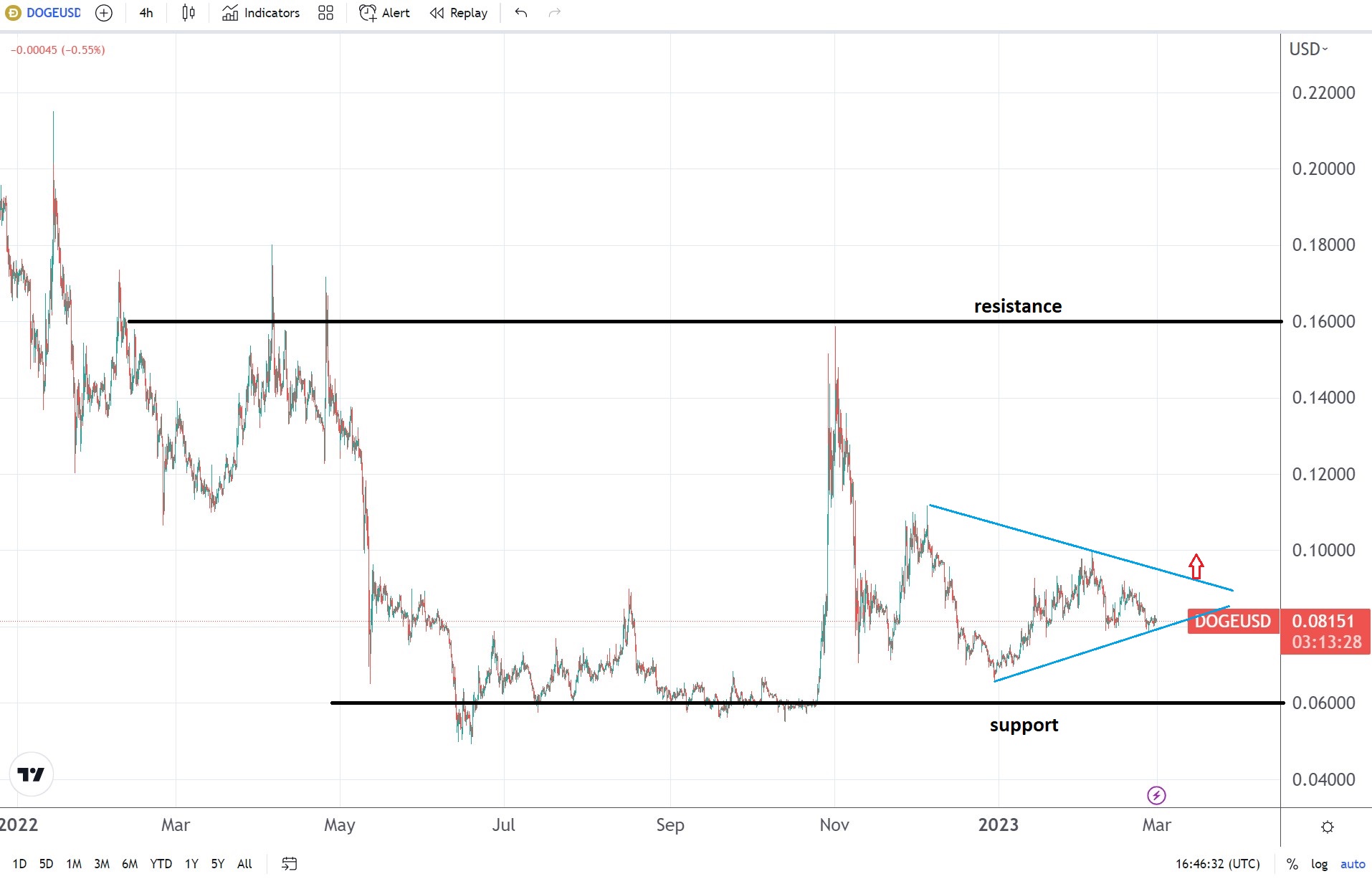
Dogecoin needs to close above $0.1 for bullish momentum to continue

  • Dogecoin bulls need to wait for the price to move above $1 before going long
  • A contracting triangle contains the price action 
  • $0.6 support must hold

Dogecoin followed the bullish trend seen in the cryptocurrency market in 2023 and gained more than 50% before the recent correction started. But the spike in the first part of the year is nothing compared to the movement seen in late November.

In fact, since then, Dogecoin has been unable to break the lower highs series, which puts a big question mark on its ability to rally. But bulls should be patient and wait for the market to move above $0.1, as it looks like a pivotal level for Dogecoin.

DOGEUSD chart by TradingView

A daily close above $0.1 opens the gates for more upside

A contracting triangle formed on the 4h timeframe, and Dogecoin’s price action has been contained since late November. Therefore, the safest way to trade this market is to wait for the price action to break above or below, the triangle’s trendlines.

Judging by the market’s resilience to drop below the $0.06 support level, it appears that the triangle will end up with a bullish breakout.

However, bulls may just want to wait until the triangle’s upper edge is broken before going long. On such a move, bulls should target resistance seen at $0.16, with a stop-loss order at $0.8. This way, the risk-reward ratio makes sense from a money management perspective.

The post Dogecoin needs to close above $0.1 for bullish momentum to continue appeared first on CoinJournal.

Marinade Finance’s Brandon Tucker says key updates will cut future Solana outages

  • Solana blockchain went offline for 20 hours last weekend.
  • Marinade Finance’s Brandon Tucker says upcoming updates will significantly reduce futures outages.
  • But technical and human errors remain a concern for crypto and users need to have this outlook “hard-wired into any risk profile.”

The Solana Foundation noted in an update on 27 February 2023 that the root cause of the 20-hour long network outage on 25 February was not yet clear.

However, Solana Labs co-founder & CEO Anatoly Yakovenko did talk about what had not caused the latest outage. The Solana Labs exec dismissed claims that the downtime was due to the clogging of the network as result of extremely high volume of on-chain votes and validator messages.

Solana updates to significantly reduce futures outages

After going offline for 20 hours, the Solana blockchain successfully restarted after two attempts.

While Solana’s many outages remain a blot on the blockchain, Brandon Tucker, the growth lead at liquid staking protocol Marinade Finance, says an upgrade to the system will significantly improve the SOL blockchain and “slash” future network freezes.

Tucker shared his views in a comment sent to CoinJournal, noting:

“Chain restarts are never welcome, but it’s not a major setback. Indeed, despite the furor, it’s a similar outage to the five others we’ve seen over the last 12-18 months. Ultimately, it’s good to see the validator community rally together on their own accord to initiate the updates and restart the chain in real time.”

Tucker opines that Solana’s push for throughput and decentralization is something no other chain is attempting, and that getting it right isn’t always straight. In his view, these goals are particularly difficult to achieve when the network is “already being used by more people than just about any other chain.”

Technical and human error are likely to happen, the Marinade developer acknowledged – especially after recent events around both Solana and the broader crypto ecosystem. Tucker believes this is something that investors should have “hard-wired into any risk profile.”

As for what happens next, he thinks the Solana team will be more diligent as they handle updates to the network.

“While the exact cause of the performance degradation is unknown at this time, the latest 1.14 update appears to be the issue. As a result, Solana should and will likely do even more due diligence during testing before rolling out these updates.”

Solana is also preparing for a new consensus implementation, expected to remove any would-be single point of failure. That upgrade is by Jump’s Firedancer validator client. Not only is it set to bolster network resilience, but according to Tucker, also greatly cut chances of future outages.

The post Marinade Finance’s Brandon Tucker says key updates will cut future Solana outages appeared first on CoinJournal.