
DOT/USD technical analysis – will the bottom hold?

  • Polkadot hodlers are underwater
  • A bullish scenario remains valid if the lows hold
  • A move above $7 should lead to more gains

It has been a tough period for long-term holders of Polkadot. The DOT/USD exchange rate has moved South relentlessly after peaking at $56 in late 2021.

From $56 to $5, it was a straight decline. It took only one year for Polkadot to frustrate bulls.

And even now, as cryptocurrencies have rallied in 2023, one should be scared looking at the daily chart. After all, the bounce from the lows looks so small when interpreting the bigger picture that it is difficult to find a bullish argument.
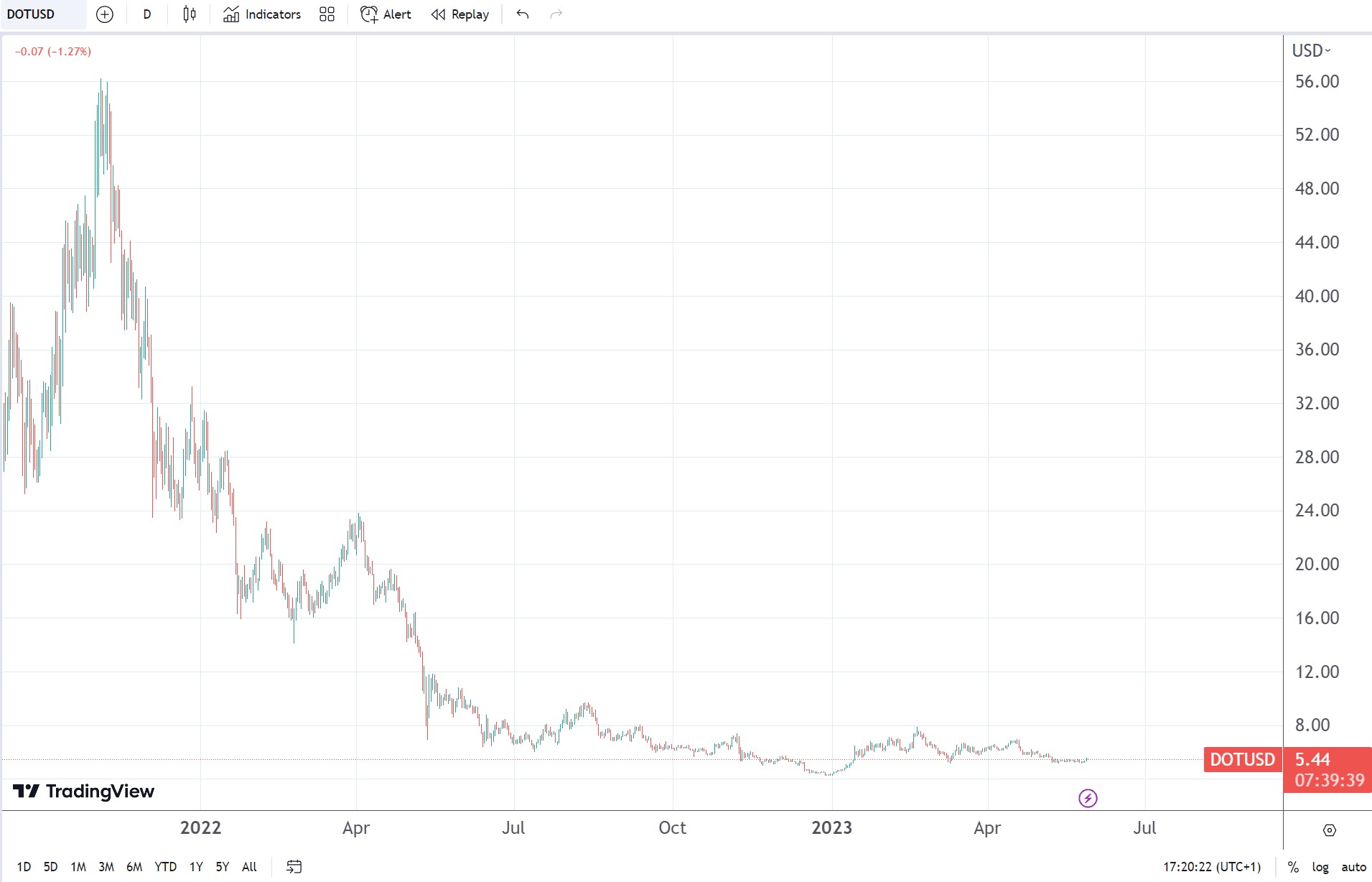
Polkadot chart by TradingView

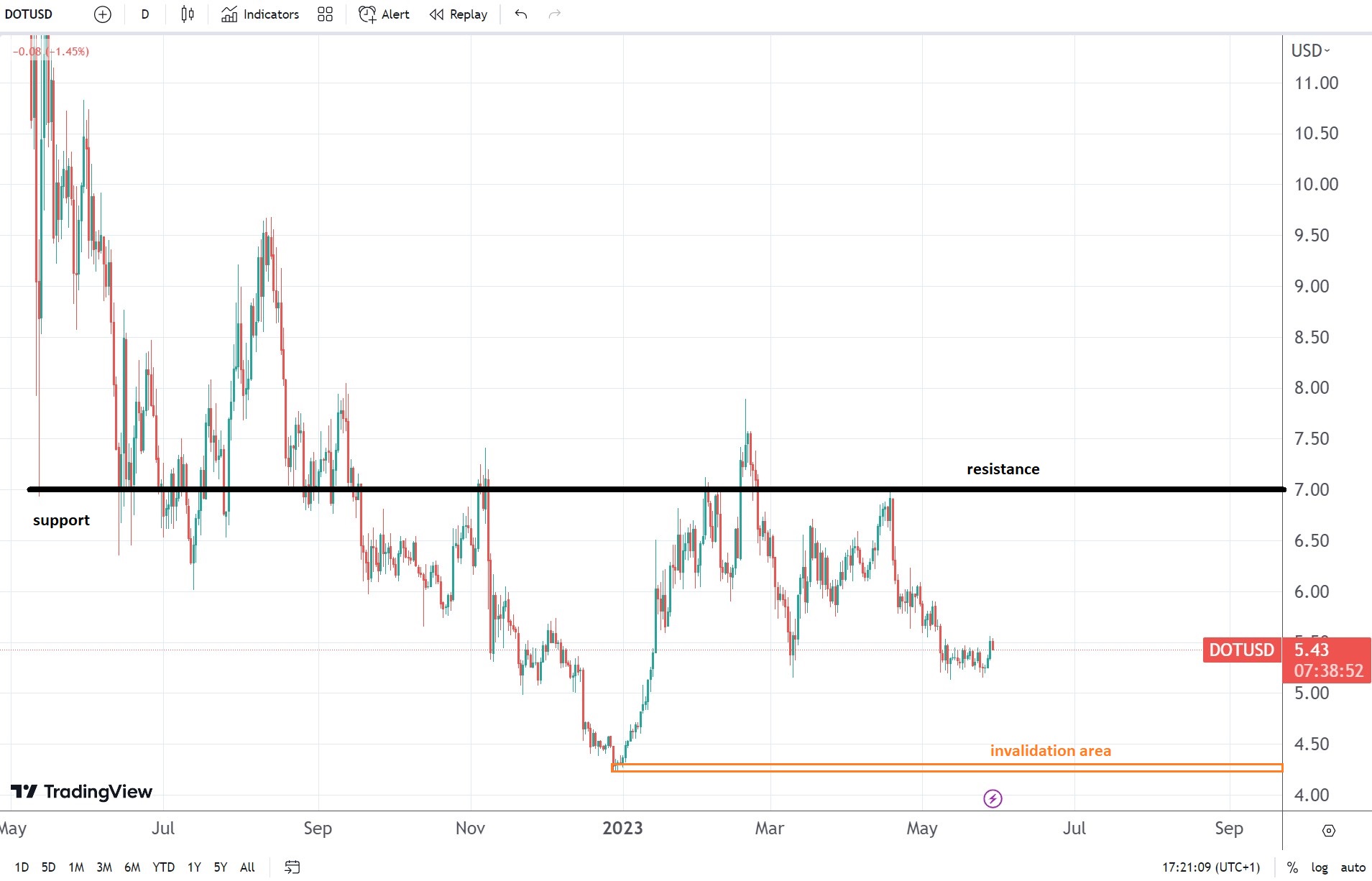
Polkadot should overcome $7 resistance area for bulls to be in control

Zooming in, one may see the 2023 rally that brought back optimism in the cryptocurrency market. Sure enough, Polkadot already gave back more than half of its YTD gains.

But the invalidation level for a bullish scenario still holds. Effectively, it means that the recent price action might be nothing but a correction part of a bigger-degree bullish trend.
Polkadot chart by TradingView

The Elliott Waves theory states that an impulsive move (i.e., the one that began at the start of the year) is followed by a corrective structure, an a-b-c.

This a-b-c that corrects a bullish trend should have two waves moving in the opposite direction (i.e., waves a and c), and one that moves in the main trend’s direction.

It means that one may easily say that the move from the 2022 lows is an impulsive structure, and the decline from the 2023 highs is the a-b-c. In this case, the implications are bullish for Polkadot and bearish for the US dollar.

However, only a move above the pivotal $7 level would cement the bullish Elliott Waves scenario. Until then, bulls might wish for the price action to hold above the invalidation area shown on the chart above.

The post DOT/USD technical analysis – will the bottom hold? appeared first on CoinJournal.
Miner earnings from Bitcoin fees decline 90% from peak of BRC-20 frenzy

  • Bitcoin miners’ revenue from fees dropped 90% since the BRC-20 peak, from $17.8 million daily to $1.7 million per day as of 29 May, 2023.
  • However, current levels remain within historical levels with only 310 out of 4674 trading days having seen greater fees.
  • In 2018, transaction fees were higher than recent highs only on two trading days.

Bitcoin miner revenue from transaction fees has declined significantly since the BRC-20 frenzy that drove network activity higher earlier in the month.

Bitcoin mining is a key component of the flagship cryptocurrency’s network operations and miners earn from the set subsidy as well as transaction fees. BRC-20 tokens are a type of fungible tokens created on the Bitcoin blockchain. They are ordinal inscriptions that can are used to represent a variety of things, including digital assets and loyalty points.

Miner revenue from fees falls sharply after BRC-20 frenzy

According to data from Glassnode, a leading on-chain and financial markets data platform, miners were earning roughly $17.8 million from transaction fees per day. This happened as Bitcoin price traded near the YTD highs and as the BRC-20 craze hit the industry. 

However, as of May 29, 2023, the earnings had declined considerably and miners were taking home just $1.7 million from network fees per day.

Miner earnings from fees has thus fallen by about $16.1 million, or 90.85% from that recent peak, Glassnode highlighted on Monday.

But as the platform noted, miners’ revenues from fees dropping to latest levels still sees the figures near historical ones seen in most trading days. Only 310 out of 4,674 days, or 6.7% of BTC trading days have seen higher miner revenue from fees.

Glassnode noted:

“At the peak of the BRC-20 frenzy, Bitcoin miners were earning $17.8M in transaction fees, with only 2 trading days across the 2018 peak recording a larger fee revenue. Currently, miners are earning $1.7M in fee revenue, a -$16.1M decline from the recent peak. However, this remains significantly elevated when compared to historical precedence, with only 310 / 4674 (6.7%) trading days recording greater fees.”

The Bitcoin network recently saw a massive surge in activity as the demand for BRC-20 tokens soared. The result, as highlighted here, was network congestion as the rush to inscriptions helped fees to spike to year-to-date highs. It proved a bumper season for miners as Glassnode data shows.

In 2018, when Bitcoin fees also spiked significantly, only 2 trading days had recorded transaction fees higher than the $17.8 million miners earned recently.

The post Miner earnings from Bitcoin fees decline 90% from peak of BRC-20 frenzy appeared first on CoinJournal.

Bybit gets “in-principle” approval to begin operations in Kazakhstan

  • Bybit has been in the process of expanding its service offerings.
  • Bybit received “in-principle” approval from the Astana International Financial Centre to begin operations in Kazakhstan.
  • The exchange will begin operating as a digital asset trading facility and as a custody services provider in the country.

Bybit has announced that it has received an “in-principle” approval from the Astana Financial Services Authority (AFSA) to start operating as a digital asset trading facility and as a custody services provider in Kazakhstan.

Commenting on the achievement, the co-founder and CEO of Bybit, Ben Zhou, stated that the Commonwealth of Independent States (CIS) as a region provides promising potential for the crypto industry.

Bybit expansion drive

Bybit has been in the process of expanding its service and product offering over the past few months.

The most recent move was its announcement on May 2 that it will start offering crypto lending services.

In March this year, Bybit announce a partnership with Mastercard for a new debit card to allow crypto payments.

Kazakhstan and cryptocurrencies

In February, local officials in Kazakhstan announced new regulations requiring 75% of the revenue made from crypto mining to be sold through a crypto exchange as the country cracks down on tax evasion in the industry.

Kazakhstan recently announced that it had collected about $7 million in crypto taxes in 2022. The country is also in the pilot phase of its digital current development.

The post Bybit gets “in-principle” approval to begin operations in Kazakhstan appeared first on CoinJournal.

Fantom resolves to give back 15% of gas fees to certain projects

  • Fantom blockchain will reward projects that contribute toward high usage of gas fees.
  • The move aims at driving increased demand for block space.
  • Eligible applications will be rewarded 15% of the gas fees they produce.

In a move to drive demand for block space on the Fantom blockchain, the blockchain has announced that it will reward projects that use the network and contribute high usage gas fees. Eligible applications will be given back 15% of the gas fees they produce thus giving developers some extra income.

The move is also expected to help add value to the FTM token, which at press time was trading at $0.3405, up 2.21% in the past 24 hours.

Fantom dApp Gas Monetization Program

The recent announcement is part of Fantom’s initiative called the “dApp Gas Monetization Program,” which was passed through a community governance vote earlier this year.

The dApp Gas Monetization Program proposal sought to bring down Fantom’s current token burn rate to direct more network fees to applications being built on the blockchain. Now that the proposal already passed, its implementation will reduce the burn rate from 20% to 5%.

Part of the gas fees saved from the reduced burn rate will be redirected towards gas monetization.

To be specific, the gas monetization program will reward in-demand applications and retain developers.

Projects already benefiting from the monetization program

According to on-chain data, some projects are already benefiting from the monetization program after the Sunday announcement that saw the start of the implementation of the passed proposal.

For example, decentralized exchange SpookySwap (BOO/USD) has earned 978 FTM ($300), while cross-chain bridge Stargate Finance (STG/USD) has earned 8,300 FTM ($2,600).

The post Fantom resolves to give back 15% of gas fees to certain projects appeared first on CoinJournal.

Mask Network (MASK) price is up 10% today: Here’s why

  • MASK price is up by double digits today and 17% this past two weeks.
  • Most of the gains have come after the team announced it had invested in The Open Network (TON) network.
  • MASK price remains nearly 90% down from its all-time high of $41.45.

Mask Network (MASK), a decentralized social network seeking to bridge Web2 and Web3 apps, has seen its price increase by over 10% in the last 24 hours. The current price of MASK is $4.40.

MASK price is up more than 17% this past two weeks.

Why is the price of Mask Network (MASK) up today?

There seems to have been no particular trigger for MASK price rallying by double-digits today. However, it is likely the project’s recent announcement of an investment in The Open Network (TON) continues to boost investor confidence and aiding buying pressure.

Another reason could be the uptick seen today across the broader cryptocurrency market.

Bitcoin price traded above $27k again after it came close to dipping under $26k earlier in the week. This comes after news the US had struck a deal on its debt ceiling, and with BTC up, it’s likely the sentiment cascaded into small cap altcoins like MASK.

At the time of writing, Mask’s daily trading volume is well over $80 million, representing a 148% jump in the past 24 hours. The spike in market activity has seen Mask Network, which is ranked 110 on CoinGecko, hit a market cap of about $354 million.

MASK price prediction

Despite the gains, MASK price remains nearly 90% down from its all-time high of $41.45. The token hit the ATH February 24, 2021.

The current value is however 352% higher than the all-time low of $0.976528, hit on Oct 13, 2022 and today’s gains could, therefore, see traders seek to take profits. While this could happen, some analysts believe that the token is primed for a breakout.

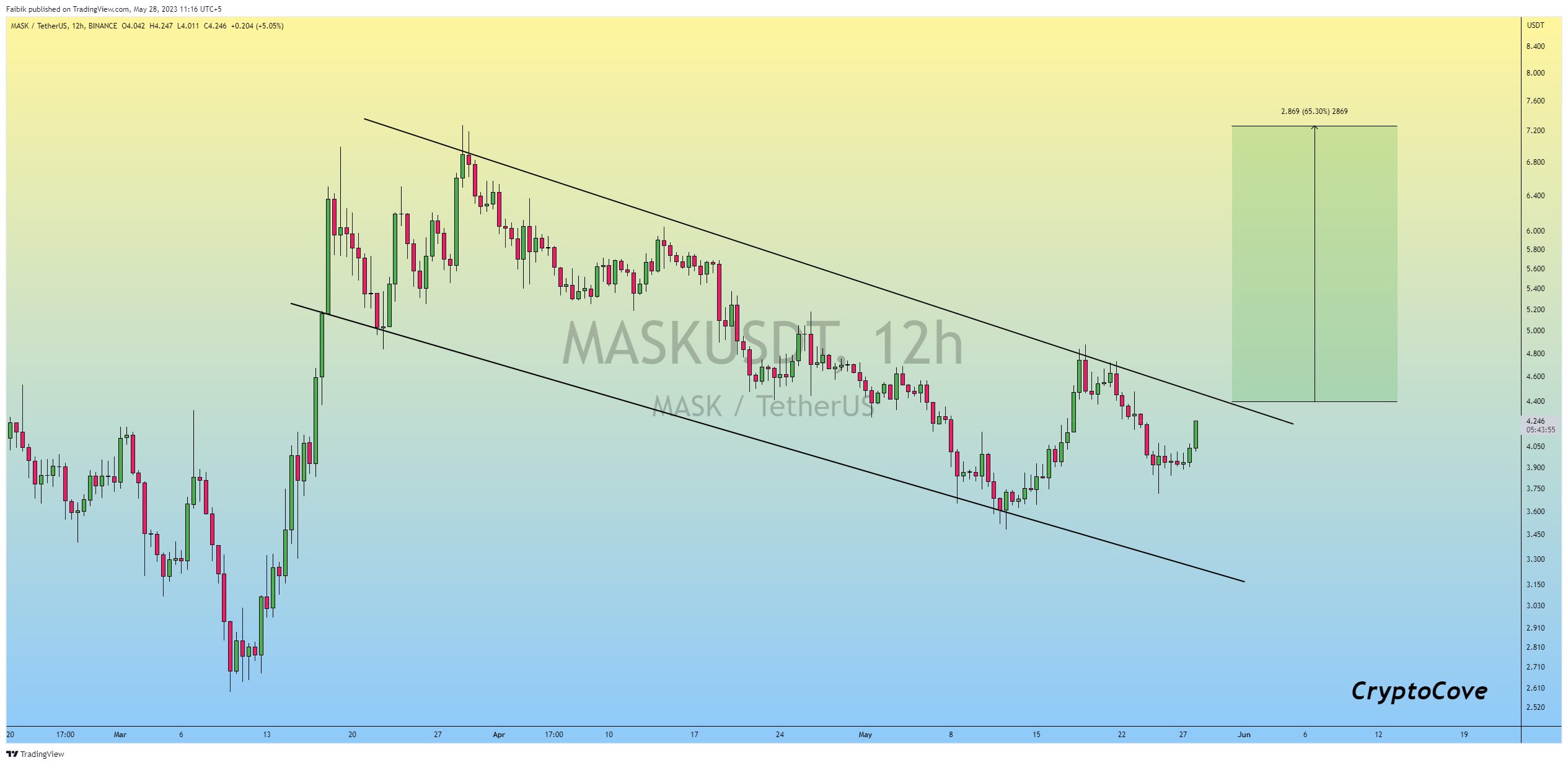
Crypto analyst Captain Faibik says MASK could see a breakout as shown in the chart below shared on Twitter.

Chart showing the potential price breakout for Mask Network. Courtesy of Captain Faibik on Twitter.

According to the analyst, MASK could surge by more than 60% to more than $7.20. Looking at the chart, it suggests the scenario will likely unfold if price breaks and sustain fresh momemtum above the upper resistance of channel pattern.

The post Mask Network (MASK) price is up 10% today: Here’s why appeared first on CoinJournal.