JPMorgan teams up with six Indian banks to build a blockchain-based platform

  • The blockchain-based platform is aimed at settling interbank dollar transactions.
  • The move is part of the Indian government’s strategy to elevate GIFT City to the League of Cities like Singapore.
  • The parties will launch a pilot project over the next few months in order to analyze the banks’ experience.

American multinational financial behemoth JPMorgan Chase & Co. has partnered with Indian banks to build a blockchain-based platform to settle interbank dollar transactions.

The Indian banks involved are based in the Gujarat International Finance Tec-City (GIFT) City and include HDFC Bank Ltd., ICICI Bank Ltd., Axis Bank Ltd., Yes Bank Ltd., and IndusInd Bank Ltd.

Elevating GIFT City status

Although it is a partnership within the private sector, the move is part of the Indian government’s strategy of elevating GIFT City to a level where it can compete with the likes of Hong Kong, Singapore, the International Financial Centre (IFC) in Dubai, and the Abu Dhabi Global Market (ADGM).

Kaustubh Kulkarni, a senior Indian officer, and vice chairman of Asia Pacific, at JPMorgan, have stated that the institution would be launching a pilot project in the coming months to examine banks’ experience.

JPMorgan and blockchain technology

JPMorgan also plans to use blockchain technology to restructure dollar transactions between financial institutions so that the transactions can be completed in a matter of seconds.

According to Kulkarni, GIFT City banks would be able to maintain their own time zone and business hours once JPMorgan creates the blockchain infrastructure enabling instant transactions around the clock.

JPMorgan’s pilot project using the Onyx blockchain technology is already expected to start on Monday after receiving clearance from the International Financial Services Centre Authority. Onyx, which is a blockchain-based platform for wholesale payment transactions was launched by JPMorgan in 2020.

The post JPMorgan teams up with six Indian banks to build a blockchain-based platform appeared first on CoinJournal.

SEC sues Binance and CZ for breaking US Securities Rules

Key takeaways

  • The US SEC has sued Binance for breaking securities rules.

  • The regulatory agency has also sued Changpeng Zhao (CZ), the CEO of the cryptocurrency exchange.

SEC sues Binance and CZ

The United States Securities and Exchange Commission (SEC) has filed a lawsuit against Binance, the world’s leading cryptocurrency exchange, and Changpeng Zhao, the CEO of the company.

This is according to a report by The Wall Street Journal a few minutes ago. According to the Wall Street Journal, the regulatory agency has sued Binance and its CEO for breaking US securities rules.

This latest cryptocurrency news doesn’t come as a surprise to some experts in the industry, as the regulatory agency has been going after cryptocurrency exchanges in recent months. 

Binance faces 13 charges from the SEC

The regulatory agency alleges that Binance secretly allow[ed] high-value U.S. customers” to trade on the platform in violation of U.S. securities laws which prohibits unregistered exchanges from servicing U.S. customers.

The lawsuit also alleges that CZ exercised control over customer assets, adding that he commingled them with personal and company holdings. SEC Chairman Gary Gensler stated that;

“Through thirteen charges, we allege that Zhao and Binance entities engaged in an extensive web of deception, conflicts of interest, lack of disclosure, and calculated evasion of the law. As alleged, Zhao and Binance misled investors about their risk controls and corrupted trading volumes while actively concealing who was operating the platform, the manipulative trading of its affiliated market maker, and even where and with whom investor funds and crypto assets were custodied.”

This latest development comes two weeks after the SEC sued Bittrex, one of the world’s largest and oldest cryptocurrency exchanges, and co-founder and ex-CEO William Shihara for violating securities laws. 

The regulatory agency had also come after several other crypto exchanges in recent months, including Kraken and Coinbase.

Bitcoin has lost more than 2% of its value so far today and could fall below the $26k level soon following this latest development. At press time, the price of Bitcoin stands at $26,682 per coin. 

The post SEC sues Binance and CZ for breaking US Securities Rules appeared first on CoinJournal.

Here’s why the MANA, SAND, Enjin, AXS token prices are soaring

  • Most metaverse tokens rose sharply on Monday as cryptocurrencies retreated.

  • The jump happened ahead of Apple’s WWDC event on Monday.

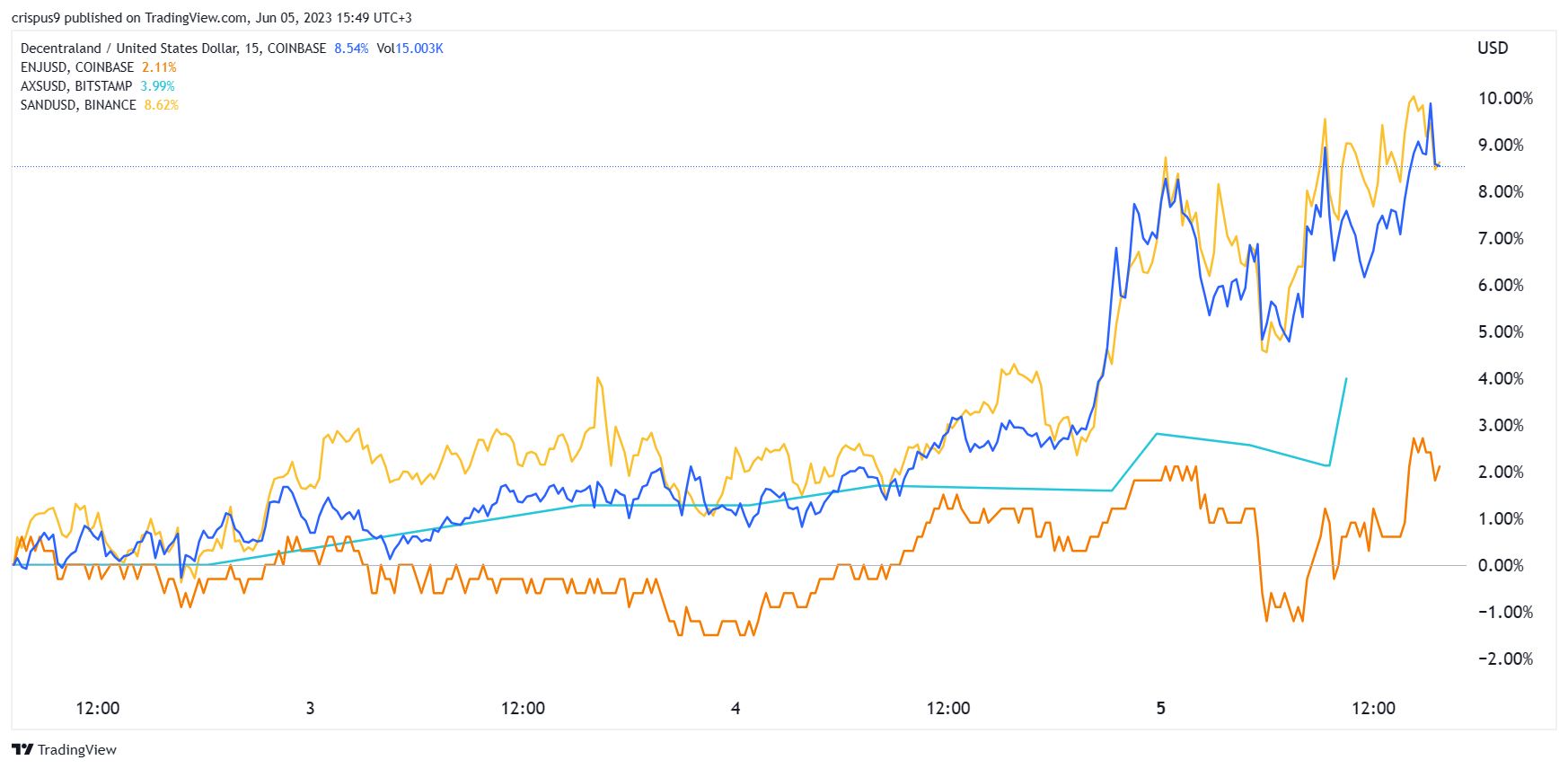
Metaverse tokens like Decentraland MANA, Sandbox’s SAND, and Axie Infinity’s AXS were among the best-performing coins on Monday. Other metaverse tokens like Enjin Coin and ApeCoin were also in the green. Most of these coins rose by more than 1.5%, which is a better performer than other coins like Bitcoin and Ethereum.

Apple WWDC event

The main reason why metaverse tokens jumped on Monday is the upcoming WWDC event by Apple. Historically, this has been the biggest event in the tech calendar since the company usually unveils its key upgrades. 

Apple is seen as the benchmark for key products. It made key products like iPhones, Apple Watch, and iPads cool. Today, other companies in the technology industry have come up with similar products.

Analysts believe that the WWDC event will see the company unveil its virtual reality set, which is its first major product in a decade. The company has been working on this product in the past seven years. In this period, the company has long believed that its product was not ready yet. According to the WSJ, the device will retail at $3,000, making it one of the company’s most premium products.

Experts believe that Apple’s entry in the industry will take the virtual reality industry mainstream. In the past, attempts by companies like Facebook and Microsoft to take them mainstream have failed. Today, only a handful of people use these products.

Therefore, metaverse tokens like MANA, SAND, Enjin Coin, and AXS token have risen because of the ongoing hype. There is a belief that this hype could rival that of artificial intelligence.

Will the metaverse tokens rally continue?

Decentraland MANA price jumped by more than 6% while Sandbox and Axie Infinity price soared by more than 5%. Similarly, Enjin and ApeCoin rose by over 4%. 

However, I believe that these gains will not hold because of a concept known as buying the rumor and selling the news. This is a situation where an asset price jumps ahead of a major news release and then declines when the news happens.

In this case, these tokens will retreat possibly because Apple’s device will not have anything to do with these tokens and their ecosystem.

How to buy Decentraland

Skilling

Skilling is a Scandinavian based cryptocurrency broker which has a desktop website as well as apps for iOS and Android devices. It supports over 50 cryptocurrencies and it has a demo account to allow users to gain familiarity with the platform. Skilling has no hidden fees, it is an officially regulated broker and it supports a wide range of payment methods.

Buy MANA with Skilling today

eToro

eToro is a global social investment brokerage company which offers over 75 cryptocurrencies to invest in. It offers crypto trading commission-free and users on the platform have the option to manually invest or socially invest. eToro even has a unique CopyTrader system which allows users to automatically copy the trades of popular investors.

Buy MANA with eToro today

The post Here’s why the MANA, SAND, Enjin, AXS token prices are soaring appeared first on CoinJournal.

Is Binance’s dominance falling?


Key Takeaways

  • Binance’s share of trading volume is at 48%, despite being 66% at the start of the year
  • Exchange has landed in hot water over a multitude of regulatory issues, while lack of transparency has caused concern in market
  • A round of layoffs is planned at the company, following in the footsteps of many companies around the industry

The world’s biggest cryptocurrency exchange dominates the landscape. At the end of last year, CCData reported that Binance’s share of trading volume on centralised exchanges was a staggering 66%. Binance began 2022, when all was well in the crypto world and the phrase “bear market” had not entered the lexicon yet, with a 48% market share. 

The surge in market share came despite overall trading volume falling 45% during the year 2022, spot trading coming in at $5.29 trillion on Binance. Nearly every other major exchange lost market share last year (with the exception of ByBit), showing that despite capital fleeing from the industry at large, Binance was eating up all before it. Second place went to Coinbase, toiling with far behind with an 8.2% share. 

Market share falling in 2023

Fast forward to today, however, and Binance’s market share seems to be falling. According to CC Data, in February 2023, three months after Binance came in at a 66% share of volume, it was down to 57.5%. Today, it is down further again, to 43%. 

The dropoff follows what has been a turbulent few months for Binance, to say the least. The exchange has found itself in hot water with regulators, right at the heart of an industry-wide crackdown in the US. In February, the SEC shut down the Binance-branded stablecoin, BUSD, over securities laws violations (deep dive on put together on that here). BUSD was issued by Paxos, a firm domiciled in New York. BUSD accounted for over a third of the company’s trading volume, the coin a vital part of the liquidity on the exchange. 

The regulatory trouble has not stopped there. Shortly after, the Commodity Futures Trading Commission (CFTC), charged Binance and high level executives, including CEO Changpeng Zhao, for leading an “intentionally opaque common enterprise”. The complaint alleges that “even after Binance purported to restrict U.S. customers from trading on its platform, Binance instructed its customers – in particular its commercially valuable U.S.-based VIP customers – on the best methods for evading Binance’s compliance controls”. The charges are hefty, including alleging Binance “failed to implement basic compliance procedures designed to prevent and detect terrorist financing and money laundering”. 

CEO Zhao also was forced to dispel concern around the company’s lack of transparency in the wake of the FTX collapse last November. Despite publicly pushing for proof of reserves declarations, Binance’s attempt to present finances to the world was lacking, omitting liabilities entirely. In truth, there is not much point proving reserves when the amount of liabilities are unknown, and the market did not react well to the omission. Zhao’s response to why liabilites were not publicised was that “liabilities are harder”, and simply said to “ask around” for proof that “we don’t owe loans to anyone”. Auditor Mazars, who oversaw the proof of reserves report, suspended work with Binance after this, citing a misunderstanding by the public on how they work.   

What does this mean for crypto?

For the crypto industry, collapsing prices of 2022 have subsided thus far in 2023, with Bitcoin up 63% year-to-date. Nonetheless, liquidity across the space has been decimated (deep dive on that here), with prices volume still a magnitude below the pandemic peaks. 

While prices are currently stable, the space is fighting a growing battle for legitimacy in the US. SEC chair Gary Gensler slammed the industry for “mass non-compliance”, while Coinbase CEO Brian Armstrong has admitted his exchange may be forced offshore if the regulatory climate continues to worsen (Coinbase was issued with a Wells notice in March over potential violations of securities laws). 

One silver lining to all this is that the sheer dominance of Binance cannot be good for the crypto industry, which was built upon the pillar of decentralisation. Binance, like it or loathe it, represents an enormous central point of risk for the space, given its importance to overall liquidity. Were anything to happen the exchange, it would have seismic consequences – this is part of the reason that there was so much concern towards the tail end of last year when Binance was under fire for its lack of transparency, 

However, Binance’s struggles are predominantly for regulatory reasons, which are affecting the overall industry. Sure, the exchange is getting hit harder than most with a plethora of complaints and allegations, but the floor seems to be falling from beneath all crypto companies domiciled in the US. 

Perhaps the biggest signal of Binance’s struggles this past few months is the round of layoffs that is coming. Many crypto companies pared down their workforces significantly over the past year, however Binance maintained that it was hiring through the downturn. That seems to have changed, although the company has not confirmed how many employees will be cut, with reports claiming up to 20% will go. Chief strategy officer Patrick Hillman insisted on Twitter that it was a resource reallocation rather than a downsizing, however he also hinted at the role that regulation has played.

“Regulators in almost every major market are also working overtime to provide greater clarity for their expectations of the industry and the asset class more broadly, which is putting even more pressure on orgs to adapt or fall by the wayside”, he said.

In conclusion, Binance’s grip on the number one spot may have loosened, but it remains incredibly dominant and clear of all competitors, at least for now. The dropoff in dominance is not a bad thing for crypto in itself, but the reasons that have led to it – regulators turning the screw and volume dipping across the space – certainly are issues. Prices may be trading flat over the last while, but the challenges facing the space remain plenty.

The post Is Binance’s dominance falling? appeared first on CoinJournal.

TRX now live on Ethereum via the BitTorrent Bridge

  • Tron founder Justin Sun has announced that TRX is now accessible on Ethereum.
  • According to Sun, Tron will leverage the BitTorrent Bridge, which provides a chain-agnostic asset transfer solution, to bring TRX to Ethereum.
  • The price of TRX rose slightly following the news, trading around $0.076 on Friday morning.

Tron‘s native token TRX is now fully accessible on Ethereum, the world’s largest proof-of-stake network.

Tron founder Justin Sun said on Friday that the cryptocurrency had expanded its reach by going live on Ethereum.

Tron’s live on Ethereum via BitTorrent Bridge

Tron’s expansion onto the leading altcoin network leverages the BitTorrent Bridge, Sun tweeted. In his announcement, Sun provided the contract address that has TRX fully accessible across the Ethereum ecosystem.

BitTorrent Bridge is a chain-agnostic, decentralized asset transfer solution offering a faster and easier way to move assets between EVM-compatible chains and Tron. TRX going live on Ethereum via the BitTorrent Bridge will boost the asset’s liquidity and help increase Tron’s overall growth within the DeFi ecosystem.

Currently, Tron ranks as the second-largest chain in terms of total value locked (TVL), with data from DeFiLlama showing a total of $5.6 billion worth of assets locked in 22 protocols. However, this pales in comparison to TVL on Ethereum – which is currently at over $27 billion.

But with 22 protocols leveraging the Tron network, data shows its way off competitors including BNB Smart Chain (606), Polygon (425) and Arbitrum (346).

TRX traded around $0.076 on Friday morning, with the price up 2.2% in the past 24 hours. Meanwhile, Ethereum’s ETH was perched near $1,900, up just over 1%.

The post TRX now live on Ethereum via the BitTorrent Bridge appeared first on CoinJournal.