
Crypto volumes continue to lag, Bitcoin & Ether fees down for fourth consecutive week


Key Takeaways

  • On-chain activity for Bitcoin and Ethereum has fallen for the fourth consecutive week
  • DEX share of trading volume had jumped up from 14% to 22% last month amid regulatory crackdown on centralised exchanges
  • DEX volume has fallen back again since, however, and entire crypto space is seeing thin liquidity


Many speculate the regulatory crackdown in the US will push crypto two ways: offshore and/or into the decentralised realm. For the former, that doesn’t need much explanation. Tightening the noose on crypto companies in the US will force those same companies to move abroad if they want to continue their operations at the same capacity (or at all).

But whether this will push activity on-chain presents as a more interesting debate. Decentralised exchanges took off during the pandemic hysteria, however their volumes fell drastically throughout 2022. While volume also fell for centralised exchanges (CEXs), the ratio of the volume of DEX trading to CEX volume fell from 16.9% at the start of 2022 to 9.6% twelve months later, showing DEXs fell further than their more conventional counterparts.

Could the regulatory travails of Coinbase, Binance and other centralised exchanges reverse this trend? The below chart shows that there was indeed an increased portion of activity accounted for by DEXs in May, with DEX trading capturing 22.1% of volume, compared to 14.7% the prior month. However, the share has dropped back down to 15.4% through the first twelve days of June.
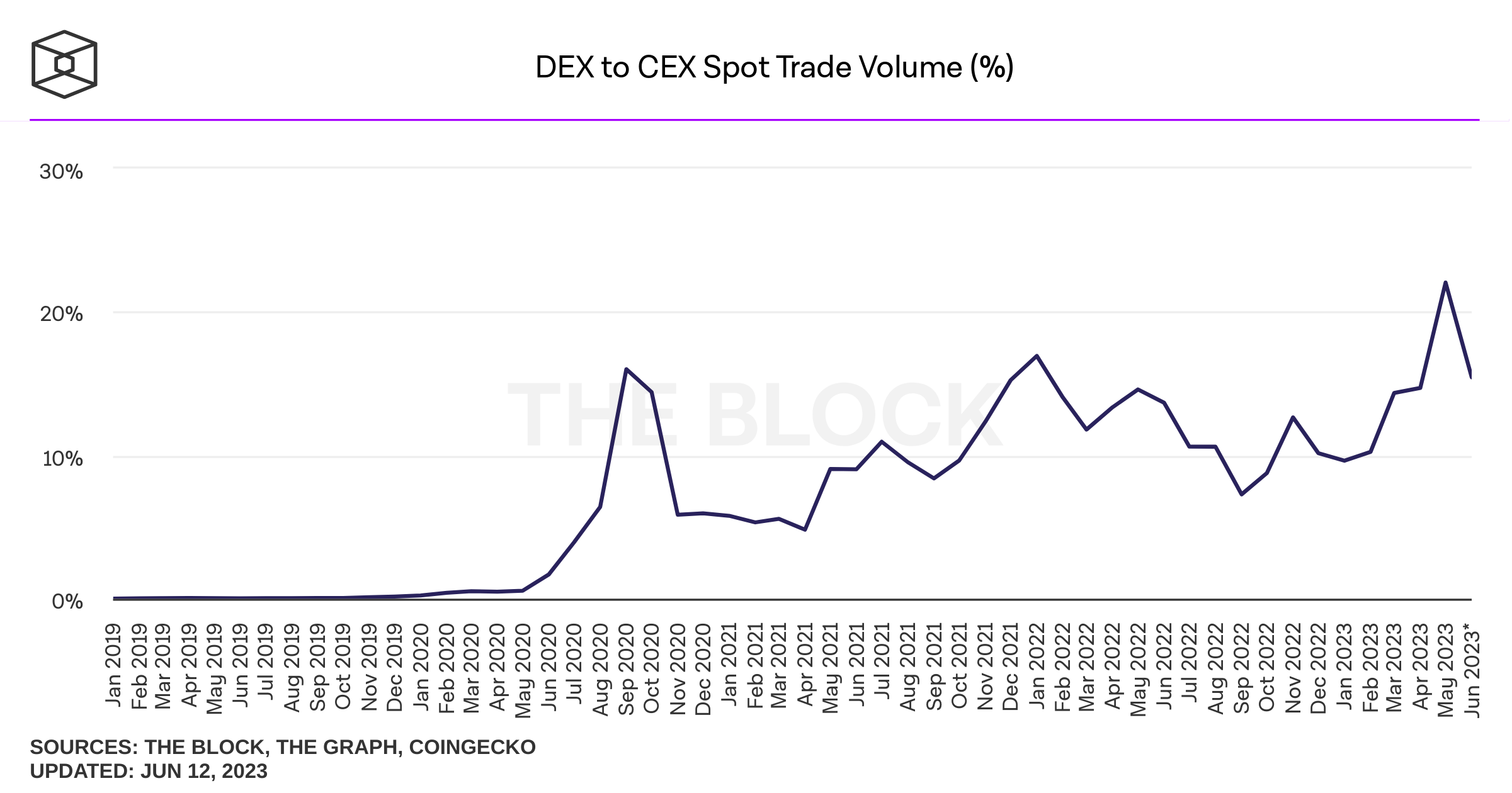
Binance was sued on June 5th and Coinbase on June 6th, which is curious when looking at the above trend as the DEX share has dropped since. Then again, these lawsuits may have been largely priced in. Coinbase was served with a Wells notice a few months ago, while Binance was (and still is) facing numerous investigations from different lawmakers. The price of Bitcoin will tell you all you need to know – it fell only 5% on news Binance had been formally sued, while the Coinbase news didn’t budge it much at all.

In truth, whatever the reasons, it is hard to draw conclusions from the above data. Volume remains incredibly thin, as I have discussed in-depth previously. In fact, on-chain activity and fees have actually fallen for the fourth consecutive week for Bitcoin, the immense spike in activity caused by the Ordinals protocol and BRC-20 tokens fading into the rear window. Despite this fall, however, it should be noted that fees are still significantly higher than the start of the year.

It is not just Bitcoin. Fees and activity are dwindling across the crypto space. The below is the same chart but for Ethereum, which has also seen four straight weeks of declining fees. In contrast to Bitcoin, the activity is inching down closer to where it was in January, however.

All in all, volume in the cryptocurrency space remains incredibly thin. This is due to a variety of factors. The first is the collapse in prices. When prices fall, people invariably trade crypto less. And with Bitcoin still 60% off its peak from late 2021, the hysteria and jammed order books feel a long way off.

But regulation is also a key factor. This has suppressed enthusiasm for the space immeasurably, with particular implications for institutions. We saw a telltale sign of that over the weekend, with Crypto.com suspending its US institutional exchange. While its retail platform will remain operational, the company cited limited demand from institutions as the reason behind the decision.

A cocktail of freefalling prices and an increasingly punitive regulatory regime is the worst possible scenario for the industry, and it is not hard to see why institutions have pulled back from the space.

The jump in DEX volume portrayed by the above on-chain data may seem promising at first glance, but that trend seems to have reversed. Additionally, for institutional capital to flow significantly into the space, centralised exchanges provide a vital function. So many were optimistic of these institutions pouring in only a couple of years ago, when companies like Tesla were stashing Bitcoin on balance sheets, but that feels a long way off now.

The post Crypto volumes continue to lag, Bitcoin & Ether fees down for fourth consecutive week appeared first on CoinJournal.
Litecoin price analysis ahead of the FOMC decision, US inflation data

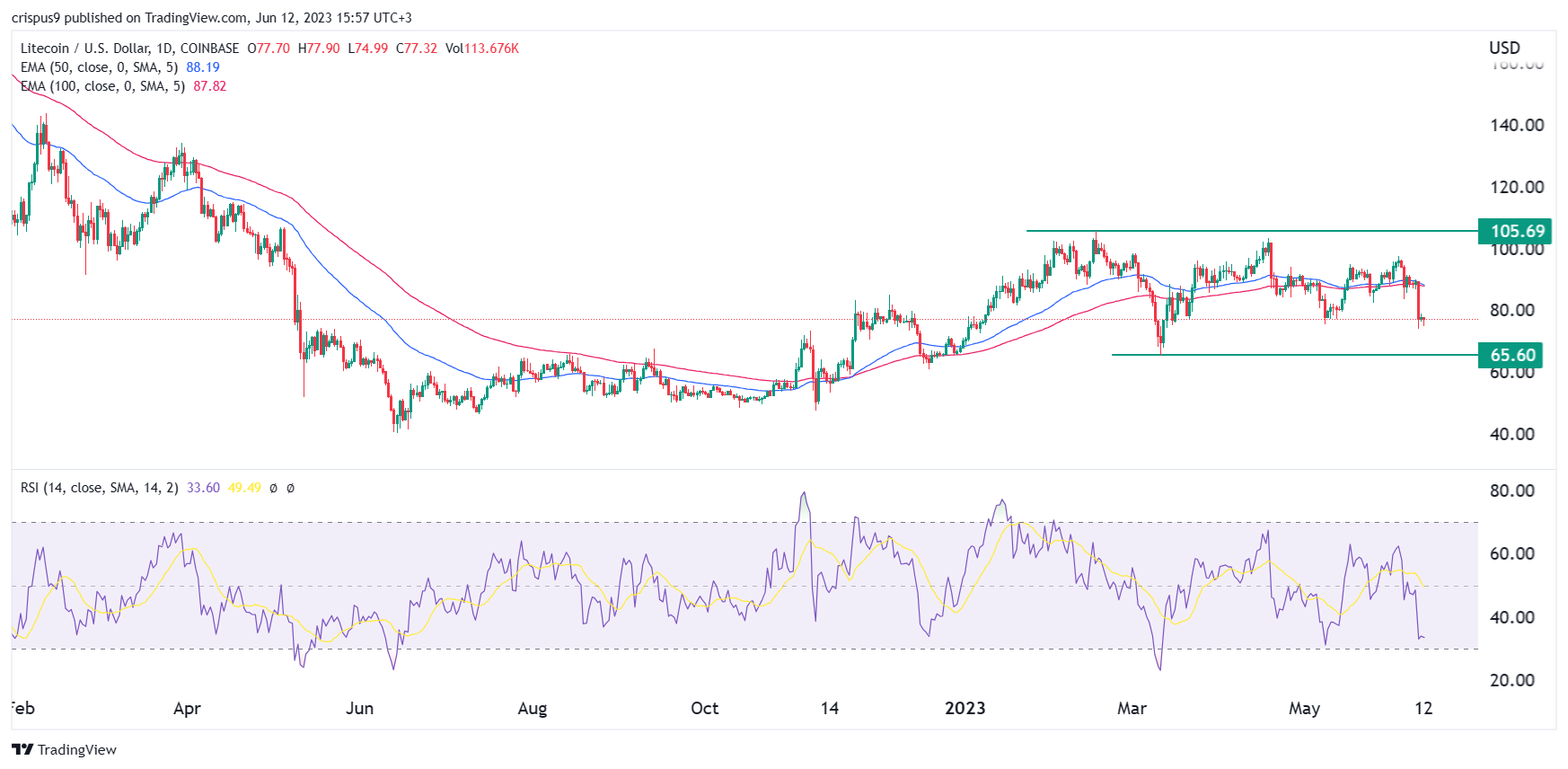
  • Litecoin has formed a triple-top pattern on the daily chart.

  • The main news is the recent lawsuits against Coinbase and Binance.

  • The Federal Reserve will deliver its next interest rate decision.

Litecoin price has come under intense pressure in the past few days as investors focus on the recent SEC lawsuits against Coinbase and Binance. LTC token retreated to a low of $73.98, lower than the year-to-date high of $105.70.

Fed interest rate decision

Litecoin, like other cryptocurrencies, is going through a rough patch as investors focus on last week’s lawsuit by the SEC. The lawsuits alleged that the companies provided unregulated securities in the United States. The agency also sued Binance’s Chief Executive, Changpeng Zhao, as we wrote here.

It is stil too early to predict the next outcome of these lawsuits. As we have seen with the ongoing SEC vs Rippple case, the process can last for several years. The most likely outcome will be a settlement between either Binance or Coinbase with the SEC. Alternatively, the two companies could lose the suits, leading to major implications foe the crypto industry. 

For example, if Coinbase loses, it means that the company will be forced to delist thousands of cryptocurrencies. Popular coins like Bitcoin and Litecoin will be safe since they are seen as commodities.

The next key catalyst for the LTC price will be the upcoming interest rate decision by the Federal Reserve scheduled for Wednesday. Analysts believe that the bank will leave interest rates unchanged at between 5% and 5.25%. 

A pause in interest rate hikes will be a positive thing for Litecoin, stocks, and other financial assets. For one, it will be the first time in 10 meetings that the Fed has not hiked interest rates.

The decision will come a day after the US publishes consumer price index (CPI) data. Analysts believe that the headline consumer price index (CPI) dropped to 4.1% in May from the previous 4.9%.

Litecoin price prediction

Turning to the daily chart, we see that the LTC price has formed a triple-top pattern at $105.70, where it struggled moving above this year. The neckline of this pattern is at about $65.60. The coin has moved below the 50-day and 100-day moving averages. 

The Relative Strength Index (RSI) has moved below the neutral point at 30. Therefore, I suspect that the LTC price will continue falling as sellers target the key support at $65.60. A move below that level will open the possibility of the coin dropping to $60.

How to buy Litecoin

eToro

Buy LTC with eToro today

Coinbase

Buy LTC with Coinbase today

The post Litecoin price analysis ahead of the FOMC decision, US inflation data appeared first on CoinJournal.

Nigeria’s SEC orders Binance Nigeria Limited to stop operations

  • Nigeria’s SEC said Binance Nigeria Limited is neither registered nor regulated and its operations in Nigeria are illegal.
  • The order against Binance Nigeria Limited comes days after the US SEC sued Binance and its founder CZ.
  • Nigeria’s SEC had previously said it viewed all crypto assets to be securities by default.

According to a Friday circular from Nigeria’s Securities and Exchange Commission (SEC), Binance’s Nigerian branch has been told to stop all operations immediately.

The circular stated that Binance Nigeria Limited’s operations in Nigeria were unlawful because it was neither registered with nor subject to regulation by the Commission. The circular by the SEC states:

“Binance Nigeria Limited is neither registered nor regulated by the Commission and its operations in Nigeria are therefore illegal. Any member of the investing public dealing with the entity is doing so at his/her own risk.

As the regulator with the statutory mandate of investor protection, the Commission urges Nigerians to be wary of investing in crypto-assets, and crypto-asset-related financial products and services if the service provider/its platform is not registered or regulated by the Commission. Nigerian investors are hereby warned that investing in crypto-assets is extremely risky and may result in a total loss of their investment.

By this circular, Binance Nigeria Limited is hereby directed to immediately stop soliciting Nigerian investors in any form whatsoever.”

Binance under siege

Binance Nigeria is the second Binance branch to be accused of operating unlicensed activities. On Monday, the US Securities and Exchange Commission (SEC) sued Binance, its US affiliate, and its founder Changpeng Zhao violating the securities laws in the country.

The US SEC has gone further to request for the assets of Binance.US to be frozen. It is currently looking for an alternative way to serve Changpeng Zhao with the court sermon.

Nigeria’s SEC stand on cryptocurrencies

While this is the first action taken by Nigeria’s SEC against a cryptocurrency exchange platform, the SEC had previously stated that it considers all crypto assets to be securities by default.

Bloomberg reported in May that Nigeria’s SEC was processing registration applications from crypto firms on a trial basis but would not begin doing so formally until it had reached an agreement with the nation’s central bank.

Currently, it is against the law for banks in Nigeria to provide services to cryptocurrency platforms.

The post Nigeria’s SEC orders Binance Nigeria Limited to stop operations appeared first on CoinJournal.

Chancer: World’s first blockchain-based predictive markets app, and a potential game-changer

  • Chancer facilitates P2P predictive markets for betting on conventional and non-conventional markets.

  • Chancer aims to enable user-led predictions amid record betting levels in traditional markets.

  • The token will start presale on June 13,th 2023.

Think about this, being able to bet against any event and setting your own rules and odds. This is what the new decentralised blockchain platform Chancer is bringing. But that’s not the main idea – Chancer will be an investment opportunity giving its holders a chance to earn in various ways. The token $CHANCER presale happens on June 13th 2023 amid growing enthusiasm around the token.

What is Chancer?

Chancer is a blockchain-based decentralised predictive markets application. Under the main slogan, “Chancer: Your Game, Your Rules, Your Odds,” the platform will allow people to set their customised P2P betting platforms complete with their own rules.

Users can bet on anything they like, from a live football match to a personal bet, say your best friend will finish the top in the class. Users can also let their friends and others join their market, bringing fun to their betting world.

The platform’s token, $CHANCER, will run on the BSC blockchain. The aim is to enable token purchases through a secure chain with minimal transaction fees and high speeds. The team behind the blockchain aims to create a platform that works similarly to a dApp, seamlessly linking to the BSC blockchain. A proof-of-stake consensus mechanism seeks to make Chancer a fully decentralised ecosystem.

Record betting an advantage to decentralised Chancer

Betting is at all-time highs, thanks to growing technology and more people seeking to grow incomes through various models and have fun. If we take sports betting, for instance, activity levels hit record levels in 2022. The American Gaming Association reported that gross gaming revenues from sports rose to a record $7.5 billion in 2022, almost a 75% increase from the previous year. In the first quarter of 2023, the AGA reported that commercial gaming revenues hit a quarterly record of more than $16 billion.

Owing to these trends, betting is a big opportunity market. However, betting models have mostly stayed the same as the platforms remain centrally controlled. The need for a betting model that is user-led and peer-controlled is needed. The decentralised model is more transparent and confers benefits to users beyond betting. Chancer follows this model to generate win-win situations for users and investors.

Is Chancer a good investment opportunity?

Chancer isn’t only a blockchain-based betting ecosystem. It confers value to its participants by being an investment opportunity. The first benefit to investors is holding the $CHANCER token. This differs from betting platforms, where the winner takes it all.

Holders of $CHANCER can create their own markets and participate in markets created by peers. With this, there is an opportunity to collaborate, engage, and profit from wider Web 3.0 betting. Users benefit from a potential $CHANCER increase in value as more join the network. They can also stake the token for passive income.

There are also market-making rewards for creating Chancer markets through the dApp and live stream features. Users can become platform validators for a chance to earn more and enjoy priorities in platform governance. Other ways to earn include Share2Earn features, where users will get rewarded for promoting the market to increase the participation of members. 

The platform will also introduce a “Loyalty” program. This is a program to reimburse small amounts of transaction charges paid by users. The rebate is an incentive and a strategy to make the platform economically viable for its investors.

The unique ways investors earn and the decentralised model make Chancer a potentially viable investment opportunity. Being the first of its kind, investors may want to experiment with blockchain-based predictions, conferring a chance for the ecosystem to grow and benefit investors.

Chancer presale and listings

Chancer’s presale seeks to raise $15,000,000 over 12 stages of the presale. The token will be listed on Uniswap, Coingecko, and Coinmarketcap in the third quarter. More listings will follow, with the testnet expected in the fourth quarter. The mainnet, with full functionalities, is expected in the first quarter of 2024.

The post Chancer: World’s first blockchain-based predictive markets app, and a potential game-changer appeared first on CoinJournal.

Crypto.com suspends institutional exchange services in the US

  • Crypto.com cited limited demand for institutional-grade services.
  • The services will be suspended from June 21.
  • Crypto.com’s retail mobile application and platform remain fully operational in the US.

Crypto.com has announced that it will discontinue its institutional exchange services in the United States from June 21, this year. This means that the services will no longer provide institutional clients with services in the United States.

While a majority of crypto players are worried about the ongoing crypto onslaught by the US Securities and Exchanges Commission (SEC), Crypto.com cited the lack of institutional demand as the main driver behind the decision, which was made worse by market testing.

The exchange, however, remains open to a potential re-launch of the suspended institutional exchange services in the US if the market conditions change.

Retail crypto services still available in the US

According to a statement from Crypto.com, institutional users of the platform were informed in advance that the service would be suspended. The exchange, however, maintains that its retail mobile application and platform remain fully operational in the US.

In addition, Crypto.com’s CFTC-regulated cryptocurrency derivatives trading is still available to American retail users, as well as its UpDown Options product, which enables users to open long or short trading positions on potential future movements of different cryptocurrencies.

Crypto onslaught by the SEC in the US

The month of June 2023 has proven to be the most turbulent in the history of cryptocurrency exchanges operating in the US. The Securities and Exchange Commission (SEC) started legal action against both Binance and Coinbase for a variety of allegations including violations of the securities laws.

The SEC’s actions have drawn criticism from the larger cryptocurrency community as the SEC appears to be tightening its regulatory clampdown on the sector eight months after FTX’s demise.

While Crypto.com is yet to be probed by the SEC, the exchange has maintained its expansion throughout the world. The Monetary Authority of Singapore (MAS) recently granted Crypto.com an official major payment institution (MPI) license for digital payment token (DPT) services, enabling it to provide its services there even as it shutters its US institutional offering.

The post Crypto.com suspends institutional exchange services in the US appeared first on CoinJournal.