Coinbase partners with Bitkey Wallet to promote Bitcoin self-custody

  • Coinbase’s partnership with Bitkey, Block’s self-custody bitcoin wallet, will span six continents.
  • The platforms will integrate Coinbase Pay to allow users buy/sell or transfer Bitcoin to their Bitkey self-custody wallet.
  • Coinbase said the collaboration will allow customers to easily buy, store and manage their BTC.

Coinbase and Bitkey, the self-custody Bitcoin (BTC) wallet built by the Block, Inc., have announced a global partnership that will see the two companies promote self-custody usage.

The partnership, which will span six continents, will see Bitkey users buy and sell BTC on Coinbase, as well as transfer their holdings to their self-custody Bitkey wallets. The wallet includes a mobile app, hardware device and set of recovery tools, the companies said in a blog announcement on Thursday.

According to the announcement, Coinbase and Bitkey will leverage Coinbase Pay to allow customers easy access to fiat-to-crypto onramps, the US-based crypto exchange noted in the blog post. It is a key component to powering the next adoption phase of the Bitcoin economy.

“At Bitkey, we’re building a self-custody bitcoin wallet designed to empower the next 100 million people to truly own and manage their Bitcoin – safely and easily,” Lindsey Grossman, Business Lead at Bitkey said.

“Partners play a key role in bringing self-custody to a wider group of people around the world, and we are incredibly proud to have partnered with leading companies like Coinbase to make self-custody both secure and easy to use.”

Bitkey launches global beta program

The collaboration between Coinbase and Bitkey is kicking off as the self-custody wallet launches its global beta program. 

Customers in the beta program will be able to transfer their Bitcoin from centralized exchanges to Bitkey’s self-custody wallet. Buying and selling as well as direct transfers between Coinbase and Bitkey will be enabled when the wallet launches to the public later this year.

As noted above, Bitkey and Coinbase will offer the service to customers in six continents. Some of the countries include the US, Canada, the UK, Brazil, and Australia.

The post Coinbase partners with Bitkey Wallet to promote Bitcoin self-custody appeared first on CoinJournal.
Binance introduces Bitcoin mining cloud services amid regulatory pressure

Key takeaways

  • Binance users interested in Bitcoin mining can now subscribe to Binance’s cloud mining services starting today.

  • The new service comes despite Binance currently facing regulatory pressure in the United States. 

Binance launches its Bitcoin mining cloud services

The world’s largest cryptocurrency exchange by daily trading volume, Binance, has launched new Bitcoin subscription-based cloud mining products. 

Starting today, June 15, Binance users interested in Bitcoin mining but who don’t have the hardware can subscribe to the cryptocurrency exchange’s cloud mining services and purchase hashrates.

At the moment, the cryptocurrency exchange is selling 1 Terahash per second (Th/s) at $10.7280. As a user purchases more hashrate. The probability of higher income in terms of the Bitcoin earned through mining increases.

Binance revealed that its BTC mining subscription service would be active for six months. For each TH/s purchased, users stand a chance to earn 0.0004338 BTC during the 180-day period. 

The product is currently available on the Binance global website, which means that it is not available to its users in the United States.

Binance continues to face regulatory pressure

This latest development comes at a time when Binance is facing regulatory pressure in the United States. 

The United States Securities and Exchange Commission (SEC) sued Binance earlier this month for allegedly breaking securities laws. The regulatory agency has also filed for a temporary restraining order to freeze Binance.US’s assets. 

Binance.US has already hired former SEC enforcement co-director George Canellos as part of its legal team as it defends itself against the regulatory agency’s allegations. 

Last week, Binance.US announced the suspension of USD deposits on its platform as it transitions into an all-crypto exchange. 

The SEC also sued rival cryptocurrency exchange Coinbase for failing to register as a broker, national securities exchange or clearing agency.

The post Binance introduces Bitcoin mining cloud services amid regulatory pressure appeared first on CoinJournal.

Crypto price prediction: XRP, Hedera Hashgraph, Stacks

  • Cryptocurrencies plunged hard after the latest Federal Reserve decision.

  • Bitcoin dropped below the key support levels at $25,300 and $25,000.

  • XRP has formed a double-top pattern on the daily chart.

Cryptocurrency prices dipped sharply this week amid significant monetary policy and regulatory concerns. Bitcoin crashed below the important support at $25,000 while most altcoins erased their 2023 gains. This sell-off accelerated after the Federal Reserve pointed to two more rate hikes later this year. In this article, we will explain what to expect in XRP, Hedera Hashgraph, and Stacks.

XRP price prediction

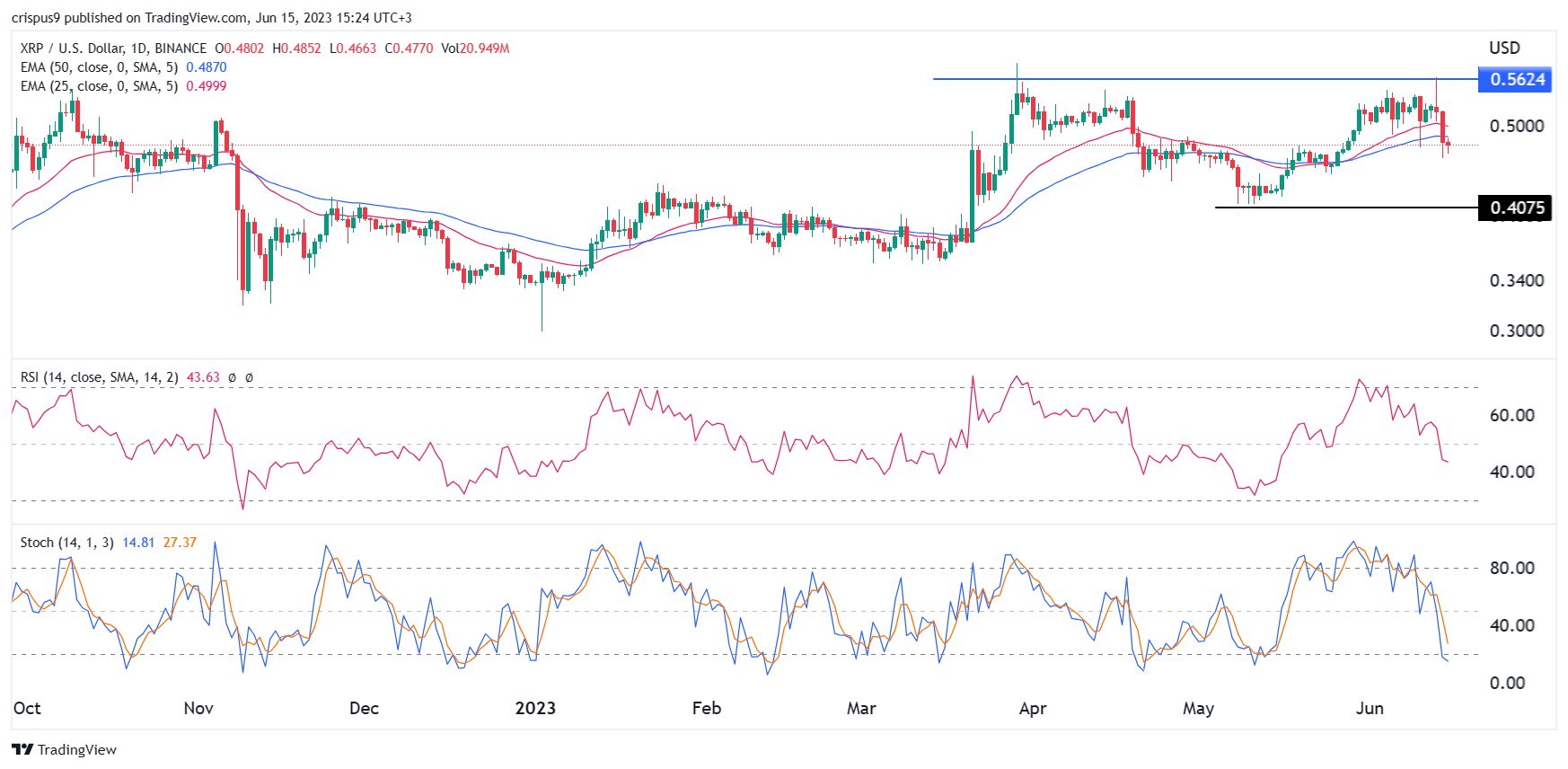
The XRP price drifted downwards this week after it jumped to a high of $0.5624. Its highest point was an important level since it was also the year-to-date high. This means that the coin has formed a double-top pattern, which is usually a bearish signal. The neckline of this price is at $0.4075, the lowest level on May 11.

At the same time, Ripple price managed to cross the 25-day and 50-day exponential moving averages, signaling that bears are gaining traction. The Relative Strength Index (RSI) crossed the key level st 50 while one line of the Stochastic Oscillator indicator dropped below the oversold level. XRP price also formed a small shooting star pattern. 

Therefore, the outlook of Ripple is bearish, with the next level to watch being at the neckline of the double-bottom pattern at $0.4075. 

How to buy XRP

inv-news-table coins=”XRP” limit=”2″]

Hedera Hashgraph price prediction

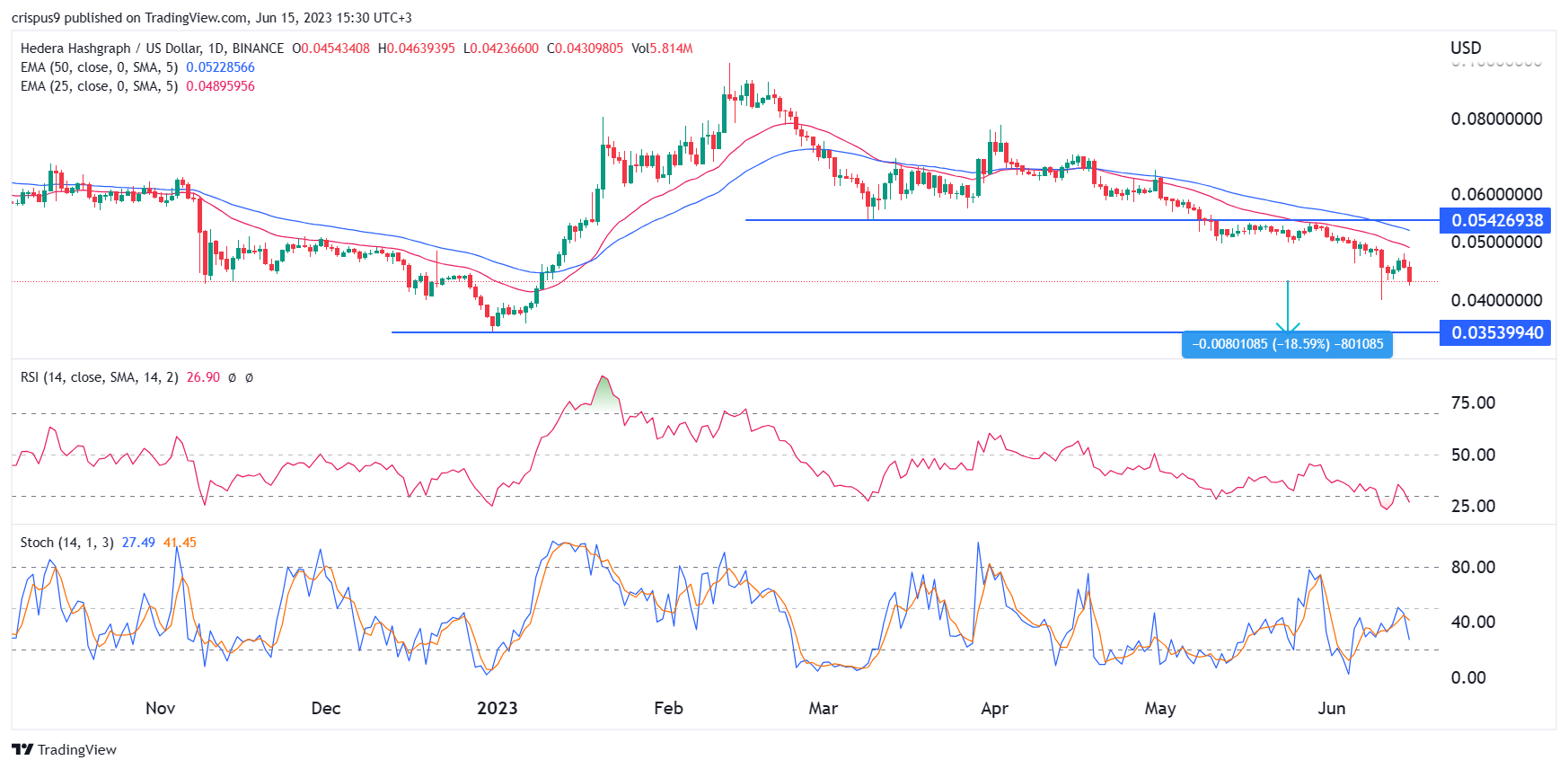
Hedera Hashgraph is a major blockchain project that seeks to become a good and faster alternative to Ethereum. It is faster, cheaper, and governed by leading companies like Google, IBM, and LG. Like other cryptocurrencies, the HBAR price has been in a strong downward trend in the past few months. It has erased about 40% from its highest level this year.

HBAR price has dropped below the important support level at $0.0542, the lowest level on March 10th. The token has moved below the 25-period and 50-period moving averages. At the same time, the Relative Strength Index (RSI) has continued falling. Therefore, there is a likelihood that the coin will continue falling as sellers target the next key support level at $0.035, which is about 18.5% below the current level.

How to buy Hedera Hashgraph

inv-news-table coins=”HBAR” limit=”2″]

Stacks price prediction

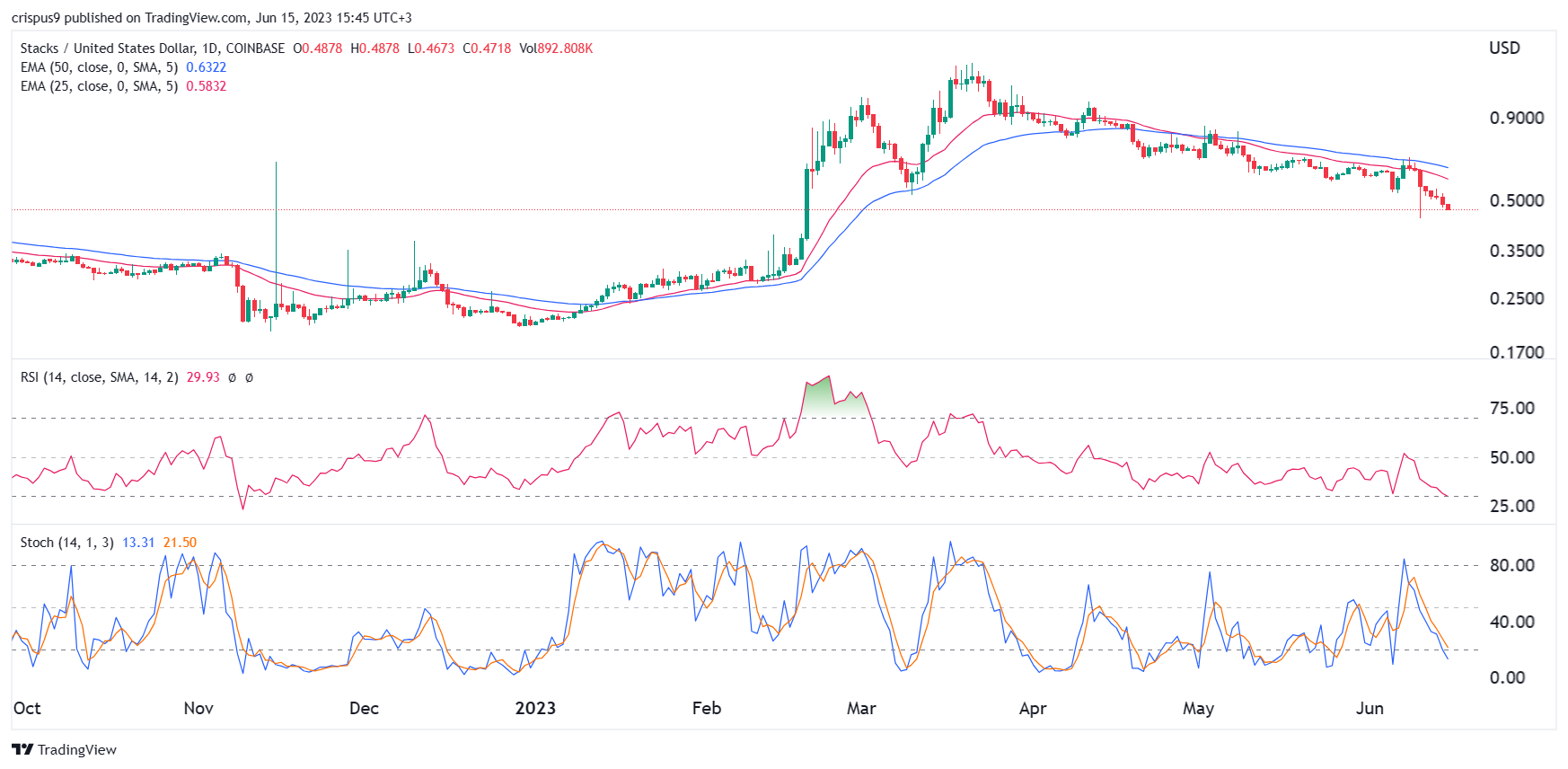
Stacks price has been in a strong bearish trend despite the rising interest of Bitcoin development. STX managed to move below the lower side of the descending channel shown in orange. At the same time, the coin has dropped below the 25-day and 50-day EMA. On the daily chart, it has moved below the 61.8% Fibonacci Retracement level.

Stacks has also moved below the psychological level of $0.50. Therefore, there is a likelihood that the coin will continue falling as sellers target the next level at $0.35.

How to buy Stacks

inv-news-table coins=”STX” limit=”2″]

The post Crypto price prediction: XRP, Hedera Hashgraph, Stacks appeared first on CoinJournal.

Crypto lending platform Delio temporarily suspends withdrawals

  • Delio’s move comes amid a heightened crackdown in the US by the SEC.
  • The move follows the recent suspension of deposit and withdrawal of digital assets at Haru Invest.
  • There have also been a sharp increase in market volatility and increased confusion among investors.

Due to increased market volatility, Delio, a Korea-owned cryptocurrency lending and savings company, has temporarily suspended fund withdrawals.

Founded in 2018, Delio offers its customers an annual percentage rate (APR) of up to 10.7% on their Bitcoin (BTC), Ethereum (ETH), and Tether (USDT) holdings.

The company said in a statement that it made the decision to halt deposits and withdrawals to protect its customers, who are currently perplexed as a result of the sharp decline in the price of Bitcoin and other cryptocurrencies. The translated version of the statement read:

“In the aftermath of the recent suspension of deposit and withdrawal of digital assets at Haru Invest., situations such as a sharp increase in market volatility and increased confusion among investors are causing.  In this situation, in order to safely protect the assets of customers currently in custody, Delio will inevitably suspend withdrawals temporarily as of June 14, 2023, 18:30, until the above situation and its aftermath are resolved.”

Crypto market decline

Since reaching an all-time high (ATH) of $69,000 in 2021, the price of Bitcoin has significantly decreased. The price of the leading cryptocurrency has decreased by more than 5% this week, and most altcoin prices have also undergone significant declines.

Without strong capital controls and reserves, the protracted bear market has made it inevitable for centralized cryptocurrency businesses to cease fund withdrawals or go out of business. Only a few of the numerous crypto lending platforms have managed to continue their regular business operations.

The bear market has seen industry heavyweights like Celsius, Voyager, BlockFi, Vauld, and a host of others go under.

One of the very few digital asset lenders that have not suspended fund withdrawal services during these difficult times is Nexo, which reached a $45 million settlement with the US SEC last January.

The post Crypto lending platform Delio temporarily suspends withdrawals appeared first on CoinJournal.

OpenAI CEO optimistic on global AI coordination: what it means for crypto AI projects

  • OpenAI CEO is touring Asian capital cities.
  • The CEO is currently touring Tokyo and is also expected to visit Singapore, Indonesia, and Australia.
  • The CEO says he is optimistic about global AI coordination, which is a good thing for AI-based crypto projects.

The CEO of ChatGPT developer OpenAI, Sam Altman, on Monday, stated that he was “quite optimistic” about the prospects for international cooperation in artificial intelligence (AI) following a tour of Asian capital cities.

OpenAI, which is backed by Microsoft Corp, has been making an effort to take advantage of the surge of interest in generative AI. It also wants to influence regulations for the field.

Speaking to students in Tokyo, Japan, Altman said:

“I came to the trip sceptical that it would be possible in the short term to get global cooperation to reduce existential risk, but I am now wrapping up the trip feeling quite optimistic we can get it done.”

Also, in a meeting with Prime Minister Fumio Kishida during his April visit to Japan, Altman expressed his interest in setting up a local office in the country. Despite the fact that its major manufacturing players are investing heavily in automation technology, Japan is viewed as a laggard in AI.

The CEO is due to visit Indonesia, Australia, and Singapore, before returning to the US.

AI regulations around the world

The use of generative AI that can generate text and images has instilled both excitement and fear for its potential to reshape a wide range of industries. As a result, regulators are frantically trying to adapt current rules and create new guidelines for the AI industry.

While the United States is leaning toward adapting existing laws for AI rather than creating new legislation, the European Union lawmakers have already passed a landmark artificial intelligence regulation.

The passed EU artificial intelligence that will be called the AI Act would ban systems that are considered to pose “unacceptable” risks to human lives. The act is expected to put European governments on a collision course with US tech giants who have invested billions in AI technology.

Most of the proposed AI regulations seek to ensure the systems do not interfere with the lives of humans, which is a good thing for AI-based cryptocurrency projects. Most AI-based crypto projects combine blockchain and artificial intelligence technologies to process data to aid in ensuring efficient financial transactions including financial trading; meaning they are less likely to be negatively affected by the proposed regulations.

Popular AI-based crypto projects in 2023

Although AI-based cryptocurrencies were not spared in the recent crypto market decline following the US SEC onslaught on cryptocurrencies, they have been performing quite well since ChatGPT was launched last year. The number of AI-based cryptocurrencies has also exponentially grown following the many new blockchain projects leveraging AI technology to address different challenges.

AltSignals, a trading signals platform, is one of the most recent entrants in the industry with its new AI-based cryptocurrency called ASI, which is currently in the presale stage. The platform’s new AI project has gathered a lot of popularity seeing that the first stage of the ASI presale was 92.43% sold out at press time.

At the moment, the top five largest AI cryptocurrencies by market cap according to Coingecko are Render (RNDR), SingularityNET (AGIX), Fetch.ai (FET), Ocean Protocol (OCEAN), and Akash Network (AKT). The largest, Render, has a market cap of $651,359,605, while the fifth, Akash Network has a market cap of $99,731,536.

The post OpenAI CEO optimistic on global AI coordination: what it means for crypto AI projects appeared first on CoinJournal.