
Justin Bieber’s $1.3M NFT investment depreciates by more than 95%

  • Justin Bieber invested about $1.3 million into the Bored Ape Yacht Club (BAYC) NFT.
  • There are speculations that Justin Bieber was gifted the NFT by MoonPay as a promotional tactic.
  • The investment has however depreciated to $59,000.

Dexerto revealed in a tweet that global pop superstar Justin Bieber’s $1.3 million investment in BAYC NFT had depreciated to $59,000; meaning he has lost about $1.2 million.

Celebrity endorsements and investments have risen sharply since the introduction of non-fungible tokens (NFTs). These blockchain-based, one-of-a-kind digital assets have given celebrities new ways to interact with their fan bases, monetize their brands, and explore the fascinating world of cryptocurrencies.

However, the NFT market is infamously unpredictable and volatile, leading to frequent sharp fluctuations in price. Unfortunately for Bieber, this instability led to the loss of his Bored Ape Yacht Club (BAYC) NFT investment. Although a sharp decline in value is unquestionably a serious financial blow, it is crucial to take the bigger picture into account.

Justin Bieber’s forays into NFTs

The $1.2 million loss from his NFT investment, while significant, is probably manageable for Justin Bieber, whose estimated net worth was $285 million as of September 2021. The “Peaches” artist has diversified his sources of income, reducing the impact of the NFT’s decline through music, merchandising, and endorsements.

There are also speculations that the BAYC NFT was a reward from MoonPay as a promotional tactic.

Many famous people have adopted the NFT culture, however, not everyone has been successful. Some people have made these investments as part of a bigger marketing strategy rather than to earn rewards. Celebrities get exposure and audience interaction by affiliating with the forward-thinking digital movement by purchasing NFTs. Some like Snoop Dogg and Wiz Khalifa have gone ahead to launch ApeCoin-themed Music NFTs.

However, not all NFT endeavours are unsuccessful. Some celebrities have gotten rich by selling NFTs for astronomical prices. It’s a game with a high chance of a high payoff.

The post Justin Bieber’s $1.3M NFT investment depreciates by more than 95% appeared first on CoinJournal.
Why is the Verge (XVG) price soaring? It’s up 295%

  • At press time, the price of XVG token had soared 295% over the past seven days.
  • The token was trading at $0.006906.
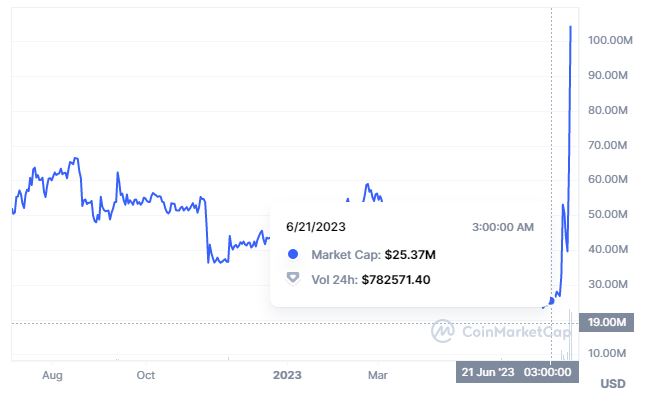
  • The Verge’s market cap has also gone up by almost 400% over the past three weeks.

What started as a slow steady bull case for the Verge (XVG) token has turned into a monster Bull Run after the token price went up by about 300% on June 3. And although the price has slightly pulled back from the June 3 high, it is still 295% high compared to where it was seven days ago.

Verge was long considered dead after it drastically dipped at the beginning of 2023 at a time when most of the cryptocurrencies showed some signs of recovery from the 2022 bear market. However, all that started to change in mid-June when the current bull trend started.

Verge (XVG) price chart. Source Coinmarketcap


While the Verge investors and traders are excited about the current bull case for the token, most crypto investors are still sceptical about the upward movement as questions of why the token is taking a ride ringer. In this article, we shall explain why the Verge (XVG) token price is rising.

Increased Verge (XVG) activity

In addition to the price surging, the Verge has also experienced an increased trading volume, which skyrocketed by a staggering 380% on June 4 to a record $507 million. And although the trading volume had dropped to $480 million at press time, the figure still shows there is still a high trading activity.

In addition to the increased market activity, there are speculations of possible manipulation by seasoned cryptocurrency investors otherwise known as crypto whales who could be angling to dispose of their large XVG holdings at a profit. While this is not confirmed, it is important to be careful when trading cryptocurrencies since they are extremely volatile assets.

The post Why is the Verge (XVG) price soaring? It’s up 295% appeared first on CoinJournal.

SEC’s spot Bitcoin ETF approval “fairly high”: Bernstein

  • $650 billion asset manager Bernstein believes there’s a good chance of a spot Bitcoin ETF approval.
  • The SEC’s argument for denial of a spot ETF while approving futures ETFs is unlikely to convince the court in the Grayscale vs SEC case.
  • The regulator is likely to approve a spot ETF by a regulated Wall Street giant than deal with OTC products like GBTC, analysts at Bernstein noted.

On July 2, Gemini co-founder Cameron Winklevoss tweeted that it has been 10 years since the Winklevoss twins filed the first spot Bitcoin ETF. Over the decade, the SEC has denied multiple proposals, a scenario that continues even as the crypto market’s outlook shifts increasingly optimistic.

The case is even more pronounced after a flurry of applications involving mainstream Wall Street giants like BlackRock, Fidelity and Invesco.

Among those to voice the latest optimistic tone over the approval of a spot Bitcoin ETF is brokerage firm Bernstein, CoinDesk reported today.

According to experts at the firm, who shared their insights in a research report, the SEC’s approval of futures Bitcoin ETFs and the leveraged futures ETF allowed last week, all leave the regulator with little room to maneouvre in terms of continuing to deny a spot ETF.

The case for a spot ETF

The SEC’s contention that futures pricing is from regulated exchanges such as the CME, as opposed to spot prices that come from crypto exchanges like Coinbase, remains. However, with major asset managers signaling towards market surveillance agreements to address possible manipulation, basically puts the SEC in the spot.

Grayscale’s case against the SEC, which relates to the regulator’s disapproval of a proposal to convert the Grayscale Bitcoin Trust (GBTC) into a spot Bitcoin ETF, is another reason why an approval is highly likely.  

[Read more: Grayscale to convert its GBTC to a Bitcoin ETF]

Analysts at Bernstein say that the court is likely not to be “convinced that the futures price is not derived from the spot price.” They also opine that allowing the futures ETFs and not disapproving spot ones could be “a difficult pill to swallow for the courts.”

Their report sums up the outlook thus:

“SEC would rather bring in a regulated bitcoin ETF led by more mainstream Wall Street participants and with surveillance from existing regulated exchanges, than having to deal with a Grayscale OTC product filling the institutional gap.”

Market experts see the SEC’s recent quick feedback on recently filed proposals, which has seen Cboe BZX refile spot ETFs for several firms naming Coinbase as the exchange they are having a surveillance sharing agreement with, as a good first step.

Nasdaq has also refiled BlackRock’s ETF proposal, naming Coinbase as the crypto exchange with the SSA.

The post SEC’s spot Bitcoin ETF approval “fairly high”: Bernstein appeared first on CoinJournal.

Thailand introduces new digital asset service providers’ regulations

  • Thailand’s SEC has introduced new regulations ensuring investor protection from digital asset service providers.
  • Digital asset providers will also not be able to provide digital assets deposited by users for loans or investments.
  • The new regulations require providers to clearly disclose the risks that may arise from trading cryptocurrencies.

In order to prioritize investor protection, Thailand’s Securities and Exchange Commission (SEC) introduced new rules for companies that provide services for digital assets.

The rules now require crystal-clear risk warnings for cryptocurrency trading. A clear warning about the possible risks associated with trading digital assets must also be provided by providers of digital assets in accordance with the new regulations.

The Thai SEC stated that the warning message, along with the disclosure of the outcomes of the investment suitability assessment and appropriate asset allocation, must be displayed prominently. According to the rules, service providers must make sure customers consent and understand the risks before using their services.

Restrictions on lending and deposit services

The new guidelines place restrictions on the deposit and lending services provided by digital asset businesses in addition to risk disclosure. With the exception of certain pre-approved promotional activities, these rules forbid the provision or support of such services beginning on August 30.

According to the Thai SEC’s guidelines, it is strictly forbidden for any entities other than businesses dealing in digital assets to promote or otherwise influence deposit-taking and lending services.

On September 1, 2022, the Thai SEC approved the requirement that cryptocurrency business operators disclose security warnings about the risks of trading cryptocurrencies, starting a dialogue on investor protection regulations.

The post Thailand introduces new digital asset service providers’ regulations appeared first on CoinJournal.

Revolut to delist Polygon, Solana and Cardano

  • Revolut is taking the step after its US-based partner Bakkt recently delisted the tokens.
  • MATIC, ADA and SOL will however still be available on Revolut across other markets.
  • Robinhood and eToro have recently also announced similar token delistings.

Revolut will end support for three major cryptocurrencies, the crypto-friendly bank has told its customers in the United States. 

The company said in a notice emailed to US customers that it will be delisting Cardano (ADA), Polygon (MATIC) and Solana (SOL). The “financial super app” added a host of tokens in early 2021 as demand skyrocketed amid the crypto bull market.

Revolut’s US partner delisted the tokens

London-based Revolut’s decision to delist ADA, MATIC and SOL comes as the company responds to the prevailing regulatory environment in the US.

The past few months have seen the US Securities and Exchange Commission (SEC) up its regulatory crackdown on multiple crypto platforms. 

Last month’s lawsuits against Binance and Coinbase highlighted the tough regulatory landscape crypto businesses faced in the US as the industry continued to fight for clarity from relevant authorities.

After the agency, led by Chair Gary Gensler, alleged the above coins and many others were securities, Revolut’s US partner Bakkt moved to delist Polygon, Cardano and Solana. The publicly-listed crypto custodian announced the delistings in mid-June.

Revolut has advised customers to sell their holdings on the app before September 18, after which any unsold assets will be sold and the cash deposited in users’ fiat accounts. 

Notably, the delisting only affects US-based users, meaning support will continue across other markets. There has also been other platforms that moved to remove various crypto tokens, including Robinhood and eToro.

The post Revolut to delist Polygon, Solana and Cardano appeared first on CoinJournal.