Bitcoin price forecast with the help of EUR/USD

  • Bitcoin and EUR/USD have a direct correlation
  • EUR/USD leads
  • Bitcoin’s recent bullish trend has been based solely on the dollar’s weakness

Today is the last trading day of a busy trading week in the traditional currency market. Three central banks (Federal Reserve, European Central Bank, Bank of Japan) have announced their interest rate policy decisions.

For cryptocurrency traders, and especially for Bitcoin investors, the first two central banks directly impact Bitcoin’s price action. As it turns out, after being part of numerous institutional investors’ portfolios, Bitcoin’s price just follows the US dollar movements.

Sure enough, the volatility in the cryptocurrency space is much higher than in the traditional currency market. Nevertheless, one cannot ignore the direct correlation between the EUR/USD exchange rate and Bitcoin in the past several months.

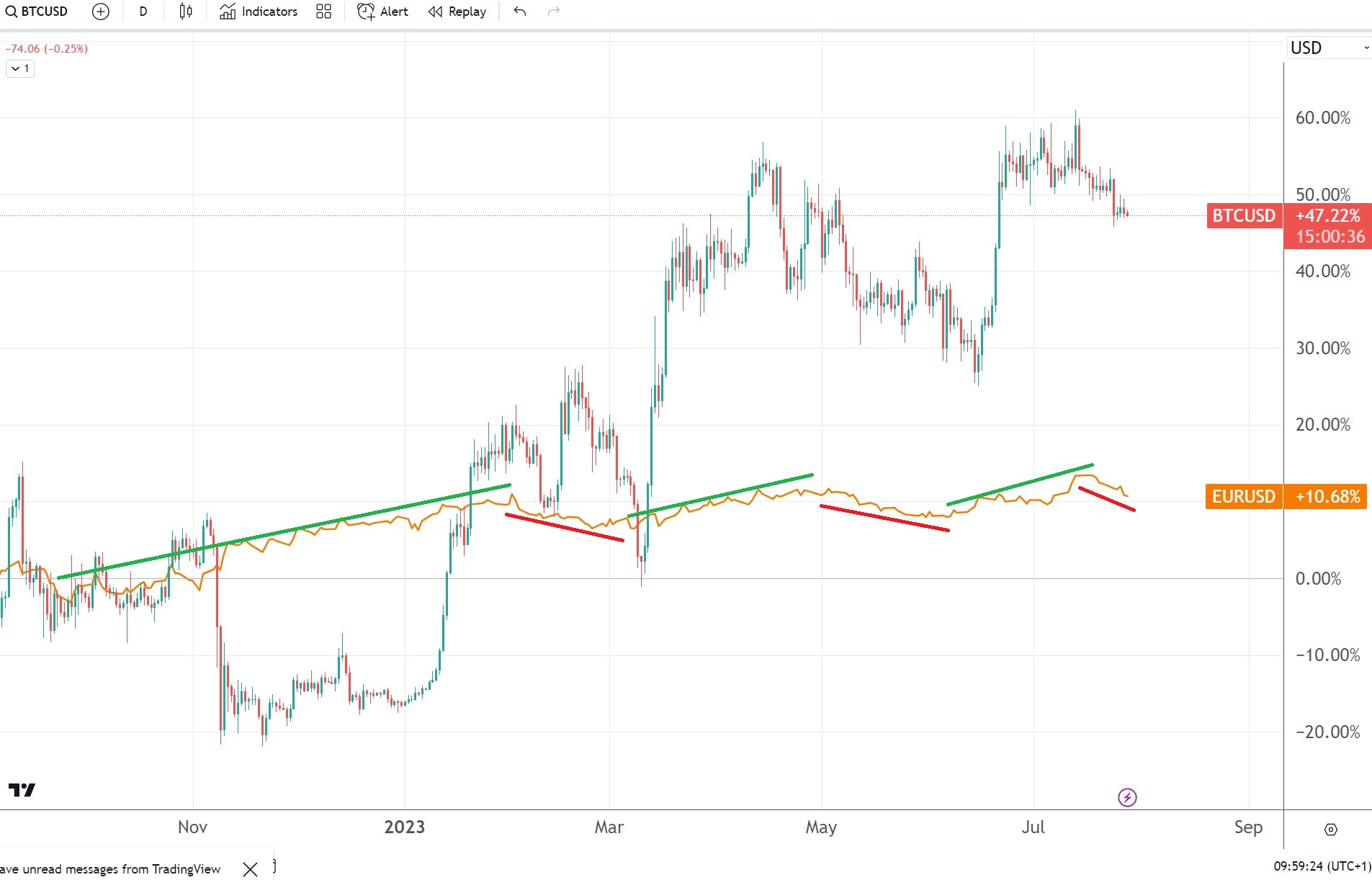
Bitcoin chart by TradingView

Bitcoin and EUR/USD have a direct correlation  

EUR/USD bottomed in October last year and has rallied ever since. Sure enough, corrections appeared, but the overall trend remained in place.

The chart above shows the different cycles that the EUR/USD formed from left to right. Unsurprisingly, Bitcoin followed.

For example, despite making a new lower low at the end of 2022, Bitcoin bounced and rallied at the start of the new year. Basically, it caught up with the EUR/USD bullish trend.

Since then, every correction or rally on the EUR/USD pair was met with a similar response from Bitcoin. Therefore, it is fair to assume that if Bitcoin hodlers hope for the price to break and hold above $30k, it can only do so with a bullish EUR/USD price action.

The post Bitcoin price forecast with the help of EUR/USD appeared first on CoinJournal.

Kin price soars after proposal to burn 7 trillion KIN passes

  • Kin community adopts proposal to burn 7 trillion of supply.
  • The total supply of Kin is 10 trillion KIN tokens.
  • The price of native token KIN jumps more than 20% as traders react to news.

Kin Foundation has announced that a proposal seeking to burn trillions of KIN tokens has passed. According to an update from the organisation, the community’s vote on the proposal to burn Kin Reserves will see over 7 trillion KIN tokens destroyed.

Kin’s path to decentralisation

About 4.96 trillion KIN held by the foundation and 2.1 trillion KIN planned for burning by Kik should be destroyed by end of day Friday, July 28. That would see roughly 71% of the total KIN supply burned.

“As a next step, the 4.96T Kin Reserves will be sent to a new Solana address and burned. After this the 2.10T Kin that Kik has agreed to burn will follow the same process. Once these burns are complete I will publish a new post that shows the on chain proof of these burns. I am hopeful this will happen by the end of day tomorrow,” the update read.

Ted Livingston, founder and CEO of Code, says the burn will make Kin a fully decentralised cryptocurrency. There will be no inflation, foundation or website.

“The vote to burn the Kin Reserves has passed, with the vast majority of votes in support. Kin is about to become one of the only fully decentralised cryptocurrencies out there, with no inflation, no foundation, and no website. More details to come once the burn is complete,” he noted.

According to data from CoinGecko, the cryptocurrency’s current circulating supply is 2,207,205,857,149. The maximum supply is 10 trillion.

KIN price surges

The price of KIN soared after the vote closed, with the token’s value having reached an intraday high of $0.000022. KIN was up 22% in the past 24 hours and more than 68% in the past week after its price jumped to highs near $0.000030 following the proposal.

KIN’s all-time high of $0.00122572 was reached on January 7, 2018.

The post Kin price soars after proposal to burn 7 trillion KIN passes appeared first on CoinJournal.

Decentralized exchange PancakeSwap taps zkSync Era blockchain

  • PancakeSwap initially launched on BNB Chain but is now available on five blockchains.
  • The zkSync Era blockchain is the most recent blockchain that the DEX will be available on.
  • The move is aimed at expanding PancakeSwap’s user base and increasing protocol revenue.

The decentralized exchange PancakeSwap (CAKE) is now available on the zkSync Era blockchain according to a statement made by the DEX’s creator “Chef Cocoa” on Thursday. While this is a major milestone for the DEX, the news has not caused a significant price movement on the native token CAKE, seeing it has only gained about 1.40% today.

The move is consistent with PancakeSwap’s goals to grow its user base and boost the protocol’s income.

Available Pancakeswap features on Era blockchain

To start with, PancakeSwap’s token swap and liquidity provisioning features will be available with transactional fees of 0.01% of the trading value.

In the coming weeks, the farms feature that allows users to stake their liquidity pool (LP) tokens to earn CAKE while keeping the LP tokens will go live.

As a decentralized exchange, PancakeSwap uses smart contracts instead of middlemen to process trades, lending and lottery services for users. Besides zkSync Era, PancakeSwap is currently available on the BNB Chain, Ethereum, Polygon zkEVM, and Aptos. As of Wednesday, the DEX held more than $1/57 billion worth of tokens according to data from DefiLlama.

On the other hand, zkSync Era, which was launched by Developer Matter Labs as an Ethereum layer 2 blockchain compatible with the Ethereum Virtual Machine (EVM) allows developers to deploy applications between zkSync Era and the Ethereum mainnet using the same code.

The post Decentralized exchange PancakeSwap taps zkSync Era blockchain appeared first on CoinJournal.

Optimism and Arbitrum metrics diverge as OP token outperforms

  • Optimism and Arbitrum are some of the best-known layer-2 networks.

  • The two network’s metrics have diverged in the past few days.

  • These metrics include the number of users and open interest.

Optimism and Arbitrum ecosystems have diverged in the past few weeks. Arbitrum’s number of active addresses has dropped from an all-time high of 191,612 in March this year to over 148k. Most recently, Optimism’s users has been in an upward trend and reached a high of 132,893.

The same trend is happening in their the performance of their decentralized finance (DeFi) industry. Data compiled by DeFi Llama shows that Optimism’s total value locked (TVL) in its ecosystem stands at over $1.27 billion while Arbitrum’s stands at over $3 billion.

The two ecosystems have been relatively stable in the past few weeks. However, while Arbitrum’s TVL has dropped by 0.40% in the past 30 days, Optimism’s TVl has risen by over 13% in the past 30 days. This makes it second only to Solana whose TVL has jumped by more than 30%.

TVL is an important metric in the crypto industry in that it shows the amount of money locked in a network. Ideally, a network with a higher TVL is seen as being more active. In this regard, the most active ecosystems are Ethereum, Tron, and BNB Chain.

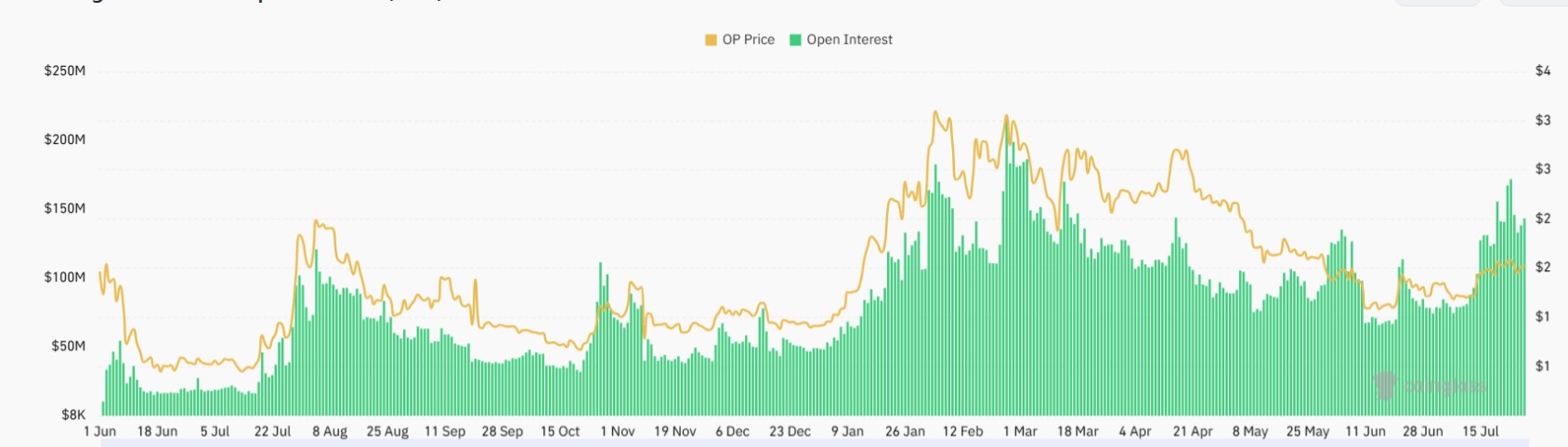
Additional data shows that the open interest of Optimism and Arbitrum’s tokens has diverged. The open interest of Arbitrum futures stands at $160 million, where it has been in the past few months. Optimism’s open interest, on the other hand, has been in an upward trend as you can see below. It rose to over $171 million this month and has now stabilised at $143 million.

A likely reason for this divergence is Worldcoin, the recently launched cryptocurrency. The WLD token has done well mostly because of the underlying technology and the fact that its creator is the founder of OpenAi, the company that introduced ChatGPT. Worldcoin is built on top of  Optimism.

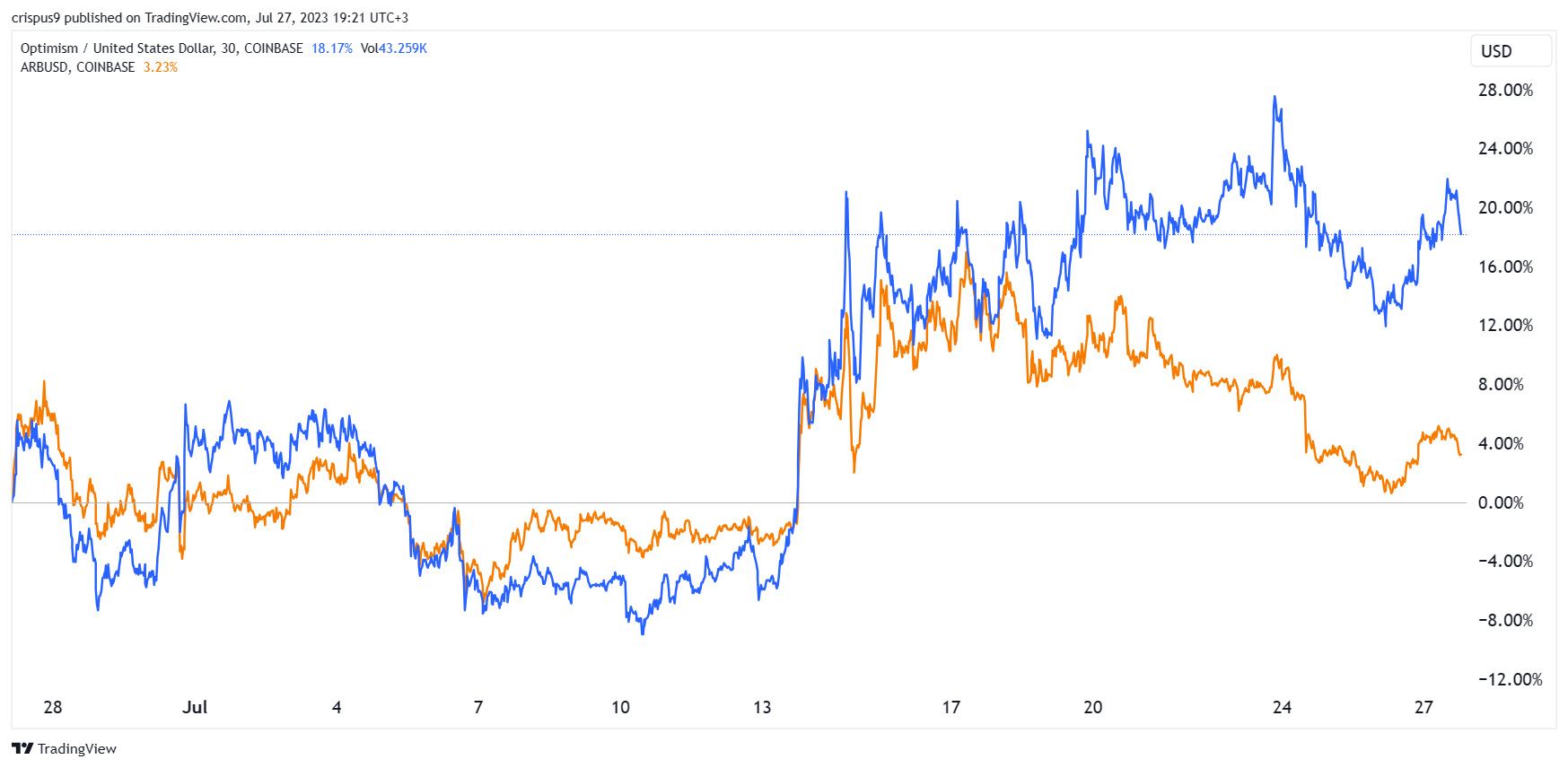
At the same time, the OP token has outperformed Arbitrum’s token. OP has risen by more than 20% this year while ARB token has risen by 4% in the past 30 days. 

Looking ahead, the next catalyst for Optimism token will be the upcoming token unlock that will happen on Sunday. The event will see the number of outstanding tokens jump according to the vesting schedule.

How to buy Optimism

The post Optimism and Arbitrum metrics diverge as OP token outperforms appeared first on CoinJournal.

Bitcoin inverse relationship with dollar weakening

  • The US dollar is the global reserve currency, meaning it is a key influence on all risk assets
  • Bitcoin has seen its negative correlation with the dollar pick up since the transition to a tight monetary regime, meaning it tends to strengthen when the dollar falls
  • This inverse relationship has softened in recent weeks, as Bitcoin has failed to capitalise on dollar weakness arising from lower inflation in the US
  • If history is to be followed and the correlation returns, Bitcoin could be in a place to advance


The status of the US dollar as the world’s reserve currency means it exhibits an enormous influence on risk assets not only in the US, but across the financial world. 

Bitcoin is no exception. We have seen an inverse relationship between the two assets play out over the last few years, meaning that as the dollar weakens, Bitcoin tends to strengthen, and vice-versa. 

This is for a couple of reasons. Firstly, Bitcoin is commonly quoted in USD due to, as mentioned above, the dollar being the global reserve currency. Therefore, it is simple math that when the denominator weakens (dollar), the ratio goes up, all else equal. 

However, the effects run deeper. Across international trade, debt and non-bank borrowing, the dollar reigns supreme. Firms issuing debt in foreign currency do so via the dollar an estimated 70% of the time (the euro is next with approximately 20%). Again, this is due to its status as the global reserve currency (we see the same in sovereign debt markets). As the dollar weakens, the cost of servicing this debt falls, greasing the wheels of global liquidity. Hence, risk assets tend to appreciate as the dollar falls, albeit a generalisation. 

For Bitcoin, we saw this in effect in 2022, as the dollar surged to a twenty-year high while Bitcoin was ravaged in line with risk assets across the market. Yet in the last month, the correlation has been fading and heading towards zero (i.e. no relationship at all). 

The above chart shows that this has happened a few times before in the last six months, only for the correlation to soon return (i.e. dip back down towards -1). The first major deviation came in March, when the regional bank crisis was triggered amid the sudden collapse of Silicon Valley Bank, sparking mass volatility in the market, with Bitcoin gaining nicely in the aftermath. More recently, the deviation seem to have been caused by the crypto-specific episodes featuring the SEC’s lawsuits against Binance and Coinbase, and the spot ETF applications from a slew of large asset managers. 

In the last week, the dollar has weakened further, continuing its steep downward trend. Its fall of nearly 2.5% is its worst drop since November, when softer-than-expectation inflation readings landed, fuelling speculation that the Federal Reserve would pare back on interest rate rises sooner than previously anticipated. Higher interest rates propel dollar strength, as capital is attracted to the dollar to exploit the higher yield on offer. 

Ten days ago, inflation landed at 3%, again softer than expected and causing a repeat of November’s episode: yet more dollar decline as the market positions itself for a potential end to the rate hiking regime. There is also the case of the dollar strengthening during times of macro uncertainty because, as the reserve currency, it is the safest asset on record. With correlations going to one in a crisis, there tends to be a significant strengthening of the dollar when fear increases. 

This is part of the reason for the dollar’s relentless advance in the first three quarters of last year, while the subsequent easing this year has seen the opposite. The below chart shows this relationship over the last half-century, with periods of recession (grey on the chart) typically resulting in gains for the greenback.  

Looking forward, one can imagine a scenario where the dollar continues to head lower. Inflation in the US is far lower than most other countries; eurozone inflation is at 5.5%, while the UK is at 7.9%, to name a couple. The Fed should have a greater ability to ease off the rate hikes if that divergence is maintained and inflation in the US continues to fall. 

For Bitcoin, should its inverse relationship with the dollar return, this could mean it may in a position to take advantage. It should be noted, however, that crypto-specific risk is high, which can overshadow any dollar effects easily. Not to mention the macro climate remains uncertain, even if things are brightening up. But history tells us that a weakening dollar is a boon for Bitcoin, and the past nine months have been no exception to this rule. 

The post Bitcoin inverse relationship with dollar weakening appeared first on CoinJournal.