Solana-based protocol Clockwork to shut down

  • Clockwork is a Solana-based smart contracts automation tool that raised $4 million from Multicoin and other investors.
  • The Devnet and mainnet nodes will be frozen on October 31.

Solana ecosystem platform Clockwork is shutting down its nodes on Devnet and mainnet on October 31, founder Nick Garfield announced on Sunday.

The smart contracts project, which raised $4 million from investors in a round led by Multicoin Capital, however says the code remains open-source for any developer looking to fork it.

“Clockwork was initially conceived out of a need for an on-chain automation primitive. To that end, the team and I feel successful in completing our original mission and proud of the adoption it has seen. Ultimately the reason we are stepping away now is simple opportunity cost. We admittedly see limited commercial upside in continuing to develop the protocol, and have a growing personal interest to explore new opportunities,” Garfield noted.

Clockwork’s automation tooling was designed to enable smart contracts functionality for payroll payments and such other transactions. Commenting on what’s next for the project, Garfield explained:

“For those who currently rely on Clockwork, we will do what we can to ensure continued service. Understand this process is an accelerated transition to full decentralization. Its success will depend on you and the will of the Solana community.”

Clockwork users looking to migrate to other platforms can look at projects such as the oracle as a service protocol Switchboard, RPC platform Helius and no-code automation service triggr.

The post Solana-based protocol Clockwork to shut down appeared first on CoinJournal.
Ripple back under pressure, bears eye major support area

  • Ripple erased all the gains following the July federal court ruling
  • Dynamic resistance held
  • All eyes are now on the major support area seen at $0.3

Crypto investors cheered Ripple’s price reaction in July following news that the XRP token is not a security when sold to the general public. The price spiked from the $0.4 area to close to $1, and finding a single bearish trader following the news was impossible.

But markets often mislead traders.

As it turns out, the SEC (Security and Exchange Commission) wants to appeal the federal court ruling in Ripple’s case. Investors did not wait and sold, sending the XRP/USD rate back to where it was before the July news.

The round trip was completed recently when Ripple fully retraced the move following July’s announcement.

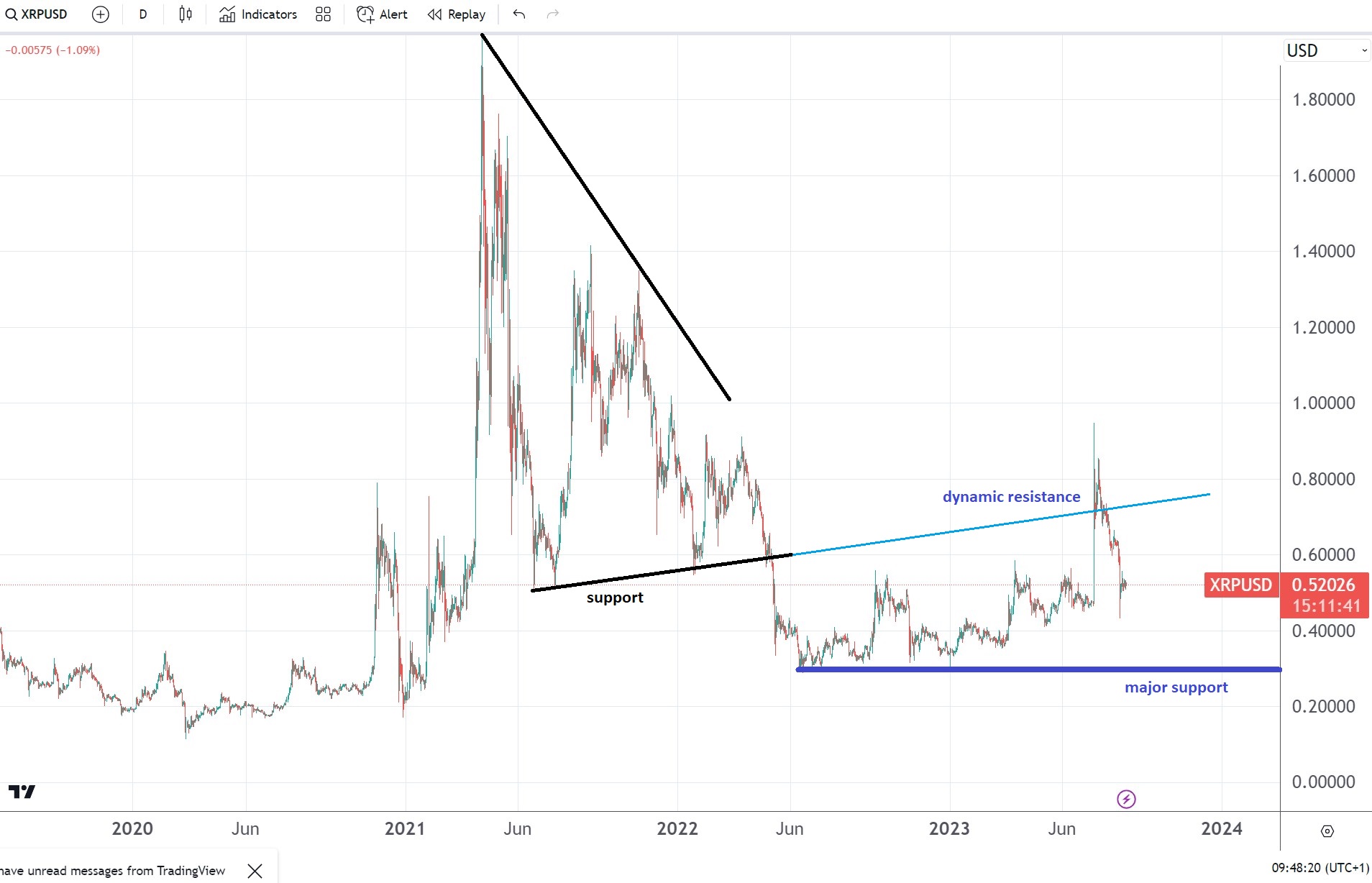
One can build both a bullish and a bearish case for Ripple by looking at the technical picture. But the main thing is that Ripple is back in the range, unable so far to break above or below major resistance and support areas.

Ripple chart by TradingView

The bullish case for Ripple

In 2021, Ripple’s price surged to over $1.8 as investors hurried to get exposure to the cryptocurrency market during the COVID-19 pandemic. But sellers quickly emerged, and a bearish triangle formed.

The triangular consolidation held until 2022. In the first half of that year, Ripple’s price broke lower. It did so by breaking support given by the lower edge of the triangle, and since then, it has not looked back.

Until this July.

Previous support turned out to be dynamic resistance. It is this resistance that kept bulls at bay following the July news.

However, despite the rejection, one can build a bullish case for Ripple. The $0.3 area acted as a major support in 2022, and the market has built a series of higher highs and higher lows ever since. As long as it holds above support, Ripple’s price might recover and attempt to break and hold above dynamic resistance again.

The bearish case for Ripple

On the other hand, the recent selloff alone has scared many traders. Optimism vaned, and with it, capital fled, too. If Ripple’s price drops below $0.4, the momentum then builds for further downside toward the major support area seen at $0.3. A break there, and it is game over for bulls that were so sure that Ripple’s time has come.

The post Ripple back under pressure, bears eye major support area appeared first on CoinJournal.

Optimism Foundation proposes a 118M OP grant to Base

  • The Optimism Foundation and Coinbase-backed layer-2 platform Base eye shared governance of OP Chains.
  • Base will receive 118 million OP token spread over six years.

The Optimism Foundation and Base, a Layer 2 on the OP Stack, are looking to cooperate further in the quest to enhance security, scalability and decentralisation in the Optimism Collective – the Superchain.   

For this, the Optimism Foundation has outlined a proposal that could see Coinbase-backed Base receive a grant totaling 118 million OP tokens.

“This grant is meant to retroactively reward Base’s contributions thus far to scaling Ethereum and the OP Stack, ensure Base’s long term alignment and commitment to the ecosystem, and critically, give Base a meaningful voice in the system of Optimism Governance, to which they’ve entrusted the future of their chain,” the announcement read.

Optimism’s revenue and governance proposal also details a commitment that the Base team has to make with regard to distributing the greater of either 2.5% of its sequencer revenue or 15% of net on-chain profits, to Optimism Collective. The 118 million OP tokens will be spread over six years and come with a cap of 9% on votable supply.

Base and Optimism to share upgrades

The move to agree on a Base/Optimism Foundation collaboration comes after last month’s “Law of Chains” proposal that seeks to transition Optimism governance from focusing on just the OP Mainnet to all chains on OP Stack. This is what’s dubbed the Superchain.

The Foundation plans to have a governance vote on the transition in place in early 2024. On what happens next, it noted:

“Base and OP Mainnet will share upgrades, so the chains’ blockspace remains compatible, homogenous, and eventually interoperable in a Superchain future.  How those upgrades evolve is up to Optimism Governance.”

If the “Law of Chains” is ratified, some of the key steps to be executed will include upgrades across Base, the OP Mainnet, and other chains on OP Stack. The teams will also work on a decentralised Security Council and “Pessimism,” a cybersecurity monitoring tool.

Base launched on August 9 and is seeing growing traction with total value locked (TVL) up 9% in the past week to $183 million. DeFiLlama data shows Optimism currently ranks sixth among top chains with over $715 million in TVL.

The post Optimism Foundation proposes a 118M OP grant to Base appeared first on CoinJournal.

Num Finance launches stablecoin pegged to Colombian Peso on Polygon

  • Num Finance’s new stablecoin nCOP adds to the nARS and nPEN pegged on Argentina Peso and Peruvian Sol.
  • Colombia is one of Latin America’s top remittances markets with nearly $6.5 billion of inflows.

Num Finance, a stablecoin issuer focused on the Latin America market, has launched a new stablecoin pegged to the Colombian Peso.

The new stablecoin is dubbed nCOP and will be issued on the Polygon network, Num Finance’s blockchain partner, and is designed to bring the benefits of borderless transactions to the Colombian remittances market.

“In Colombia, there exists a unique opportunity to “tokenize” remittances and offer them a yield in nCOP, based on regulated financial products. Currently, Colombia is one of the main recipients of remittances in Latin America, with nearly USD 6.5 billion flowing into the country. Num Finance aims to provide a new possibility for people to send and receive nCOP as remittances and get a yield on it,” Num Finance CEO Agustín Liserra said in a blog release.

Num Finance’s footprint in Latin America

nCOP will be an overcollateralized stablecoin pegged 1:1 to the Colombian Peso and will offer people in the region a robust, stable and secure channel to send and receive funds. The stablecoin will also enable companies to tap into real time settlements, bringing efficiency to cash management.

Num Finance will also offer a yield feature for nCOP, with token holders getting rewards from regulated financial products.

Other than the Colombian peso-pegged stablecoin, Num Finance also issued nARS and nPEN, which are pegged to the Argentine Peso and Peruvian Sol. 

The company launched in 2021 and raised $1.5 million in a pre-seed funding round closed in May. The capital financing was led by crypto project Reserve and attracted several investors including H20 Scouter Fund, Ripio Ventures, and Auth0 CTO Matias Woloski.

The post Num Finance launches stablecoin pegged to Colombian Peso on Polygon appeared first on CoinJournal.

Whale moves millions of XRP tokens to Bitstamp

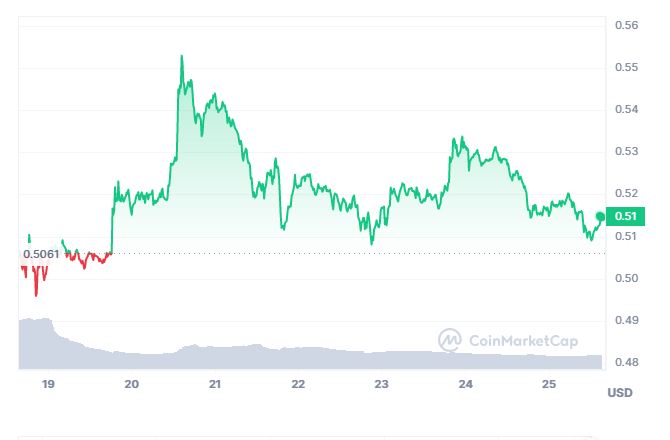
  • At press time, Ripple (XRP) was trading at $0.5149, down 1.64% in the past 24 hours.
  • The XRP trading volume has dropped by 4.56% today as fears of XRP’s future continue.
  • The Court allowed the US SEC to appeal the Ripple (XRP) case.

Investors appear to be liquidating their positions as Ripple (XRP) struggles to maintain growth following Judge Torres’ summary finding in the US SEC v. Ripple Labs case that XRP isn’t a security. Additionally, following a recent price decrease, a whale moved over 29 million XRP, worth over $15 million, to the Bitstamp cryptocurrency exchange.

According to a Whale Alert article on August 24, the whale transferred 29,300,000 XRP worth $15.13 million to the Bitstamp.

Additional information raises the probability that this whale may be angling to sell its XRP holdings because it recently transferred another 14 million XRP to Bitso.

Although Ripple (XRP) has become a centre of attention after winning the case against the SEC, the cryptocurrency is facing an uncertain future after Judge Torres allowed the U.S. Securities and Exchange Commission (SEC) to lodge an interlocutory appeal challenging the sale of XRP tokens. After the ruling, the price of XRP fell sharply and broke through important support levels of $0.6 and $0.5 even as some professionals hold that the appeal would not be a setback for Ripple.

Ripple (XRP) price chart

 Although the XRP price has since slightly risen from the $0.5 support level, there is a big chance of a sharp decline if traders and whales decide to sell their holdings in fear of the outcome of the SEC appeal.

The appeal case between Ripple and the US SEC is expected to start around the middle or end of May 2024 in the interim. This timetable is consistent with the SEC and Ripple Labs court notifications, as well as those of CEO Brad Garlinghouse and executive chairman Chris Larsen, who stated that they would not be available until the second quarter of 2024.

The post Whale moves millions of XRP tokens to Bitstamp appeared first on CoinJournal.