
Bitcoin jumps on Grayscale news, but what happens with the USD is more important

  • Grayscale won a landmark ruling against US regulators
  • The SEC was wrong to reject Grayscale’s application to transform the Bitcoin trust into an ETF
  • Bitcoin’s price jumped, but it is more relevant what happens to the US dollar next

Grayscale is a leading crypto asset manager. It enables traders and investors to gain exposure to the cryptocurrency market through a Bitcoin trust.

The trust now has over $17 billion in assets under management, and the eligible shares of Grayscale Bitcoin Trust are quoted on OTCQX under the symbol GBTC.

Yesterday, Grayscale won a landmark decision from a US court that ruled against the Securities and Exchange Commission over Grayscale’s Bitcoin ETF.

Grayscale wants to convert the Grayscale Bitcoin Trust into an ETF (Exchange Traded Fund), but the SEC did not allow it. However, the federal court ruled that the SEC was wrong.

As a result, Bitcoin price jumped above $27k. While Grayscale’s news is positive for the industry, for Bitcoin, it is more relevant what happens to the US dollar.
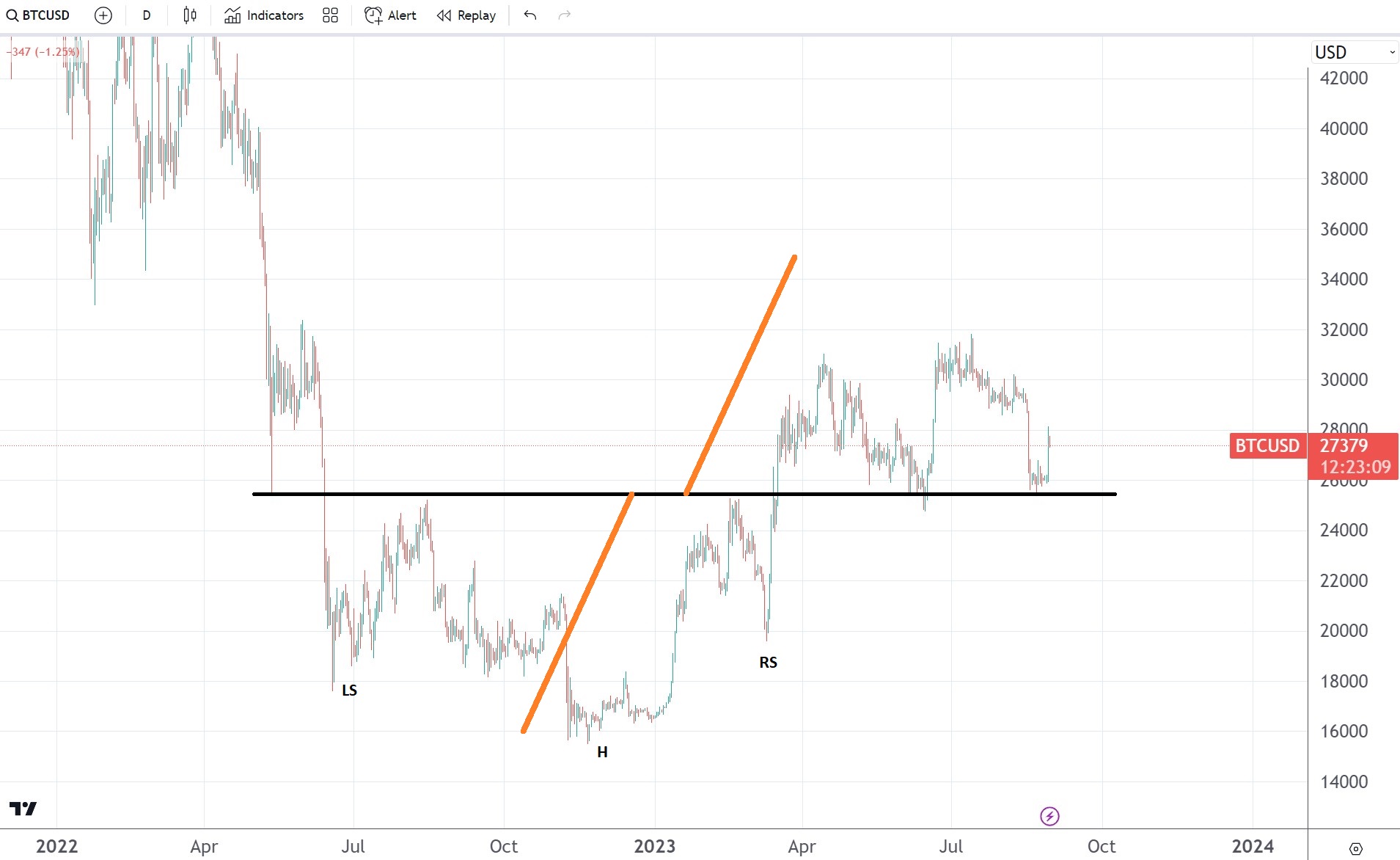
Bitcoin chart by TradingView

Bitcoin bounces from support as the US dollar weakens

At the same time, when the US federal court ruled in favor of Grayscale, news came out that the labor market in the United States softened. Major stock market indices advanced as the dollar lost ground.

This is a trend to watch in the future.

Because the Fed is convinced that inflation has peaked, the focus sits now on the labor market. If jobs data this week confirms the soft path, expect Bitcoin to gain some more.

From a technical standpoint, Bitcoin bounced from horizontal support given by the neckline of an inversed head and shoulders pattern. The neckline is often retested, and now the focus shifts (again) to the measured move that points to $35k and beyond.

The post Bitcoin jumps on Grayscale news, but what happens with the USD is more important appeared first on CoinJournal.
EOS expands into East Asia markets with regulatory approval in Japan

  • The EOS received a whitelist approval from the Japan Virtual and Crypto Asset Exchange Association (JVCEA).
  • EOS will start trading on BitTrade in Japan in mid-September.
  • Crypto-asset providers in Japan are monitored and regulated by the JVCEA and FSA under the Payment Services Act.

The EOS Network Foundation has announced that the Japan Virtual and Crypto Asset Exchange Association (JVCEA) has approved the EOS cryptocurrency for inclusion on its whitelist. The accomplishment opens the door for EOS to be traded in Japan on authorized cryptocurrency exchanges against the yen.

By giving the EOS Network more exposure and accessibility to a wider spectrum of Japanese end users, developers, and investors, the JVCEA’s approval represents a significant advancement for EOS. Midway through September, EOS will start trading on BitTrade, a renowned cryptocurrency exchange authorized and governed by the nation’s Financial Services Agency (FSA).

Japan’s strict crypto regulations

Japan’s strict regulatory regime controlling digital tokens is well known for its thoroughness and sturdiness. The Payment Services Act mandates a detailed pre-screening procedure for new digital assets, and the JVCEA and FSA closely monitor and regulate crypto-asset providers. The EOS Network’s adherence to these strict rules demonstrates its dedication to openness, security, and innovation.

With the successful extension of Upland, built on EOS and one of the largest metaverses in the business, to encompass Tokyo, the network is already experiencing a rise in popularity and usage in the Japanese market.

EOS has a solid reputation among blockchain fans and developers thanks to its five years of uninterrupted mainnet operation and its top-tier Ethereum Virtual Machine, which offers unrivalled performance.

This endorsement shows that the EOS Network’s dependability and performance have been acknowledged, opening the door for further development and acceptance in East Asian markets. As one of the top blockchains globally, EOS is well-positioned for ongoing progress in the area thanks to strong collaborations and a successful track record.

The post EOS expands into East Asia markets with regulatory approval in Japan appeared first on CoinJournal.

Digital asset investment products record largest outflows since March

  • Digital assets investment products saw outflows of $168 million last week, $146 million of which was for Bitcoin.
  • It’s the largest weekly outflows total since March 2023, according to a report by CoinShares.

CoinShares’ latest weekly report on digital asset investment flows shows that the market witnessed its largest funds outflows in nearly six months last week. The outflows come as sentiment across cryptocurrency dips amid recent sell-off.

Crypto sees $168 million in outflows

According to the report, outflows totaled $168 million over the week to mark the largest outflow from crypto products since March 2023 when the US Securities and Exchange Commission (SEC) started its regulatory crackdown on major exchanges.

The outflows in the week ended August 25 saw the monthly outflows stand at $278 million as sentiment continued to trend negative amid “exceptionally low trading volume.” Indeed, CoinShares data shows the investment products market traded $1.3 billion last week, about 16% off the year’s average.

“This negative sentiment we believe is due to the increasing acceptance that a spot-based ETF for Bitcoin in the US is likely to take longer than many expect, with recent delays being announced by the SEC,” said James Butterfill, head of research at CoinShares.

Bitcoin continues to lead

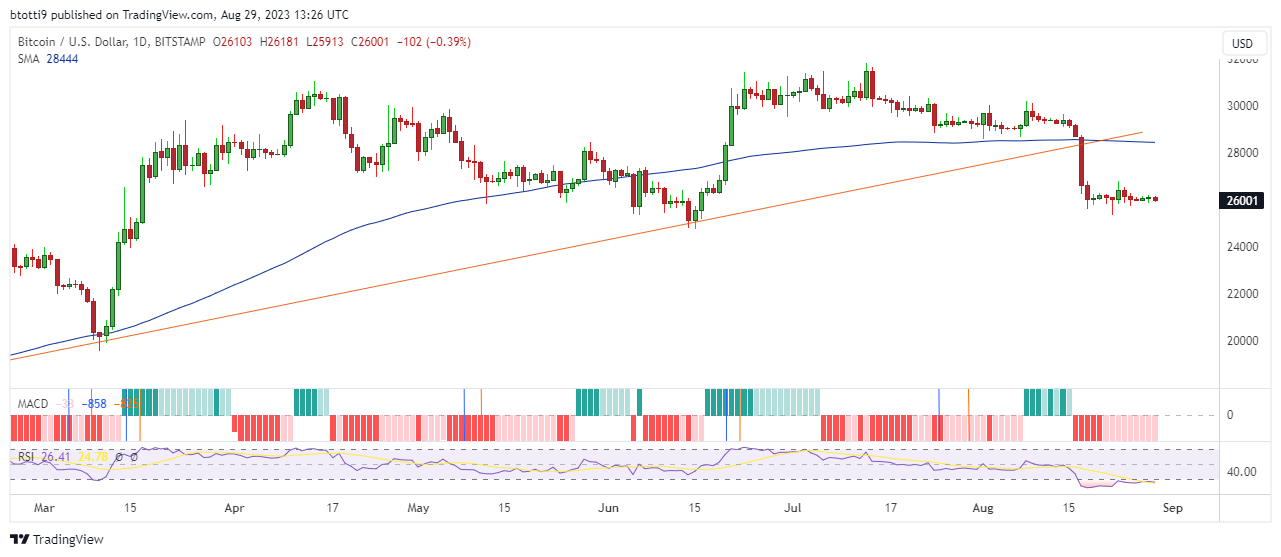
The crypto market recently witnessed a sharp sell-off for Bitcoin, the benchmark cryptocurrency falling to lows of $25,350. The struggle to strengthen above $26k has illustrated the market jitters permeating the broader risk assets sector, with this shown in outflows from Bitcoin investment products.

Bitcoin price chart

However, while outflows totaled $149 million last week, the flagship crypto asset’s flows are net positive for the year at roughly $265 million. Meanwhile, investors are increasingly selling their short positions, with $4 million in outflows registered last week for an 18-week streak of outflows. 

Data shows shorts outflows are currently 89% of the total AuM.

In the altcoin market, Ethereum recorded outflows of $17 million, while XRP and Litecoin had minor inflows of $0.5 million and $0.44 million, respectively.

The post Digital asset investment products record largest outflows since March appeared first on CoinJournal.

Bitcoin miner Canaan’s mining revenue rose 43% in Q2

  • Canaan Inc. (NASDAQ: CAN) has released its Q2 financial report showing an increase in mining revenue.
  • The Bitcoin miner’s total revenue rose to $73.9 million, increasing by 33.7% compared to Q1, 2023.
  • Canaan reportedly held 1125 bitcoins as of June 30, 2023.

Canaan Inc. (NASDAQ: CAN), one of the leading Bitcoin mining companies, has reported its unaudited financial results for Q2, 2023. According to the report, revenue from BTC mining jumped 43.3% quarter-on-quarter, from $11.1 million to $15.9 million.  

Meanwhile, total revenues rose to $73.9 million in the quarter, 33.7% up on Q1 revenues of $55.2 million. However, with the crypto market still heaving from the bear market impact, Canaan’s second quarter revenue is significantly lower compared to the $245.9 million reported in Q1, 2022.

Commenting on the financial results, Canaan CEO Nangeng Zhang, said in a press release: 

“We navigated the challenges in the second quarter of 2023, surpassing our topline guidance to achieve $73.9 million in revenue. Despite the relatively stagnant bitcoin price in the second quarter, our endeavor to drive sales across various fronts, including major clients, channels, and retail, yielded encouraging results. This effort propelled our total computing power sold to a remarkable 6.1EH/s, up 44% sequentially.”

Canaan held 1,125 bitcoins

According to Mr. Zhang, the company benefited from its collaboration with channel clients, and saw its online retail store attract new clients from across the globe.  The firm has recently looked to cement its footprint in the sector, setting up mining ventures in Africa and South America.

As noted above, Canaan sold 6.1 million Thash/s – this up from 4.2 million Thash/s in Q1, 2023. The company had sold a total of 5.5 million Thash/s in Q1, 2022.

CFO James Jin Cheng stated: “In the second quarter of 2023, we observed improvement in both our sales and mining activities, which contributed to our better-than-expected revenue performance. Despite a decrease in average selling price, our product sales grew by 31.3% quarter over quarter, driven by increases in total computing power sold.”

While the company expects Q3 revenue to decline to $30 million owing to the market conditions, net loss in Q2 was $110.7 million, compared to $84.4 million in Q1. The company had seen a net income of $90.1 million during the same quarter in 2022.

Per the report, Canaan held 1,125 bitcoins worth $28.8 million as of June 30, 2023. The company owned 747 of these bitcoins, while 378 BTC was from customer deposits. Impairment on the crypto in Q2 was $2.4 million, compared to $0 in Q1 and $4.5 million in Q2, 2022.

The post Bitcoin miner Canaan’s mining revenue rose 43% in Q2 appeared first on CoinJournal.

Crypto exchange Binance is considering a full exit from Russia

Key takeaways

  • Binance is considering exiting the Russian market as it continues to face regulatory challenges in other parts of the world. 

  • The crypto exchange recently revealed that its users in Belgium will access its services via its Poland unit.

Binance to exit the Russian market

Binance, the world’s leading cryptocurrency exchange by market cap, is reportedly considering exiting the Russian market. This is according to a recent report by the Wall Street Journal. 

This latest cryptocurrency news comes as the crypto exchange continues to face regulatory challenges in Europe and the United States. 

The report pointed out that Binance is currently tackling multiple lawsuits with US regulators and is currently considering numerous options, including a full exit from the Russian market.

Binance is working to align itself with international sanctions

Binance said it is working to align itself with international sanctions following allegations that it is helping nationals move funds outside the United States earlier this year. 

The cryptocurrency exchange is working to block accounts belonging to Russian nationals with connection to the Kremlin. 

In 2022, the crypto exchange took steps to block accounts belonging to Elizaveta Peskova, the daughter of Dmitry Peskov, spokesperson for Russian leader Vladimir Putin. 

Binance also said it shuttered accounts from others connected to family members of top Russian officials. The moves came following sanctions against Peskova by the US Treasury. 

The cryptocurrency exchange has been facing regulatory challenges in the United States and other parts of the world.

Earlier this month, Binance informed its users in Belgium that they could now access its services via Binance Poland, the crypto exchange’s Polish-regulated arm. The move was to ensure that Binance complies with regulatory requirements in the country.

The cryptocurrency exchange also discontinued support for its crypto-backed debit card for customers in Latin America and the Middle East earlier this month. However, Binance didn’t specify the reasons behind its decision. 

The US and EU have imposed sanctions on Russia after it invaded Ukraine last year. They have imposed bans on the acquisition, import, or transfer of coal and other solid fossil fuels.

The post Crypto exchange Binance is considering a full exit from Russia appeared first on CoinJournal.