
Bitcoin trades with a bullish bias ahead of the US inflation data

  • Financial market participants await the US inflation data
  • Bitcoin shows signs of a possible reversal
  • A falling wedge and a bullish divergence support the case for higher Bitcoin prices

Today is important for anyone interested in financial markets and US data. Because the US economy is the largest in the world and the US dollar is the world’s reserve currency, monetary policy is the main driver of financial markets’ volatility.

Volatility, or the lack of it, is the one that upsets cryptocurrency traders. Bitcoin went nowhere since it traded above $30k in April, as every rally was sold.

But a close look at the traditional currency market reveals that most fiat currencies have traded similarly against the US dollar. Therefore, if anything is going to push the cryptocurrency market’s volatility up, it is going to be the US dollar.

Core CPI expected at 0.2% in August

Today’s release in the United States is expected to show that the Core CPI in August has increased by 0.2% m/m while the headline inflation is set to rise to 0.6% m/m from the previous 0.2%.

But the bias is that inflation will surprise to the downside.

If that is the case, the bets will increase the Fed will hold rates steady and perhaps, it will be enough to convince market participants that there will be no rate hike anymore and that the Fed has already reached the terminal rate.

A bullish divergence supports the case for higher Bitcoin prices

The summer months brought broad US dollar strength across financial markets. EUR/USD dropped from above 1.12 to below 1.07. At the same time, Bitcoin declined from $32k to $25k as investors bought the US dollar.
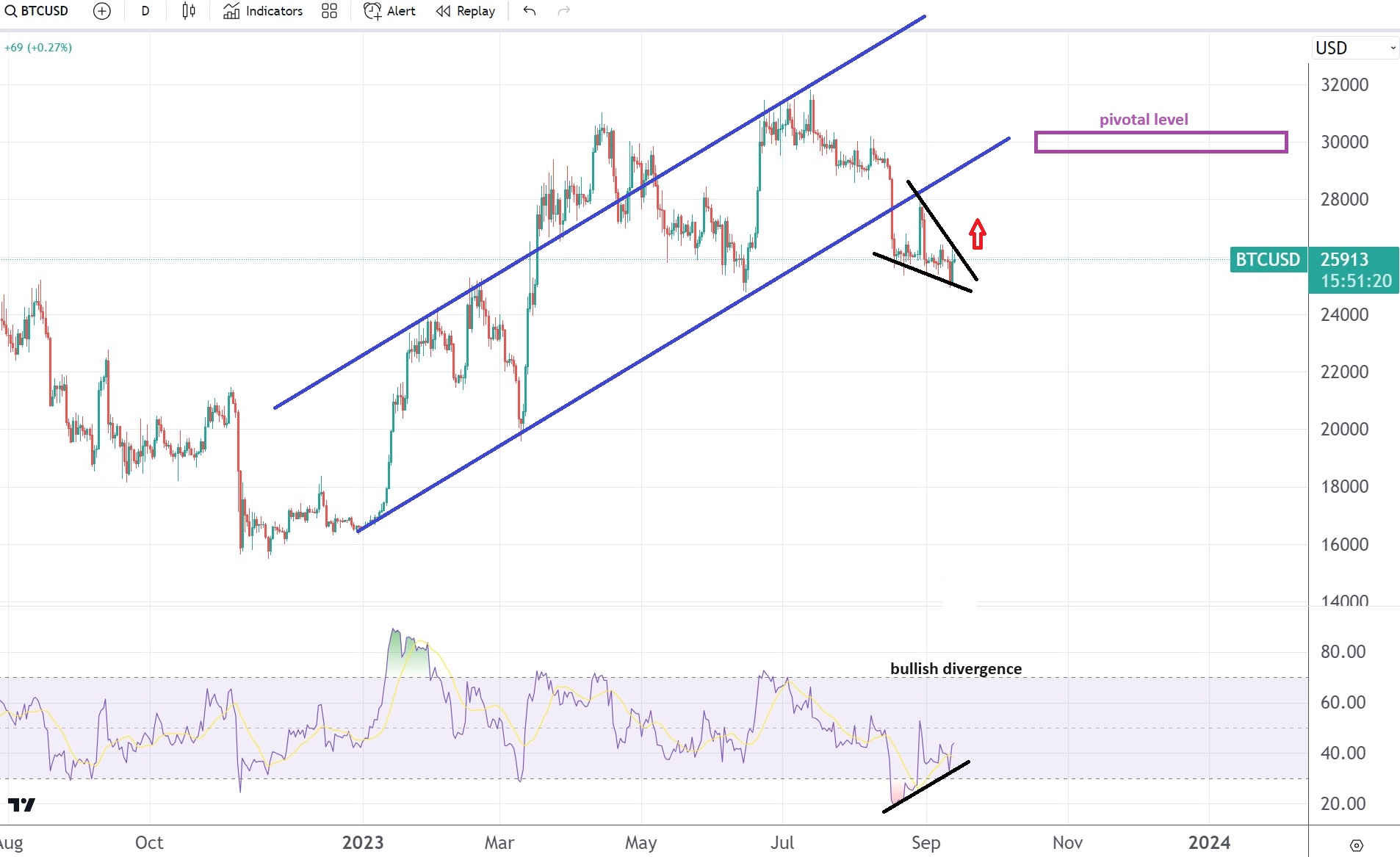
Bitcoin chart by TradingView

However, recent price action suggests that there is scope for optimism. First, the market formed a bullish divergence with the RSI. Second, a falling wedge pattern suggests that a reversal might be in the cards.

All in all, we will all find out where Bitcoin goes next sooner rather than later. Now that the lull summer trading is gone, expect the market’s volatility to pick up as important economic data is due.

The post Bitcoin trades with a bullish bias ahead of the US inflation data appeared first on CoinJournal.
BitMEX launches prediction market for real-world events- implications for Chancer?

  • BitMEX launched the Prediction Markets product to allow traders bet on events such as outcome of FTX bankruptcy claims and Sam Bankman-Fried’s criminal case.
  • The product offers speculative contracts that will be marked at Last Price.
  • Chancer on the other hand is a blockchain-based prediction markets platform expected to revolutionise the gambling industry.

 Crypto exchange BitMEX has unveiled a new predictions product for its users, with the global community able to bet on real-world events from within the platform. What is BitMEX’s Prediction Markets and how is this different from what Chancer, an anticipated game-changer for the $80 billion gambling industry, offers?

What’s BitMEX’s Prediction Markets?

Prediction Markets is a new crypto derivatives offering from BitMEX that will allow traders to take positions that predict the outcome of certain real-life events. While the contracts will cover nearly every topic, industry or event, it’s BitMEX that will add the markets and thus dictate what traders can bet on at any given time.

Bet on events such as Bitcoin spot ETF approval, SBF jailing

For its first contracts, the crypto exchange is offering account holders  a chance to earn returns on predictions on three topics – FTX bankruptcy claims, Bitcoin ETF approval and fate of former FTX CEO Sam Bankman-Fried.

Other markets will be added soon, with users able to benefit from not just trading, but hedging opportunities. According to details in a blog post, BitMEX is offering the first three predictions markets events as from September 13. 

The speculative contracts are marked on Last Price, with no leverage. Margin and settlement will be in Tether (USDT).

What is Chancer?

BitMEX’s new offering adds to what’s available and in the pipeline for the prediction markets. But there’s a huge difference to what Chancer offers and how it works.

Simply put, Chancer offers a decentralised betting platform powered by the $CHANCER token, where anyone can create bets on any event. There’s no central bookmaker and wagers can be on anything – from global sports, elections and community events. Even the likes of whether Bitcoin will end the year above or below a certain price is possible.

Chancer’s social betting model, which allows for features such as sharing of bet markets and livestreaming, is expected to revolutionise the $80 billion gambling industry. Growth for the sector, coupled with expected adoption of cryptocurrency, is likely to propel the blockchain-based platform into becoming the dominant force in peer-to-peer (P2P) betting.

Per the Chancer roadmap, the above scenario will begin to take shape when the Chancer platform goes live in the first quarter of 2024. By then, $CHANCER holders will have access to passive earning opportunities, including through staking. Find out more here.

Why buy $CHANCER now?

As the crypto market gets more and more institutionalized, so is the potential for an explosion of everyday usage.

Taking control from centralised bookmakers and giving the power to create bets, determine odds and earn payouts to individual users gives Chancer an upper hand when it comes to tapping into a market expected to grow significantly over the next decade.

This is what makes $CHANCER’s presale price of $0.011 today look attractive – a bargain vis-à-vis the future potential. Investors keen on a new crypto gem might fancy a portion of their investment in this project. Factors such as the mainnet launch, listing on major crypto exchanges and broader sector outlook suggest this could be a good time to take a long-term bet on this blockchain-powered project.

Currently, investors can participate in the presale and buy $CHANCER with ETH, BNB, USDT and BUSD. The project has so far raised nearly $2 million.

Are you interested in $CHANCER? Visit the official Chancer presale page for more on how to buy.

The post BitMEX launches prediction market for real-world events- implications for Chancer? appeared first on CoinJournal.

Crypto volatility continues to plummet, spot volume now at two-year lows


Key Takeaways

  • Volatility briefly rose in crypto markets last month but is back near all-time lows
  • Capital flight out of the space has been enormous, with liquidity also at multi-year lows
  • Trading volume continues to decline, with Binance’s volume down 95% from the peak in 2021
  • Ethereum is now trading at a similar volatility to Bitcoin
  • A combination of tight monetary conditions in the economy, as well as crypto-specific scandals and a regulatory crackdown, have all made their mark on the space

Volatility in the crypto markets is back to multi-year lows. After a brief pickup amid the positive ruling on the Grayscale ETF case last month, markets are back to the placid state we have become familiar with this year.

Looking at 90-day annualised volatility, both Bitcoin and Ethereum are close to the lowest levels we have seen. The chart below shows that, aside from three isolated episodes, we have seen volatility in a near-constant state of decline since Q1 of 2022. That marks the infelxion point for the wider economy, when we transitioned to a tight monetary environmen, kicking off what would prove to be a gruesome time in crypto.

The three episodes of reprieve with regard to volatility were the Terra collapse and subsequent summer of bankruptcies (from May 2022), the FTX collapse in November 2022 and, most recently, the banking contagion in March 2022. Otherwise, it has been a downhill ride.

The muted state of the once-volatile asset class is hurting market makers and liquidity. While the entire ecosystem has been ravaged, it is important to note that the macro environment has also pared down in volatility this year, as can be seen on the below chart where we have included the 90-day volatility of the Nasdaq for reference. 

However, the scale of the decline in crypto has gone above and beyond. While digital assets remain highly correlated with risk assets (the tech-heavy Nasdaq being the classic example), the capital flight and drain of both volatility and liquidity form the blockchain sector have been unmatched elsewhere.

Such is the lack of volatility that we are now even seeing Ethereum trade with similar volatility to Bitcoin (for a brief period, Ethereum’s volatility was even even lower than Bitcoin’s), despite the former traditionally operating at volatility levels above the world’s biggest crypto. 

On the one hand, this is positive for Ethereum and demonstrates a growing maturity. On the other hand, the convergence is emblematic of the drain in overall volatility from the space at large. 

Yet, in the context of what is happening across the space, the drawdown is not surprising. We keep mentioning the capital flight and dearth of liquidity; in looking at the numbers, the chasm compared to previous years is enormous. 

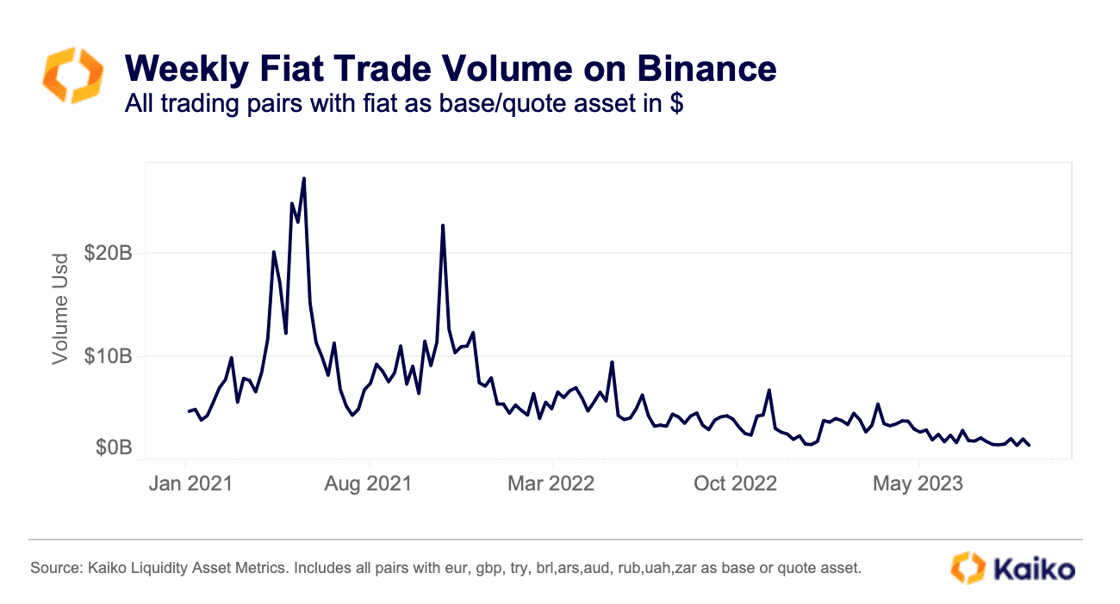
Fiat trade volume on Binance, the world’s biggest exchange with an approximate two-thirds market share of total volume, is down to its lowest level in more than two years. Fiat trade volume on Binance has declined by more than 60% since early January and is down 95% relative to its 2021 peak, according to data from Kaiko. 

While Binance is facing myriad issues which may have exacerbated the decline, the underlying fact remains: liquidity has fled the space at the speed of light, to the extent which has surprised perhaps even the most bearish of crypto analysts’ predictions. Not to mention, one of the many accusations levelled against Binance through several lawsuits is an alleged manipulation of trade volume, so perhaps the dropoff is even worse than those above numbers imply. 

Given volume and volatility go hand-in-hand, the subsequent drawdown in the latter is, therefore, not surprising. Crypto resides as far out on the risk spectrum as can be, and in a world that has seen interest rates jump from 0% to above 5% – and at a pace among the fastest in modern economic history – the fallout makes sense. And that is without even layering in the numerous scandals and crypto-specific episodes which have pushed market makers and investors alike away.

The post Crypto volatility continues to plummet, spot volume now at two-year lows appeared first on CoinJournal.

Lido price staggers ahead of the 1.5 million LDO token unlock

  • At press time, Lido Finance (LDO) was trading at $1.47, down 1.41% in the past 24 hours.
  • Lido Finance is set to unlock 1.5 million tokens in the next 24 hours.
  • The tokens to be unlocked constitute approximately 0.27% of the circulating supply.

Lido Finance (LDO) has garnered notable attention lately, primarily due to its involvement in Ethereum (ETH) staking. However, an impending token unlock scheduled within the next 24 hours is poised to augment the circulating supply of its ecosystem token, LDO. 

The key questions are how significant this token increase might be to the circulating supply and what potential ramifications it could entail.

Unlocking More Tokens at Lido Finance

In accordance with a post by Token Unlocks dated September 11, Lido Finance is slated to undergo its final token unlock on September 13. This unlocking event will introduce 1.50 million LDO tokens into circulation, valued at approximately $2.24 million, constituting approximately 0.27% of the circulating supply.

CoinMarketCap’s data indicates that the circulating supply of LDO at press time exceeded 888 million tokens. With the impending release of these unlocked tokens, the circulating supply is set to surpass 889 million.

According to data on CoinMarketCap, Lido Finance experienced a significant surge in trading volume over the past 24 hours. The volume chart on Santiment also depicts a minor spike resulting from this uptick. It’s worth noting that the volume had been on a declining trajectory until this recent surge.

As of the time of writing, the trading volume was well over $41 million.

Expected impact of the LDO token unlock

While token unlocks are known to cause a significant price drop due to a sudden increased supply, it may not be the case for the LDO token taking into account the prevailing state of trading volume at press time and historical trends. The forthcoming unlock of LDO tokens is unlikely to exert a substantial impact on LDO’s price trajectory.

Given that the total value of the LDO tokens set to be unlocked amounts to $1.5 million, or roughly $2.24 million, market conditions appear capable of absorbing this amount without causing significant disruption.

The post Lido price staggers ahead of the 1.5 million LDO token unlock appeared first on CoinJournal.

Binance US reduces staff by a third, CEO leaves

  • Binance US has been facing regulatory pressure from the SEC.
  • Binance’s US cryptocurrency market share dropped from more than 22% in April to approximately 0.9% by June 26.
  • Norman Reed, the Chief Legal Officer of Binance US, has assumed the role vacated by Brian Shroder.

Binance US, the US branch of the Binance cryptocurrency exchange, has undertaken significant restructuring measures, which include a workforce reduction of approximately one-third, equivalent to the elimination of 100 positions. Brian Shroder, the President and CEO of Binance US, has also stepped down from his role.

Brian Shroder joined Binance US in September 2021, and his departure coincides with a wave of regulatory actions taken against the exchange in recent months.

As a temporary measure, Norman Reed, the Chief Legal Officer of Binance US, has assumed the role vacated by Brian Shroder.

A spokesperson representing Binance US officially verified these layoffs and Brian Shroder’s departure and said that the actions were taken to bolster the exchange’s financial resilience, providing it with a substantial financial buffer as it transitions into a crypto-only exchange.

Impact of SEC’s regulatory action against Binance

 The cryptocurrency exchange spokesperson emphasized the impact of the Securities and Exchange Commission’s (SEC) robust regulatory action on the cryptocurrency industry asserting that the actions of the regulator have tangible repercussions on American jobs and innovation.

Earlier this year, both the SEC and the Commodity Futures Trading Commission (CFTC) initiated legal action against Binance, Binance US, and the exchange’s co-founder, Changpeng “CZ” Zhao for operating an illicit exchange, selling unregistered securities, violating commodities regulations, and mismanaging customer funds.

In response to the regulatory challenges, on June 9, Binance US suspended dollar deposits and communicated the temporary cessation of fiat withdrawal channels during its ongoing battle with the SEC. The exchange subsequently operated exclusively as a crypto-only platform for two months before reintroducing USD transaction capabilities in August after a partnership with MoonPay.

According to a July report from Reuters, which cited data from Kaiko, Binance US experienced a substantial reduction in its market share in the US cryptocurrency market. Its market share plummeted from more than 22% in April to approximately 0.9% by June 26, underscoring the evolving landscape and challenges faced by the exchange in the United States.

The post Binance US reduces staff by a third, CEO leaves appeared first on CoinJournal.