
Chase Bank customers can now pay mortgages using crypto through FCF Pay

  • Chase Bank customers can make cryptocurrency payments for credit card bills, loans, and mortgages.
  • Accepted cryptocurrencies include Bitcoin, Ethereum, Shiba Inu, XRP, Dogecoin, Binance Coin, Tether, and USD Coin.
  • Despite this collaboration, Chase Bank maintains its stance of settling payments in fiat currency, not cryptocurrencies.

In a significant development in the world of finance, Chase Bank, a subsidiary of JP Morgan Chase, has teamed up with FCF Pay, a Canadian blockchain payments processor, to offer customers the option of paying their credit card bills, loans, and mortgage payments using cryptocurrencies.

This move adds Chase Bank to the growing list of financial institutions that are exploring the integration of digital currencies into their services.

Cryptocurrency payments for bills

Under this new partnership, Chase Bank customers can make payments using a variety of popular cryptocurrencies, including Bitcoin (BTC), Ethereum (ETH), Shiba Inu (SHIB), Ripple (XRP), Dogecoin (DOGE), Binance Coin (BNB), as well as stablecoins like Tether (USDT) and USD Coin (USDC).

This expanded payment option reflects the increasing acceptance of digital assets in mainstream finance.

While this development may seem like Chase Bank is fully embracing cryptocurrencies, it’s essential to clarify that the bank’s core stance on crypto has not shifted. FCF Pay processes these cryptocurrency payments on behalf of customers, but the final settlements with Chase Bank are made in fiat currency through an off-ramp solution.

This ensures that Chase Bank continues to operate within traditional financial frameworks.

Chase doesn’t directly accept crypto

Justin K. Page, the Communications VP for Chase Bank, emphasized that Chase does not directly accept cryptocurrencies for mortgage payments, loans, or credit cards. The bank’s official position remains unchanged, as it does not have an affiliation with FCF Pay. This distinction is crucial, as it clears any misconceptions about the bank’s stance on cryptocurrency acceptance.

Notably, Chase Bank’s foray into cryptocurrency payments follows the footsteps of other major financial institutions that have embraced blockchain technology. Earlier in 2023, JP Morgan Chase launched blockchain Euro payments, demonstrating its support for the adoption of blockchain technology.

The post Chase Bank customers can now pay mortgages using crypto through FCF Pay appeared first on CoinJournal.
Tradecurve Markets (TCRV)’s meteoric rise rivals Tron (TRX) and Avalanche (AVAX)

In the ever-evolving world of cryptocurrencies, Tradecurve Markets has emerged as a new contender, experiencing a meteoric rise that is drawing investors away from established coins like Tron (TRX) and Avalanche (AVAX). 

Even though Tradecurve Markets is still in its presale phase, the industry-defining features of this platform are turning heads in the crypto community.

Tradecurve Markets bridging crypto, Stocks, and Forex

Tradecurve Markets is a hybrid trading platform that’s rapidly becoming a force to be reckoned with. Recently, it’s not just its innovative approach to trading that’s catching attention, but its remarkable ability to attract and redirect investments from established giants like Tron and Avalanche.

The platform amalgamates multiple asset classes, spanning cryptocurrencies, forex, commodities, and company stocks. This one-stop-shop approach to trading eliminates the inconvenience of managing assets across different platforms, offering users a singular, streamlined interface.

In an age where data privacy is paramount, Tradecurve Markets’ commitment to user anonymity stands out. The platform challenges the status quo by dismissing the customary, often tedious, KYC/AML processes. Instead, users can effortlessly onboard with just an email address and a cryptocurrency deposit.

Beyond its ease of use, Tradecurve Markets distinguishes itself with a suite of advanced trading tools. The inclusion of AI-enhanced trading strategies copy trading options, and leverages reaching up to 500:1 caters to both novices and seasoned traders.

The undeniable excitement surrounding the TCRV token is a testament to Tradecurve Markets’ burgeoning popularity. The token’s value has surged from $0.010 to $0.030 (representing a 200% surge) in a matter of weeks, with no signs of slowing.

Market analysts note that Tradecurve Markets’ surge in value is seeing an exodus of investors from Tron, Avalanche, and other established coins. They therefore expect the platform to close the gap between itself and its competitors in the coming months, with a $1.00 target price for the TCRV token by the close of 2023.

Tron (TRX)’s initial explosion and the hype cycle

Tron has been making headlines since its inception in 2017 as a blockchain-based platform for content sharing. That year saw Tron’s value soar to an all-time high of $0.30 per token and a whopping market capitalization of $12 billion. Fast forward to now, and its price has dwindled, settling at $0.077 and a market cap just north of $6 billion.

Much of Tron’s early ascent can be credited to the relentless marketing campaigns orchestrated by Tron’s CEO, Justin Sun. He painted Tron as the “next big thing” in the realm of smart contract platforms. But as the promotional blitz subsided, so did Tron’s price and market enthusiasm.

Adding to Tron’s woes is the circulating rumour regarding its CTO’s detention. Many Tron holders are now seeking solace in the Tradecurve Markets presale to grab the last remaining phase-5 tokens before the public launch.

Avalanche’s lead in the DeFi arena

Avalanche has been a major player in the DeFi arena since its launch in 2019. Much like Tron, it initially skyrocketed to reach an all-time high of $146 and a market cap of over $30 billion. That was back at the end of January 2021 though – today, Avalanche’s price is just $10.03.

Avalanche’s decline has been attributed to its lack of scalability and use cases, with many users finding it difficult to interact with the Avalanche platform due to its complexity and technical nature.

The current price of $10.03 means that Avalanche is on the edge of breaking below the significant $10 support zone. This Avalanche support has held strong for more than two years, so you can imagine the shockwave that will be sent through the DeFi space if it breaks

With a possible Avalanche decline to the $3.50 level on the horizon, many Avalanche investors could turn to Tradecurve Markets to advantage of the TCRV presale.

For more information about the Tradecurve (TCRV) presale visit their official Website or Twitter handle.

The post Tradecurve Markets (TCRV)’s meteoric rise rivals Tron (TRX) and Avalanche (AVAX) appeared first on CoinJournal.

New token quietly gaining traction, while Dogecoin and Cardano stagnate

Popular cryptocurrencies, Dogecoin (DOGE) and Cardano (ADA) are getting stiff competition from a new token called Everlodge (ELDG).

Everlodge (ELDG) is currently conducting a presale that is offering participants a chance to win a luxury holiday to the Maldives.

Robinhood Wallet accepts Dogecoin (DOGE)

Robinhood has added support for Dogecoin (DOGE) to its self-custody crypto wallet. Thus, Dogecoin holders can now store, send, and receive their DOGE directly from their Robinhood Wallet.

The addition of Dogecoin (DOGE) to Robinhood Wallet is a significant milestone for the memecoin. It makes Dogecoin more accessible to a wider audience and opens up new possibilities for DOGE holders. For example, Dogecoin holders can now use their DOGE to buy goods and services from merchants who accept Robinhood Wallet.

The current price of Dogecoin is $0.061 per DOGE. Dogecoin (DOGE) is 91.75% below its all-time high of $0.74. The price of Dogecoin (DOGE) has fallen by 1.41% in the past 7 days but has increased by 0.43% in the last 24 hours.

Cardano (ADA) price struggles, but interest remains high

Cardano (ADA) has been struggling in recent months. The price of Cardano has fallen by over 90% from its all-time high and is currently trading at around $0.24 per ADA.

Despite the price struggles, the Cardano (ADA) community is growing. The number of unique wallet addresses has increased by 6% since April 1, and there are over 30,000 new delegators on the Cardano (ADA) network. Thus, there is still a lot of interest in Cardano (ADA), even though the price does not reflect it.

There are a few reasons why Cardano’s (ADA) price has been struggling. Firstly, the overall crypto market is bearish. Secondly, there haven’t been any major developments on the Cardano network lately. Finally, Cardano (ADA) is facing competition from other blockchain platforms.

Everlodge (ELDG) presale

Ever wanted to own a piece of luxury property, but didn’t have the money? If so, then you need to check out Everlodge. It is a new platform that is revolutionizing the real estate market by making it possible for anyone to own a piece of luxury property, even if they don’t have a lot of money. The average price of fractional ownership is between $50,000 and $200,000. But Everlodge will let you own a part of a luxury property for just $100.

The platform will use blockchain to split real estate properties into smaller parts that can be owned by many people. The platform will provide liquidity for fractionalized NFTs, making it easy to buy and sell them. It will also offer a launchpad for real estate developers, providing them with a way to raise money for their projects.

Additionally, the ELDG tokens will be used to access a variety of benefits. The platform will offer discounts on property purchases, staking rewards, and early access to new projects.

Everlodge is still in its early stages but has the potential to change the way people invest in real estate. The platform has already sold over 3,649,713 tokens in its third presale. The current presale price is $0.019 and is expected to reach $0.020 soon.

To learn more about the Everlodge (ELDG) Presale, visit their official Website or join their Telegram. 

The post New token quietly gaining traction, while Dogecoin and Cardano stagnate appeared first on CoinJournal.

ETH/USD analysis: Bears appear in control

  • Despite dropping $4000 from highs, ETH/USD price action remains bearish 
  • Head and shoulders pattern indicates more downside
  • A bearish flag pattern supports short-sellers

Traders are often impatient for a market to move. Long periods of price consolidation lead to overtrading or giving up on an idea simply because the market did not move. 

This is particularly true in the crypto market. Known for its high volatility, it brought fortunes to many traders as quick moves resulted in quick profits. 

For instance, ETH/USD rose from $1000 in 2021 to $5000 in 2022. The ones that bought and held onto their traders for a year saw their accounts increasing exponentially. 

But trading is a story of both winning and losing. Not everyone wins. In fact, most retail traders lose money trading. It is easy to say that you might have bought ETH/USD at $1000 and close it at $5000. How about buying at $5000 on fears of missing out on an even bigger move, only to see the market crashing back to $1000. 

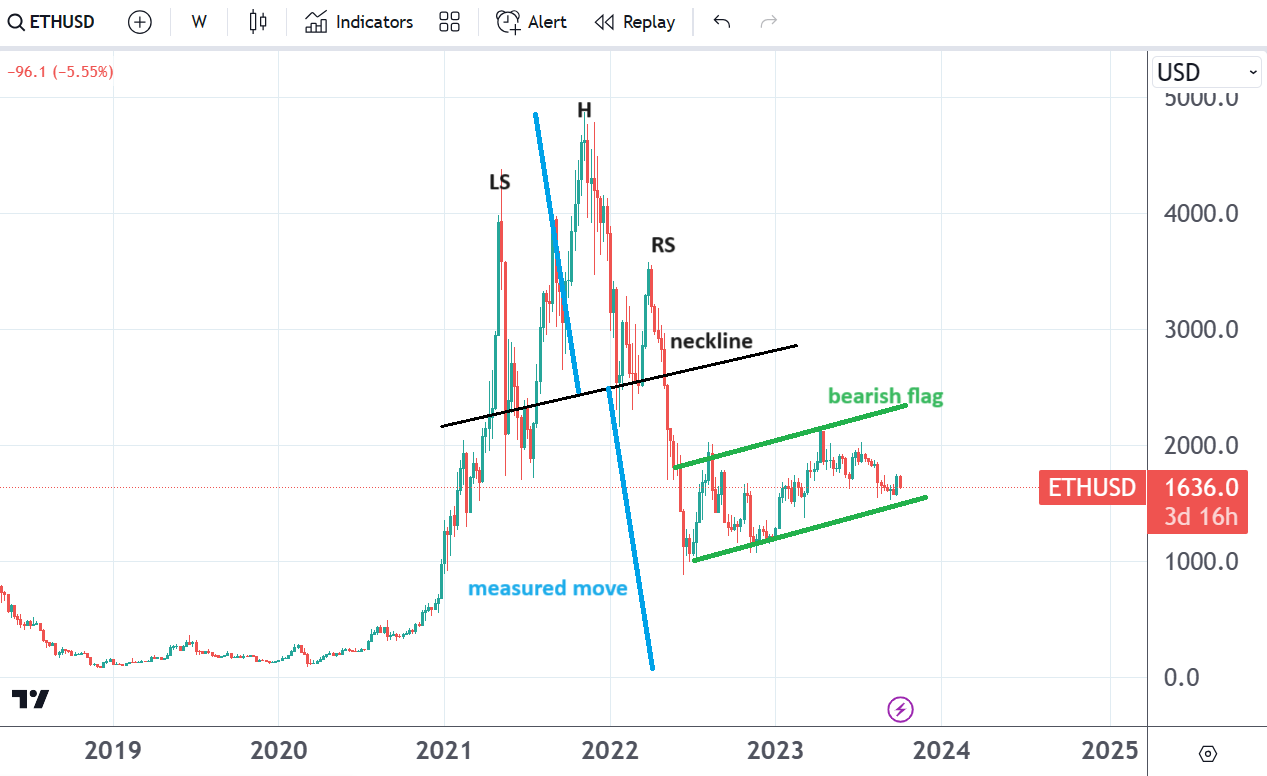
Sure enough, plenty of traders have bought into the dip. And, even though ETH/USD dropped $4000 from its highs, the bias remains bearish. 

Ethereum chart by TradingView

ETH/USD bigger picture is a reason for bulls to worry

On its trip to $5000, ETH/USD formed a head and shoulders pattern. Once the price broke below the neckline, it found no support until it reached $1000. 

The level marked the bottom of the year for the stock market and the highest point for the US dollar. Since then, stocks bounced sharply, and the cryptocurrency market followed. 

But despite the rally at the start of 2023, the bigger picture remains bearish for ETH/USD. A bearish flag pattern should be a good enough reason for bulls to worry, as it is usually followed by more downside. 

Bears would want to see the price dropping to $1000 once more. It would mean that the bearish flag pattern ended and that the next target is the head and shoulders’ measured move. 

On the other hand, bulls may want the price to simply stay in the flag and test the upper edge of it. This is the only way to invalidate a bearish flag pattern. 

The post ETH/USD analysis: Bears appear in control appeared first on CoinJournal.

JPEX crypto exchange faces controversy over asset conversion

  • JPEX’s attempt to transition into a DAO has sparked controversy and frustration among some users.
  • The users who claim their assets were converted without their consent.
  • The exchange is also facing scrutiny from authorities in Hong Kong.

In a surprising move, the JPEX cryptocurrency exchange has initiated a contentious DAO Shareholder Dividend Scheme, leaving some users in distress as their assets reportedly get converted without their consent.

JPEX recently announced its intention to transform into a decentralized autonomous organization (DAO) and offered users the opportunity to convert their frozen assets into DAO Stakeholder dividends at a 1:1 ratio. Additionally, the exchange introduced a repurchase option, allowing users to recover 30% of the conversion price after one year and 100% after two years.

Disquiet among customers

JPEX’s scheme was seemingly devised to tackle JPEX’s ongoing liquidity challenges, providing an incentive for users to lock up their assets on the platform.

However, the transition has not gone smoothly for all users. Some claim their assets were converted to JPEX Coin (JPC), a low-liquidity token with limited utility, without their consent or prior knowledge.

One user, who spoke to the South China Morning Post, lamented the disappearance of their Tether (USDT) and other cryptocurrencies, which were mysteriously transformed into JPC. This user plus other users now find themselves unable to withdraw or trade their assets, leading to frustration and concerns about their investments turning into “waste paper.”

Remarkably, some users asserted that they were coerced into accepting the scheme, as there was no option to vote against it on JPEX’s mobile application.

Ongoing troubles for JPEX

These developments come amidst a backdrop of ongoing troubles for JPEX. Hong Kong authorities have arrested multiple individuals associated with the exchange, accusing it of operating an unauthorized crypto platform.

The Securities and Futures Commission of Hong Kong also alleges that JPEX defrauded over 2,300 people for $178 million (1.4 billion Hong Kong dollars).

To address illicit activities within the crypto space, Hong Kong authorities have established a crypto-focused task force in collaboration with the police and securities regulator.

As JPEX grapples with these legal challenges and users’ discontent regarding asset conversion, the exchange’s future remains uncertain.

The post JPEX crypto exchange faces controversy over asset conversion appeared first on CoinJournal.