FTX trial: FTX used billions in customer funds for Binance stake buyback

  • FTX is accused of using customer deposits to repurchase Binance stake.
  • An accounting professor hired by the US Department of Justice reveals over a billion dollars came from customer funds for the share buyback.
  • FTX’s proposed recovery plan offers hope, aiming for a 90% asset return to customers affected by the exchange’s bankruptcy.

In a shocking revelation, the ongoing legal proceedings surrounding the defunct cryptocurrency exchange FTX have unveiled that the exchange allegedly used customer funds to buy back its stake held by Binance.

This development has raised serious concerns about the handling of customer deposits within the crypto industry.

Customer funds diverted for Binance share repurchase

During a court hearing, it was disclosed that FTX, a crypto exchange that filed for bankruptcy in November 2022, employed customer deposits to repurchase its shares from competitor Binance. Binance CEO Changpeng Zhao in November 2022 acknowledged that his company had received over $2.1 billion in Binance USD (BUSD) stablecoins and FTX’s FTT tokens as part of this transaction.

The revelation has led to intense scrutiny and legal action, with an accounting professor from the University of Notre Dame, Peter Easton, being hired by the US Department of Justice to trace the flow of billions of dollars between Alameda, the parent company of FTX, and the exchange. Professor Easton confirmed that user deposits were redirected for various purposes, including reinvestment in businesses and real estate, political contributions, and charitable donations.

The most significant revelation, however, was that over a billion dollars for the share repurchase had come directly from customer funds held by FTX. This has raised concerns about the exchange’s financial practices and the protection of customer assets.

FTX’s recovery plan

Amidst the controversy surrounding the use of customer funds, FTX’s estate has proposed a settlement plan to address the loss of customer assets when the exchange declared bankruptcy in November 2022. The plan aims to provide a 90% return of assets to affected customers, potentially offering relief to those who suffered losses during the exchange’s collapse.

This development signifies a potential path forward for affected customers and highlights the ongoing efforts to resolve the fallout from FTX’s bankruptcy. The legal and regulatory proceedings will be pivotal in determining the fate of this proposed recovery plan and the ultimate distribution of customer assets.

The post FTX trial: FTX used billions in customer funds for Binance stake buyback appeared first on CoinJournal.

Ripple drops another 2% today: a descending triangle points to more downside

  • Ripple’s bearish momentum continues
  • A descending triangle points to a drop to $0.4
  • A head and shoulders pattern paints a gloomy picture for Ripple

There is no break from the bearish momentum in the cryptocurrency market. Unless you are invested in Bitcoin, the suffering from being on the long side of any other coin has been tremendous. 

Take Ripple (XRP/USD), for example. 

After spiking close to $1 during the summer, it quickly returned all its gains. Basically, a classic pump-and-dump price action, enough to attract late newcomers to the party, only to see their investment quickly disappear. 

More problematic is the recent price action. It gives no signs of the bearish pressure easing anytime soon. 

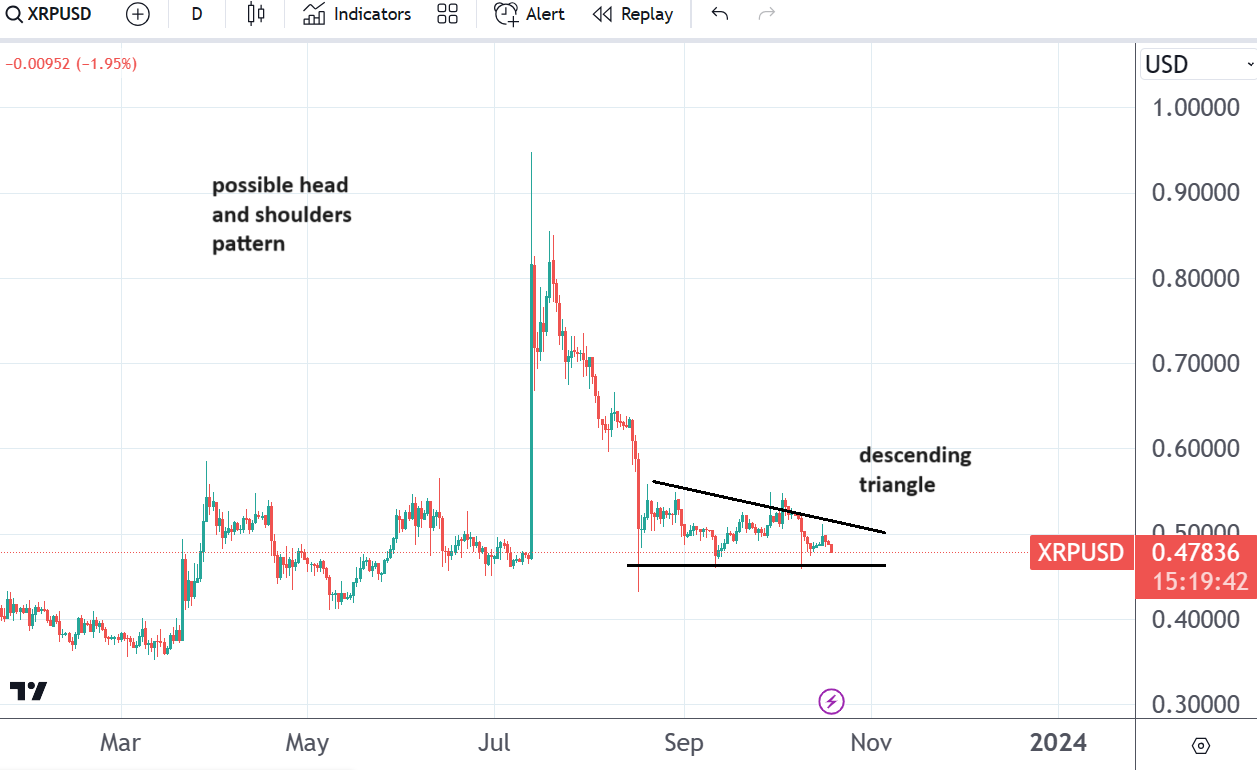
Just the opposite, as the market appears to form a bearish continuation pattern – a descending triangle. 

Ripple chart by TradingView

Descending triangle points to a quick move to $0.5

As a bearish continuation pattern, a descending triangle hints at more downside to come. Its measured move equals the length of the longest segment of the triangle – in this case, it signals a drop to $0.4. 

The main feature of such a triangle is the fact that bounces from horizontal support are smaller and smaller until, eventually, support gives way. 

On an even bigger scale, the descending triangle might just be the right shoulder of a head and shoulders pattern. If that is the case, the spike during the summer months close to the $1 area would be the head of the pattern. 

If a head and shoulders pattern does materialize, Ripple has much more room to the downside than bullish investors would want to assume now. 

The post Ripple drops another 2% today: a descending triangle points to more downside appeared first on CoinJournal.

Stake.com’s $41M hack: Implications and lessons in crypto security

  • Stake.com was recently hacked for $41 million. What happened during the incident?
  • How did the crypto casino giant respond to the attack?
  • The implications and lessons for crypto.

The security breach that saw online crypto casino Stake.com lose $41 million to hackers on September 4 is among the most notable attacks to hit the cryptocurrency industry this year. Since the incident, blockchain security analysts and law enforcement have linked the “suspicious outflows,” to a sovereign state actor – North Korea’s Lazarus Group.

On September 7, the  Federal Bureau of Investigation (FBI) released a report that identified the Lazarus Group as the hacker responsible for the theft. The FBI also pinned several other crypto hacks to the group, including the attacks on Alphapo, CoinsPaid, and Atomic Wallet. The group is reportedly responsible for attacks that have seen more than $200 million in crypto stolen in 2023 alone.

Understanding what happened

Blockchain data revealed that the Stake.com hack started with a transaction on Ethereum, with hackers transferring roughly $3.9 million of the stablecoin Tether (USDT). 

The attackers then   withdrew 6,001 Ether (ETH), worth about $9.8 million at the current market price. Also withdrawn was approximately $1 million in USD Coin (USDC), $900,000 worth of Dai (DAI), and 333 Stake.com Classic (STAKE) tokens, each valued at $75.48.

While initial reports indicated stolen crypto funds amounted to $16 million, that rose to $41 million.

On September 7, the platform disclosed that the hacker had begun cross-chain transactions by transferring funds to the BTC blockchain through new wallets on Polygon and Avalanche. As of September 8, $4.5 million has been moved to BTC addresses. Meanwhile, the majority of the stolen funds, approximately $36 million, remain on the Ethereum, Polygon, and BNB Chain networks.

Stake.com assured its customers that user funds were safe and that only a small percentage of the online casino’s total funds had been affected. But amidst the incident, many fake accounts on X (formerly Twitter) cropped, with fake updates that tried to trick people into clicking on phishing links for refunds.
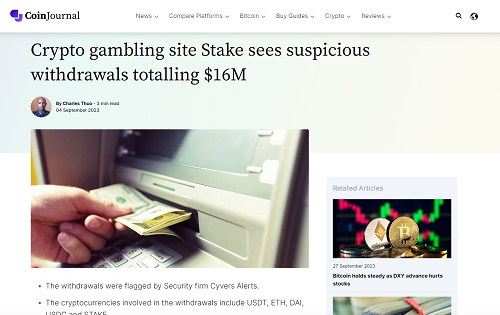
Understanding hot wallets and cold wallets

Crypto wallets are essential for storing and managing cryptocurrency assets. They come in two main types: hot wallets and cold wallets. Both types of wallets have their own advantages and disadvantages. The right type of wallet depends on how much crypto an individual holds, their security preferences, and how accessible they want their funds to be.

Hot crypto wallets are always connected to the internet, with examples being exchange wallets. They are typically free and allow users to store, send, receive, manage, and view their cryptocurrency assets. Access is via any internet-enabled device, including phones, tablets, and PCs. It is why hot wallets are preferred for easy access and trading.

But while hot wallets offer convenience and quick transactions, they are less secure when it comes to storing high-value assets. The risk of hacking is higher compared to cold wallets.

As cold wallets store assets offline, with access via hardware devices, the threat of being hacked is significantly lower. Use of cold wallets has increased, especially after the collapse of FTX, and hacks on several other centralised crypto exchanges.

Looking over the security aspects

Wallets work with public and private keys, which are the cryptographically generated strings of letters and numbers that authorise crypto transactions.In traditional banking terminology, the public key is like a user’s account name while the private keys are like the password needed to access the account. Without it, you cannot access the stored cryptocurrencies.

Adding a layer of security is key to use of hot wallets, and this can be achieved in various ways, including splitting wallet keys and storing them in different places. Other controls like limits to  fund transfers, frequency, and eligible receiving addresses could be helpful. Such measures helped limit the Stake.com hacker to its bankroll pool and ETH/BSC.

Stake.com’s response to the hack

According to Ed Craven, co-founder of Stake.com, the platform has a small percentage of its crypto reserves in a hot wallet. However, he noted in an interview with DL News that the breach was not because of the hackers acquiring Stake.com’s hot wallet private keys.

Craven also noted in a blog post on Medium, that the company’s team acted swiftly following the hack, halting all withdrawals and deposits to prevent further theft.

This was done within 20 minutes, with malicious components disabled and necessary containment measures put in place within 4 hours. As a result, the attack impacted only a small portion of Stake.com’s reserve funds meant for large winnings. Stake.com also quickly resumed its operations and began crediting customers who sent funds during the exploit. 

Meanwhile, the company is working with law enforcement and cybersecurity experts as they look to unmask and apprehend the hackers.

Stake, which supports 18 cryptocurrencies as a payment method, also noted that the two games impacted by the security breach will remain disabled throughout the investigation. 

Lessons for the crypto industry

The recent security breach at Stake.com has sounded alarms about the robustness of online crypto platform securities. Major security compromises in history, such as Sony’s 2011 PSN intrusion and the 2017 Equifax data exposure, have served as crucial learning points in their sectors. 

Likewise, the Stake.com incident highlights the imperative for bolstered defence mechanisms in the rapidly evolving crypto space. Such vulnerabilities, if left unaddressed, could not only impact immediate financial holdings but also erode long-standing reputations.

Given the jeopardy faced by Stake.com’s financial reserves, there’s unease concerning the reliability of cryptocurrency in everyday practical business application. This loss in consumer and business confidence could translate to potential delays or reductions in disbursements, an adverse outcome for creators, especially those recently migrating to Kick in search of a more lucrative platform. Yet, if Stake.com can adeptly navigate through this turbulence and curtail the repercussions, its overarching fiscal health may remain intact.

This breach has prompted industry specialists to reexamine the inherent risks of amalgamating cryptocurrency functionalities with platforms akin to Kick. The incident serves as a clarion call for companies pondering similar integrations.

To fortify defences, platforms should advocate for encrypted transactions, unwavering data protection, uphold fairness through Random Number Generator (RNG) protocols, and emphasise layered account safeguards. Furthermore, it’s paramount to offer secure transactional methods, sustain vigilant surveillance, and ensure dedicated customer engagement.

For casinos aiming for sustainability and adaptability amidst sophisticated threats, incorporating AI-centric fraud detection becomes pivotal. Regular security evaluations and pertinent certifications solidify a commitment to preserving a trustworthy environment for its user base while upholding the platform’s esteemed reputation.

The resilience of Stake.com’s operations

Stake.com, founded in 2017 and is headquartered in Curacao, is one of the leading crypto casinos in the world. The platform generated around $2.6 billion in revenue in 2022 and recent reports revealed that the gambling platform recorded over 900M bets in August.

Beyond its primary casino functionalities, Stake.com has forged strong ties with Kick Streaming, a platform celebrated for sponsoring renowned streamers, including Adin Ross, Amouranth, and XQC. Notably, the platform also boasts a partnership with Drake as a prominent ambassador, further elevating its prominence in the industry.

The hacking incident underscores the importance of ongoing security enhancements, heightened vigilance, and user education to safeguard both experienced and novice crypto gamblers.

Before the recent hack, Stake.com had taken various security measures to protect user data and funds. The platform required complex passwords and implemented two-factor authentication (2FA) to add an extra layer of security to user accounts. These measures are designed to make it difficult for unauthorised individuals to access user accounts.

The company also performed regular security audits to identify and fix potential vulnerabilities. This is an attempt to stay ahead of cybercriminals. It also used encryption technologies to protect user data and financial transactions.

In addition, the platform also provided guidance to users, warning them against playing high-risk games that could expose them to hacks. Safe gambling, also known as responsible gambling, is highly encouraged.

To gamble safely, Stake.com advises players to balance gambling with other recreational activities, set a spending plan and time limit, bet with affordable funds, take breaks, and grasp the odds and associated risks. The company also reminds players not to let losses overly upset or anger them during gambling sessions.

However, it is essential to note that no security measure is perfect. The Stake.com hack demonstrates that even well-established and well-funded crypto casinos can be vulnerable to attack. The company promises to continue investing in cyber security to adapt quickly to emerging threats.

Conclusion

Stake.com has shown greater resilience in the wake of the security breach, taking significant steps to enhance security and protect user data and funds. However, the incident highlights that even well-established crypto platforms are not immune to such attacks. 

The critical role of hot wallets in another take from the incident, with Stake.com’s strategic use of secure hot wallets enabling a swift recovery and the protection of user funds. Yet, as the industry continues to mature, hacks highlight the fact that crypto casinos, including Stake.com, need to prioritise continuous vigilance, robust security measures, and proactive incident response mechanisms to ensure the safety of digital assets.

The post Stake.com’s $41M hack: Implications and lessons in crypto security appeared first on CoinJournal.

Bitcoin ETF may be a ‘limited’ benefit for Coinbase stock: Barclays

  • Mike Novogratz expects SEC to approve a Spot Bitcoin ETF this year.
  • Barclays analyst does not expect that to be a huge benefit for Coinbase.
  • Coinbase stock is currently down over 30% versus its year-to-date high.

Mike Novogratz – the Chief Executive of Galaxy Investment Partners expects the Securities & Exchange Commission to approve a Spot Bitcoin ETF by the end of this year.

Here’s what Mike Novogratz said today on CNBC

Last week, the U.S. regulator refrained from appealing a court’s ruling that said it did not have sufficient reason to block Grayscale from converting its flagship trust to an exchange-traded fund.

Note that Galaxy itself has filed for a Spot Bitcoin ETF in collaboration with Invesco. On CNBC’s “Squawk Box”, Novogratz said today:

Dialogue with SEC is heading in right direction. It is no longer talking how Bitcoin works. It’s just a recognised macro asset and that’s a huge psychological shift.

The billionaire investor expects a positive news on the ETF front to lead the market higher. Still, Barclays is not entirely convinced that it will be a material catalyst for Coinbase Global Inc.

Barclays analyst shares his view on Coinbase stock

Analyst Benjamin Budish told clients in a research note today on Wednesday that approval of a Spot Bitcoin ETF will likely be a “limited” benefit for Coinbase.

It is not clear how successful ETF launches would translate into a meaningful P&L benefit for Coinbase despite it being an integral service provider.

He agreed that the Nasdaq-listed firm will serve as custodian for four BTC exchange-traded funds (at least) but said it is unlikely to earn significant custodial and prime brokerage fees.

Barclays has an “underweight” rating on Coinbase stock with a price target of $70 that suggests another 6.0% downside from here. Earlier this week, Cathie Wood – the Founder of Ark Invest also took a positive tone on a Spot Bitcoin ETF approval.

The post Bitcoin ETF may be a ‘limited’ benefit for Coinbase stock: Barclays appeared first on CoinJournal.

Shiba Memu’s investment gold rush as the countdown to presale close begins

  • Shiba Memu presale is nearing its conclusion, with 13 days left.

  • The price of Shiba Memu has increased consistently each day on presale.

  • The value of Shiba Memu could be unlocked from post-listing liquidity in Q3 2023.

With millions raised in presale, investors hold high hopes for a new token sensation, Shiba Memu. The meme token has enjoyed a stellar presale, with daily price increases the icing on the cake. Now, FOMO could be gripping investors, as increased buying takes the presale to almost $4 million raised. The presale is on a 13-day countdown to close, after which the token could rise massively on the listing.

About Shiba Memu presale

Shiba Memu (SHMU) opened its presale in July, initially set to be an 8-week process. However, high demand and investor requests prompted the team to extend the presale by another 60 days. The extended presale concludes on October 31st, paving the way for the next step, listing.

Since launching the presale, Shiba Memu has generated value for its early backers. From an initial price of $0.011125, the token is now valued at $0.034750. The gains have been made possible by the project tokenomics. The tokenomics allow the Shiba Memu price to increase automatically daily at 6 PM GMT. The price is expected to rise further within the 13-day window to the end of the presale. 

Once the presale ends, Shiba Memu will be listed on major centralised exchanges. The team has earmarked the last quarter of 2023 as the time for listing. Debuting on the best exchanges is expected to unlock utility and facilitate the price discovery for Shiba Memu.

Why has Shiba Memu attracted such a high demand?

The speculative value of Shiba Memu is huge, considering the amounts raised in presale. This is one of the critical ingredients of meme cryptocurrencies, as their value is driven mainly by hype. However, Shiba Memu’s ability to convince investors of its market potential has got many talking.

Boosting cutting-edge AI technology, Shiba Memu aspires to be a leader in the meme sector. The project uses AI to self-promote on social forums and dominate online chatter. Shiba Memu can write its own social copy and marketing materials using AI. It then self-publishes the content across social media platforms to gain traction.

The AI and marketing prowess make Shiba Memu an ingenious and highly sustainable project. It doesn’t depend on temporary social media hypes to dominate. With this capability, Shiba Memu has been hailed as one of the most innovative meme projects. Investors also earn yields from staking, which lets them commit some tokens to the project’s growth.

Shiba Memu also taps into the power of a dedicated community to achieve success. The project team has allocated 85% of its 1,000,000 tokens in supply for the presale. Once the project is launched, Shiba Memu will engage its community through an AI dashboard. Users can channel their market insights into conversations through the dashboard. They can query the AI and get up-to-date answers on marketing strategies and advertising trends.

Is Shiba Memu worth buying in the presale?

Meme cryptocurrencies always generate FOMO due to the ability to return massively after listing. Reflecting on some of the top meme coins like PEPE, gains have exceeded 10,000%. Others, like meme leader Dogecoin, have hit a market cap that justifiably puts them on the top ten list. 

Shiba Memu carries the same potential owing to the early demand and investor enthusiasm. Investors could see a potential 10x gain or higher if the token replicates the returns of its meme peers.

Shiba Memu is only on a presale, and post-listing gains could be a little distant. The presale has 13 more days to run, with gains made each day. Investing in the presale is advantageous in maximising organic profits. Presale backers will also carry a better chance of riding an uptrend once the token is listed. 

The post Shiba Memu’s investment gold rush as the countdown to presale close begins appeared first on CoinJournal.