Ripple announces new partnership with Uphold

  • Uphold will help Ripple enhance its underlying crypto liquidity infrastructure.
  • Ripple’s cross-border solution has gained huge traction amid use cases such as liquidity management, tokenization and custody solutions.

Ripple has struck a new partnership with crypto exchange and Web3 financial platform Uphold, the companies announced on Tuesday.

As noted in a press release, the collaboration is aimed at enhancing crypto liquidity for Ripple’s cross-border payments infrastructure.

Uphold to enhance Ripple’s infrastructure

Ripple’s solution, which involves the use of XRP to reduce cost and delivery time in cross-border payments, has gained massive traction amid the San Francisco-based company’s global partnerships. 

Uphold, a multi-asset crypto platform with a presence in more than 180 countries and providing access to 200 cryptocurrencies and fiat currencies, could play a key role in advancing Ripple’s global cross-border remittances market.

“Our new partnership with Uphold enables us to enhance our underlying infrastructure and Uphold’s deep liquidity expertise further underpins Ripple’s ability to offer fast and flexible cross-border payments around the world. We see this as the start of our relationship and are excited about what the future holds,” said Pegah Soltani, head of payments product at Ripple.

As its infrastructure grows, with the expansion of its liquidity hub, Ripple has looked to leverage its blockchain infrastructure to allow for real time international transfers. Its product offerings include use cases such as liquidity management, tokenization and custody solutions for businesses.

Commenting on this in light of the new partnership, Uphold CEO Simon McLoughlin said:

“Ripple provides a tremendously valuable service to businesses making cross-border payments and we are thrilled to be an essential part of it. Our partnership illustrates how the unique capabilities of our platform can be used by enterprises to make efficient crypto-to-fiat transfers and bank payouts.”

The post Ripple announces new partnership with Uphold appeared first on CoinJournal.
Bank of Spain, Banco de España, embraces digital euro

  • Banco de España has backed the digital euro.
  • The digital euro promises offline payments and privacy, akin to cash.
  • European central banks, including the Bank of Finland, are supportive of the digital euro project.

In a significant move towards digitalization, Banco de España, Spain’s central bank, is aligning with its European counterparts to introduce a digital euro.

This initiative aims to revolutionize the way financial transactions are conducted, offering a range of potential benefits for consumers and businesses.

A new era in finance with the digital euro

Banco de España has joined the growing chorus of European central banks in endorsing the digital euro, a central bank digital currency (CBDC).

The traditional form of physical cash, according to the central bank, falls short of harnessing the advantages presented by the increasingly digitalized economy and society. As a response, the digital euro is set to emerge as a pivotal component of the financial system, paving the way for electronic payments to become more seamlessly integrated into daily financial transactions.

The “preparation phase” of the digital euro project, which commenced on October 18, is expected to continue until 2025. It’s important to emphasize that the final decision regarding the issuance of the pan-European CBDC is yet to be determined.

The Bank of Finland has also expressed its support for the digital euro, underscoring its significance in the European payment sector. Furthermore, the European Central Bank (ECB) has launched a dedicated information page to enlighten the public about the digital euro’s potential benefits, promising an “easier life” and a “stronger Europe.”

As the digital euro project advances, it holds the promise of revolutionizing the way financial transactions are conducted, offering enhanced privacy, offline payment capabilities, and a seamless transition into the digital age of finance.

Key advantages of the digital euro

One of the notable features of the digital euro is its ability to facilitate offline payments. Users will be able to engage in transactions even without an internet connection, enhancing its versatility and accessibility.

The other advantage is that the level of privacy offered by the digital euro. The digital euro will hopefully address concerns about data security and user anonymity. Notably, when using the digital euro online, user data will remain visible only to their respective financial institutions and not to the central bank’s infrastructure provider, Eurosystem.

The post Bank of Spain, Banco de España, embraces digital euro appeared first on CoinJournal.

Monero fails to build on Bitcoin’s momentum; one-year range holds

  • XRM/USD keeps trading in a range
  • Bearish momentum persists
  • A stronger dollar pressures most cryptocurrencies

Bitcoin rallied at the start of this week, triggering much-needed enthusiasm among crypto investors. However, the so-called “crypto winter” is still visible in other crypto markets, such as XMR/USD. 

Monero failed to capitalize on Bitcoin’s strength. Some other times, whenever Bitcoin rallied, other cryptocurrencies followed. 

Only this time is different. Therefore, one may argue that other cryptocurrencies lag and will jump, too, following Bitcoin’s lead. But another take is that Bitcoin gains will disappear, and a stronger US dollar will emerge. 

One thing is for sure, though – Monero’s technical picture is not encouraging. 

Monero chart by TradingView

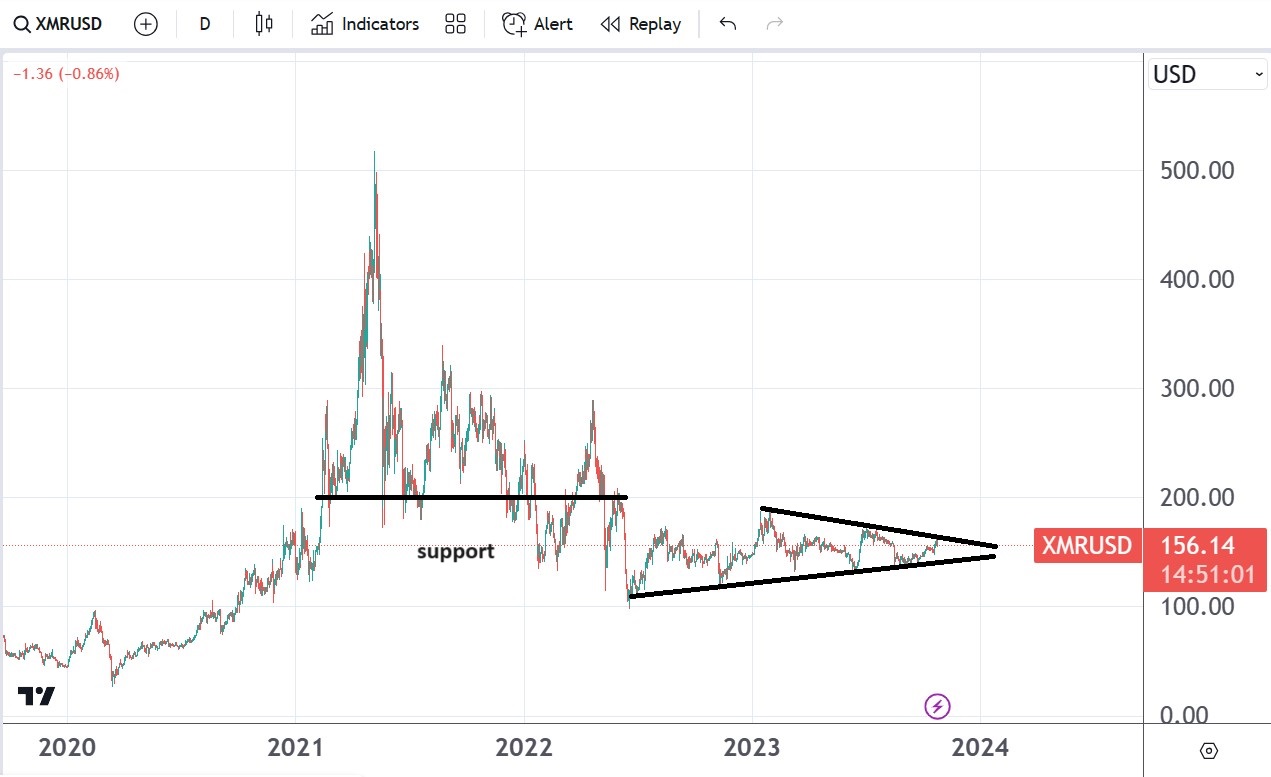
The one-year-long range keeps Monero at bay

Monero’s underperformance this year might be viewed in two ways – one bullish and one bearish. 

The bullish view is that Monero is building energy, forming a contracting triangle that will break to the upside. And, on its way up, the market will break horizontal resistance given by the previous support area. 

The bearish view is that the one-year-long triangle is a bearish continuation pattern. If that is the case, the US dollar will keep gaining against its fiat peers and cryptocurrencies. 

$100 and $200 are key levels to watch for XRM/USD. Until any of them is broken, the range might continue still. 

The post Monero fails to build on Bitcoin’s momentum; one-year range holds appeared first on CoinJournal.

Bitcoin diverges from fiat currencies and makes a new high for the year; is this bullish?

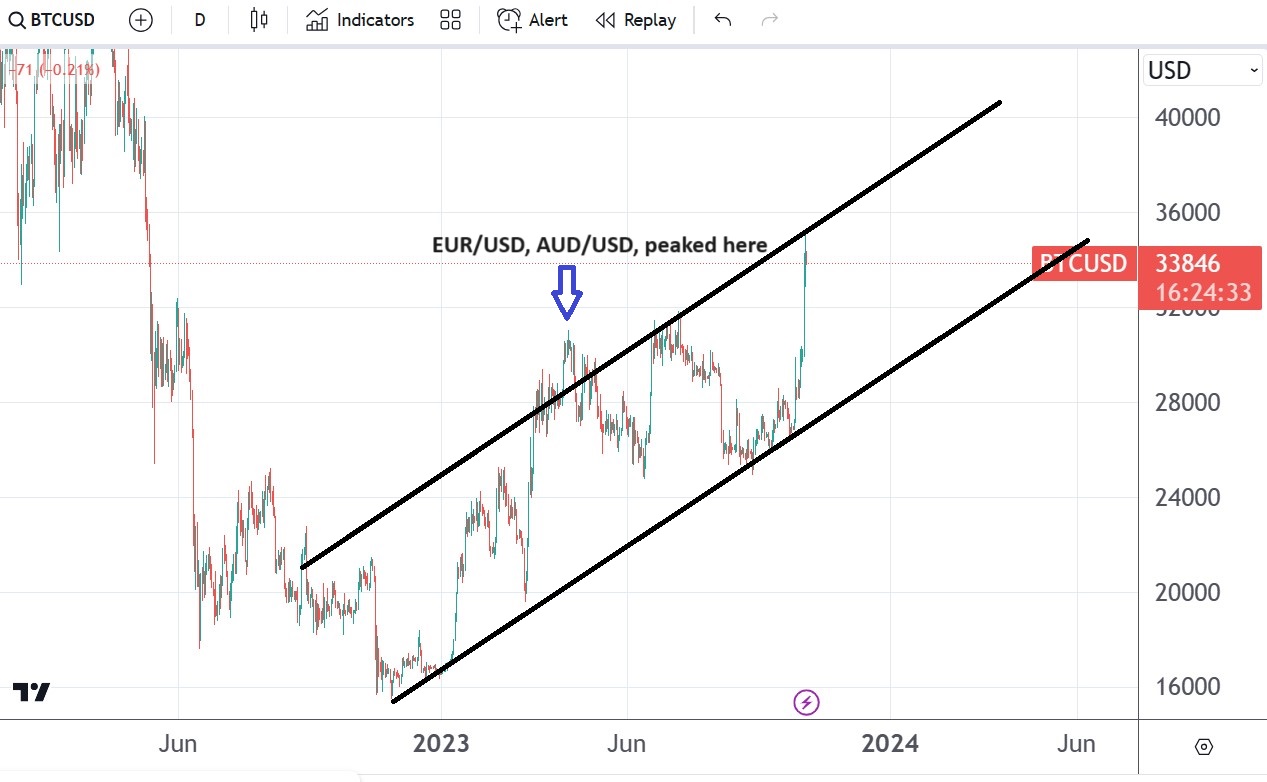
  • Bitcoin breaks horizontal resistance at the $32k area
  • The rally extended above $35k
  • Bulls should be worried because Bitcoin diverges from the US dollar

Bitcoin investors are thrilled to see the cryptocurrency jumping to a new high for the year. More precisely, Bitcoin traded above $35k for the first time in over a year. 

It did so by tripping stops seen in the $32k area. This area provided resistance for quite some time, and Bitcoin finally broke above. 

That is the good news for bulls. 

The bad news is that in doing so, Bitcoin diverges with the rest of the fiat currencies. More precisely, while Bitcoin gained against the US dollar, the greenback rallied against its peers. 

It may or may not be something to worry about. But if I were an investor in Bitcoin (which I’m not), I would worry. Here is why. 

Bitcoin chart by TradingView

Bitcoin and the US dollar have diverged since Q1 2023

The problem for Bitcoin is that the dollar strengthened since Q1 2023 against its peers. Two examples are the EUR/USD and AUD/USD exchange rates, which peaked in the year’s first quarter. 

EUR/USD, for instance, peaked at 1.12 and now trades around 1.06. AUD/USD erased almost all its gains from the lows in October 2022.

Bitcoin is the last one standing against the dollar. While bulls may say that it is only normal because Bitcoin is not correlated with macro risks and positioning, I beg to differ. 

Since Bitcoin is part of many institutional portfolios, it does react to macro. Therefore, the rally we see here would likely be reversed unless the US dollar strength dissipates. Only if the dollar starts weakening it makes sense to cheer for a Bitcoin rally. 

Until then, caution is needed.

The post Bitcoin diverges from fiat currencies and makes a new high for the year; is this bullish? appeared first on CoinJournal.

Marinade Finance ceases operations in the UK citing FCA compliance concerns

  • Marinade Finance is currently the largest DeFi protocol on Solana.
  • Marinade Finance has blocked UK users due to concerns over FCA regulations.
  • The FCA’s Financial Promotions Regime has prompted several cryptocurrency entities, including Marinade Finance, to exit the UK market.

In a recent development, Marinade Finance, a leading decentralized finance (DeFi) protocol operating on the Solana blockchain, has halted its services for users in the United Kingdom. Interestingly, the price of the Marinade (MNDE) token has surged by 22.54% today despite the exit news. The token has hit a daily high of $0.07032.

The decision comes in response to growing compliance concerns arising from the regulatory framework established by the UK Financial Conduct Authority (FCA).

Compliance issues prompt UK market exit

Users from the UK were greeted with a block page on October 23 when attempting to access Marinade Finance’s website from a local IP. The message displayed on the page cited “compliance concerns relating to rules and regulations promulgated by the UK Finance Conduct Authority,” thus restricting any further access to the platform.

Notably, the protocol has extended an option for UK-based users to perform specific actions, including withdrawing liquidity, claiming delayed tickets, and delaying unstake through the use of its software development kit (SDK).

Marinade Finance’s decision reflects a growing trend within the cryptocurrency industry, as several other prominent players, such as Binance and PayPal, have also retracted their services from the UK market due to regulatory challenges.

This move aligns with the stringent measures imposed by the FCA, signalling an intensified focus on ensuring transparency and fairness within the cryptocurrency sector.

Impact on the Solana Blockchain

With Marinade Finance holding a substantial $241 million, which accounts for a remarkable 70% of all funds locked on the Solana blockchain, its exit from the UK market is poised to have significant repercussions.

However, Marinade Finance’s exit from the UK market has not had an impact on the price of Solana (SOL). SOL has surged by 7.09% to trade at $31.78 today.

The exit underscores the pivotal role regulatory compliance plays in the operations of DeFi protocols, especially in the context of stringent guidelines set forth by regulatory authorities.

While some DeFi firms are leaving the UK, other companies like OKX and MoonPay are preparing to adhere to FCA’s regulations. The industry is likely to witness further adjustments aimed at fostering a transparent and compliant environment for cryptocurrency operations globally.

The post Marinade Finance ceases operations in the UK citing FCA compliance concerns appeared first on CoinJournal.