Polkadot (DOT) surges 8% with staking dashboard upgrade

  • Polkadot’s price experiences an 8% increase.
  • The surge is bolstered by the introduction of the Staking Dashboard 1.1.
  • The upgrade allows users the ability to view the 14-day activity of validators on the Polkadot network.

Polkadot (DOT) has once again made headlines with its impressive price movement in the crypto market. At the time of writing, each DOT is priced at $4.34, reflecting a 3.23% increase in the past 24 hours.

This surge in DOT price is attributed to the recent deployment of Polkadot’s Staking Dashboard 1.1, designed to enhance the user experience within the Polkadot ecosystem.

Polkadot’s resurgence

Over the past week, Polkadot has been among the best performers in the top 20 cryptocurrency rankings by market capitalization, with an 8% price gain during this period. This positive momentum underscores Polkadot’s readiness to retest the resistance point at $5 in the near term.

The surge in Polkadot’s price is not merely coincidental. It is closely tied to the introduction of the Polkadot Staking Dashboard 1.1, a critical upgrade in the Polkadot ecosystem that provides users with improved insights into the network’s validator activities and performance.

The Polkadot Staking Dashboard 1.1

The Polkadot Staking Dashboard 1.1, unveiled by Ross Bulat, an engineer with Parity Technologies offers Polkadot Stakers a more intuitive reporting system, making it easier for users to understand ongoing activities within the ecosystem.

Among the features of this upgrade is the ability to view the 14-day activity of validators on the Polkadot network, along with their performance concerning the staker’s nominations. Light clients are now supported, and asynchronous synchronization is enabled, enhancing the overall user experience.

The dashboard also includes a ranking system that classifies validators based on their performance, allowing potential stakers to make informed decisions. To ensure maximum accuracy, the dashboard showcases the validator with the best performance by default.

This upgrade is designed to promote transparency and ease of use, ultimately encouraging greater participation in the Polkadot network and driving the recent surge in demand for DOT tokens. With high-profile partnerships and the increased accessibility provided by the Staking Dashboard 1.1, Polkadot appears poised for continued growth.

The post Polkadot (DOT) surges 8% with staking dashboard upgrade appeared first on CoinJournal.
Robert Kiyosaki picks gold and bitcoin over stocks and bonds

  • Robert Kiyosaki challenges the 60/40 investment strategy that has 60% stocks and 40% bonds.
  • He says a portfolio with 75% gold, silver Bitcoin mixed 25% real estate/oil is better.
  • Investors might want to shift if they want to survive an imminent economic crash of historic proportions.

Robert Kiyosaki, a renowned author and entrepreneur, says the current market is not one where the traditional 60/40 investment advice works. 

Financial experts have for ages talked about having 60% of one’s portfolio in stocks and 40% in bonds. But according to Rich Dad Poor Dad author, those who take this approach to portfolio allocation are “the biggest of losers.”

Gold, silver and Bitcoin

Rather than the 60/40 strategy, Kiyosaki suggests putting 75% of the investment in gold, silver and Bitcoin, and 25% in real estate or oil. Such a portfolio might survive a global crash.

 “Forever and ever financial experts have promoted the idea “Smart Investors invest in 60/40 60% bonds 40% stocks. In 2024 60/40 investors will be biggest losers. Before going down with the ship consider a shift to 75% Gold, Silver, Bitcoin 25% real estate/oil stocks. This mix may allow you to survive the greatest crash in world history,” he said in an October 29 post on X.

In another post last week, Kiyosaki noted that his first gold coin cost him $40 – today it’s worth $2,000. Rather than wanting to be like the Oracle of Omaha Warren Buffett, he opined that “Dollar Cost Averaging” was what average investors should go for when looking to accumulate assets.

The investor’s latest take on investing comes as the Bitcoin price hovered above $34,000. The benchmark crypto asset is forecast to embark on a new bull market that could take its price to highs of $125k in 2024.

Currently, bulls are looking to retest resistance above $35k, with analysts saying investors could be watching for volatility amid an upcoming Fed meeting and the unfolding geo-political landscape.

The post Robert Kiyosaki picks gold and bitcoin over stocks and bonds appeared first on CoinJournal.

UK publishes proposals on stablecoin regulation, outlines FCA’s regime

  • The HM Treasury today published a policy update to the country’s crypto regulation.
  • In it, the UK government has outlined the FCA’s regime in stablecoin regulation.
  • The Bank of England (BoE) and the Payment Systems Regulator (PSR) will also have a role.

The UK government has published a policy update outlining a phased regulation of fiat-backed stablecoins in the country.

In terms of regulating activities around stablecoins, the HM Treasury will focus on two areas – their use in payment chains and issuance and custody “in or from the UK.” The latter will be irrespective of a fiat-backed stablecoin’s uses, that’s whether for payments, as a settlement asset, or as a store of value.

FCA, BoE role in stablecoin regulation

In the publication, which was made public on Monday, the HM Treasury explains the expected regulatory regimes of the Financial Conduct Authority (FCA), the Bank of England (BoE) and the Payment Systems Regulator (PSR).

“The regulatory landscape will bring certain (fiat-backed) stablecoins within the remit of the Bank of England, Financial Conduct Authority (FCA) and Payment Systems Regulator (PSR), which altogether will aim to minimise potential for customer harm and mitigate the conduct, prudential, and financial stability risks arising from those stablecoins, particularly when used for payments,” the document reads in part.

The government expects the FCA, BoE and PSR to work within statutory objectives that align with the overall stablecoin regulation framework, with regulators coordinating for a clear approach.

While the HM Treasury secondary legislation via parliament will bring stablecoins within the FCA’s regulatory perimeter, there’s co-responsibility on the FCA and BoE to supervise a firm recognised as systemic.

“In a scenario where an FCA authorised fiat-backed stablecoin firm is recognised as systemic by HM Treasury, and so should be supervised by the Bank of England, the government expects that the Bank of England should act as the lead prudential regulator and be able to supervise such an entity through Part 5 of the Banking Act 2009, while the firm continues to also be regulated by the FCA for conduct,” the document states.

UK’s legislation on crypto is set for 2024, after the Financial Services and Markets Act 2023 passed into law in June to allow for the treatment of crypto as a regulated activity. The latest policy update looks to prepare the various government agencies and regulators for this.

The post UK publishes proposals on stablecoin regulation, outlines FCA’s regime appeared first on CoinJournal.

FLR token rising as Flare launches public staking

  • FLR token gains 18.88% in a week, currently valued at $0.01077.
  • Flare introduces public staking service, allowing FLR holders to participate in the ecosystem.
  • Flare Network transition to proof-of-stake model.

FLR, the native token of the Flare network, is making waves following the recent launch of a public staking service.

FLR has seen a surge in both interest and value. Here’s a closer look at how this development has impacted the FLR token.

FLR token price on the move

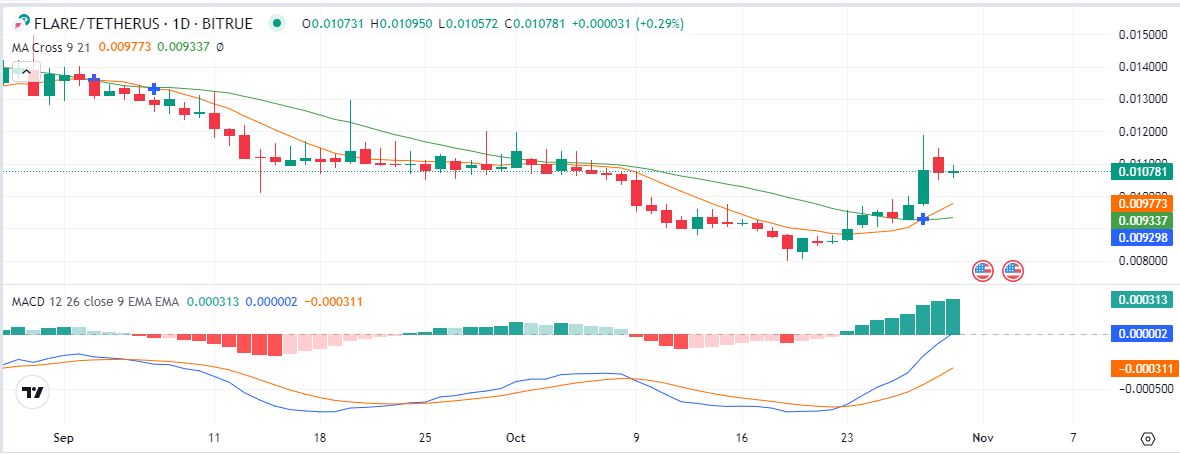
Over the past seven days, FLR token has demonstrated impressive performance, with an 18.88% increase in its price. Currently valued at $0.01077, this token is gaining traction in the market, capturing the attention of investors and enthusiasts alike.

Flare price chart


Flare’s public staking service

Flare, an EVM-based layer 1 blockchain giving developers decentralized access to high-integrity data from other chains and the internet, has taken a significant step towards enhancing its ecosystem. The Flare team on October 29 unveiled a public staking service for FLR token holders, aligning with its transition to a proof-of-stake consensus model.

This dedicated staking platform allows FLR holders to delegate their tokens to validators, contributing to the ecosystem’s growth.

While initially, users could only stake FLR with Avalanche application set on Ledger hardware wallets, the development team has promised to introduce more staking options in the future.

The minimum staking threshold stands at 50,000 FLR, equivalent to approximately $500 at current rates, with a lockup period of 14 days.

Flare embracing PoS model

Flare made a decision to embrace a proof-of-stake model in July 2023 aiming at creating a more cost-effective and environmentally friendly solution.

To set up a complete infrastructure within the Flare network, interested parties are required to hold a minimum of 1 million FLR tokens (equivalent to around $10,000) and maintain an uptime of at least 80% to participate in the validator reward pool.

These innovations, including the Flare Time Series Oracle (FTSO) and State Connector, demonstrate Flare’s commitment to enhancing the utility of blockchain technology. By providing reliable access to data from various sources, FLR and the Flare network are poised to offer developers new opportunities and a more versatile environment for decentralized applications, ultimately benefiting a wider user base.

The post FLR token rising as Flare launches public staking appeared first on CoinJournal.

ADA/USD price forecast: bullish reversal as horizontal support holds

  • Cardano forms a bullish reversal pattern 
  • The Federal Reserve might signal the end of the tightening cycle
  • A move above $0.35 would trigger more strength

The week ahead is important for the US dollar as the Federal Reserve of the United States announces its interest rate decision on Wednesday. The market unanimously expects the Fed to hold the funds rate at the same level as six weeks ago, the second pause in the current tightening cycle.   

However the focus will not be on the actual decision. Instead, it will be on what the Fed will signal that will come next. 

More precisely, is the tightening cycle over? Can the Fed declare its fight against inflation over? 

Sure enough, inflation has dropped from its highs. Also, it continues to drop. 

If one can draw a parallel with Europe, then the Fed should prepare for inflation to drop even further. In Europe, the prices of goods and services have dropped drastically in October. Considering that the Fed and the ECB had similar tightening cycles, one may expect similar inflation trends. 

A dovish Fed would spark US dollar weakness and some markets already sniffed it. The cryptocurrency market is one example, where Bitcoin rallied to $35k recently, triggering similar moves in other cryptocurrencies such as Cardano.

ADA/USD bounced from horizontal support – how much can it rally?

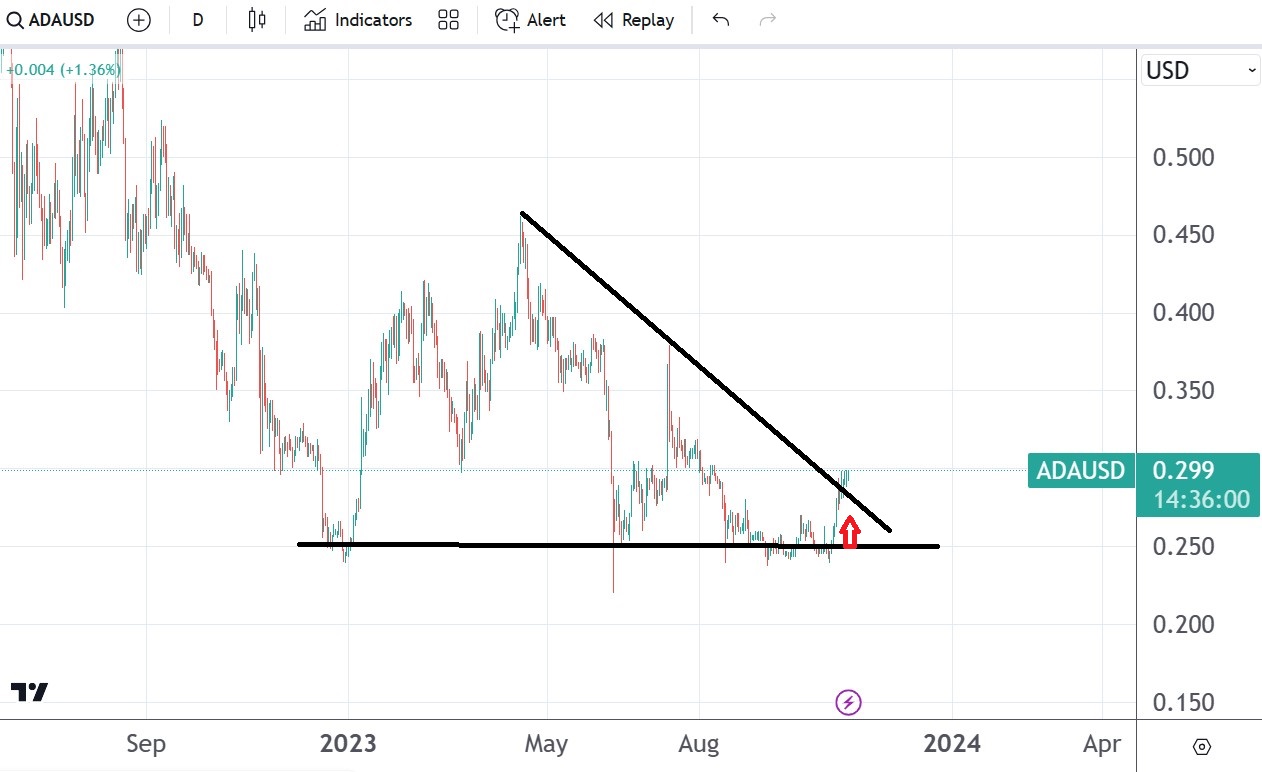
One of the cryptocurrencies that anticipates a dovish Fed is Cardano. ADA/USD has rallied from horizontal support and is trying to break dynamic resistance. 

Cardano chart by TradingView

Cardano rallied with other cryptocurrencies at the start of the trading year but failed to hold onto its gains. However, it found strong support at $0.25, and then it bounced from the lows. 

The market formed a bullish reversal pattern that might represent the end of the bearish market. A move above $0.35 should trigger more strength, while a drop below the 2023 lows would invalidate the bullish reversal pattern. 

The post ADA/USD price forecast: bullish reversal as horizontal support holds appeared first on CoinJournal.