
Tether invests in Georgia education platform Academy of Digital Industries

  • Tether has announced it invested in the Series A round of the Academy of Digital Industries, an educational platform in Georgia.
  • The ongoing financial investment will help support the “real world” education about blockchain, bitcoin, stablecoins and P2P technologies, Tether CEO Paolo Ardoino said.

Tether Operations Limited, the company behind the USDT stablecoin, has made an undisclosed investment in the Series A round of Academy of Digital Industries, a Georgia-based education platform.

The investment in the educational platform follows recent initiatives aimed at promoting blockchain innovation in Georgia. This program is expected to be an ongoing one, with Academy receiving long term financial assistance, Tether said in an announcement on Friday.

Tether steps into education business

According to Tether, the partnership offers the Georgian platform the opportunity to tap into the stablecoin issuer’s global network and expertise as it brings Bitcoin, stablecoins, AI and P2P technologies to students.

The collaboration and investment into the Academy of Digital Industries is also part of Tether’s commitment to support financial freedom and innovation globally, Tether CEO Paolo Ardoino said.

“Tether is a strong believer in financial freedom, freedom of communications, and freedom of education. High quality, accessible, and unbiased education is one of the most important pillars for the future of humanity,” he noted.  

In a comment posted on X, the Tether boss said the company “is stepping into the education business.” He added:

“This is Real World Education, not “yet another couple of blockchain and defi courses” play.”

Apart from the partnership, Tether also revealed an educational program dubbed “Mastering the Blockchain,” had been completed. This is the first such initiative in Georgia, which was made possible in collaboration with the Georgian Agency for Innovation and Technology (GITA) and Business and Technology University.

The post Tether invests in Georgia education platform Academy of Digital Industries appeared first on CoinJournal.
BarnBridge DAO agrees to settle $1.7M with the SEC for charges against it

  • BarnBridge DAO, founders to settle SEC charges for $1.7M over unregistered SMART Yield bonds.
  • SEC alleges failure to register crypto asset securities, cites violation of securities laws.
  • Gurbir Grewal emphasizes blockchain compliance, highlighting the universal application of securities laws.

Decentralized finance (DeFi) protocol BarnBridge DAO and its founders, Tyler Ward and Troy Murray, are set to pay over $1.7 million to settle charges brought by the Securities and Exchange Commission (SEC).

The charges against BarnBridge were related to the failure to register the offer and sale of their structured crypto asset securities known as SMART Yield bonds. The SEC alleged that the DAO and its founders marketed these bonds without proper registration, a violation of securities laws.

BarnBridge DAO’s $1.7M settlement

BarnBridge DAO, a player in the evolving DeFi space, has agreed to a settlement exceeding $1.7 million with the SEC. The settlement includes BarnBridge yielding almost $1.5 million in proceeds from SMART Yield bond sales, and individual civil penalties of $125,000 for both Ward and Murray.

The US SEC accused the DAO and its founders, Tyler Ward and Troy Murray, of not registering the “offer and sale of structured crypto asset securities known as SMART Yield bonds.” According to the SEC’s statement, SMART Yield pooled cryptocurrencies from investors to generate returns for paying investors.

The SEC’s investigation revealed that Ward and Murray extensively promoted SMART Yield, likening it to asset-backed securities, through social media and appearances on YouTube channels related to decentralized finance. This approach attracted investments exceeding $509 million from various investors. 

In the wake of this settlement, the SEC reinforces its stance on the necessity for compliance within the blockchain and crypto space. The regulatory environment is evolving, and companies operating in this sector must navigate it with a keen awareness of regulatory obligations.

The post BarnBridge DAO agrees to settle $1.7M with the SEC for charges against it appeared first on CoinJournal.

Paxos expands its stablecoin to the Solana blockchain

  • Paxos has expanded to Solana, the first expansion for its USDP stablecoin to a new blockchain.
  • The regulated company will issue its stablecoin on Solana starting January 17, 2024.

Stablecoin issuer Paxos has expanded its stablecoin issuance to the Solana blockchain, marking the company’s second blockchain integration after Ethereum. 

The firm’s Pax Dollar (USDP) stablecoin is planned for mainnet integration with Solana on January 17, 2024, according to details in a blog post published on December 22.

According to Paxos, the strategic expansion to a new blockchain “represents a significant milestone” in its innovation and evolution.

“The expansion of our stablecoin platform to support Solana marks an important step towards making stablecoins ubiquitous for everyday consumers,” Paxos head of strategy Walter Hessert, said. “Paxos has set the standard for oversight, reserve management and issuance in the stablecoin market. By integrating USDP with Solana, we’re making it easier for anyone to get and use the safest, most reliable stablecoins.”

Paxos also issues PYUSD and PAXG

Paxos is regulated in the US by the New York Department of Financial Services (NYDFS) and in Singapore by the country’s central bank the Monetary Authority of Singapore (MAS). Paxos Trust Company was granted the BitLicense in May 2015.

In November this year, Paxos announced it had received two preliminary approvals for stablecoin issuance in Abu Dhabi.

Today’s announcement reportedly comes after NYDFS granted it a regulatory greenlight.

Other than USDP, Paxos also issues PayPal USD (PYUSD) and Pax Gold (PAXG). In June this year, the NYDFS order the stablecoin issuer to halt issuance of the Binance USD (BUSD) stablecoin. Paxos later announced it had ended its relationship with crypto exchange Binance.

The post Paxos expands its stablecoin to the Solana blockchain appeared first on CoinJournal.

Hong Kong regulators open doors to spot crypto ETFs

  • Hong Kong’s SFC and HKMA are ready for spot crypto ETF applications.
  • SFC revises rules, allowing funds direct exposure to spot virtual assets, emphasizing secure transactions.
  • Contrary to China’s stance, Hong Kong attracts 11% of global crypto VC funding.

Hong Kong’s financial regulators, the SFC and the Hong Kong Monetary Authority (HKMA), have jointly announced their preparedness to accept applications for spot crypto ETFs.

This move positions Hong Kong as a forward-thinking financial hub embracing the evolving digital asset landscape.

SFC welcomes spot Crypto ETF applications

The move by Hong Kong’s financial regulators follows the SFC’s previous approval for licensed crypto providers to offer cryptocurrency futures ETFs, marking a significant expansion in the region’s crypto investment offerings.

In response to the increasing interest in spot crypto ETFs, the SFC has updated its regulatory framework. Departing from the previous “professional-investors-only” approach, the SFC’s revised rules, implemented in October, now facilitate broader investor participation in spot crypto and ETF investments.

The guidelines issued by the SFC specify criteria for funds seeking authorization to invest directly in spot virtual asset (VA) tokens. These tokens must be available to the Hong Kong public on SFC-licensed Virtual Asset Trading Platforms (VATPs). The SFC emphasizes that transactions conducted by these ETFs must occur through SFC-licensed crypto platforms or authorized financial institutions.

Hong Kong emerges as crypto investment hub

Contrary to China’s crackdown on crypto activities, Hong Kong continues to position itself as a welcoming environment for crypto firms. The region actively encourages collaboration with banks and has become a significant player in the global blockchain and crypto sectors, attracting over 11% of global venture capital funding.

The city’s strategic policies, including the issuance of cryptocurrency-related policy statements in October 2022 and the introduction of a crypto licensing system for virtual asset trading platforms in June, underline its commitment to becoming a global financial hub for digital assets.

This regulatory shift is particularly noteworthy as it coincides with global speculation about the potential approval of a spot bitcoin ETF by the U.S. Securities and Exchange Commission (SEC) in the early weeks of the upcoming year.

The post Hong Kong regulators open doors to spot crypto ETFs appeared first on CoinJournal.

Injective (INJ) 2024 price prediction after 3000% rise in 2023 as Pullix’s presale hits $1.2M

  • Injective (INJ) hits ATH at $43 after a 3000% in 2023.
  • Pullix disrupts DeFi with $1.2M raised, $0.044 per PLX, and a unique hybrid approach.
  • INJ’s AI integration and Pullix’s innovative DeFi platform signal a transformative 2024.

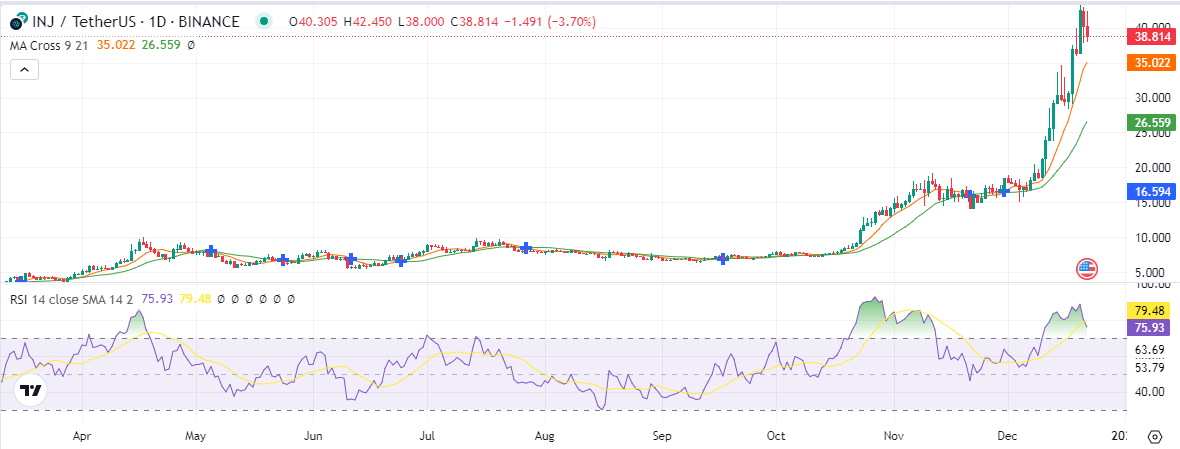
The recent Injective (INJ) price surge to $43 has captivated the crypto community. With a 3000% increase in 2023, this AI finance blockchain token is demonstrating robust momentum. While Bitcoin traded sideways, INJ defied market trends, securing a weekly gain of nearly 64%.

While all eyes are on the future trajectory of INJ and the factors fueling its impressive rally, another crypto project Pullix, which is currently in the presale stage, is making waves for its revolutionary online trading model.

Injective’s phenomenal price surge

Injective (INJ) has been a standout performer in the cryptocurrency market, and its recent surge to $43 marks a significant milestone. With a staggering 3000% rise over the last 12 months, the AI finance blockchain has not only caught the attention of seasoned investors but also dominated social media discussions.

Injective price chart


The weekly gains of nearly 64% showcase the resilience of INJ, especially when compared to Bitcoin’s sideways movement.

Injective price prediction

The surge in INJ prices is not merely a short-term phenomenon. Market analysts are optimistic about its future trajectory, with the unique AI integration and a robust blockchain foundation contributing to sustained growth.

Considering the negative correlation with Bitcoin and the ongoing buzz around AI technologies, Injective’s potential to maintain its upward trajectory remains strong. Rekt Capital has forecast that a new macro uptrend could begin once the 500-day macro downtrend, which INJ entered after hitting its new ATH, ends.

Pullix: bridging the gap with a unique DeFi approach

As Injective captures the limelight, another player is making waves in the decentralized finance (DeFi) space. Pullix, the new hybrid trading and investment exchange, is on the brink of disrupting traditional norms.

With its ongoing presale, Pullix has already raised a substantial $1,201,770. The presale price of $0.044 per PLX token has attracted significant attention, and with 14.2% already sold, the countdown to the next price increase adds an element of urgency.

What sets Pullix apart is its unique approach to bridging the gap between centralized and decentralized exchanges. Users are offered the best of both worlds, addressing the liquidity problem in DeFi that has long hindered decentralized exchanges. Pullix’s commitment to user security, a non-custodial approach, and a focus on liquidity provision distinguish it in a crowded market.

Pullix’s ecosystem is designed with the user in mind. From institutional trading tools powered by OpenAI to perpetual futures, CFDs, and a secure vault for cryptocurrency storage, Pullix offers a comprehensive suite of features. The platform’s decentralized, off-chain order book ensures speed advantages comparable to conventional centralized exchanges. Moreover, the innovative PLX token, offering “Trade-to-Earn” benefits, has garnered attention for its revenue-sharing mechanism.

The PLX token serves as the currency for traders on the platform, providing exclusive access, staking opportunities, and serving as a vehicle for rewards and exchangeability. The tokenomics are meticulously crafted to promote utility, sustainability, and mutual benefits for all stakeholders. The transparent allocation of tokens, including presale distribution and incentives for staking, adds to the appeal.

Conclusion

Injective’s remarkable surge and Pullix’s innovative approach position both projects for a promising future in 2024. As INJ continues to capture market attention with its unique AI integration, Pullix’s ongoing presale and feature-rich platform make it a contender for reshaping the landscape of decentralized finance.

The crypto space is witnessing dynamic shifts, and the synergy between cutting-edge technologies and user-friendly platforms is propelling the industry toward a more democratized and efficient financial future.

The post Injective (INJ) 2024 price prediction after 3000% rise in 2023 as Pullix’s presale hits $1.2M appeared first on CoinJournal.