
FTT price prediction amid FTX’s repayment proposal as new hybrid exchange emerges

  • FTX Exchange bankruptcy and customer claims turmoil.
  • FTT’s price rollercoaster: bullish momentum, bearish setbacks, technical signals.
  • Pullix emerges as a DeFi alternative: PLX token’s Trade-to-Earn model.

A recent court filing has revealed that FTX is seeking approval to repay customer claims in US dollars, sparking debates among creditors. Meanwhile, FTT’s unpredictable journey adds intrigue to the bankrupt crypto exchange.

Amid this chaos, a hybrid cryptocurrency exchange Pullix is attracting crypto enthusiasts with its ongoing PLX token presale.

FTX Token’s rollercoaster ride

The FTX Token (FTT) has embarked on a rollercoaster ride in recent months, characterized by volatility and uncertainty. After a brief consolidation phase, the token showcased resilience by breaking out of its range, resulting in a notable 60% surge. However, the bullish momentum faced a setback as the price encountered resistance at $6 and succumbed to a bearish influence.
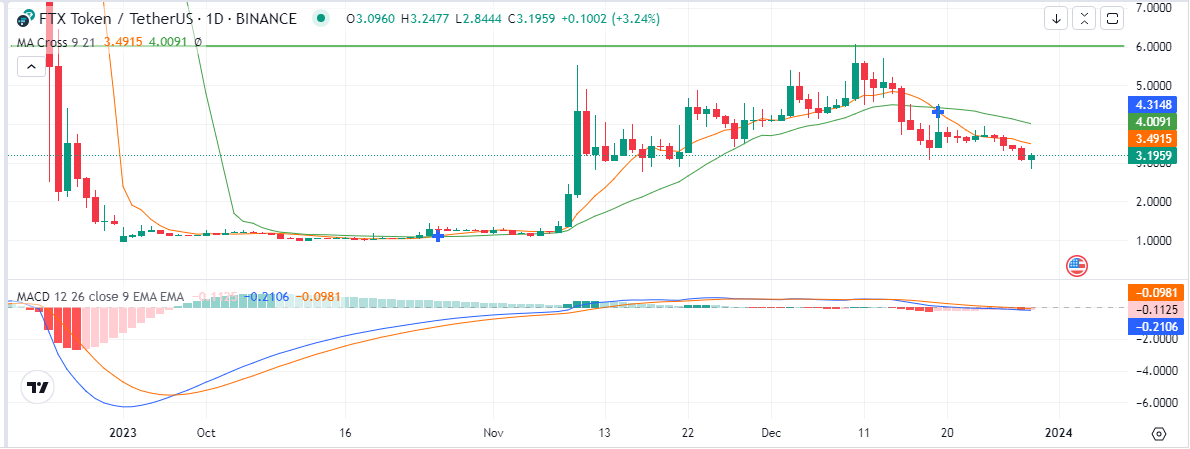
FTX Token price chart 

Technical indicators, such as the Moving Average Convergence Divergence (MACD), depict ongoing price action, signalling a potential continuation of market fluctuations. The looming possibility of a Death Cross, as indicated by the Cross EMA 50/200 Day, and the resistance of FTX’s proposed repayment plan adds an element of caution for investors navigating the FTT landscape.

FTX bankruptcy drama unfolds: customer claims

Amid the FTT’s price turmoil, the FTX exchange is grappling with bankruptcy proceedings, prompting scrutiny from creditors. A recent court filing reveals FTX’s controversial proposal to appraise customer claims in US dollars, based on cryptocurrency prices as of the bankruptcy date, November 11, 2022. However, creditors argue that the proposed values significantly undervalue their digital assets, igniting a legal battle over the valuation of crypto claims.

The FTX 2.0 Coalition, representing a group of creditors, urges affected customers to contest the undervalued compensation plan. The court’s decision, anticipated by the January 11 deadline for filing objections, will significantly impact the course of FTX’s legal proceedings and set precedents for crypto-related bankruptcy cases.

FTX Token (FTT) price prediction

As FTX token holders navigate the uncertainties, analysts provide a glimpse into potential price scenarios for FTT as 2023 comes to an end. The technical analysis suggests that if bulls manage to push the price above the resistance level of $4.0396, FTT could target upper resistance levels at $4.5550 and $5. Conversely, a bearish scenario could see the price testing support levels at $3.4550 and $2.8934 if bears dominate the market.

The intricate dance between bulls and bears, coupled with the dynamics of technical indicators, sets the stage for a critical period in FTT’s price trajectory. Traders and investors keenly await developments that will shape the token’s future in the crypto market.

Pullix emerges as a decentralized trading alternative

Amidst the chaos surrounding FTX, Pullix emerges as a potential game-changer in the decentralized trading space. The platform’s unique approach aims to bridge the gap between centralized and decentralized exchanges, tackling liquidity issues that have hindered DeFi’s growth. Offering institutional, liquid, and slippage-free trading, Pullix distinguishes itself with a commitment to user security and a hybrid DeFi model.

The PLX token, Pullix’s native cryptocurrency, introduces a “Trade-to-Earn” concept, allowing users to earn instant rewards for trading and providing liquidity. Unlike traditional exchanges, PLX token holders benefit from a revenue-sharing mechanism, earning a fixed passive income by contributing to automated market makers. With an innovative approach to liquidity provision and a community-driven ethos, Pullix presents itself as a compelling alternative in the ever-evolving crypto landscape.

Conclusion

In the unfolding narrative of FTX’s financial woes, FTT’s price dynamics, and Pullix’s emergence, the crypto community is presented with a variety of investment opportunities. They can choose to follow FTT price prediction or dive into the new PLX token currently in the presale stage.

However, whichever opportunity they decide to grab, they must remain vigilant, navigating the intricate crypto landscape where volatility and innovation go hand in hand.

The post FTT price prediction amid FTX’s repayment proposal as new hybrid exchange emerges appeared first on CoinJournal.

DeFi protocol Dolomite launches vARB to bring dual functionality to ARB holders

  • Dolomite says vARB is a “vote-enabled ARB” token that will allow holders to participate in Arbitrum’s governance through voting.
  • While it cannot be lent or borrowed, vARB means users can use their ARB collateral to vote.

DeFi protocol Dolomite has launched vARB, a “vote-enabled ARB” token that allows holders participate in governance voting on the Arbitrum network.

vARB is not a new token, and is non-transferable and non-tradable. Unlike ARB, users won’t be able to lend or borrow this token, the protocol said in a press release shared with CoinJournal.

However, vARB will allow holders to tap into ARB tokens deposited as collateral to access governance and voting rights on Arbitrum.

Amplify ARB voting power

According to Dolomite, vARB will be held in “isolation mode” on the protocol, with users able to use them for voting on Arbitrum. That’s not possible with the ARB locked in liquidity pools and used for lending and borrowing. As it stands, ARB locked in DeFi protocols such as Aave or Compound cannot be used in governance votes.

vARB makes this possible as users can use the same ARB for voting and for lending and borrowing by easily converting their ARB to vARB. The token however does have another advantage – holders can use it to amplify their votes’ weight.

To achieve this, users deposit vARB as collateral, getting to borrow more ARB. They can then swap the additional ARB for vARB, with this possible up to five times. As stated in the announcement, holders face no risk of liquidation from price movements given the value of vARB remains the same as that of ARB.

Arbitrum continues to grow as one of Ethereum’s most dominant Layer-2 networks. The network launched its ARB token in March and has over $2.4 billion in Total Value Locked (TVL) as of December 28, 2023. 

The price of ARB was $1.52, up by more than 32% in the past week as analysts predict a potential surge to $2.

The post DeFi protocol Dolomite launches vARB to bring dual functionality to ARB holders appeared first on CoinJournal.

Celsius Network granted approval to pivot to Bitcoin mining

  • The US Bankruptcy Court for the Southern District of New York approved Celsius Network’s restructuring plans for bitcoin mining on Wednesday.
  • Celsius filed for Chapter 11 bankruptcy protection in July 2022.

A US bankruptcy court has approved Celsius Network’s bitcoin mining shift as part of the ongoing Chapter 11 bankruptcy proceedings the collapsed crypto lender filed in July 2022.

The approval order was given by Judge Martin Glenn of the US Bankruptcy Court for the Southern District of New York on December 27, Reuters reported.

Per the ruling, Celsius can go ahead with the restructuring plans that aims at focusing the company’s operations on Bitcoin mining. 

The judge’s order overruled objections to the restructuring plans, paving the way for the move as the crypto firm looks to navigate away from the impactful bankruptcy proceedings. As reported,   US Bitcoin Corp announced in August that it had entered into agreed to host 8,500 miners for Celsius Network.. 

Celsius customers allowed withdrawals

With yesterday’s court approval, a total of $225 million in crypto earmarked for a business operations rejected by the SEC, is now available for distribution to Celsius customers. Shares in the new mining company will also be available to customers.

Celsius began allowing withdrawals for some customers in late November. The plan allows eligible participants in the crypto lender’s custody program to withdraw 72.5% of their crypto holdings, with a deadline set for February 28, 2024.

The post Celsius Network granted approval to pivot to Bitcoin mining appeared first on CoinJournal.

Argentina’s President Milei proposes incentives for declaring crypto holdings

  • Argentina’s President Milei proposes tax incentives in a draft bill for crypto regularization.
  • Asset regularization scheme offers favourable rates, encouraging prompt declaration by citizens.
  • The controversial omnibus bill sparks debates and protests amidst economic and political reforms.

Argentina’s pro-Bitcoin president Javier Milei is making waves with a groundbreaking draft bill aimed at regularizing cryptocurrency holdings as part of his ambitious economic and political reform agenda.

The legislation, titled the ‘Law of Bases and Starting Points for the Freedom of Argentines,’ proposes a unique approach to regulate both domestic and foreign cryptocurrency holdings.

Tax incentives for crypto declaration

President Milei’s draft bill introduces an ‘asset regularization scheme,’ offering tax incentives to individuals declaring crypto assets, irrespective of their origin or location. The proposed tax rates under this scheme vary based on the timing of declarations. Argentines declaring their crypto holdings before March 31, 2023, will benefit from a significantly low 5% tax rate, with gradual increases to 15% by November 30, 2023.

This move is strategically designed to encourage prompt declaration, fostering a more transparent and accessible process for formalizing cryptocurrency holdings. The inclusive nature of the legislation covers various assets, such as cryptocurrencies, crypto assets, and other similar goods, disregarding their issuer, owner, or storage location.

Debate and protests surrounding the bill

Despite the positive reception in the crypto market, President Milei’s omnibus bill has ignited controversy and protests within Argentina. The proposed economic and political reforms, including the crypto regularization initiative, have sparked debates in a nation grappling with deep-rooted financial issues, prolonged economic difficulties, high inflation, and currency instability.

The bill’s introduction marks a critical juncture for Argentina, highlighting both potential benefits and challenges. The success of this initiative hinges on the government’s ability to effectively balance regulatory oversight with the dynamic and decentralized nature of digital currencies.

In the coming months, the trajectory of this legislative effort will be closely watched, as it not only offers a pathway to legalize and regulate cryptocurrencies but also raises questions about its implications for Argentina’s economic future. President Milei’s bold stance on cryptocurrencies adds an intriguing layer to the ongoing discourse surrounding the country’s economic reforms.

The post Argentina’s President Milei proposes incentives for declaring crypto holdings appeared first on CoinJournal.

India issues compliance notices to nine offshore exchanges including Binance

  • India issues show-cause notices to Binance, Kucoin, and others for PMLA violations.
  • Finance Ministry urges blocking URLs of offshore exchanges operating illegally in India.
  • 1% tax on local exchanges prompts 3-5 million Indian users to shift to offshore platforms.

In a decisive move, India’s Finance Ministry has issued compliance show-cause notices to nine major offshore cryptocurrency exchanges, including industry giants like Binance, Huobi, and Kucoin. The government accuses these platforms of operating illegally within the country’s borders without adhering to local money laundering laws.

This development marks a significant step in India’s efforts to regulate the crypto industry, with a focus on enforcing compliance with the Prevention of Money Laundering Act (PMLA), 2002.

Compliance show-cause notices and URL blocking

The Finance Ministry of India served compliance show-cause notices to nine major players namely Binance, Kucoin, Huobi, Kraken, Bittrex, Gate.io, Bitstamp, MEXC Global, and Bitfinex. The nine were accused of allegedly violating the Prevention of Money Laundering Act (PMLA).

The notices demand an explanation for their non-compliance with the established regulations. Simultaneously, the ministry has urged the Information Technology Ministry to block the URLs of these exchanges, citing their illegal operations within the country.

This move underscores India’s commitment to bringing offshore crypto exchanges under regulatory oversight, signalling a significant shift in the country’s approach toward monitoring and controlling digital asset transactions. The lack of a specified timeframe or consequences in the issued notices leaves the crypto community and the exchanges in question in suspense, with potentially far-reaching implications for their operations in the Indian market.

Financial Intelligence Unit-India (FIU-IND)

India’s Finance Ministry emphasizes the necessity for virtual digital asset (VDA) service providers to register with the Financial Intelligence Unit-India (FIU-IND). This includes activities such as the exchange between virtual digital assets and fiat currencies, with obligations extending beyond physical presence in India.

While 31 service providers have registered with the FIU-IND, the ministry points out that several offshore entities serving a substantial Indian user base have failed to comply with the Anti-Money Laundering (AML) and Counter Financing of Terrorism (CFT) frameworks.

The implementation of a 1% tax on crypto transactions in India on local exchanges has led to a notable migration of users to foreign platforms. Between February and July 2022, three to five million Indian users shifted to offshore exchanges, causing potential revenue loss for the government. A single offshore exchange reported a surge in sign-ups following the tax implementation, highlighting the impact of regulatory measures on user behaviour.

The post India issues compliance notices to nine offshore exchanges including Binance appeared first on CoinJournal.