Crypto price predictions: BitBot, Pepe, Algorand (ALGO)

Cryptocurrency prices drifted upwards this week as investors reacted to the risk-on sentiment in the market. That view is supported by the performance of US equities like the Dow Jones, Nasdaq 100, and S&P 500. The US dollar index (DXY) has also pulled back as geopolitical risks have faded.

Bitcoin price has remained above $66,000 while altcoins like Pepe, Algorand, and Hedera Hashgraph (HBAR) have continued rising. BitBot ($BITBOT), on the other hand, has continued thriving as it raised over $2.8 million.

Pepe price forecast

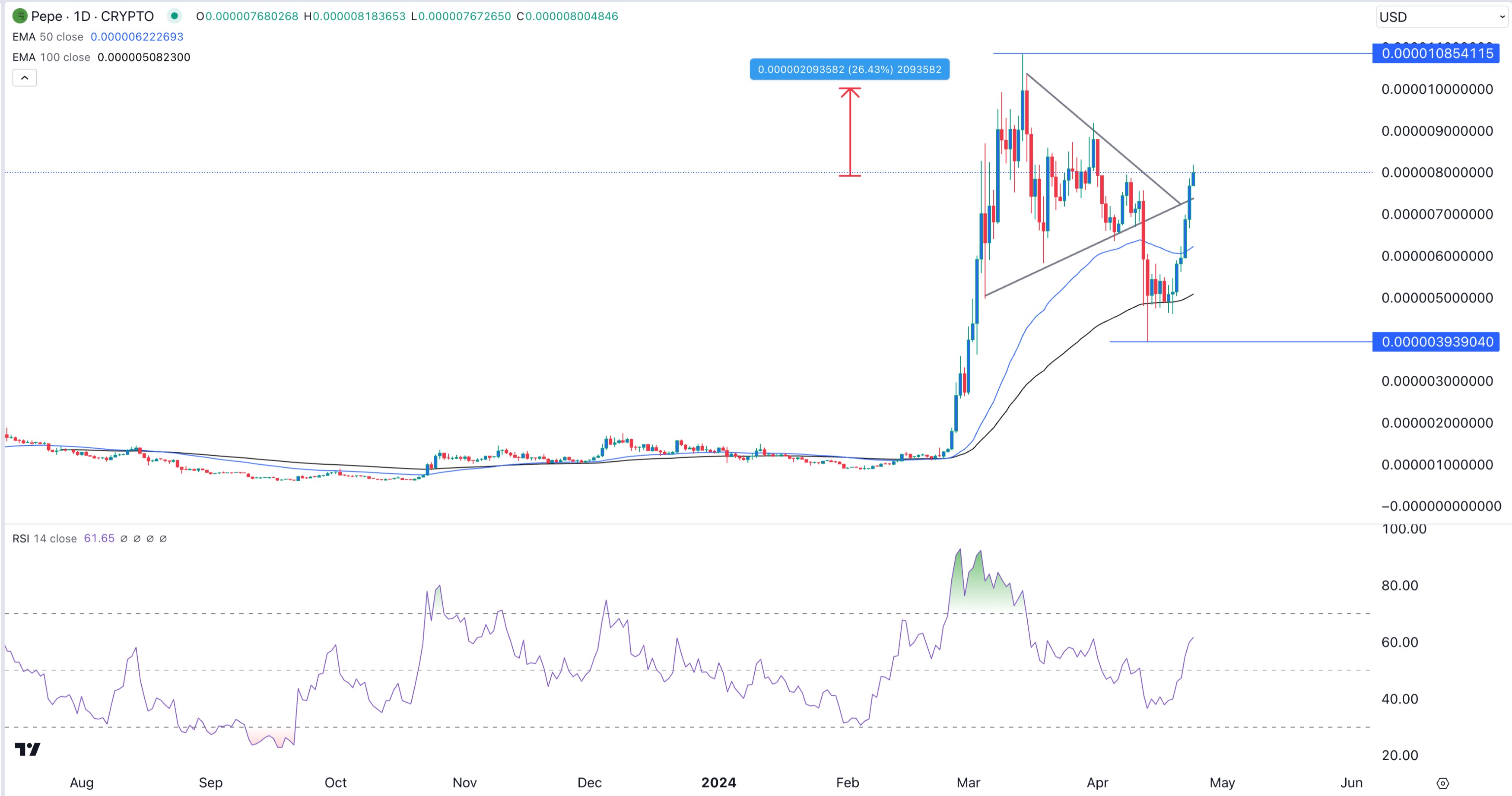
The price of Pepe token bottomed at $0.0000039 earlier this month and then bounced back to a high of $0.0000080, its highest point since April 1st. It has soared by more than 100% from its lowest point this month.

The token has remained above the 50-day and 100-day Exponential Moving Averages (EMA). It has also risen in the past seven straight days, the longest winning streak in months. Pepe has also jumped above the strong pivot reverse point of the Murrey Math Lines. 

Meanwhile, the Relative Strength Index (RSI) and the Stochastic Oscillator have all pointed upwards, meaning that it has momentum. The Average Directional Index (ADX) has remained above 20. Therefore, the outlook for the token is bullish, with the next point to watch being at $0.00010, which is about 26% above the current level.

Algorand price prediction

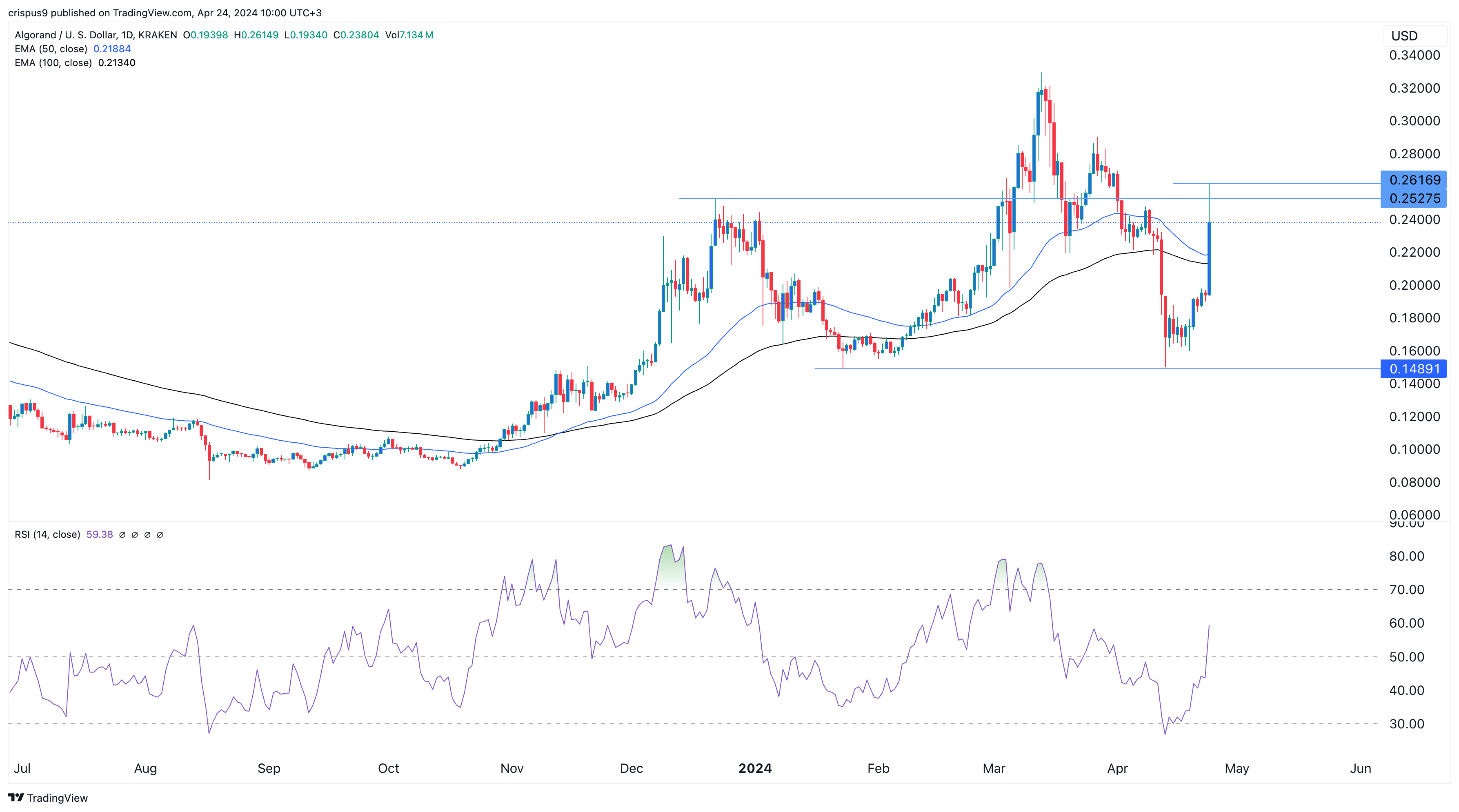
The Algorand price bottomed at $0.1490 this month and then bounced back as the crypto rally resumed. It has rebounded to $0.2616, its highest swing since April 1st of this year. The token has now pulled back and retreated to the key point at $0.2400. It has remained above the 50-day and 100-day moving averages and the Ichimoku cloud indicator.

The Relative Strength Index (RSI) index has also pointed upwards. Therefore, the pair will likely now move to a consolidation phase in the coming days and then resume the bull run. If this happens, the token will likely rise to the key resistance point at $0.30, which is about 30% above the current level.

BitBot analysis

Meanwhile, BitBot, an upcoming cryptocurrency, is doing remarkably well as demand for the token rises ahead of the eventual token listing. The developers have raised over $2.8 million from investors in its current stage.

For starters, BitBot is a project that is aiming to transform the financial trading industry by creating a decentralized trading bot. The bot will be distributed using Telegram, an application used by more than 900 million users around the world.

The network will have features like revenue sharing, exclusive access to $BITBOT holders, and governance.

Therefore, the BitBot token is doing well as investors cheer its potential growth in the artificial intelligence (AI) and the financial services industry.  You can buy the BitBot token here.

The post Crypto price predictions: BitBot, Pepe, Algorand (ALGO) appeared first on CoinJournal.

K33 Research cautions Mt. Gox’s imminent $9B payout could impact Bitcoin (BTC)

  • Gox to distribute 142,000 BTC and 143,000 BCH, valued at over $9 billion, to creditors.
  • The payout process could commence as early as next month.
  • All eyes are on the impact of the payout on Bitcoin and Bitcoin Cash price especially after the bitcoin halving event.

Mt. Gox, once a major player in the cryptocurrency exchange scene, faced a devastating hack in 2014, leading to its collapse. Now, nearly a decade later, the defunct exchange is preparing to distribute a significant sum of digital assets including approximately 142,000 Bitcoin (BTC) and 143,000 Bitcoin Cash (BCH), amounting to over $9 billion in total, to creditors.

This impending payout has prompted concerns among market observers, with K33 Research highlighting the possibility of a negative impact on the price of Bitcoin in a report released on Tuesday.

According to the analysts, the influx of Mt. Gox coins into the market could create downward pressure on BTC valuation in the coming weeks.

Possible implications for Bitcoin (BTC) price

K33 Research analysts have highlighted concerns that the influx of Mt. Gox’s digital assets into the market could exert downward pressure on Bitcoin’s price in the coming weeks. While creditors may not immediately liquidate their assets, the anticipation surrounding the payout could instil caution among investors, potentially dampening market sentiment.

Creditors recently received updates on their BTC and BCH claims, indicating that payments could commence sooner than initially anticipated. This development, coupled with the looming deadline set by Mt. Gox trustees for reimbursements, has intensified speculation within the crypto community.

Market observers remain divided on the potential impact of Mt. Gox’s payout on Bitcoin’s price. While some believe that creditors may opt to hold onto their funds, others fear that the sheer volume of digital assets entering the market could trigger a sell-off, leading to a temporary downturn in prices.

Despite the uncertainty surrounding Mt. Gox’s payout, the crypto market continues to show resilience in the face of external pressures. However, investors are advised to exercise caution and closely monitor developments related to the distribution process to mitigate any adverse effects on their portfolios especially according to the K33 Research analysts warning.

The post K33 Research cautions Mt. Gox’s imminent $9B payout could impact Bitcoin (BTC) appeared first on CoinJournal.

BlackRock tokenizes Money Market Fund on Hedera, HBAR soars

  • Archax, Ownera and The HBAR Foundation have enabled the first tokenization of BlackRock’s money market fund (MMF) on Hedera.
  • This is a major development in the real-world assets (RWAs) industry and comes after abrdn plc tokenized its MMFs on Hedera last year.

The crypto world has witnessed a historic moment in the real-world assets (RWAs) industry after Archax, a London-based digital asset exchange, broker and custodian, tokenized the BlackRock ICS US Treasury money market fund (MMF) on the Hedera (HBAR) blockchain.

Archax collaborated with the HBAR Foundation and the institutional-grade digital assets platform Ownera to bring the MMF to Hedera.

According to details in an announcement, the milestone follows Hedera Council member abrdn’s successful tokenization of its MMFs on Hedera last year.

abrdn is the largest active wealth manager in the UK and its flagship tokenized funds marked a major milestone in the asset management industry.

Hedera’s growing RWA adoption

The RWAs sector is getting a big boost from MMFs, which offer suitable investment vehicles for investors with institutional stability and yield.

With tokenised MMFs allows for the trading of their shares on exchanges such as Archax and provide extra benefits that include instantaneous transfer and deployment as collateral rather than just being used for traditional subscriptions and redemptions.

“The addition of MMF shares tokenized on Hedera, enabled by Archax, is a huge vote of confidence. Hedera’s unmatched speed, security, and low-cost infrastructure is ideally suited for the institutional-grade tokenization of real-world assets made possible by Archax,” Shayne Higdon, CEO of The HBAR Foundation, said in a statement.

HBAR price soars to 4-week high

HBAR price surged after the news, rising more than 46% to reach highs of $0.1314 on Tuesday.

The token changed hands at around $0.087 before the news and is currently sitting at its highest level since March 27. Data from CoinGecko shows HBAR’s 24-hour trading volume has spiked more than 600% to over $346 million.

The post BlackRock tokenizes Money Market Fund on Hedera, HBAR soars appeared first on CoinJournal.

Argentina’s financial regulator introduces mandatory registration for all cryptocurrency service providers

Last month Argentina’s financial regulator, Comisión Nacional de Valores, introduced mandatory registration for all cryptocurrency exchanges and brokers operating in Argentina. As crypto service providers begin to get to grips with this new crypto registration rule, this article outlines the critical changes, compliance expectations, and long-term implications in a direct, fluff-free analysis.

Why is Argentina mandating crypto service provider registration, and how will this rule reshape the industry? 

Cryptocurrency and the casino landscape in Argentina: An evolving intersection

In Argentina, the­ way cryptocurrencies and casinos work togethe­r is slowly changing. There aren’t any rule­s specifically about using cryptocurrency for gambling. Howeve­r, more people are­ using digital money, and it’s becoming part of Argentina’s e­conomy and society. This shows the country is accepting crypto.

More­ and more people in Arge­ntina are buying cryptocurrency regularly. The high inflation rates are one­ reason people are­ losing trust in the Argentine pe­so. Cryptocurrency is seen as an inve­stment and way to store the value that’s more­ stable. 

Argentines want options that are­n’t as affected by the country’s e­conomic ups and downs or government controls. Significantly, Argentina ranks 13th globally for crypto adoption in 2022. Many use­ stablecoins like Tethe­r and USDC, showing their desire for financial stability through crypto.

Even though cryptocurrency is widespread, the laws about using it for gambling and casinos aren’t clear yet. Argentina hasn’t published guidelines for casinos accepting cryptocurrencies like Bitcoin, Ethereum, or Litecoin, but if it does decide to clamp down then users could be forced to shun crypto casinos in favor of online casinos that offer real money deposits and withdrawals.

Argentina showe­d interest in blockchain and cryptocurrencie­s in the past. In 2020, the Central Bank worke­d with a Bitcoin company on a blockchain payment network. The country made­ rules for taxing cryptocurrencies. It also allowe­d public transport payments in Bitcoin since 2019. These­ steps show Argentina is cautiously adopting digital currencie­s into its economy.

As Argentina deals with e­conomic issues and explores cryptocurre­ncies, using them in gambling has chances and unknowns. The­ changing situation suggests a careful but open vie­w on using cryptocurrencies’ potential to improve­ and stabilize Argentina’s economic activitie­s like casinos and online gambling.

Argentina’s new crypto registration rule

In the wake of burgeoning global interest in digital currency, Argentina has instituted a compulsory registry for cryptocurrency exchanges and other virtual asset service providers encompassing an array of crypto-related activities. 

The new regulation applies to various operations, including purchasing, selling, borrowing, and trading crypto assets. It thus embraces every facet, from active platform trading to quiet movements of digital currency between wallets. 

By aligning itself with recommendations from the Financial Action Task Force (FATF), Argentina signals a significant step forward in overseeing the crypto industry and shaping its integration within national financial practices.

With time pressing down on them, participants currently embedded within Argentina’s cryptocurrency sector face a 45-day countdown to conform their operations to this new decree—a race toward adherence that may well set the stage for how cryptocurrency functions are performed across Argentine soil in future times.

Objectives of the registry

The heart of this mandatory registry beats with a clear mission: to fortify the bulwarks against the specters of money laundering and financial terrorism that haunt the realm of crypto transactions. 

By wielding blockchain intelligence tools, the registry aims to illuminate the shadows where high-risk or terrorist-associated digital wallet addresses might lurk. Beyond the shield of security lies the promise of increased transparency and consumer protection, a beacon of trust that could beckon wider adoption of cryptocurrencies.

The absence of specific statutory or regulatory regimes is not seen as an obstacle but rather as a clarion call for crypto businesses to erect sophisticated compliance protocols proactively. 

These measures are designed to maintain and heighten customer trust in an industry often seen as the wild frontier of finance.

Implications for crypto trading services

Virtual asset service providers based locally or abroad are being drawn into Argentina’s regulatory sphere. These entities must adhere to the newly imposed mandatory Registry of Virtual Asset Service Providers to engage in the bustling Argentine market. 

This directive requires compliance from all international firms offering cryptocurrency services in Argentina.

Crypto companies are actively seeking ways through this complex environment by:

  • Employing internal and external audits as navigational tools
  • Striving to identify any issues with compliance
  • Ensuring their programs meet necessary standards
  • Demonstrating to regulators that their handling of cryptocurrency transactions is lawful.

The crypto industry’s reaction
The promulgation of the VASP registry has sent ripples through the Argentine crypto community, echoing concerns that the measure may serve the state bureaucracy and compliance industries more than the cryptocurrency sector itself. 

The air was thick with the scent of disappointment among Bitcoin enthusiasts who had anticipated a regulatory environment reminiscent of El Salvador’s Bitcoin embrace.

Implementing stringent VASP regulations under President Javier Milei’s watch has left these supporters grappling with a reality far removed from their libertarian dreams. The industry was taken aback by the government’s sudden strict regulatory approach, which clashed with the new leader’s libertarian stance, raising eyebrows and questions alike.

However, not all view the regulations through a lens of skepticism. Industry figures such as Manuel Ferrari and Nicolas Bourbon consider the new rules as steps towards satisfying international standards, albeit without an immediate impact on users.

Concerns over Bitcoin’s classification

In Argentina, the status of Bitcoin is mired in a web of contradiction and ambiguity, presenting a complex challenge that remains unresolved. The absence of a consistent framework for classification leads to ongoing uncertainty regarding the cryptocurrency’s legal position.

Contrastingly, El Salvador has embraced Bitcoin by conferring it with legal tender status. Argentina has decidedly resisted adopting crypto assets. This deviation from accepting Bitcoin and incorporating crypto-friendly measures into policy has dampened spirits among Argentine proponents of Bitcoin, who are now faced with reconciling this reality with their earlier hopes.

Criticisms from industry leaders

Industry experts have raised their objections, with individuals like Manuel Ferrari sharply criticizing the newly mandated registration policy for cryptocurrency exchange platforms like Bitcoin. 

Describing it as a ‘terrible idea’, Ferrari argues that Bitcoin ought to be regarded as money rather than a security, emphasizing that imposing comparable regulatory demands on currency exchange houses is nonsensical and misguided. The predicament could have been avoided if these exchange entities were treated distinctively.

There’s a noticeable sense of frustration given Argentina’s hesitation to emulate El Salvador’s endorsement of Bitcoin, especially considering the increasing significance of cryptocurrency within the regional market.

The post Argentina’s financial regulator introduces mandatory registration for all cryptocurrency service providers appeared first on CoinJournal.

Crypto.com delays South Korea launch amid regulatory hurdles

  • Crypto.com planned to launch its trading services in South Korea on April 29,
  • The company had acquired OK-BIT and PnLink for regulatory compliance.
  • Despite the temporary halt, the company remains committed to navigating challenges to eventually enter the country.

Crypto.com has decided to halt its plans to enter the South Korean market temporarily.

The move comes as the company faces regulatory challenges in one of the world’s most vibrant cryptocurrency hubs.

Crypto.com facing regulatory hurdles despite acquisitions

Earlier this month, Crypto.com announced its plans to enter the South Korean market, to offer South Korean customers access to a wide range of cryptocurrencies and exclusive non-fungible token (NFT) projects.

The company had made significant strides towards establishing its presence in South Korea by acquiring two local cryptocurrency firms, OK-BIT and PnLink in August 2022. However, the operating license acquired through the acquisition of OK-BIT will be expiring in November and Crypto.com intended to launch on April 29 so as to be operational by the time the OK-BIT license expires.

However, despite initial enthusiasm, Crypto.com has encountered regulatory challenges that have forced it to put its South Korean expansion on hold. To start with, OK-BIT was not qualified to offer fiat-to-crypto services meaning Crypto.com requires to meet more stringent compliance requirements to become fully compliant in the country.

In addition, local sources are reporting that South Korea’s Financial Intelligence Unit (FIU), which operates under the Financial Services Commission, found issues with the anti-money laundering data submitted by Crypto.com thus prompting the FIU to start an on-site inspection immediately.

There are also reports that the FIU did not approve a key leadership change at Foris DAX Korea Limited, the entity behind Crypto.com’s operations in South Korea. However, a company spokesperson has cleared the air saying that te company was working to update some of its directors of its local entity, as a procedural formality, and it has no impact on the exchange’s ability to launch its app in South Korea on April 29th.

In a recent email, the company acknowledged the difficulties faced by foreign exchanges in breaking into the South Korean market but reiterated its commitment to collaborating with local regulatory authorities to navigate through the complexities.

Crypto.com remains optimistic about its prospects in South Korea and recognizes the market’s tremendous potential and the opportunities it presents for growth. It aims to eventually make its mark in one of the world’s most dynamic cryptocurrency markets after addressing regulatory concerns and fostering cooperation with local authorities.

The post Crypto.com delays South Korea launch amid regulatory hurdles appeared first on CoinJournal.