Dogwifhat (WIF) massive pump on Bybit after listing causes market frenzy

  • Dogwifhat (WIF) was listed on Bybit crypto exchange today.
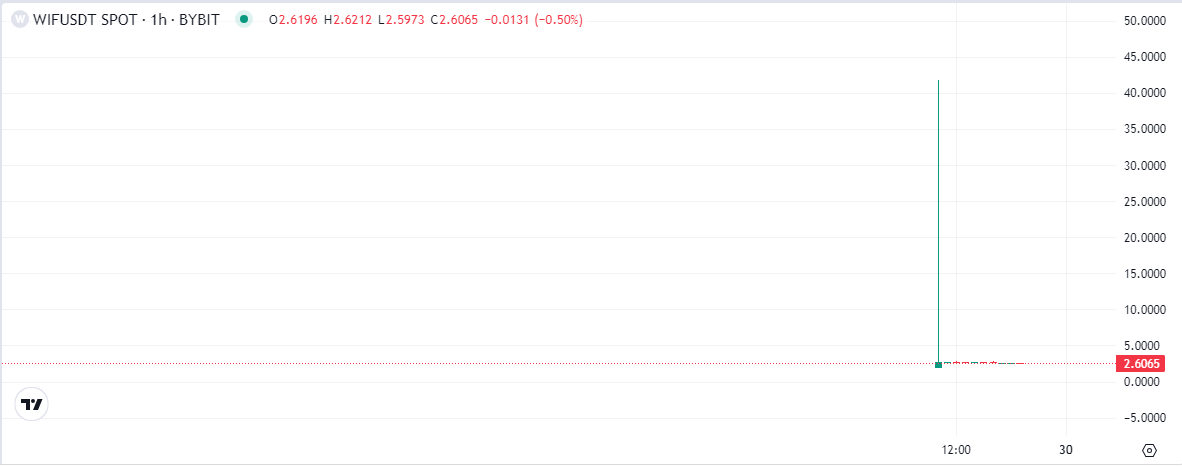
  • Immediately after listing the meme coin’s price hit $41.85 before quickly retracing.
  • At press time, Dogwifhat (WIF) was trading at $2.61, down 6.13% in the past 24 hours.

Dogwifhat (WIF), the latest sensation in the world of meme coins, caused a frenzy on the Bybit exchange shortly after its listing.

Within minutes of trading going live, the price of Dogwifhat skyrocketed by a staggering 1,450%, reaching a high of $41.85. The surge was, however, short-lived as the price quickly retreated back to $2.64, aligning with the token’s price across the broader market.

Dogwifhat explosive surge first day on Bybit

Dogwifhat (WIF) trading on Bybit commenced at 8:50 a.m. ET on Bybit and in just over 10 minutes, the token’s price surged from $2.70 to its peak of $41.85, marking an extraordinary spike.

WIF price pumps and dumps on Bybit

Interestingly, the sudden price increase was confined solely to Bybit, with no notable impact on other major exchanges like Binance.

CoinGecko data reveals that Binance facilitates a significant portion of Dogwifhat’s trading volume, yet its price remained unaffected by the Bybit surge.

The Dogwifhat (WIF) meme coin sensation

Dogwifhat, adorned with the image of a dog donning a hat, quickly gained traction amid the recent memecoin trading frenzy.

Notable traders and influencers, including Hsaka and Ansem, threw their support behind Dogwifhat, contributing to its popularity.

Moreover, the coin’s community rallied to raise $700,000 to showcase Dogwifhat’s image on the iconic Las Vegas sphere for a week, although the execution of this plan remains uncertain.

With its brief but monumental surge on Bybit, Dogwifhat (WIF) continues to captivate the attention of crypto enthusiasts and meme coin aficionados alike.

However, despite its transient glory on Bybit, the coin’s journey in the volatile world of cryptocurrencies remains unpredictable, leaving investors and supporters eagerly anticipating its next move.

The post Dogwifhat (WIF) massive pump on Bybit after listing causes market frenzy appeared first on CoinJournal.

EigenLayer announces token launch and airdrop for the community

  • EigenLayer’s token EIGEN will launch in May, with a total supply of 1.67 billion tokens.
  • The Eigen Foundation has announced an airdrop for the community, set for May.

The Eigen Foundation, the non-profit supporting the development of restaking protocol EigenLayer, has announced the launch and distribution of the native token EIGEN.

Alongside the announcement for the token, the foundation and the Eigen Labs team unveiled the EigenLayer whitepaper. The project, which attracted investment from Binance Labs and a16z early this year, has seen tremendous growth in terms of staked Ether (ETH).

EIGEN token launch and airdrop

According to today’s announcement, the Eigen Foundation will launch the EIGEN token in May. An airdrop for the community of stakers on EigenLayer will also go live.

The new token is set at a total supply of 1.67 billion, with 45% of the EIGEN tokens allocated to the community.

Per the details in a blog post summarizing the distribution, 15% of supply will go to stakedrops, another 15% set aside for community initiatives and a similar amount (15%) allocated to the EigenLayer ecosystem development.

The EIGEN airdrop Season 1 will see the community get a chance to grab a share of 5% of the token supply. This allocation goes to stakedrop participants captured in a snapshot taken on March 15, 2024. Claims for this airdrop begin on May 10, with 90% of the tokens claimable for up to 120 days.

The next batch, which is the remaining 10%, will go live will 30 days after the first phase claim window ends.

Meanwhile, the Eigen Foundation has earmarked 29.5% of supply for investors and 25.5% for early contributors.

Allocations to investors and early contributors face a 3-year crypto vesting period, with total lockup in year 1. The next two years will include an unlock rate of 4% per month.

The post EigenLayer announces token launch and airdrop for the community appeared first on CoinJournal.

SEC has regarded Ethereum as security for at least a year: report

  • SEC began investigtions into Ethereum as a security in March 2023.
  • The regulator sent subpoenas and a Wells Notice to Consensys, a Ethereum development firm.

The US Securities and Exchange Commission (SEC) has reportedly viewed Ethereum as an unregistered security for at least a year, FOX Business reported on Monday.

According to the publication, this consideration about ETH comes to light following court filings by Ethereum software developer company Consensys.

The company, which sued the SEC last week amid investigations around the cryptocurrency, maintains that Ethereum is not a security.

Consensys sued the SEC

The Consensys team’s lawsuit filed in Texas accused the Gary Gensler led SEC of “overreach” in its regulation of the crypto space. The lawsuit also asked the court to declare ETH not a security.

SEC’s Wells Notice to Consensys and an investigation against the Ethereum Foundation have been key events to unfold in the past few weeks.

FOX Business’ report states that documents show the SEC’s Enforcement Division has looked at Ethereum as an unregistered security since March last year. Per the documents, the investigation centers on the so-called “Ethereum 2.0.”

The SEC believes that there might have been securities “offers and sales” involving Ethereum since 2018.

Interestingly, this is the same year that SEC’s then-Director of Corporation Finance Bill Hinman said Ethereum was a security. Former SEC Chair Jay Clayton also gave guidance to that effect, while the Commodity Futures Trading Commission has deemed ETH to be a commodity.

But per the new court documents, SEC’s Division of Enforcement head Gurbir Grewal gave the nod to a formal investigation into Ethereum’s status on March 28, 2023.

The order authorised enforcement staff to probe and issue subpoenas to entities and individuals deemed to have been involved in the buying and selling of ETH.

These investigations have formed one part of the hurdle market experts say could see the SEC deny spot Ethereum ETFs in May.

The post SEC has regarded Ethereum as security for at least a year: report appeared first on CoinJournal.

Upcoming changes to Belgian gambling laws prompt shift to offshore Bitcoin casinos

  • The upcoming changes to Belgian gambling laws include bans on certain devices, gifts, bonuses, and free games.
  • The age limit for punters will also be raised from 18 to 21 years.
  • Many Belgian gamblers are shifting to online crypto casinos to circumvent the new changes.

As Belgium gears up for significant changes to its gambling laws, scheduled to take effect in September, a notable shift is underway in the country’s gambling landscape. The impending revisions, aimed at enhancing player protection and tightening regulations, have spurred a surge in Belgian punters turning to offshore Bitcoin casinos. 

While there are legally licensed crypto casinos operating in Belgium, illegal crypto casinos leveraging the anonymity and versatility of cryptocurrencies, are attracting players seeking to circumvent the impending regulatory changes and enjoy a broader range of gambling options. However, concerns abound regarding the risks associated with illegal gambling and the potential consequences for both punters and the regulated gambling industry.

Upcoming Belgian gambling law changes

Belgium’s gambling industry boasts a rich history dating back to the 1300s, offering a diverse range of legal gambling options, including casinos and sports betting. However, the industry faces many challenges and the government is taking a proactive stance towards regulating the industry and safeguarding players by implementing sweeping changes to the country’s gambling laws. 

Among the key revisions is the raising of the legal gambling age from 18 to 21, aligning various forms of gambling with age restrictions already in place at land-based casinos. This measure aims to curb underage gambling and promote responsible gaming practices, reflecting a commitment to protecting vulnerable segments of the population.

Additionally, the revised legislation introduces stringent regulations on advertising and licensing, aiming to minimize exposure to gambling-related messaging and mitigate potential harm, particularly among minors and individuals with gambling disorders. There are also prohibitions on certain gambling devices and restrictions on the accumulation of online licenses to foster fair competition and prevent monopolistic practices within the online gambling sector. 

Moreover, the revised laws introduce bans on gifts, bonuses, and free games to curb excessive or irresponsible gambling behavior.

In a nutshell, the changes introduced in the gambling laws emphasize the government’s dedication to promoting responsible gambling practices by anyone who operates a casino in belgium.

The rise of offshore Bitcoin casinos

Despite the government’s efforts to enhance regulation and player protection, a growing number of Belgian punters are still turning to illegal offshore crypto casinos as an alternative to traditional gambling options. These online platforms, facilitated by the use of cryptocurrencies such as Bitcoin, offer punters anonymity, privacy, and a wider array of games compared to their legal counterparts. 

Furthermore, the allure of circumventing regulatory restrictions and enjoying unrestricted gambling experiences has led many gamblers to explore these illegal offshore Bitcoin casinos, despite the associated risks.

One of the primary draws of offshore crypto casinos is the anonymity afforded by Bitcoin transactions, allowing players to bypass traditional financial systems and evade regulatory scrutiny. Moreover, these platforms boast a diverse range of games and innovative features, catering to the varied preferences of punters and providing an enticing alternative to regulated gambling establishments.

However, the rise of illegal offshore crypto casinos poses significant risks to players, including potential fraud, scams, and legal repercussions. 

The lack of regulatory oversight leaves punters vulnerable to exploitation by unscrupulous operators, while engaging in illegal gambling activities exposes them to fines and prosecution under Belgian gambling laws. Furthermore, the unregulated nature of financial transactions and Bitcoin usage on these platforms increases the risk of financial loss, identity theft, and cyberattacks.

The challenges posed by the illicit online platforms underscore the need for continued vigilance and cooperation among stakeholders to safeguard players and preserve the integrity of the regulated gambling industry in Belgium. 

In response to the proliferation of offshore Bitcoin casinos, authorities have intensified efforts to combat illegal gambling and enforce existing regulations.

The post Upcoming changes to Belgian gambling laws prompt shift to offshore Bitcoin casinos appeared first on CoinJournal.

Wasabi Wallet developer bars U.S. users amidst regulatory concerns

  • zkSNACKs restricts Wasabi Wallet access for U.S. citizens and residents.
  • Decision follows arrests of Samourai Wallet and Tornado Cash founders.
  • Move aims to mitigate legal risks amidst regulatory scrutiny.

In response to recent legal actions and regulatory scrutiny, zkSNACKs, the developer behind the privacy-focused Wasabi Wallet, has decided to restrict access to its services for United States users.

This move comes amidst growing concerns within the cryptocurrency community following the arrests of individuals associated with other privacy-enhancing wallet services, such as Samourai Wallet and Tornado Cash.

Arrests of the founders of Samourai Wallet

The decision to block access for U.S. citizens and residents was announced in a blog update by zkSNACKs, citing recent developments involving other privacy-focused wallet services.

Specifically, the arrests of the founders of Samourai Wallet on charges of money laundering, as well as the arrest of Tornado Cash co-founder Roman Storm on allegations of money laundering and sanctions violations, have raised red flags within the cryptocurrency ecosystem.

These legal actions have put privacy-focused wallet developers under increased scrutiny from regulatory authorities, who are concerned about the potential misuse of these tools for illicit activities such as money laundering.

While privacy-focused wallets offer users enhanced anonymity and security when transacting in cryptocurrencies, they have also attracted attention from law enforcement agencies seeking to crack down on illegal activities in the crypto space.

By proactively restricting access to users from the United States, zkSNACKs aims to mitigate any potential legal risks and ensure compliance with relevant regulations.

The post Wasabi Wallet developer bars U.S. users amidst regulatory concerns appeared first on CoinJournal.