
Gemini Earn users get $2.18 billion in crypto, representing 232% recovery

  • Gemini Earn users get $2.18 billion in digital assets back, which represents a 232% recovery.
  • Users will receive 100% of their crypto back, with the initial distribution representing 97% of Earn users’ assets.

Gemini has announced that its customers of its Gemini Earn program have received $2.18 billion worth of digital assets.

The distribution is in kind and represents a 232% recovery for Earn users, Gemini co-founder and CEO Tyler Winklevoss and co-founder and President Cameron Winklevoss said in a news release.

Gemini Earn users get $2.18 billion in digital assets

Per Gemini‘s announcement, the $2.18 billion distribution accounts for 97% of the digital assets owed to Gemini Earn’s users. The initial payout is $1 billion on more, or 232% recovery on users’ digital assets following Genesis’s halting of withdrawals and bankruptcy.

Commenting on the payment in kind, Gemini noted that a customer who deposited one bitcoin receives one bitcoin back. Gemini has also assured Earn users that they will receive “any and all appreciation” of their digital assets from the time they lent them into the program.

A long wait

Crypto lender Genesis halted withdrawals in November 2022, a development that followed the shocking collapse of cryptocurrency exchange FTX. Genesis revealed it had significant exposure to the imploded crypto exchange.

While crypto prices plummeted amid the chaos that followed, including Bitcoin’s dive to lows of $15,600, the past two years have seen BTC prices skyrocket.

In March this year, Bitcoin rose to a new all-time high above $73,000. The top digital asset traded around $22,700 when Genesis filed for Chapter 11 bankruptcy plan in January 2023.

Gemini Earn’s users are getting their digital assets back after a US bankruptcy judge approved Genesis Global’s chapter 11 wind-down early this month.

Earn users to receive 100% of their assets

In February, Gemini announced that it would return 100% of users’ assets following a settlement with Genesis and the bankrupt crypto lender’s other creditors.

According to today’s announcement, users should expect the balances within the next 12 months.

“It’s important to note that the Genesis bankruptcy was not a crypto problem. It was old-fashioned financial fraud compounded by a lack of regulatory clarity,” Gemini CEO Tyler Winklevoss said.

The exchange reportedly contributed $50 million towards the Earn recovery.

The post Gemini Earn users get $2.18 billion in crypto, representing 232% recovery appeared first on CoinJournal.
PayPal stablecoin PYUSD launches on Solana

  • PayPal USD (PYUSD) is now live on the Solana blockchain.
  • Users can buy PYUSD via PayPal, Venmo, Crypto.com, Phantom and Paxos.

PayPal USD (PYUSD), the stablecoin that payments giant PayPal launched in August 2023, is now live on Solana.

Users on Solana can buy PYUSD via PayPal and Venmo wallets. Also announced as the first providers to allow fiat-to-crypto purchases for the stablecoin are Crypto.com, Phantom and Paxos.

PayPal brings PYUSD to Solana

PayPal announced the availability of PYUSD on Solana at Consensus 2024 kicked off on May 29 in Austin, Texas, with the stablecoin’s launch on the blockchain coming several months after the initial rollout on the Ethereum mainnet.

According to a press release, the Paxos-issued stablecoin will leverage Solana to drive further adoption across commerce and payments.

Features that the PayPal USD team looked at in their decision to integrate Solana include cost-effectiveness, high transaction throughput, settlement speed and token extensions.

The expanded functionality will bring fast and secure stablecoin payments via PYUSD to the more than 30 million merchants, PayPal said in a news release published on Wednesday.

“Making PYUSD available on the Solana Blockchain furthers our mission of enabling a digital currency with a stable value designed for commerce & payments,” Jose Fernandez da Ponte, PayPal’s SVP for Blockchain, Crypto & Digital Currencies, said in a statement.

PayPal eyes growing stablecoin market

The launch of PYUSD on Solana sees PayPal join Visa, WorldPay and Stripe among other top financial institutions that currently tap into Solana’s blockchain technology. The stablecoin’s support on Solana will therefore be key to PayPal and Paxos’s mission to make PYUSD a global leader in the stablecoin market.

Having a faster and cheaper stablecoin experience is an important aspect of this endeavour.

While Solana has previously suffered negativity amid network outages, its growth and stability have been steady. The network’s capacity for up to 65,000 transactions per second at negligible costs contrasts with Ethereum’s relatively slow 15 transactions per second performance. Fees on Ethereum are also way higher compared to Solana’s.

“The Solana network’s speed and scalability make it the ideal blockchain for new payment solutions that are accessible, cost-effective, and instantaneous,” Sheraz Shere, the general manager of payments at the Solana Foundation, said.

According to Shere, the continued adoption of new payment solutions by industry behemoths like PayPal is helping push fintech innovation to the next level.

The post PayPal stablecoin PYUSD launches on Solana appeared first on CoinJournal.

BlackRock’s IBIT flips Grayscale’s GBTC to become world’s largest Bitcoin ETF

  • BlackRock’s IBIT has flipped Grayscale’s GBTC in Bitcoin ETF holdings.
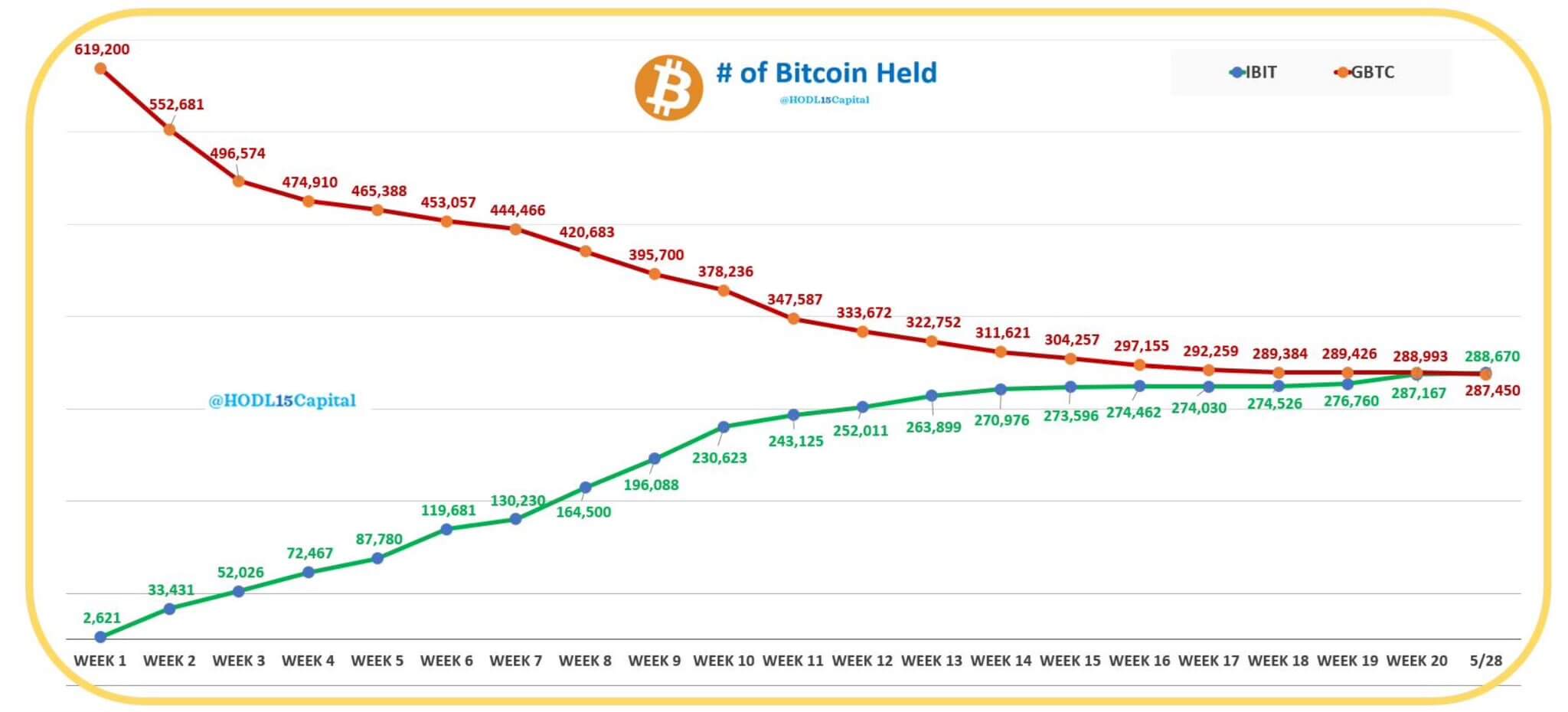
  • IBIT holdings have surged to 288,670 BTC compared to 287,450 for GBTC.

One of the top Bitcoin news headlines today is that BlackRock’s iShares Bitcoin Trust (IBIT) has become the largest Bitcoin exchange-traded fund (ETF) in the world, surpassing Grayscale’s Bitcoin Trust (GBTC).

On May 28, inflows into IBIT reached $103 million while GBTC saw outflows of $105 million. Overall, the spot Bitcoin ETF market recorded net inflows for the 11th straight trading day on May 28 with a total of over $45 million.

IBIT surpasses GBTC as largest Bitcoin ETF

As Grayscale’s spot BTC ETF recorded outflows of $105 million or 1,540 BTC, BlackRock’s IBIT saw inflows of nearly $103 million, or plus 1,501 BTC.

BlackRock now holds 288,670 BTC for its IBIT ETF, while Grayscale’s GBTC holdings have shrunk further to 287,450 BTC.

Notably, when spot Bitcoin ETFs debuted in January, Grayscale’s ETF held 620,000 Bitcoin. However, as data HODL15Capital shared on X shows, these have quickly shrunk as BlackRock, Fidelity and others swelled in the last four months.

BlackRock’s IBIT has added BTC holdings as Grayscale’s GBTC bleeds since SEC approved first spot Bitcoin ETFs for US market in January 2024

According to HODL15Capital, Grayscale’s outflows have come amid the fee issue (1.5% for GBTC vs. 0.2% for peers).

“Grayscale held 620,000 BTC at the time of the conversion (1/10/2024), which was more than 3% of circulating supply, but refused to lower the fee (1.5% vs 0.2% for peers), even after investors pulled 330,000+ BTC.  So much for the “differentiated” strategy,” HODL15Capital noted.

A Bloomberg report published on Wednesday notes that BlackRock’s BTC holdings reached $19.68 billion as of the end of trading Tuesday, compared to $19.65 billion in BTC for Grayscale. Fidelity’s FTBC, which registered inflows of $34.3 million on May 28, currently holds $11.1 billion.

IBIT’s flippening of GBTC comes as BlackRock revealed in a regulatory filing that its funds have purchased IBIT shares.

Specifically, the BlackRock Strategic Income Opportunities Fund (BSIIX) bought IBIT shares worth $3.56 million in the first quarter. Meanwhile, the Strategic Global Bond Fund (MAWIX) holds the ETF’s shares worth $485,000.

The post BlackRock’s IBIT flips Grayscale’s GBTC to become world’s largest Bitcoin ETF appeared first on CoinJournal.

Judge orders the U.S. SEC to pay $1.8M in Debt Box case dismissal

  • Judge dismisses U.S. SEC’s case against Debt Box, orders SEC to pay $1.8 million in fees.
  • The Ruling cites SEC’s bad faith conduct in obtaining asset freeze order.
  • Debt Box calls the court’s decision a significant victory against regulatory overreach.

In a significant legal victory for Digital Licensing, the firm known as Debt Box, a federal judge has dismissed the U.S. Securities and Exchange Commission’s (SEC) civil lawsuit and ordered the regulatory body to pay approximately $1.8 million in fees.

The ruling, handed down on May 28 by Judge Robert Shelby in the U.S. District Court for the District of Utah, marks a notable rebuke of the SEC’s actions in this case.

The U.S. SEC on the receiving end

The fees include roughly $1 million for attorney fees and costs, and an additional $750,000 for receiver fees and costs.

This order followed a March court decision that found the SEC had engaged in “bad faith conduct” by seeking a temporary restraining order to freeze Debt Box’s assets based on inaccurate information. This misconduct led the court to threaten sanctions against the commission.

Judge Shelby’s ruling mandated that the SEC cover all attorney fees and costs resulting from the erroneous ex parte relief, with the exception of one $649 fee which he deemed inappropriate.

Debt Box, in a statement released via X, hailed the decision as a major triumph, stating, “This is a significant win for us. It means that the SEC cannot proceed with the case as it stands.”

What was the Debt Box case all about?

The SEC’s lawsuit, initially filed in July 2023, accused Debt Box of orchestrating an illegal $50 million cryptocurrency scheme.

However, Debt Box countered with documentation suggesting that the SEC had made false statements and misrepresentations, which led to the improper restraining order.

This case drew considerable attention within the cryptocurrency community, highlighting issues of regulatory overreach.

Meanwhile, the SEC continues to pursue legal actions against several other crypto firms, including Binance, Kraken, Ripple, and Coinbase.

In response, lawmakers are advocating for clearer regulatory frameworks for digital assets, with proposed legislation like the Financial Innovation and Technology for the 21st Century Act aiming to address these concerns.

The post Judge orders the U.S. SEC to pay $1.8M in Debt Box case dismissal appeared first on CoinJournal.

Google Cloud becomes a key node validator for Fantom (FTM)

  • Fantom partners with Google Cloud as a key node validator to boost DApp development.
  • Google Cloud’s infrastructure and AI capabilities will enhance Fantom’s ecosystem.
  • FTM price shows little reaction despite the trading volume surging by 34%.

Fantom (FTM) has partnered with Google Cloud, which will now serve as a key node validator for the platform.

The collaboration is set to enhance the development and performance of smart decentralized applications (DApps) on Fantom, leveraging Google Cloud’s robust infrastructure and artificial intelligence (AI) capabilities.

This partnership builds on an existing relationship where Google Cloud indexes Fantom’s data in BigQuery as part of its public datasets program. By deepening this collaboration, Fantom aims to capitalize on its Directed Acyclic Graph (DAG) protocol’s scalability and secure a larger market share.

Incentivizing innovation in the Fantom (FTM) ecosystem

Beyond validating transactions, Google Cloud will play a crucial role in incentivizing innovation within the Fantom ecosystem.

The partnership is designed to empower developers to create the next generation of secure and engaging DApps.

Google Cloud’s infrastructure is renowned for its scalability, security, and resilience, making it an ideal backbone for Fantom’s ambitious plans.

Validator role to eventually transition to Sonic Network

While Google Cloud will handle validator responsibilities on Fantom’s Opera Network following this partnership, there are plans to transition these duties to the new Sonic Network, which is compatible with the Ethereum Virtual Machine (EVM).

This shift is part of Fantom’s broader strategy to pivot in the smart contract space, enhancing its ecosystem’s performance and developer appeal.

Fantom price jumps on the news

While the partnership announcement has had a little impact on the price of Fantom (FTM), the trading volume has surged by 34% to $239,543,832, indicating growing interest and optimism among investors.

As the partnership unfolds, the entire Fantom ecosystem is expected to benefit from improved performance and increased developer engagement, potentially driving FTM’s price higher.

The strategic alliance with Google Cloud marks a significant milestone in Fantom’s journey towards becoming a leading platform for smart DApps and decentralized innovations.

The post Google Cloud becomes a key node validator for Fantom (FTM) appeared first on CoinJournal.