
MicroStrategy’s stock performance soars amid Bitcoin rally

  • MicroStrategy’s stock outperformed major tech stocks due to its significant Bitcoin holdings, surging 15% recently.
  • Since the start of 2024, MicroStrategy’s stock price has risen by 135%, driven by Bitcoin’s rally.
  • The company announced a 10-for-1 stock split to make shares more accessible, effective August 1.
  • Michael Saylor attributes MicroStrategy’s success to its aggressive Bitcoin acquisition, holding 226,331 Bitcoin worth $7.538 billion.

MicroStrategy, led by Michael Saylor, has recently gained significant attention for its aggressive Bitcoin investment strategy, resulting in remarkable financial returns. As of July 17, 2024, MicroStrategy’s stock has outperformed major tech giants like Tesla, Nvidia, and Microsoft, primarily due to its substantial Bitcoin holdings. As such, its stock price mimics Bitcoin’s movement and has rallied from recent lows of $1,207 to close at $1,794 as of COB today. Its most recent rally is in tandem with Bitcoin’s from $53,500 around the same period to $67,605 as of writing.

MicroStrategy’s strategic Bitcoin accumulation as a core reserve asset has proven exceptionally lucrative. The company holds 226,331 Bitcoin, valued at approximately $7.54 billion. This substantial holding has driven a 1,203% surge in MicroStrategy’s share price since August 10, 2020, outperforming Nvidia’s 1,050% and Tesla’s 167% gains over the same period. The company’s impressive growth trajectory has continued in 2024, with a 135% increase in share price year-to-date, compared to Bitcoin’s 44% rise.

A key aspect of MicroStrategy’s success is its ability to raise funds through debt offerings to purchase more Bitcoin. In June 2024, the company expanded a debt offering from $500 million to $700 million to fuel additional Bitcoin acquisitions. This strategy has paid off, as evidenced by the company’s stock performance and the growing value of its Bitcoin holdings.

Michael Saylor has been vocal about the benefits of adopting a Bitcoin standard. He recently tweeted a chart highlighting MicroStrategy’s 1,203% share price surge since adopting Bitcoin, urging other companies to consider a similar approach. Saylor’s firm belief in Bitcoin’s potential is evident in his continuous advocacy for the cryptocurrency as a superior asset.

MicroStrategy’s recent 10-for-1 stock split, scheduled for August 1, is another strategic move to broaden its investor base. This action aims to make MSTR shares more accessible and affordable, potentially attracting more investors to benefit from the company’s Bitcoin-centric strategy. The company’s performance and Michael Saylor’s strong stance on Bitcoin highlight the transformative potential of integrating cryptocurrency into corporate strategies. Companies like MicroStrategy continue to set a precedent for leveraging digital assets to drive growth and shareholder value as the market evolves.

The post MicroStrategy’s stock performance soars amid Bitcoin rally appeared first on CoinJournal.
ETHTrustFund DAO accused of $2M rug pull in latest crypto scam

  • ETHTrustFund DAO allegedly stole $2M and laundered funds via mixer apps.
  • Developer Peng went silent months before the rug pull and deleted all accounts.
  • Besides ETHTrustFund, other recent rug pulls in crypto include Gemholic and Ordiz, showing rising fraud risk.

In a troubling development for cryptocurrency investors, the ETHTrustFund DAO, a decentralized autonomous organization (DAO) operating on the Base network, has been accused of conducting a $2 million rug pull.

The allegations, substantiated by recent reports by 0ctoshi, suggest that the project executed a deliberate exit scam.

According to a detailed report by blockchain security firm PeckShield, ETHTrustFund transferred its entire treasury to a new wallet on July 20, 2024.

The funds were subsequently moved through mixer applications, such as Tornado Cash and Railgun, in an apparent attempt to obfuscate the trail and launder the stolen assets.

The rise and fall of ETHTrustFund

ETHTrustFund, which had modeled itself after successful projects like Olympus and Wonderland, initially attracted investors with promises of a unique rebase mechanism.

The project was designed to offer blockchain-based bonds and issue new ETF tokens to users who staked their holdings.

Unlike traditional rebaseDAOs that continually inflate their token supply, ETHTrustFund aimed to eventually debase its tokens to increase the value of the remaining supply, generating yield for its investors.

However, the project’s trajectory took a dramatic turn when lead developer Peng reportedly ceased communication with the community in April.

According to Octoshi, Peng’s inactivity, coupled with the sudden disappearance of ETHTrustFund’s online presence, including its website and social media accounts, pointed towards a potential exit scam.

Octoshi first highlighted the issue on July 21, 2024, reporting that the project had moved over $2 million from its treasury to a fresh wallet, and was draining the funds via Railgun Project.

The project’s official Telegram and social media accounts, previously managed by Peng, were deleted.

In the wake of these revelations, Octoshi urged the community to report the scam on Chainabuse, a platform dedicated to documenting and combating fraudulent activities in the crypto space.

The Chainabuse report, created by user @cryptogle, confirmed the allegations and emphasized the project’s abrupt disappearance.

The wake of exit scams in crypto

ETHTrustFund’s incident follows a series of similar scams in the crypto industry.

In June, the Gemholic protocol faced accusations of a $3.5 million exit scam, while March saw the Ordiz bridge admin accounts executing a $1.4 million fraud.

These cases highlight the persistent risk of rug pulls in the rapidly evolving cryptocurrency landscape, underscoring the need for vigilance and thorough due diligence among investors.

The post ETHTrustFund DAO accused of $2M rug pull in latest crypto scam appeared first on CoinJournal.

Cboe Announces July Date to List Five Spot Ether ETFs

  • Cboe is planning on listing five ether exchange-traded funds (ETFs) on July 23
  • It will begin trading spot ETFs from the 21Shares Core Ethereum ETF, Fidelity Ethereum Fund, Franklin Ethereum ETF, Invesco Galaxy Ethereum ETF, and VanEck Ethereum ETF
  • Bitwise’s CIO Matt Hougan believes Ethereum ETFs could see around $15bn in net flows in their first 18 months on the market

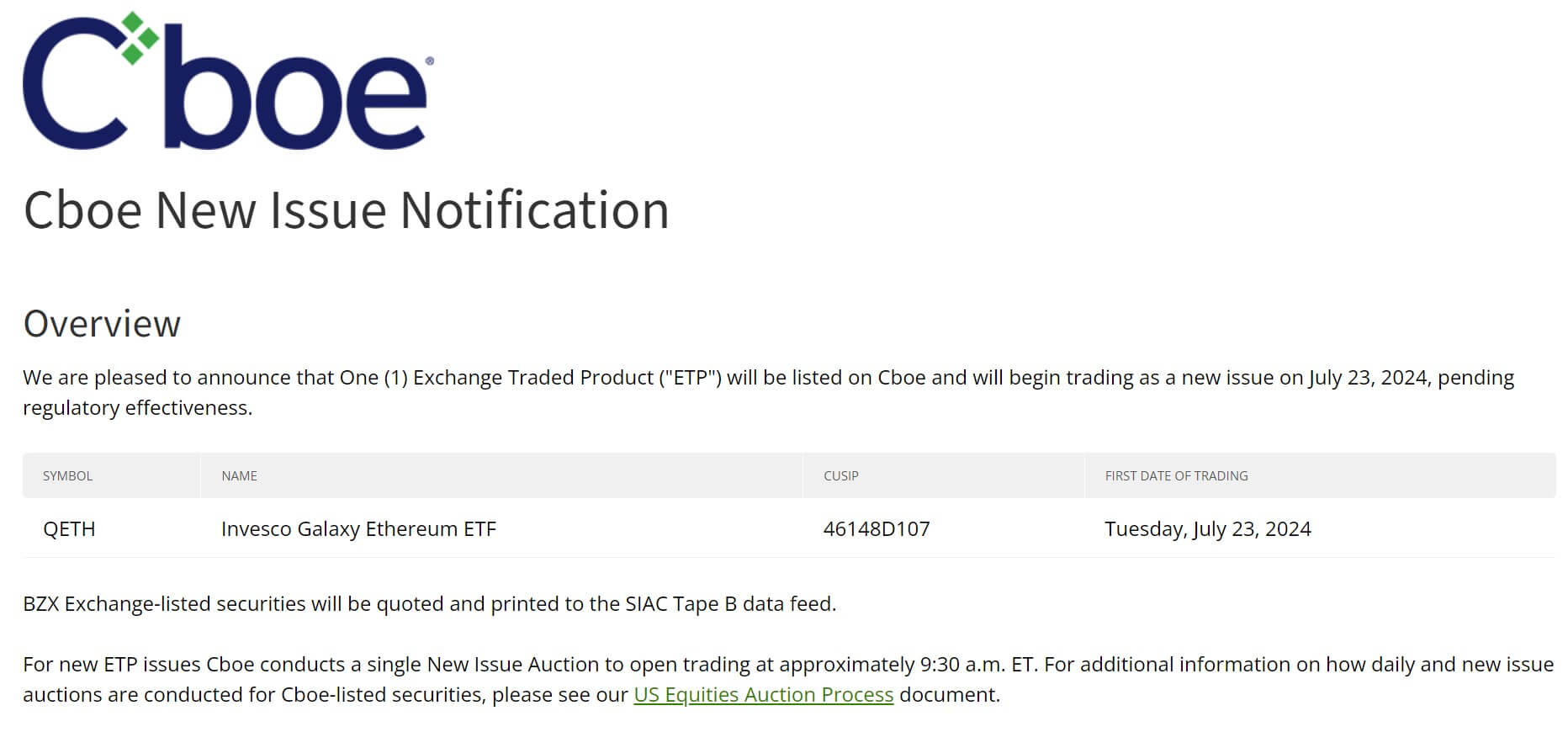
The Chicago Board Options Exchange (Cboe) intends to list five ether exchange-traded funds (ETFs) on July 23, “pending regulatory effectiveness,” Cboe announced.

The five spot ether ETFs expected to begin trading are the 21Shares Core Ethereum ETF, Fidelity Ethereum Fund, Franklin Ethereum ETF, Invesco Galaxy Ethereum ETF, and VanEck Ethereum ETF.

Cboe Ether ETF filing with Invesco Galaxy Ethereum ETF

In May, the US Securities and Exchange Commission (SEC) approved rule changes to spot ether 19b-4 filings; however, before they can launch, their S-1 registrations need to be approved by the regulator.

Earlier this month, the SEC required asset managers to submit their finalised S-1s by July 16. Asset manager Bitwise filed an amended S-1 form on July 3. One of its amendments included a six-month fee waiver of up to $500m.

As the July 23 launch date creeps closer, all eyes will be on the SEC and those keen to launch a new investment product in the market. In June, Bitwise’s CIO, Matt Hougan, stated that Ethereum ETFs could see around $15bn in net flows in their first 18 months on the market.

Solana ETF

Keen to add more investment products for its investors, Cboe submitted two applications to list spot Solana ETFs on its platform earlier this month.

The exchange has asked the SEC to approve the listings of its 21Shares and VanEck Solana ETFs. Filing the 19b-4 forms, the SEC has until March 2025 to make a decision.

At the end of June, VanEck filed an S-1 form with the SEC, making it the first US company to do so. Similarly, 21Shares also filed its own S-1 application with the SEC in June, stating on X that they “believe this is a necessary step for the crypto industry.”

With increased interest in Bitcoin ETFs and now Ethereum ETFs set to start trading on Cboe, asset managers are looking to other types they can potentially provide to investors, pending regulatory approval from the SEC.

The post Cboe Announces July Date to List Five Spot Ether ETFs appeared first on CoinJournal.

Avalanche holds above $30 despite politics-driven crypto dip

  • Avalanche (AVAX) hovered above $30 after breaking out from lows of $26 last week.
  • Despite overall dip in crypto amid latest US politics news, AVAX looked poised for more gains.

The price of Avalanche (AVAX) continues to hover above $30 as the altcoin holds onto gains despite a broader crypto market dip in the past 24 hours.

On Monday, AVAX price traded around $31.93 at 10.30 am CET. The price remained double-digits up in 24 hours with bulls looking to hold above the key threshold following the spike from $26.73 on July 19.

Crypto dips amid US politics news

On Sunday, US President Joe Biden announced his exit from the 2024 US election presidential race, endorsing his VP Kamala Harris. The immediate market reaction following the news was a slight dip in crypto prices as some panic hit.

Bitcoin, which had traded above $68k on the day, dropped to below $67,500 and Ethereum, Solana and other top altcoins pared gains.

Crypto market intelligence platform Santiment noted that the pattern seen late Sunday and early Monday morning mirrored the crypto market reaction in the hours after last week’s assassination attempt of former president Donald Trump.

“Though wildly different circumstances, the news of the Trump attempted assassination from 2 weeks ago caused a similar price pattern. Throughout the closing hours of Sunday, prices quickly bounced after an initial drop, and are now quite volatile to start the week,” Santiment wrote.

Given Biden has endorsed his VP and other top democrats have followed suit, its likely news related to Kamala Harris will be another trending topic that impacts crypto prices. A similar outlook will also continue to emerge around Trump, who is expected to speak at the Bitcoin 2024 conference in Nashville, Tennessee this weekend.

In this case, Santiment expects US politics to “continue to prove fragile correlations with speculation-driven cryptocurrency prices”.

Avalanche market outlook

Like many altcoins, Avalanche price has surged or dipped in tandem with market sentiment, news and Bitcoin’s performance.

Over the past four months, the cryptocurrency has benefited from positive network developments, particularly partnerships. However, price has also declined sharply on negative news, including the 10% dive that followed the recent incident involving Turkish crypto exchange BtcTurk.

The price of Avalanche dipped as the exchange reportedly lost AVAX tokens worth over $54 million from its hot wallets.

However, integration with Stripe and an announcement from MapleStory Universe had seen AVAX price surge significantly.

While gaming has picked up momentum on Avalanche, there’s new traction in the liquid staking space and the Avalanche blockchain could be set for take-off. The upcoming Avalanche Summit LATAM in Buenos Aires is also a big event in the horizon for Avalanche.

The post Avalanche holds above $30 despite politics-driven crypto dip appeared first on CoinJournal.

HKX joins growing list of crypto exchanges exiting Hong Kong

  • HKX to cease operations in Hong Kong due to regulatory compliance issues.
  • Thirteen crypto exchanges have had their license applications withdrawn or rejected in Hong Kong.
  • Another exchange, Gate.HK, plans to overhaul platform to meet regulatory standards and resume operations, after a similar move.

HKX cryptocurrency exchange, hi5 (Hong Kong) Limited, has announced its decision to cease operations in Hong Kong. This decision follows challenges in meeting the region’s stringent regulatory requirements.

The announcement was made on July 18, with the HKX management advising users to withdraw their assets promptly.

HKX withdraws license application

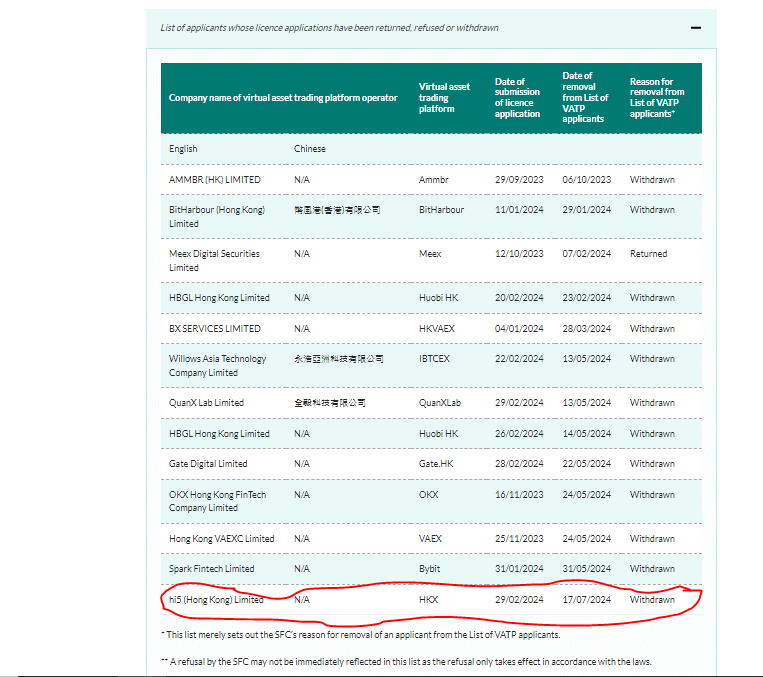
The Securities and Futures Commission (SFC) of Hong Kong has added HKX to its list of cryptocurrency exchanges that have withdrawn their license applications.

HKX had initially applied for the necessary licenses in February, seeking compliance with both the Securities and Futures Ordinance (Cap. 571) and the Anti-Money Laundering and Counter-Terrorist Financing Ordinance (Cap. 615).

However, despite these efforts, HKX struggled to meet the regulatory standards set by Hong Kong authorities.

In a statement published on their official website, the HKX management elaborated on their decision stating: “We would like to inform you that our management team has, after careful consideration, decided to withdraw our application for the Type 1 and Type 7 licenses under the Securities and Futures Ordinance and the virtual asset service provider license under the Anti-Money Laundering and Counter-Terrorist Financing Ordinance.”

Crypto exchanges withdraw licenses applications in Hong Kong

HKX’s decision to exit the Hong Kong market is part of a broader trend. According to the information on the SFC website, a total of 13 cryptocurrency exchanges had either withdrawn their license applications or had their applications refused and returned by the SFC by July 22.

List of applicants whose licence applications have been returned, refused or withdrawn in Hong Kong

The increasing regulatory scrutiny and the high standards required for compliance have posed significant challenges for crypto exchanges operating in the region.

Gate.HK, another Hong Kong-based cryptocurrency exchange, had previously faced similar challenges. OKX also withdrew its VASP license application in May.

After failing to meet the local licensing requirements, Gate.HK withdrew its application but announced plans to overhaul its platform to align with regulatory standards. The exchange is currently focused on allowing withdrawals for its customers and aims to resume operations in the future, contributing to the virtual asset ecosystem once the necessary licenses are obtained.

In preparation for its shutdown, HKX had already halted new user registrations and suspended trading and deposit services on May 29. The company emphasized its commitment to assisting users with the safe withdrawal of their assets, ensuring a smooth transition during the winddown process.

However, there are no immediate plans for HKX to restart services or reapply for a license.

This wave of exits underscores the complex regulatory landscape in Hong Kong for cryptocurrency exchanges.

As the HKSFC continues to enforce stringent compliance measures, the future of cryptocurrency trading in the region remains uncertain, with only those able to meet these rigorous standards likely to continue operations.

The post HKX joins growing list of crypto exchanges exiting Hong Kong appeared first on CoinJournal.