
Valour to issue digital asset ETPs in Kenya as it expands beyond Europe

  • Valour partners with NSE and SovFi to launch Bitcoin, Ether, Solana, and Hedera ETPs.
  • The ETPs will be passported to NSE, marking Kenya’s first digital asset products.
  • Kenya’s regulatory framework for digital assets is evolving, supporting new innovations.

Crypto fund issuer Valour is set to expand its reach beyond Europe with a significant move into the Kenyan market. The company has signed a memorandum of understanding with the Nairobi Securities Exchange (NSE) and SovFi to issue and trade digital asset exchange-traded products (ETPs) in Kenya.

This strategic expansion will introduce Bitcoin (BTC), Solana (SOL), Ethereum (ETH), and Hedera (HBAR) ETPs to the NSE, marking a milestone as these offerings could be the first digital asset products on the exchange.

Valour pioneering digital asset offerings in Kenya

Valour’s entry into the Kenyan market represents a major development in the region’s financial landscape.

The ETPs, including those for Bitcoin, Ether, Solana, and Hedera, will be “passported” to the NSE, leveraging the expertise of Valour’s parent company, DeFi Technologies.

DeFi Technologies, based in Canada, has previously demonstrated its innovation in issuing ETPs across European exchanges. It launched a validator node on the Core Chain in June after Valour and Core partnered to issue Valour Bitcoin Staking ETP on the Nordic Growth Market exchange.

Currently, Valour issues 33 ETPs on European exchanges including the recently launched Near Protocol (NEAR) ETP on the Swedish Spotlight Stock Market.

Olivier Roussy Newton, CEO of DeFi Technologies, emphasized the goal of providing secure and regulated exposure to digital assets for investors through this new venture.

Kenya’s evolving digital asset regulation

Kenya’s regulatory environment for digital assets has been evolving since November 2022, when the country began formal regulation of these financial instruments.

A multi-agency government working group is actively developing a comprehensive regulatory framework, with the Blockchain Association of Kenya contributing to the process.

This regulatory development comes amid growing interest in Web3 technologies and recent partnerships, such as the one with Abu Dhabi’s Venom Foundation to launch a blockchain and Web3 hub.

Valour’s move aligns with Kenya’s progressive stance on digital assets, enhancing the country’s growing digital asset ecosystem.

The post Valour to issue digital asset ETPs in Kenya as it expands beyond Europe appeared first on CoinJournal.
Core Scientific surges 17% after latest CoreWeave announcement

Core Scientific shares climbed more than 17% on Tuesday as the bitcoin mining company announced new developments around its deal with artificial intelligence provider CoreWeave.

According to a press release on Aug. 6, CoreWeave has agreed to add to its hosting deal with the Bitcoin miner, with additional infrastructure set to see Core Scientific deliver another 112 megawatts for Coreeave’s Nvidia graphic processing units.

Core Scientific and CoreWeave deal

The new adjustments to the deal will roll in before the end of 2024, with operations expected to go live in early 2026. Core Scientific’s multi-year deal with CoreWeave will add roughly $2 billion in new hosting revenue, with the 12-year contract projected bring in over $6.7 billion in cumulative revenue after the initial contract’s expected total of $4.7 billion

“We have now contracted with CoreWeave for a total of 382 megawatts of HPC infrastructure, reflecting the strong demand for high-power data center infrastructure and the unique ability of our team to deliver it,” Core Scientific CEO Adam Sullivan said.

“CoreWeave has one remaining option for 118 megawatts of our infrastructure and we are actively building our pipeline of potential new sites to expand our infrastructure portfolio and business opportunity. By maximizing the value and increasing the scope of our infrastructure portfolio for HPC hosting and bitcoin mining, we believe we can grow our business and the value we deliver to clients and shareholders,” Sullivan noted.

CORZ stock price

Core Scientific shares traded around $9.63 at the time of writing, more than 17% up on the day. CORZ is up 179% year-to-date. CORZ stock has traded higher since a breakout above $5 in May, with recent news helping the bullish case.

In comparison, BTC is up just over 5% in the past 24 hours as it changes hands around $56,900. 

While the value is up since the dip to near $49k on Aug. 5, Bitcoin remains more than 12% in the red in the past week. In the past month, BTC/USD is up 28% at the time of writing.

The post Core Scientific surges 17% after latest CoreWeave announcement appeared first on CoinJournal.

Indian law enforcement agency DGGI wants $86M unpaid GST from Binance

  • India demands $86 million in unpaid GST from crypto exchange Binance.
  • Indian law requires 1% TDS on crypto transactions and 30% tax on profits.
  • Binance plans to resume operations in India after being banned in January 2024 for noncompliance.

In a significant move, Indian authorities have demanded nearly $86 million in unpaid Goods and Services Tax (GST) from the cryptocurrency exchange Binance.

This marks a pivotal moment as it is the first instance of the Indian government levying a tax demand on any crypto exchange. It comes barely a month after India’s financial watchdog, the Financial Intelligence Unit (FIU), imposed a 188.2 million rupees ($2.25 million) fine on Binance for violating India’s anti-money laundering (AML) rules.

India’s stringent crypto tax framework

The Directorate General of Goods and Service Tax Intelligence (DGGI) issued the demand on August 6, highlighting the rigorous enforcement of the country’s tax regulations on cryptocurrency transactions.

According to Indian law, all crypto service providers and investors are required to pay a 1% Tax Deducted at Source (TDS) on every crypto transaction, regardless of its value.

Additionally, a 30% tax is imposed on all profits derived from crypto investments. These regulations aim to ensure proper tax compliance and curb potential tax evasion in the burgeoning crypto market.

While Indian crypto exchanges such as WazirX and CoinDCX have implemented internal mechanisms to simplify tax obligations for their users, offshore exchanges like Binance have lagged in enforcing these requirements.

Recently, Binance, along with several other offshore crypto exchanges, faced a ban in India in January 2024 due to non-compliance with local regulations.

However, Binance has shown intent to resume operations in the region, contingent on settling its tax liabilities.

The DGGI’s notice underscores the government’s commitment to holding all market participants accountable, regardless of their geographical base. It signals a more stringent regulatory environment for crypto exchanges operating in India.

As Binance moves forward with plans to restart its operations after clearing its dues, this case sets a precedent for how India might handle similar situations with other offshore crypto platforms.

The coming months will be crucial for Binance as it navigates this complex regulatory landscape and strives to regain its foothold in the Indian market.

The post Indian law enforcement agency DGGI wants $86M unpaid GST from Binance appeared first on CoinJournal.

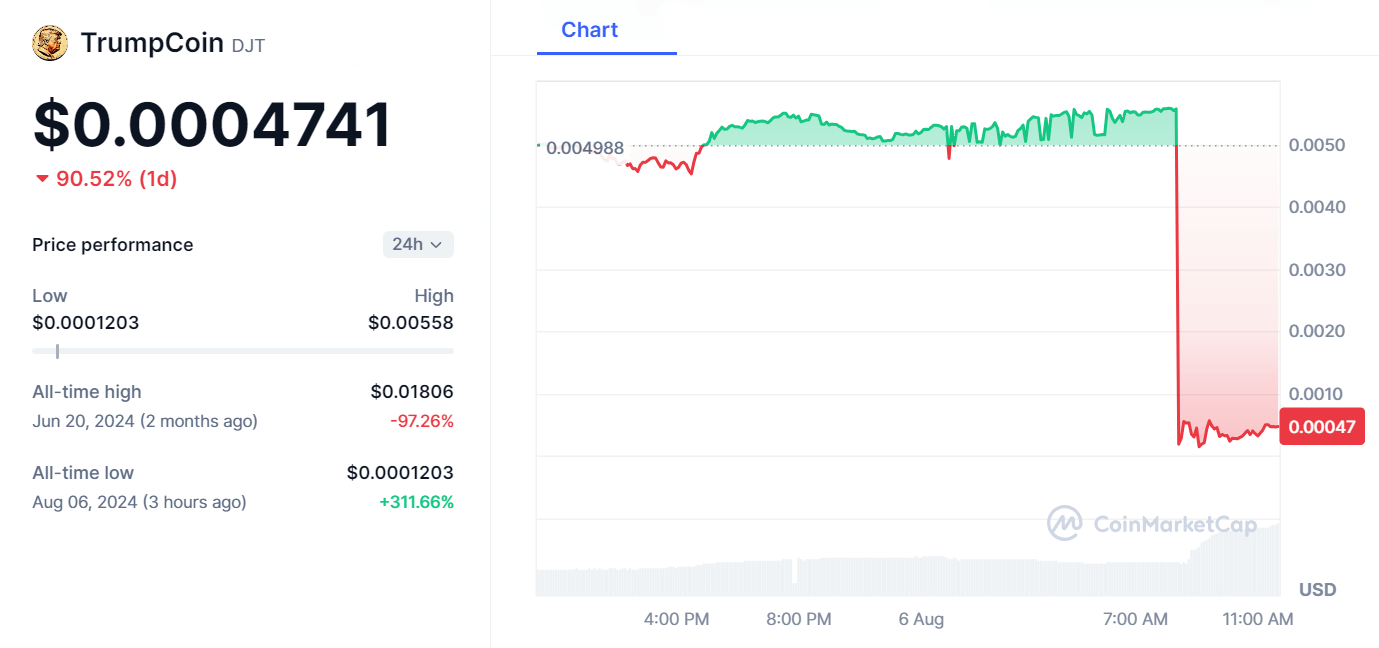
Crypto meltdown sends TrumpCoin (DJT) crashing over 90%

  • TrumpCoin crashed by 95%, plummeting from $0.00555 to a low of $0.0001203.
  • Trading volume surged by 169%, reaching $8.91 million despite the price drop.
  • Controversy surrounds TrumpCoin’s origins, with claims involving Donald Trump denied.

In a dramatic turn of events, TrumpCoin (DJT), a Solana-based meme coin using former President Donald Trump’s name and image, has experienced a steep price drop. The token’s value plummeted by 95%, falling from $0.00555 to a low of $0.0001203 before recovering to around $0.00042 at press time.

TrumpCoin (DJT)

Despite the massive price drop, trading activity for TrumpCoin surged. Data from Coinmarketcap reveals a 169% increase in trading volume, which stood at $8.91 million at press time.

While some may link the surge in trading activity to investors trying to offload their holdings, the total value locked (TVL) in TrumpCoin stands at approximately $23.1 million, reflecting ongoing investor interest despite the sharp price decline.

Why has TrumpCoin crashed?

The broader crypto market downturn significantly influenced TrumpCoin’s fall. A large-scale sell-off in the crypto market saw Bitcoin and Ethereum prices drop by 10% and 18%, respectively, erasing at least $500 billion from the market capitalization within three days.

The equity markets were also affected, with the S&P 500 falling 4.4%, driven by weak employment data and disappointing earnings from major tech firms.

Prior to the current market turmoil, Martin Shkreli, infamously known as “Pharma Bro,” claimed his involvement in creating TrumpCoin, sparking rumours that the project had official ties to Donald Trump.

Shkreli alleged that Trump and his son Barron were behind the memecoin, a claim that Roger Stone, a close aide to Trump, vehemently denied. This controversy led to over $6.3 million in bets on the authenticity of TrumpCoin on the crypto betting site Polymarket.

Despite reaching an all-time high of $0.01806 in June 2024, TrumpCoin has faced a steep decline, marking an all-time low of $0.0001203 on August 6, 2024.

The meme coin situation remains fluid amid the ongoing cryptocurrency meltdown and the controversy around who is behind the meme coin.

The post Crypto meltdown sends TrumpCoin (DJT) crashing over 90% appeared first on CoinJournal.

Online casinos will add $7.10B a year to the British economy by 2029, according to market data

  • UK online casino sector to grow from $6.47B to $7.10B annually by 2029
  • UK leads globally in online casino revenue, surpassing the US in 2024
  • Cryptocurrency adoption boosts UK online casino growth and user engagement.

The online casino industry in the United Kingdom is set to experience significant growth over the next five years. Currently generating an impressive $6.47 billion annually, market projections indicate that this figure will rise to $7.10 billion a year by 2029. 

This growth underscores the dynamic and evolving nature of the UK’s online gambling sector, which remains a global leader in terms of revenue.

Current online casino market performance

The UK’s online casino market is not only thriving but also outpacing other nations. With a projected revenue of $6.47 billion in 2024, the country has the highest-earning online casino sector globally. 

It surpasses the United States, which, despite its larger population, is expected to generate slightly less revenue at $6.29 billion in the same year. 

The key to this success lies in the UK’s higher user penetration rate of 17.4%, compared to the US’s 9.4%, and a significantly higher average revenue per user (ARPU). UK players spend approximately $0.63k annually, more than double the US ARPU of $380.50.

Factors driving the growth of online casinos in Britain

Several factors contribute to the robust performance and future growth of the British online casino industry. A significant driver is the growing adoption of cryptocurrencies by crypto casino sites. 

A crypto casino site with cryptocurrencies incorporated into the platform’s payment and withdrawals system offers enhanced security, anonymity, and faster transaction times, which appeal to many casino users. This technological adoption is making online gambling more accessible and attractive to a broader audience.

Additionally, the convenience and tax-free nature of online gambling in the UK are compelling factors. The shift towards online platforms, accelerated by the COVID-19 pandemic, has remained strong even as traditional gambling venues reopened. 

The ease of access from home, coupled with a wide array of gaming options, continues to draw more users to online casinos.

Cultural and regulatory influence

The cultural acceptance of gambling in the UK, supported by a long history of betting on events like horse races and the national lottery, also plays a crucial role. 

According to YouGov’s Global Gambling Profiles data, nearly half of UK online gamblers spend more than £5 monthly on fantasy sports and sports bets. The diversity in gambling preferences, spanning slot machines, casino games, and bingo, reflects a deeply ingrained gambling culture.

Regulatory frameworks established by the United Kingdom Gambling Commission (UKGC) have provided a secure environment for online gambling. These regulations ensure fair play, consumer protection, and the integrity of the gambling industry. 

Despite these stringent measures, challenges such as addiction, bankruptcy, and fraud persist. The UK government has introduced measures like levies on individual stakes for online slot machines and increased funding for treatment systems to address these issues. 

Advocacy for further measures, including slower spin speeds and affordability checks, continues.

The rise of non-GamStop casinos

Another emerging trend is the rise of non-GamStop casinos. These platforms operate outside the jurisdiction of the UKGC, providing an alternative for players seeking to bypass the restrictions of GamStop, the UK’s national online self-exclusion scheme. 

While these casinos offer greater flexibility, they also pose significant regulatory and safety risks. Players must exercise caution, ensuring they engage with reputable platforms that prioritize security and fairness.

Future outlook

The future of the UK’s online casino market looks promising. With an expected annual growth rate (CAGR) of 1.88% from 2024 to 2029, the market is projected to reach $7.10 billion by 2029. 

The number of users is also expected to grow, reaching 12.4 million by 2029, with a slight increase in user penetration to 17.9%.

This growth trajectory highlights the UK’s position as a global leader in the online gambling industry. The combination of cultural acceptance, advanced regulatory frameworks, and technological adoption, including cryptocurrencies, positions the UK’s online casino market for continued success. 

As the industry evolves, it will be crucial to balance growth with responsible gambling practices, ensuring a sustainable and secure environment for all players.

The post Online casinos will add $7.10B a year to the British economy by 2029, according to market data appeared first on CoinJournal.