
Mantle price prediction: is MNT signaling a bottom?

  • Mantle price sits near $0.7,  barely in the green in the past 24 hours.
  • But while the price movements point to a lack of momentum, it could explode.
  • The broader market performance and Bitcoin’s next moves will be key for altcoins such as MNT.

Mantle (MNT) is trading around $0.70, showing little change on the day and holding a gain of just over 6% for the week.

While these price movements indicate a lack of momentum, they mirror broader market performance.

It also points to a massive consolidation as Mantle signals a potential bottom.

Amid recent updates from the Mantle team, including the launch of Mantle Banking and the Mantle Index Four (MI4), the recipe might be there for MNT to explode in the coming weeks and months.

A move upward for Bitcoin could trigger further gains, as analysts at Glassnode observe.

“Bitcoin’s Accumulation Trend Score is currently at 0.34 – the highest it’s been year-to-date. This suggests that, on aggregate, wallets are beginning to re-enter accumulation mode, with larger cohorts stepping in modestly despite recent price weakness,” the platform posted on X.

Mantle’s ecosystem growth fuels optimism

Mantle is a project that eyes traction within the on-chain finance market, bringing its features to the ecosystem with Mantle Network, mETH Protocol and FunctionBTC.

A big part of its quest is scheduled to go live in Q2 2025, which introduces two major initiatives: Mantle Banking and the Mantle Index Four (MI4).

Mantle Banking aims to bridge traditional finance (TradFi) and decentralized finance (DeFi).

A unified platform where users can manage fiat and crypto finances seamlessly is its core target.

This “crypto neobank” will allow users to receive fiat salaries, tokenize them into stablecoins, and spend globally using virtual cards at competitive fees.

Meanwhile, MI4, backed by a $400 million anchor investment from the Mantle Treasury, is positioned as the “S&P 500 of crypto.”

It seeks to offer diversified exposure to top crypto assets in a tokenized fund format.

These developments signal Mantle’s ambition to mainstream crypto adoption, potentially driving demand for MNT as the ecosystem grows.

Further boosting confidence, Mantle’s ecosystem fund deployed $10 million to support web3 startups, fostering innovation and growth within its network.

The strategic moves underscore Mantle’s traction and potential, key to user growth and impact on MNT’s long-term value.

MNT price prediction: signs of a bottom?

From a technical perspective, MNT appears to be forming a bottom on the macro chart, suggesting a potential reversal from its downtrend.

The Relative Strength Index (RSI) has returned to a level where MNT previously bottomed, a key indicator of a possible trend shift.
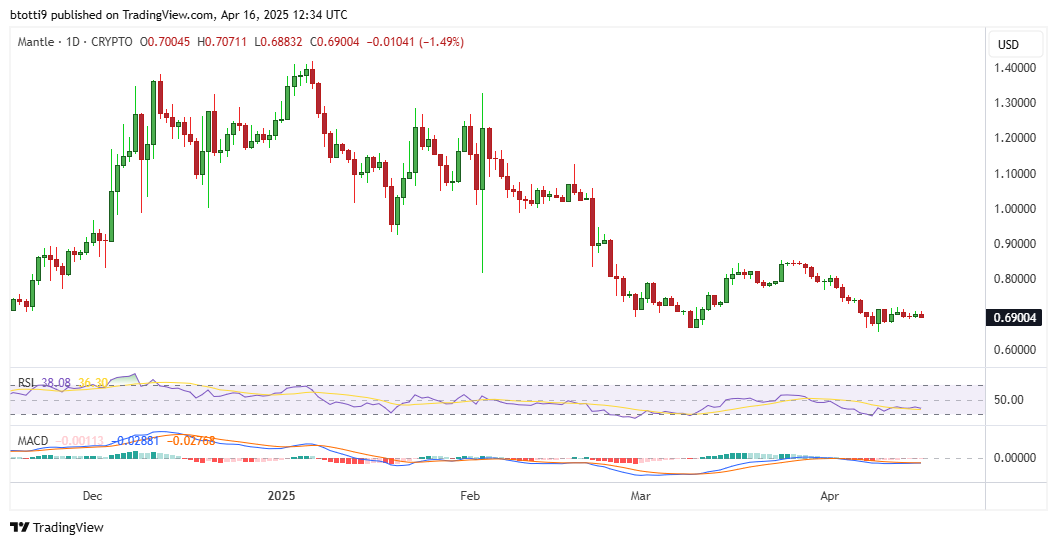
MNT chart by TradingView

Historically, the movements of RSI and MNT have been highly correlated, lending credibility to this signal.

With the RSI suggesting a flip from the oversold territory, Mantle’s price could be ready for a run.

This breakout is likely if bullish momentum builds as the MACD indicator suggests.

The post Mantle price prediction: is MNT signaling a bottom? appeared first on CoinJournal.

Block settles $40 million crypto investigation linked to Cash App

  • This follows an earlier $80 million penalty paid to other US state regulators in 2024.
  • Cash App now has over 57 million active users and supports various crypto services.
  • Block reported $6.03 billion in 2024 revenue, with earnings per share up 51%.

Block Inc., the parent company of Cash App, has agreed to a $40 million settlement with the New York Department of Financial Services (NYDFS) following findings of compliance shortcomings tied to its crypto services.

The settlement follows a state investigation that uncovered weaknesses in anti-money laundering (AML) controls, including failures to detect suspicious activity and monitor high-risk Bitcoin transactions.

Block, co-founded by Jack Dorsey, resolved the matter without admitting wrongdoing, stating the issues stemmed from legacy systems within Cash App’s historical compliance programme.

AML lapses flagged

Block’s compliance failures included insufficient customer due diligence, weak transaction monitoring, and inadequate screening of high-risk crypto activity.

The NYDFS concluded that the company’s systems were not robust enough to detect suspicious patterns tied to Bitcoin usage.

Block had been under investigation since 2023, and the company disclosed the probe and related negotiations in regulatory filings with the US Securities and Exchange Commission.

The $40 million settlement comes just months after Block paid $80 million in penalties to multiple state regulators earlier this year, also tied to AML compliance.

The back-to-back fines have renewed scrutiny on fintech platforms offering crypto services as regulators increase oversight of digital assets.

Crypto business grows

Despite facing multiple compliance challenges, Block continues to grow its crypto and banking offerings through Cash App.

The platform, which has enabled Bitcoin purchases since 2018, integrated tax-reporting software TaxBit in 2023 to support users managing their crypto liabilities.

As of early 2024, Cash App had more than 57 million monthly active users and generated $1.38 billion in gross profit in the fourth quarter alone.

Block’s financial health remains strong, reporting $6.03 billion in revenue for 2024, up 4.5% year-on-year, and per-share earnings of $0.71—an increase of 51%. The company’s gross payment volume grew 10% to $61.95 billion.

However, investors remain wary. Block’s share price has fallen 32% since the beginning of the year and more than 80% since its 2021 high.

Banking push stalls

As Block faces pressure from regulators, it is also confronting challenges in turning Cash App into a full-service banking platform.

The company has launched marketing efforts in major US cities and introduced services such as high-yield savings accounts, debit cards, short-term loans via Cash App Borrow, and buy now, pay later products through Afterpay.

The direct deposit feature reached 2.5 million users by December, an important milestone for broader financial services uptake.

Still, building trust remains a hurdle. In early 2024, the Consumer Financial Protection Bureau ordered Cash App to refund up to $120 million to users over deficiencies in fraud investigations.

Analysts are questioning whether Cash App can compete with fintech players like Robinhood, which have begun offering higher-interest accounts and more comprehensive banking products.

Block’s efforts to reposition Cash App as a digital bank come at a time when regulatory scrutiny of fintechs is intensifying, particularly around cryptocurrency compliance and fraud prevention.

While the company has avoided admitting guilt in its settlements, the multiple investigations have raised questions about its readiness to scale its financial services model within a tightly regulated environment.

The post Block settles $40 million crypto investigation linked to Cash App appeared first on CoinJournal.

SEC dismisses Helium case as Trump-era crypto rules take shape

  • New SEC chair Paul Atkins confirmed on 10 April.
  • Enforcement pivot includes Coinbase and Kraken case drops.
  • Legal clarity boosts DePIN sector, but risks remain.

In a major development for the decentralised wireless network sector, the US Securities and Exchange Commission (SEC) has dismissed its case against Helium with prejudice, marking a rare reversal in crypto enforcement policy.

The decision ends a long-standing legal cloud over the regulatory status of Helium’s three key tokens—HNT, IOT, and MOBILE.

It also signals a broader shift under the Trump administration’s SEC chair Paul Atkins, confirmed on 10 April, who is known for his pro-crypto stance.

While Helium celebrated the dismissal as a “major win” in its 11 April blog post, court records reveal that its parent company, Nova Labs, quietly agreed to pay a $200,000 penalty to settle separate securities fraud allegations.

Tokens no longer under scrutiny

The SEC formally dropped charges alleging that Helium’s core tokens were unregistered securities, stating that the case would be dismissed with prejudice—effectively barring any future prosecution on similar grounds.

This decision closes a chapter of uncertainty that had cast a shadow over the Decentralised Physical Infrastructure Network (DePIN) space.

Helium’s post attributed the outcome to the SEC’s updated approach to Web3 projects, especially those involving hardware and community-driven incentives.

It said the ruling “brings clarity” to a sector often caught in a legal grey zone, where distributing tokens for user engagement was frequently seen as a securities issue.

While this dismissal may serve as a precedent for similar decentralised infrastructure ventures, it does not offer immunity from other compliance risks.

Nova Labs pays $200,000 penalty

Although the SEC case regarding token classification is closed, Nova Labs remains tied to a $200,000 civil penalty issued over alleged fundraising misconduct.

The penalty resolves accusations that Nova Labs misrepresented partnerships with major firms including Nestle, Salesforce, and Lime during a 2021–2022 capital raise.

The SEC alleged that Nova Labs used those inflated claims to boost its valuation to $1 billion, luring in investors under false pretences.

The settlement, finalised without an admission or denial of guilt, ensures the company will not face further regulatory action on those claims, but it remains a cautionary tale for other crypto startups seeking funding.

SEC shifts under Trump appointee

The case dismissal is part of a wider change in tone at the SEC under Paul Atkins, a known supporter of digital asset innovation.

His confirmation on 10 April follows several agency reversals, including the dropping of lawsuits against Coinbase, Kraken, and Consensys.

This emerging trend points to a deliberate pivot in the SEC’s enforcement strategy—one focused more on regulatory clarity and less on litigation.

Industry analysts suggest this could embolden more crypto infrastructure firms to scale without fear of blanket regulatory action, provided they maintain transparency in investor communications.

The timing of the Helium case dismissal—just one day after Atkins’ appointment—reinforces the view that the Trump administration is prioritising blockchain innovation over punitive measures.

While this could revive confidence in DePIN and similar sectors, critics argue that enforcement gaps may still persist without new legislative frameworks.

DePIN still faces legal gaps

Despite the positive outcome for Helium, the broader DePIN landscape remains a work in progress when it comes to compliance.

Many projects operate at the intersection of telecommunications, finance, and decentralised governance—areas where existing US rules remain ill-suited.

The SEC’s clarification in the Helium case—that selling hardware and distributing tokens for network growth does not automatically make those tokens securities—could offer temporary relief.

However, lawyers warn that this does not remove the need for careful disclosures, especially during token sales or equity fundraising rounds.

As tokenisation and decentralised infrastructure continue to merge with traditional industries, the Helium ruling provides a key legal benchmark—but not a complete solution.

Stakeholders across crypto, telecoms, and regulation will now look to see whether this softer stance will translate into durable legal clarity or further policy reversals in the months ahead.

The post SEC dismisses Helium case as Trump-era crypto rules take shape appeared first on CoinJournal.

The future of payments? a16z bets on stablecoins to revolutionize money transfers

  • a16z says stablecoins are a “WhatsApp Moment” for money transfers.
  • Stablecoins eliminate historical gatekeepers in the payments industry.
  • Stablecoins offer a clean-slate alternative to costly and outdated systems.

Remember when making international calls or sending text messages across borders meant hefty fees?

Modern messaging apps like WhatsApp have made those costs a thing of the past.

Now, venture firm Andreessen Horowitz (a16z) believes stablecoins could revolutionize money transfers in a similar way, democratizing the payments industry by dismantling traditional gatekeepers and eliminating inefficiencies.

“Just as WhatsApp disrupted costly international phone calls, blockchain payments and stablecoins are transforming global money transfers,” the firm stated in a blog post published on Wednesday, laying out its vision for the future of money.

A new era for global payments

The current global payment infrastructure is a complex and often convoluted web, involving a multitude of intermediaries: points of sale, payment processors, acquiring banks, issuing banks, correspondent banks, foreign exchanges, and card networks.

This complex network not only creates friction but also adds significant costs and delays to international transactions.

a16z points out that remittance fees can reach as high as 10%, a burden reminiscent of the high costs associated with cross-border calls and texts before the advent of instant messaging apps.

Stablecoins on the blockchain

Enter blockchain and stablecoins – cryptocurrencies that are pegged to stable assets like the U.S. dollar, offering a more stable and predictable value.

“Stablecoins offer a clean-slate alternative. Instead of stitching together clunky, costly, and outdated systems, stablecoins flow seamlessly on top of global blockchains,” the blog post argues, emphasizing the potential for streamlined transactions.

“Already, stablecoins are slashing the cost of remittances: Sending $200 from the US to Columbia using traditional methods will cost you $12.13; with stablecoins, it costs $0.01,” a16z stated, highlighting the significant cost savings that can be achieved.

The transformative potential of stablecoins extends far beyond remittances.

They could also revolutionize business-to-business (B2B) payments on a massive scale.

a16z uses business transactions from Mexico to Vietnam as an example, noting that these transactions can take three to seven days to process and cost anywhere from $14 to $150 per $1000 transacted, often passing through as many as five intermediaries, each taking a cut.

The adoption of stablecoins could make such transactions nearly free and almost instantaneous, eliminating the delays and expenses associated with traditional methods.

Corporate adoption: SpaceX leads the way

Some forward-thinking corporations have already taken notice.

Elon Musk’s SpaceX, for example, is using stablecoins to manage its corporate treasuries, seeking to shield itself from foreign exchange (FX) volatility, demonstrating the practical applications of stablecoins in the business world.

These trends help explain why the total market capitalization of stablecoins has surpassed $200 billion, and the annualized transaction value of stablecoins in 2024 reached $15.6 trillion – figures that are roughly 119% and 200% that of Visa and Mastercard, respectively, underscoring the growing importance of stablecoins in the global economy.

However, the rise of stablecoins has not been without its challenges.

Regulatory bodies have scrutinized their use, creating significant hurdles for bridging traditional finance to stablecoins, according to a16z.

The landscape is now evolving, as policymakers are actively working to shape rules to recognize and regulate stablecoins in the US.

“A forthcoming bill clarifying this regulation could pave the way for even broader adoption and integration into the global financial system,” the blog post predicts.

As the financial landscape rapidly evolves and cryptocurrency adoption becomes more mainstream, stablecoins are poised to emerge as a transformative force, revolutionizing the future of money.

“Just as WhatsApp disrupted costly international phone calls, blockchain payments and stablecoins are transforming global money transfers,” concludes a16z, reiterating its bullish outlook on the future of stablecoins.

The post The future of payments? a16z bets on stablecoins to revolutionize money transfers appeared first on CoinJournal.

XRP holds potential despite 16% plunge, expert urges caution

  • XRP drops 16% to $1.76 amid broader cryptocurrency market sell-off.
  • Expert Vincent Van Code links XRP’s past spike to US political optimism.
  • Van Code warns of a global financial reset and advises holding XRP positions.

XRP investors are facing a challenging moment as the digital currency has dropped 16% to $1.76 amid widespread selling across cryptocurrency markets.

The decline reflects broader turmoil, with major cryptocurrencies also taking a hit. Bitcoin values have plummeted more than 8% to $76,000.

The sell-off appears to be part of a larger crypto sector trend, leaving investors questioning their next moves.

Vincent Van Code, a well-known software engineer, has weighed in, expressing confidence in XRP despite the sharp price drop.

He attributes the decline to fear-driven market sentiment rather than any fundamental issues with the token itself.

XRP price spike tied to political optimism

Van Code suggests that XRP’s previous price surge, which saw it rise from $0.54 to $3.40, was largely driven by political optimism surrounding the new US administration’s pro-cryptocurrency policies.

This indicates that the token’s value has been heavily influenced by external political factors rather than solely technical advancements or adoption rates.

Despite the recent fall, Van Code maintains that nothing has fundamentally changed about XRP’s prospects.

He links the current market instability to spillover effects from traditional markets, noting reports of the US stock market losing approximately $6.5 trillion in value over two days last week due to global trade tensions.

This broader economic context, he argues, is amplifying the pressure on cryptocurrencies.

Expert warns of economic reset and market shorting

Van Code connects the ongoing volatility to what he describes as a “global financial reset,” suggesting that the US government’s actions are destabilizing multiple economies as part of a transformative process.

He warns that such sweeping changes often require the breakdown of existing structures before rebuilding, urging investors to brace for further turbulence.

Rather than viewing the decline as a reason to panic, Van Code sees it as potentially deliberate, with influential market players profiting by shorting the market ahead of the drop.

He predicts these investors will soon reverse their positions, potentially triggering a “miraculous” market bounce.

Drawing an analogy to swimming near whales in a stormy sea, he emphasizes the need for strategic patience.

Van Code advises XRP investors against closing their positions, asserting that a significant price recovery remains possible once market conditions stabilize.

The post XRP holds potential despite 16% plunge, expert urges caution appeared first on CoinJournal.