
Pocket Network launches TriForce

Pocket Network, a Web3 app blockchain data ecosystem, has launched an initiative to sustain blockchain community growth called TriForce. 

It gives communities an incentive to fortify ties and be a part of Pocket Network’s growth trajectory, Coin Journal learned from a press release. 

The initiative will enable community members to sustain and grow blockchain traffic for their different ecosystems. This way, they will also help the network offer RPC services to highly decentralized crypto networks. 

Shards support community growth 

Each TriForce has three components, collectively referred to as shards. These components describe how each TriForce can benefit blockchain communities with individual expertise. 

Ultimately, the three-pronged support program will provide them with the tools to survive and thrive. The following areas are subject to involvement by blockchain communities: 

  • Business Development
  • Marketing
  • Technical Support

Pocket DAO will allocate funds to encourage eligible communities that want to use Pocket nodes to strengthen their blockchain ecosystems.

Pocket DAO will also allocate budgets for communities that qualify and reward members in proportion to their contributions to current incentives.

Shards help pursue shared goals 

Shards will have collective goals for the benefit of all ecosystems, even though each one will operate semi-independently. 

Pocket Network aims to provide quick support to as many blockchains as possible and has asked community members for commitment to fast-track this goal. 

Michael O’Rourke, CEO of Pocket Network, said: 

As the internet moves away from the top-down model synonymous with Web2, community-centric models for project management, treasury oversight, and key decision-making have risen to prominence. Pocket’s TriForce program aligns with this narrative, supporting the open discourse and grassroots engagement that is a mainstay of Web3.

Pocket Network expects blockchain communities to identify new network growth opportunities and take responsibility for developing new on-chain use cases as the TriForce program takes effect. 

The network aims to integrate 100 blockchains by the end of the year, up from 50 at the moment. 

About Pocket Network

Pocket Network is a platform built for applications that use cost-efficient economics to coordinate and distribute data at scale.

The post Pocket Network launches TriForce appeared first on CoinJournal.

Cronos and Covalent partners to simplify on-chain data access for developers

Cronos, a layer-1 blockchain built on Cosmos SDK, has announced a partnership with Covalent. The partnership comes as a relief for developers who are willing to venture into the Web3 innovations. The partnership aims at simplifying on-chain data access for data analysts and developers. 

In addition to the simplification of the workflow for their participants, Cronos and Covalent will work together to bring out the transparency of on-chain data to crypto wallets, investors, and others. With this partnership, they will be able to make Web3 experience great while allowing developers and projects access to information that will power decentralized applications.

Benefits to Cronos and Covalent ecosystems

While explaining the working principle of this integration, Covalent CEO and co-founder, Ganesh Swami, said that the Covalent Unified API which is a code-free solution for developers will work on adding another layer of simplicity by sourcing all the relevant information.

Swami also added that developers’ experience level will be a bonus, however, he noted that this will not be a hindrance for those seeking to create projects with little or no coding experience.

Cronos chain and Cronos Labs managing director, Ken Timsit, also supported this noting that there is a need to have a simple unified solution that will boost successful Web3 adoption. He also added that Cronos identifies with the Web3 ecosystem growth and with the Covalent Unified API, Cronos will be able to meet the developers’ rising expectations as they try to find a better user experience, functionality, and utility.

In addition, the Covalent Unified API will simplify the workflow as well as increase the efficiency and time to markets saving developers time that they consume while trying to find their work.

Cronos and Covalent achievements

Cronos is compatible with Ethereum Virtual Machine (EVM) and is backed by Crypto.com, Crypto.org, and more than 300 application developers. Cronos’ plan is to onboard over 50 million users by offering an ecosystem where developers can develop DeFi applications and GameFi.

One of the recent Cronos team achievements is the recent launch of a $100 million accelerator program fund by Cronos Labs aimed at helping developers shape the future of Web3 by creating new projects. 

On the other hand, Covalent has been providing Unified API services to allow Web3 data points visibility. It powers over 1,000 applications with over 27,000 developers depending on it.

Some of the many data points that Covalent Unified API allows access to include decentralized exchange transactions, token balances, and ERC20 token transfers.  

The post Cronos and Covalent partners to simplify on-chain data access for developers appeared first on CoinJournal.

American video gaming platform GameStop launches NFT marketplace

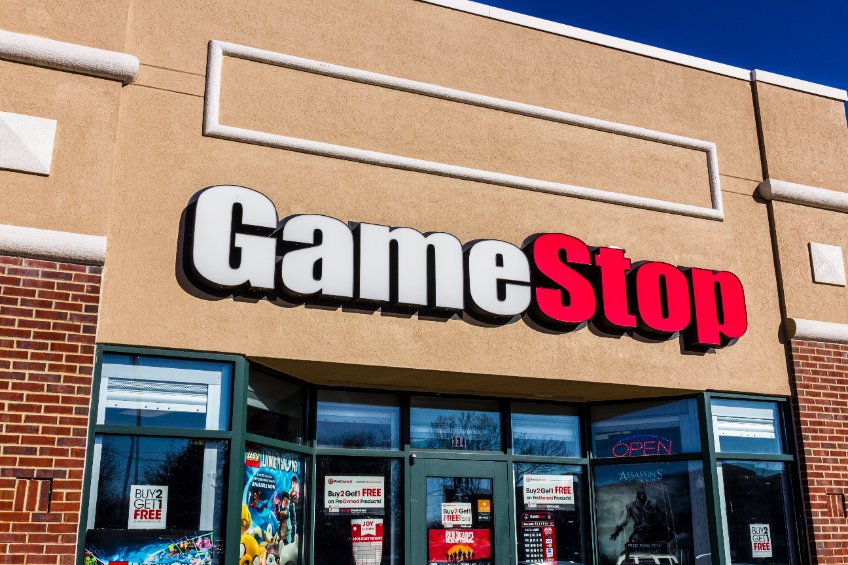
Leading American video gaming platform, GameStop on Monday launched its first NFT marketplace duped GameStop NFT. The market provides users with the opportunity to buy, sell, and trade NFT collections.

According to the press release, the NFT marketplace will also enable users to connect their digital wallets including the GameStop Wallet that was recently released. With time, GameStop also plans to expand the functionalities of the NFT marketplace to include Web3 games.

Commenting about the newly launched NFT marketplace, GameStop said:

“The Company’s NFT marketplace is a non-custodial, Ethereum Layer 2-based marketplace that enables parties to truly own their digital assets, which are represented and secured on the blockchain. Over time, the marketplace will expand functionality to encompass additional categories such as Web3 gaming, more creators, and other Ethereum environments.”

Projects currently available on GameStop NFT

In the meantime, the GameStop marketplace houses a variety of projects built on Ethereum mainnet and Loopring, a layer-2 scaling solution.

In essence, the video gaming company is aiming to also become a significant player in the NFT gaming industry. Besides digitized artworks, NFTs have also found their way into the gaming arena where they exist as vital interactive elements that gamers can use within the games and also trade on NFT marketplaces.

GameStop also recently hinted at integrating Immutable X, which is an Ethereum-based platform used by some NFT games. This comes months after the two (GameStop and Immutable X) announced a $100 million grant incentive for NFT creators.

The NFT marketplace is a significant milestone for the company since it comes at a time when the company has been battling with the falling crypto market that has forced it to lay off workers and even fire its CFO.

The post American video gaming platform GameStop launches NFT marketplace appeared first on CoinJournal.

GMX price has staged a slow recovery. Is it still a good buy?

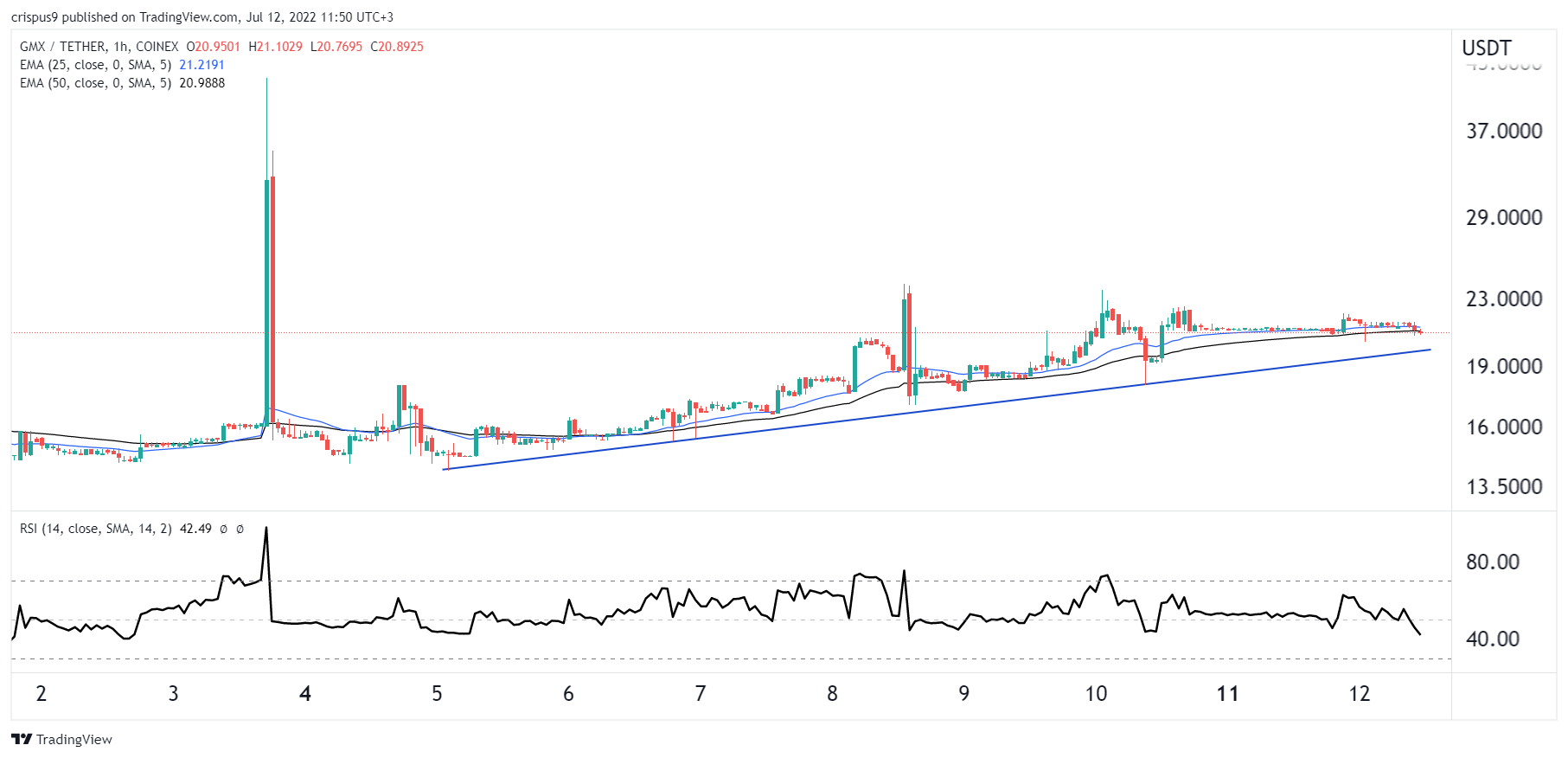
The GMX price has been in a slow recovery as investors attempt to buy the dip. The token is trading at $21, which is the highest it has been since July 3rd of this year. It has jumped by more than 120% from the lowest level in June this year. GMX has a market cap of over $168 million. 

What is GMX? 

There are primarily two main types of cryptocurrency exchanges: centralized and decentralized platforms. In the past few years, the concept of decentralized exchanges has become so popular that analysts believe that they will soon overtake centralized exchanges like Coinbase and Binance. 

GMX is a relatively small but fast-growing decentralized perpetual exchange that enables people to buy and sell crypto derivatives in just a few steps. Unlike centralized exchanges, you don’t need to register. Instead, all you need is to connect your wallet to its platform and start trading. 

Read our review of the best crypto exchanges.

GMX makes it possible for people to use leverage to maximize their crypto investments. It also has substantially lower fees than other perpetual protocols. In addition to trading, one can easily swap coins in a few steps. 

GMX uses two smart contracts that are all easily available to most users. Its main platform was built on Arbitrum, which is well-known for its low fees and high performance. It is also available on Avalanche. According to its website, GMX has helped to facilitate over $47 billion in trading volume from over 69k users. 

GMX has two tokens: GMX and GLP. GMX, the main coin, is the utility token for the ecosystem. It accrues about 30% of the total fees earned from the ecosystem. Holders earn about 21% on both Arbitrum and Avalanche. On the other hand, GLP is the liquidity provider token for the network. It accrues about 70% of its fees. 

GMX price prediction 

The hourly chart shows that the GMX token price has been in a slow upward trend in the past few days. The coin has managed to move above the ascending trendline that is shown in blue. It is also hovering around the 25-period and 50-period moving averages. 

A closer look shows that it has formed what looks like an ascending head and shoulders pattern. Therefore, we can’t rule out a situation where the GMX price makes a major pullback in the coming days. If this happens, the next key support level to watch will be at $18.

The post GMX price has staged a slow recovery. Is it still a good buy? appeared first on CoinJournal.

Origin Protocol price prediction: Is it safe to buy the OGN dip?

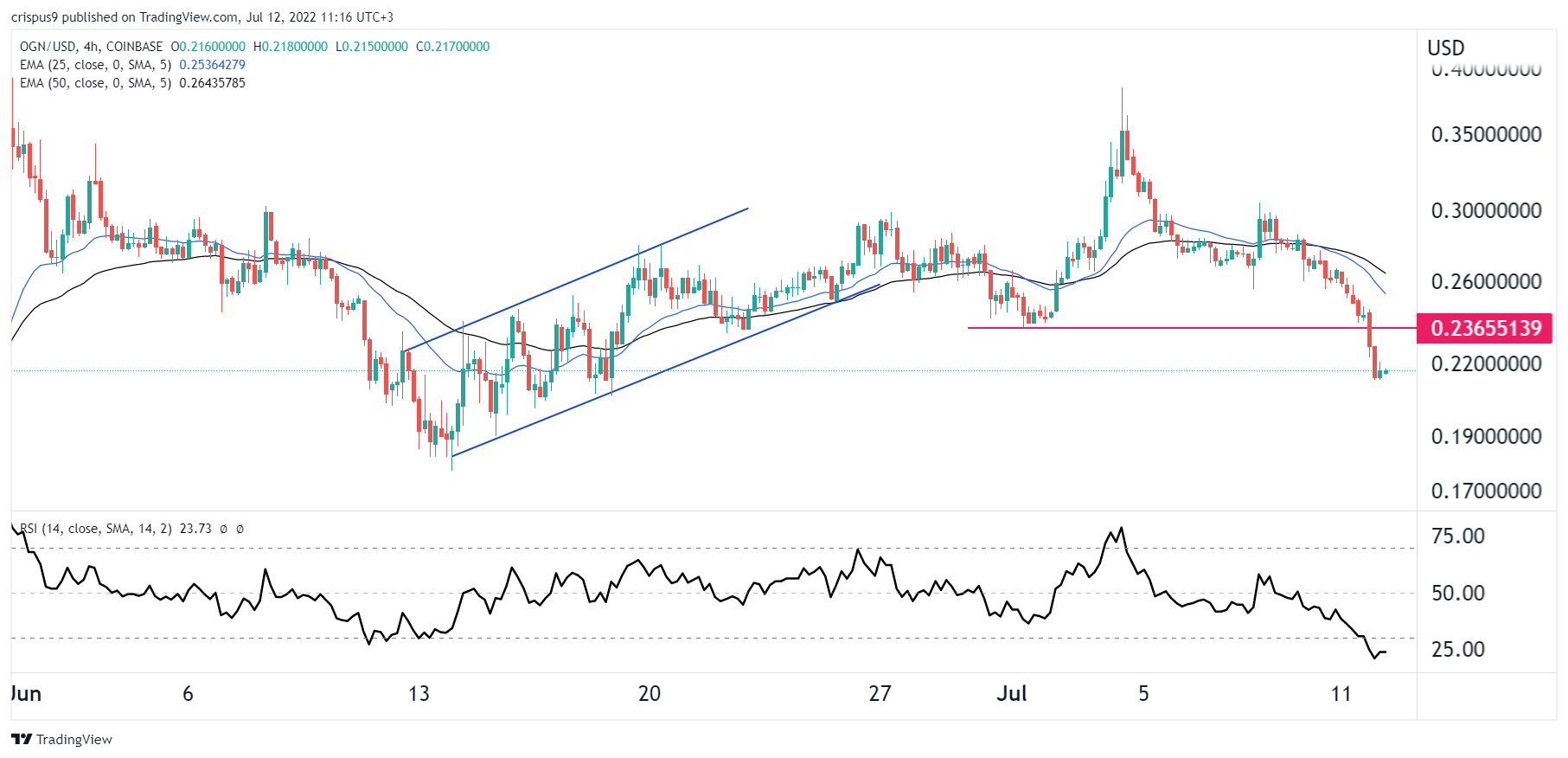
The Origin dollar price joined other cryptocurrencies in a strong sell-off as investors waited for the upcoming American inflation data. OGN, the network’s coin, is trading at $0.2170, which was the lowest level since June 18th. It has crashed by more than 40% from its highest point this month, bringing its total market cap to about $111 million.

What is Origin Protocol and why is it falling?

Origin Protocol is a blockchain project that is at the intersection of three well-known industries in the decentralized industry: DeFi and NFTs. 

DeFi is an industry that is attempting to change how people handle finances. Instead of using centralized companies like banks, DeFi is enabling people to use organizations backed by smart contracts. Anyone can participate in this Decentralized Autonomous Organization (DAO) by buying th OGN token.

Origin Protocol’s DeFi platform is made possible by Origin Dollar (OUSD), which is an algorithmic stablecoin. Unlike popular stablecoins like USDT and USDC, OUSD is not backed by fiat currencies. 

Like Terra UST, OUSD is an algorithmic stablecoin that aims to achieve its peg through arbitrage. According to CoinGecko, Origin Dollar has a total market cap of over $66 million, making it the 319th biggest cryptocurrency in the world.

Like Anchor Protocol, Origin’s DeFi product enables OUSD holders to earn interest by just holding the coin. At the time of writing, the coin has an APY of 12.50%, which is a higher yield than what fiat currencies like the US dollar earns. 

Origin Protocol also owns Origin Story, a platform in the NFT industry. The platform enables people to mint NFTs and sell them in the platform. They can personalize their storefronts and engage their audience easily.

The OGN price has declined recently mostly because people are worried about both the DeFi and NFT ecosystems. There are concerns about the future of the OUSD and the fact that NFT sales are falling.

Origin Protocol price prediction

The four-hour chart shows that the OGN price has been in a strong bearish trend in the past few weeks. It has managed to move below the support at $0.2365, which was the lowest level on July 1st. It has also dropped below the 25-day and 50-day moving averages while the Relative Strength Index (RSI) has moved below the oversold level.

Therefore, the Origin Protocol price will likely continue falling as sellers target the key support at $0.1900. 

The post Origin Protocol price prediction: Is it safe to buy the OGN dip? appeared first on CoinJournal.