JPMorgan: Retail demand is improving as ‘intense phase’ of deleveraging fades

JPMorgan says deleveraging in May and June was the most intense since 2018, but that’s getting behind the crypto ecosystem amid increased retail demand.

JPMorgan analysts are saying positivity among retail investors is on the upward trajectory, with an improved  market outlook coming on the back of huge turbulence and uncertainty.

The banking giant notes in a report cited by CoinDesk on Thursday that the unfolding improvement is down to the reducing intensity of the massive deleveraging that characterised the market crash in May and June, as well as over the last several months following the 2021 bull run.

According to JPMorgan analysts, “the extreme phase of backwardation” witnessed in the market over the last two months was the worst since 2018. However, that extreme pain period looks to be fading off amid the sharp crypto price bounces seen this past few days.

Bitcoin (BTC) jumped above $24,000 to test its highest level in over a month, with on-chain data from Glassnode showing the number of wallets in loss (7 day moving average) has dropped to a 30-day low.

Retail demand jumps amid Ethereum “Merge” news

While Bitcoin’s upside was remarkable, the main avenue of positivity was around Ethereum (ETH), the bank said.

Investor expectations are high after last week’s announcement that Ethereum’s long anticipated “Merge” would be hitting mainnet in September. The buying pressure around the excitement for cryptocurrency’s largest smart contracts platform also seeped into the rest of the market, with ETH/USD jumping above $1,500 as the overall crypto market cap crossed above $1 trillion.

For Ethereum, the number of addresses in profit (7 day moving average) has also reached a one month high.

Notably, the bounce in crypto prices isn’t reflected in crypto funds or futures market, which the bank says is indicative of demand being retail-driven.

Further evidence of retail demand is seen in the increase in the number of “smaller wallets” holding BTC or ETH, JPMorgan added

The post JPMorgan: Retail demand is improving as ‘intense phase’ of deleveraging fades appeared first on CoinJournal.

Syscoin to launch a ZKCross-chain bridge to prevent bride exploits

Syscoin, the only scalable layer-1 Blockchain with Ethereum Virtual Machine (EVM) functionality, is set to launch a zero-knowledge cross-chain bridge (ZKCross) for demonstration by September. The bridge is expected to work on the principle of preventing bridge exploits while also facilitating cross-chain decentralized exchanges and lowering fees.

This year alone, hackers have managed to get away with over $1 billion, causing tension among the investors. Over the years, cross-chain bridges have been using multi-party computation (MPC) or multi-signature to authenticate trades, and this is what has fuelled the rampant cross-chain bridge attacks.

Managing liquidity and trading across multiple chains.

Syscoin’s ZKCross bridge will come as a relief to investors as it will operate an off-chain automated market maker (AMM) mechanism. The mechanisms curb all exploitable consensus protocols as well as manage trade and liquidity across multiple chains.

During the transactions, zero-knowledge proof, a fast and private data authentication, will be used before transactions are compressed and rolled up on the Syscoin base layer to ensure accuracy.

According to Syscoin, the bridge technology will aid economies of scale. However, when the AMM goes offline, the users will be required to exit to the base layer.

 Syscoin lead developer, Jagdeep Sidhu said:

“If it’s not this bridge, someone else will release a zero-knowledge bridge and that’ll be the bridge solution everyone is using. I really think this is where things are headed.’’

Zero-knowledge advantage and limitations

Zero-Knowledge bridging will be cost-effective to users as the only cost the users will incur is that of their CPU. However, zero-knowledge technology has limitations with the main one being a lack of decentralization.

Sidhu said:

“All the rollups are centralized right now, we’ll start with a centralized sequencer, but the goal is to create a decentralized sequencer down the road.”

Meanwhile, Syscoin is optimistic about creating a zero-knowledge Ethereum virtual machine (EVM), which is the best proof system for Ethereum smart contracts, like the zkEVM protocol launched by Polygon. Besides, Sidhu believes that no one in the crypto industry has ever created “proper EVM” however, he noted that all protocols will eventually join the space.

The post Syscoin to launch a ZKCross-chain bridge to prevent bride exploits appeared first on CoinJournal.

Coinbase affirms no financial exposure to embattled crypto firms

Coinbase has said in a blog post that it is not financially exposed to bankrupt and restructuring crypto companies, including Three Arrows Capital, Celsius, and Voyager Digital.

Coinbase is not exposed to the crypto companies that are currently engulfed in bankruptcy, restructuring and such other troubles, the crypto exchange has reaffirmed.

The company is moving to reassure its customers and the broader crypto community that its business and consequently client assets are safe amid all the contagion within the crypto market.

Nasdaq-listed Coinbase says it has “no financing exposure to the groups” of platforms that have hit turbulence and that the company did not engage in the lending malpractices associated with many of the platforms.

The exchange’s reassurance comes as Zipmex became the latest platform to pause withdrawals citing liquidity issues and exposure to beleaguered counterparties.

A ‘credit specific’ problem

Writing in a blog post, Coinbase executives Brett Tejpaul (Head of Coinbase Institutional) Matt Boyd (Head of Prime Finance), and Caroline Tarnok, (Head of Credit and Market Risk) noted that “the shocks to the crypto credit environment over the last few weeks are likely to be a major inflection point for the industry.”

According to Coinbase, the solvency issues currently surrounding crypto firms like lender Celsius, and Voyager Digital, and hedge fund Three Arrows Capital (3AC), reflect the lack of risk controls during the bull market.

The failing companies have what the firm sees as a “credit specific” problem, which has nothing to do with them being just crypto platforms.

“Many of these firms were overleveraged with short term liabilities mismatched against longer duration illiquid assets,” the Coinbase executives wrote in the blog post.

Coinbase notes that the events around the unhedged bets, with massive exposure to the collapsed Terra ecosystem, and 3AC are highlights of similar events in the traditional financial markets – the 1990s Long Term Capital Management and 2000s Lehman Brothers among the standout episodes.

The post Coinbase affirms no financial exposure to embattled crypto firms appeared first on CoinJournal.

Tesla sold 75% of its Bitcoin holdings while retaining all of its Dogecoin

Tesla, which is the leading electric motor company and one of the companies that had accumulated the largest amount of bitcoins, has sold 75% of its bitcoin holdings in the second quarter of 2022.

According to Tesla’s second-quarter report:

“As of the end of Q2, we have converted approximately 75% of our Bitcoin purchases into fiat currency. Conversions in Q2 added $936M of cash to our balance sheet.”

While giving reasons as to why they sold the bitcoin holdings, Tesla said that it sold the butch of bitcoins because they “were uncertain as to when the Covid lockdowns in China would alleviate.” Tesla also went ahead to say that the move should not be taken as a form of a verdict on Bitcoin.

Tesla retains its Dogecoin holdings

After revealing the sale of 75% of its bitcoin holdings, Elon Musk went ahead to confirm that the company has however not sold any of its Dogecoin holdings.

Tesla had accumulated bitcoins worth about $1.5 billion by early last year and it even went ahead to briefly accept it for payment in the purchase of Tesla vehicles before dropping due to environmental concerns. According to the financial statement by Tesla, the company is only left with $218 million worth of digital assets including Dogecoin, which it currently accepts as payment for Tesla merchandise.

A surprise turn of events

The sale of bitcoins by Tesla took a majority of the crypto community by surprise since Musk had in May said that the company would not sell Bitcoin.

In addition, nobody expected the company to sell bitcoin after it dropped the way it has.

The post Tesla sold 75% of its Bitcoin holdings while retaining all of its Dogecoin appeared first on CoinJournal.

Navcoin price has recovered recently. Is it a good coin to buy?

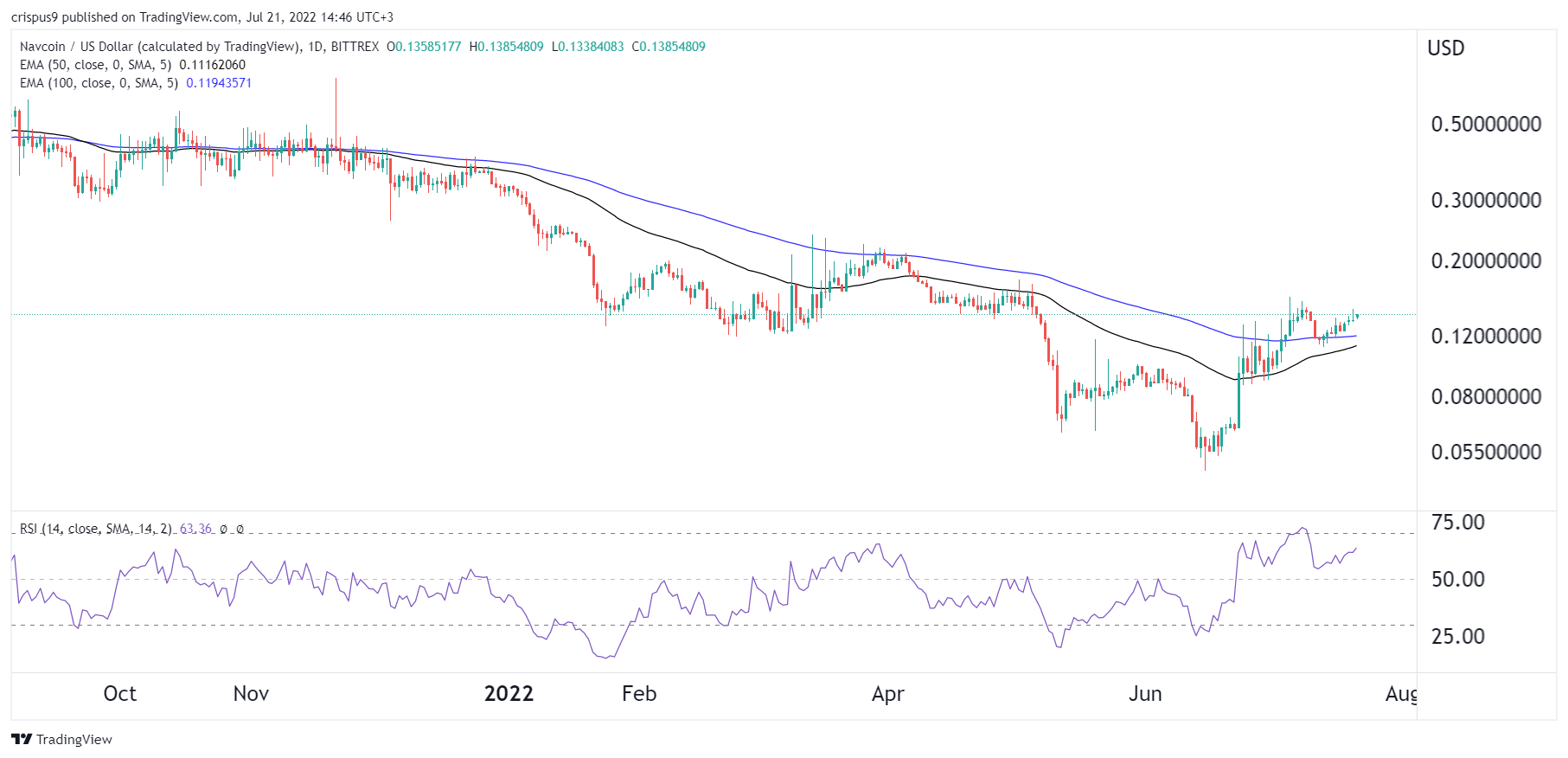
The Navcoin price has staged a strong recovery in the past few days as cryptocurrency prices rebound. The NAV token rose to a high of $0.1385, which was the highest level since May 17th. It has risen by more than 186% from its lowest level this year. As a result, its total market cap has jumped to over $10 million.

What is NAV and why is it rising?

Navcoin is a relatively small cryptocurrency that was started in 2014. The developers’ goal was to solve some of the challenges that Bitcoin has. Most importantly, they wanted to solve the privacy challenges that the coin had. 

Navcoin solves the challenge of privacy by ensuring that all transactions are highly private and that no one can track them. It uses a secondary sub-chain known as NavTech that enables transaction anonymization and mixing.

For example, when a person sends Navcoins, the funds first move to the sub chain, where they are tweaked before they get to the recipient. Navcoin was also among the first coins to implement a proof-of-stake consensus.

Navcoin’s developers have also created more features. In addition to the native NAV token, they have launched xNAV, which is a private currency created to protect information by hiding the sending and receiving addresses and amount. They also launched xNAV, which is a wrapped representation of NAV.

The Navcoin price has bounced back in line with the overall recovery of other cryptocurrencies. Indeed, Bitcoin has jumped to over $24,000 while Ether has moved to about $1,500. As a result, the total market cap of all coins has risen to over $1 trillion.

Navcoin has also jumped as investors cheer the strong performance of other privacy tokens. For example, Monero has jumped by more than 5% in the past 24 hours. The same is true with other coins like Dash and ZCash. 

Navcoin price prediction

The daily chart shows that the NAV price has been in a strong bullish trend in the past few days. It has managed to move above the 25-day and 50-day moving averages while the Relative Strength Index (RSI) has moved close to the overbought level. 

Therefore, the coin will likely keep rising as bulls target the key resistance at $0.50. However, a drop below the support level at $0.106 will invalidate the bullish view.

The post Navcoin price has recovered recently. Is it a good coin to buy? appeared first on CoinJournal.