Crypto exchange Zipmex resumes withdrawals

Zipmex crypto exchange has announced the resumption of withdrawals after it announced on Wednesday that it had halted withdrawals due to the ongoing crypto market meltdown.

However, only withdrawals from the Trade wallet, one of the exchange’s wallets, have resumed.

Zipmex uses two types of assets (Trade Wallet and Z Wallet). The Trade Wallet is used by users to deposit crypto assets and fiat to trade on the platform. On the other hand, Z Wallet allows users to earn bonuses and rewards once they deposit their funds.

Z Wallet operations to remain closed

However, according to the announcement, withdrawals will only be available on the Trade wallet starting today at 7 a.m. ET while Z wallet operations will remain closed until further notice.

However, this is after the platform said yesterday in a Facebook post that it is exploring all the available options and plans to restore withdrawals from some wallets.

Zipmex recovers some of its funds

Notably, Zipmex had an exposure of $5 million to Celsius and $48 million to Babel Finance, which had halted withdrawals earlier on because of insolvency pressure. However, Zipmex noted that it has recovered some of the assets from its partners.

The company said:

“Zipmex has retrieved the majority of our funds and assets that were historically deposited with our deployment partners and have been actively working to resolve the situation for the remaining outstanding assets, there were no materially adverse impacts to our operations.”

The post Crypto exchange Zipmex resumes withdrawals appeared first on CoinJournal.

Is it time to buy Hedera Hashgraph after the latest gains?

  • Hedera Hashgraph token has gained 14% in the last week

  • Hedera network’s differentiation is a source of strength

  • HBAR, the native token, has hit a resistance

Hedera Hashgraph HBAR/USD has returned 14% in the past week. To an investor, the gains elicit the obvious question of whether the cryptocurrency will sustain gains. This analysis finds it’s not unless a key breakout and crypto sentiment is sustained. 

Hedera Hashgraph boasts of being a crypto network that lets anyone deploy applications. Hedera differentiates itself by restricting nodes used in determining the transaction history. That way, it reduces the potential alterations to the transactions. Hashgraph believes the feature guarantees businesses when using data to make decisions. Corporates such as IBM have been attracted to Hedera’s model.

While the use case for Hedera is never in doubt, it faces competition from other blockchains. Investors interested in the native token HBAR need to watch key level (s) before entering.

HBAR meets resistance amid a bullish week

Source – TradingView

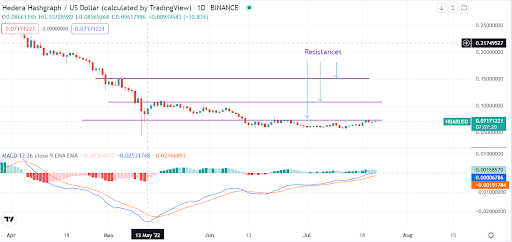
HBAR is bullish after the week’s gains. The MACD line is above the moving average, confirming bullish momentum. However, a technical trader will be keen to know that HBAR has just met resistance at $0.07. The token is consolidating and likely to drop below as bullish momentum fades. That’s speculative as any potential surge could see HBAR trade above the resistance.

We insist HBAR must break above the resistance level to claim higher prices. If that successfully occurs, HBAR could reclaim $0.1. The next level is $0.15, depending on the prevailing crypto sentiment. For now, HBAR remains susceptible to $0.05.

Summary

Despite the weekly gains, HBAR is trapped by the $0.07 resistance. The token could slide further. A break above the resistance could help HBAR reach $0.1.

The post Is it time to buy Hedera Hashgraph after the latest gains? appeared first on CoinJournal.

Investigating Crypto.com’s bullish case after the integration of Google Pay

  • Crypto.com announced an integration of Google Pay for crypto payments

  • The cryptocurrency has been posting gains in the last week

  • CRO still lacks a strong bullish push as the cryptocurrency consolidates

Crypto.com exchange continues to make headlines. On Thursday, the exchange said it was integrating Google Pay. The integration will be for its crypto wallet and trading platform. The integration will allow Android users to pay for cryptocurrencies using Google Pay. 

On Friday, Crypto.com was approved by the Cyprus regulator to offer its products and services in the country. That expands the crypto exchange’s presence in Europe. Crypto.com has received similar approvals in countries such as Singapore and Italy. 

Despite the latest developments, crypto.com token CRO/USD remains in the trenches. As of the time of writing, the token was up by 5%. The gains reflected overall market recovery rather than positive developments. CRO’s gains in the week were 13%; still, an average achievement as most tokens boomed. We believe CRO will take time before investors see lasting gains. Still, the current price is attractive.

CRO lacks buyer interest after breaking past a key resistance

Source – TradingView

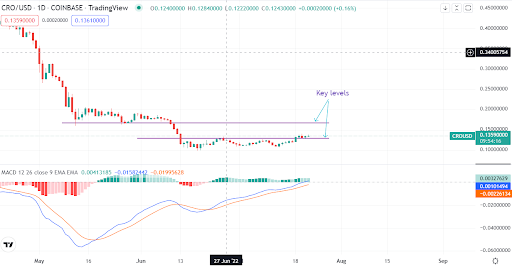
Technically, CRO has broken past key resistance at $0.13. The MACD indicators are bullish on the cryptocurrency. However, CRO still lacks a strong bullish momentum at the current level. The token is consolidating at or slightly above the resistance zone. That indicates a lack of buyer interest. Investors could also be turning attention to other cryptocurrencies such as Bitcoin.

If CRO manages to hold above the $0.13 level, that sets it on course to claim $0.168. We still believe CRO is attractively priced for investors looking to hold it long-term. The positive developments are a catalyst for the token’s gains.

Summary

CRO has announced the integration of Google Pay. The token is yet to price the news as the price remains in consolidation at or slightly above $0.13.

The post Investigating Crypto.com’s bullish case after the integration of Google Pay appeared first on CoinJournal.

Top Cryptocurrencies to benefit the most from Ethereum’s growth

The much-awaited Ethereum merge is expected to take place in September. It is a big step towards improving Ethereum scalability while retaining its decentralized nature. 

While talking about the merge at the EthCC, Ethereum’s founder, Vitalik Buterin, said that the merge would make Ethereum’s development process only 40% complete. He added that going into the future; the focus will be on taking the load off the Ethereum mainnet. Vitalik said that besides layer-2’s handling most transactions, there was a need to eliminate the need for Ethereum nodes to store the blockchain’s entire history.

Going by Vitalik Buterin’s talk, it is clear that as Ethereum continues to evolve, there are cryptocurrencies within the Ethereum ecosystem that are set to reap big.

Below are some of the cryptocurrencies most likely to succeed for anyone interested in crypto as Ethereum evolves into a more decentralized and scalable internet computer. 

The Graph (GRT)

Vitalik Buterin specifically referenced The Graph (GRT) as one of the cryptocurrency projects that have a major role to play in the future growth of Ethereum. According to Buterin, The Graph is a valuable tool that can be used to store Ethereum’s historical data instead of keeping it on-chain. 

This is a big deal, as it puts The Graph at the forefront of cryptocurrencies whose futures are directly tied to that of Ethereum. Already, The Graph is showing positive signals after the comments that Buterin made about it at the EthCC. While most cryptocurrencies have eased up a little in the last 24 hours, The Graph continues to surge in value.

It is an indicator that investors are excited about The Graph’s role in the Ethereum ecosystem going into the future. As this use case takes shape, The Graph stands out as one of the cryptocurrencies with strong growth potential. 

Polygon (MATIC)

Polygon is one of the best-performing cryptocurrencies this week. In the last 7-days, Polygon is up by 30%, and upside momentum is rising. This is largely driven by news that Disney added Polygon to its Accelerator program.

However, the more important news is that the Polygon team is working hard to make Polygon stand out as one of the best Ethereum layer-2s in the market. Earlier in the week, Polygon co-founder, Bjeric said that they were committed to Ethereum and looking to give back to the Ethereum ecosystem.

Many have speculated that the giving back is in the form of launching Polygon Hermez. Hermez will introduce zero-knowledge proofs (Zk Rollups) to Polygon. Not only will this help Polygon scale better (to Ethereum’s benefit), but it will also significantly improve security. That’s because, with Zk Rollups, it is possible to verify a transaction without revealing the identity of the one verifying it.

With Ethereum set to entrench its dominance after the merge, Polygon comes across as a top cryptocurrency worthy of investing in now. The odds are that as Ethereum grows, so will MATIC.

The post Top Cryptocurrencies to benefit the most from Ethereum’s growth appeared first on CoinJournal.

The Science DAO: a streamlined and fast funding solution for science projects

As the adoption of blockchain technology and cryptocurrencies gathers momentum across various fields, decentralized autonomous organizations (DAOs) are becoming popular among different industries and companies. In particular, DAOs are proving to be well-suited for fields like science that suffer from the lack of sufficient funding because of poor market conditions.

In most cases, scientists have been forced to turn to centralized organizations like governments and banks when they need funding for their projects. However, these organizations are in most cases slow and very bureaucratic leading to long delays and at times the funds are never processed.

Besides funding problems, scientists are also forced to seek help or personnel resources from other professionals; something that could impact the quality of their research since the scientists are first forced to forsake their primary role of researching to look for the resources.

However, if scientists are to use a decentralized organization approach, they would not have to worry about competing for resources since everyone has a fair say in how the organization is run and every invention gets a fair share of the funding. One such DAO that has gained a lot of reputation among scientists is The Science DAO.

How The Science DAO works

The Science DAO is a decentralized think tank, incubator engine, and accelerator platform that drives funding for various science projects and inventions. It is a decentralized community comprising scientists, entrepreneurs, engineers, and other people who are interested in science.

Being a DAO, The Science DAO is run by its members; meaning it does not receive instructions from any centralized organization. As such, it is agile and its operations are responsive to the needs of the members.

It focuses on increasing the flow of resources to scientists working on cutting-edge projects revolving around natural science and computing, health and environment, and technology. It does so by connecting the innovators or scientists with investors who can provide them with the required resources to realize their projects.

Some of the projects that are currently being funded through The Science DAO include the development of new treatments like the use of nanotechnology to destroy cancer cells and the use of tailored treatments.

Funding projects through decentralized organizations

Given that most science projects are long-term and require a lot of money to actualize, decentralized organizations offer a more efficient funding solution.

With traditional funding methods, scientists waste a lot of time in the lengthy processes of applying for funding and also wait longer (months or years) to see if they shall get the funding or not. This results in a lot of time wastage which the scientists could use to work on their projects instead.

On the contrary, DAOs like The science DAO offer a faster and more efficient solution.

The Science DAO, which is the first of its kind platform to apply the DAO model in funding science projects, uses non-fungible tokens (NFTs) to distribute funds to innovators and scientists.

Each invention, development, or research project is divided into different parts and each part is represented by an NFT. These NFTs are then sold out to investors. For example, if a project can be divided into 2000 parts, it means it will have 2000 NFTs and if the NFTs are sold at $1000 per NFT, the project will be able to raise $2,000,000 by selling all the NFTs. This way, science projects can get funded without depending on traditional venture capital firms, banks, or the government.

If the company or project performs extremely well, the market value of the NFTs rise, and investors can sell them at a profit in the secondary markets.

However, every project that seeks to be funded on The Sconce DAO must first be vetted by the DAO’s community. This ensures that only the best legit projects are funded and also increases the likelihood of the projects being successful.

Conclusion

Although there are many areas that decentralization can benefit the field of science, funding is where decentralized science shines most. The funding process is more streamlined and fast allowing scientists to focus on their research instead of worrying about where the funds will come from.

Besides, with The Science DAO, investors are assured of investing only in the best projects since every project is vetted before being allowed to conduct funding on the platform.

Additionally, The Science DAO is advised by some of the best minds there is in the science industry. They include the likes of Mark Ashida (the former senior executive at Microsoft), John Aitchison, Ph.D. (the co-founder of the Center for Global Infectious Disease at Seattle Children’s Research Institute), Juan Carlos Jaume (Professor of Medicine and chief, Endocrinology, Diabetes and Metabolism at the University of Toledo), and Juan Carlos Jaume (Professor of Medicine and chief, Endocrinology, Diabetes, and Metabolism at the University of Toledo) among others.

The post The Science DAO: a streamlined and fast funding solution for science projects appeared first on CoinJournal.