Telegram founder proposes NFT marketplace for auctioning popular usernames

Telegram founder Pavel Durov is proposing the creation of an NFT marketplace that can use “NFT-like smart contracts” to facilitate auctioning of popular usernames.

Durov’s proposal comes after the success of domain name auctions on The Open Network (TON), which is a layer-1 blockchain designed by the Telegram team. The Open Network launched the TON DNS Service in mid-July allowing users to assign human-readable names to crypto wallets, websites, and smart contracts.

Durov through a message shared on his personal Telegram group, Durov’s Channel, on Tuesday said that he was impressed by the success of the domain auctions on TON. He said that Telegram could tap into the same technology and launch a new marketplace that would be used to buy and sell “catchy t.me addresses like @storm or @royal, and all four-letter user names.”

Durov said:

“Imagine how successful Telegram with its 700 million users could be it we put reserved @ usernames, group and channel links for auction… This would create a new platform where username holders could transfer them to interested parties in protected deals – with ownership secured on the blockchain via NFT-like smart contracts.”

Auctions on TON DNS Service

The first auction on TON DNS was conducted on July 30 and just like the Ethereum Name Service (ENS) “.eth” domains, the “.ton” domains allow users to access decentralized applications in a simpler way without needing to write the long crypto wallet addresses.

The Open Network uses FunC programming language for the TON Virtual Machine and to launch specific smart contracts on the blockchain. If Telegram was to launch NFTs, it would most likely use the same standard.

Durov said:

“Our team can write bullet-proof smart contracts for TON (since it was us who invented its smart contract language), so we are inclined to try out TON as the underlying blockchain for our future marketplace.” 

The post Telegram founder proposes NFT marketplace for auctioning popular usernames appeared first on CoinJournal.


Acala community okays burning billions of erroneously minted aUSD stablecoin

According to a news post by the co-founder of Acala Network, Bette Chen, the Acala community has voted to burn 2.97 billion Acala USD (aUSD) stablecoins.

Acala is a scalable and Ethereum-compatible layer-1 smart contract platform built on Polkadot blockchain and it is the blockchain network that powers the aUSD stablecoin.

The aUSD stablecoin

aUSD is over-collateralized by several digital assets from the Kusama network and Polkadot ecosystem, with a deposit rate of 195% per every minted aUSD.

aUSD de-pegging

Last week, the price of aUSD de-pegged from its US dollar peg and dropped to below $0.01. The cause for the de-pegging was later found to be a sudden influx of the aUSD stablecoin supply caused by an erroneous minting.

3.022 billion aUSD stablecoins were erroneously minted after the iBTC/aUSD liquidity pool that went live on August 14 was misconfigured.

The misconfiguration has however since been rectified and the wallet addresses that benefited from the erroneously minted aUSD identified through on-chain tracing. Thirty-five accounts were found to have received 12.38 million aUSD.

More than 99% of the erroneously minted aUSD were then transferred to the Acala parachain. But some, approximately worth $9.69 million, had been swapped to DOT and moved to centralized crypto exchanges.

The aUSD is currently trading at about $0.84 which is still below its dollar parity; meaning the erroneous minting is still affecting the system’s equilibrium.

The post Acala community okays burning billions of erroneously minted aUSD stablecoin appeared first on CoinJournal.

Is Ethereum Classic losing the technical battle at $34?

  • Ethereum Classic is trading slightly below key support of $34

  • The token is expected to benefit from the Ethereum merge; however, disputed

  • Ethereum Classic could head to $26 next if it loses the $34 technical battle

Ethereum merge euphorbia seems to be now fading. As the September 15 date fast approaches, Ethereum and hard fork Ethereum Classic ETC/USD are falling. That, of course, is not to mean that the hard fork will not have a bullish impact on price. If speculations are to be believed, Ethereum’s price will hit $5,000 after a successful merge. Its hard fork, Ethereum Classic, is expected to surge too on the influx of PoW to the protocol. The idea is still disputed if, indeed, Ethereum Classic will benefit. ETC gains have been direct as a result of expectations. 

It is too early to speculate that ETC will benefit from Ethereum Merge. However, speculations will remain as cryptocurrencies are known to benefit from them, if positive. Thus, we cannot underestimate how much ETC could surge in the 3 weeks to the merge. We still urge caution as the technical indicators are currently not pricing to a potential merge rally.

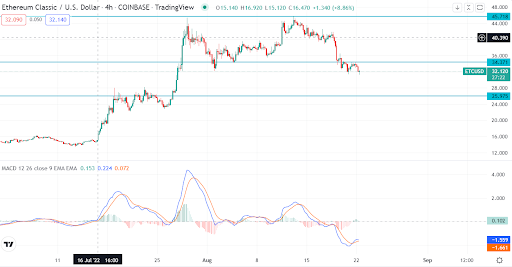
Ethereum Classic could retest $26 as the price remain bearish

Source – TradingView

Ethereum Classic trades at $32. The price below key support at $34 indicates bear momentum. Using a short time frame of 4 hours, we can see that the MACD line has moved above the moving average. That suggests a short-term price appreciation. The momentum indicator still remains in bear territory. 

Concluding thoughts

Potential price discovery is expected to push Ethereum Classic to $34. However, the token will remain bearish if the price fails to break past $34. A price rejection will see bears take control, with ETC potentially crashing to $26.

The post Is Ethereum Classic losing the technical battle at $34? appeared first on CoinJournal.

Cardano retests key support amid bearish sentiment and testnet concerns

  • ADA has dipped 3% in the past day.

  • Reports of a bug in one of Cardano’s testnets likely to delay Vasil upgrade.

  • Technical indicators are looking bearish below the $0.56 resistance level.

Cardano’s ADA/USD has dropped 3% in the past day, increasing weekly losses to 19%. Its market capitalization is down to $15,218,450,837 with lower trading volumes. ADA trading volumes reduced by 8% to slightly above $650 million in the past day.

The bearish momentum in Cardano is partly linked to the ongoing crypto market correction. Aside from the correction, an important fundamental aspect has shaken the smart contract blockchain. A bug reported in its testnet could delay the anticipated Vasil hard fork.

Cardano’s founder Charles Hoskinson has refuted the claims, which termed the testnet ‘catastrophically broken’. Hoskinson said that the bug had already been solved in a previous update and was not a major issue. He maintains that the concerns could unnecessarily delay the hard fork.

Vasil upgrade is expected to introduce major updates on Cardano. Some benefits include enhanced throughput speed and reduced latency of block transmission. However, there have been multiple delays, with the latest being in July. The delays are causing a subdued performance in ADA, as shown in the daily chart below.

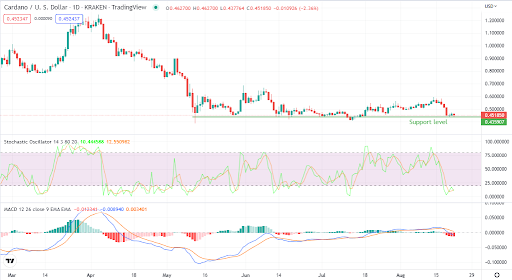
ADA retests $0.4 support

Source: TradingView

According to the technical chart above, ADA has retested the $0.43 support level. The level has been retested several times since mid-May. Overall, the token has remained subdued at under $0.56 for the past three months.

The technical indicators are not looking bullish either. MACD histograms are red, with the trend following lines crossing close to the neutral point. The Stochastic Oscillator is at the lowest point since July 13.

At 11, the momentum indicator is at the oversold zone and could be due for a bounce back. However, with the momentum being bearish, the token must flip $0.56 to welcome any bullish sentiment.

Concluding thoughts

ADA has retested a key support level. The technical and fundamentals are pointing to more bearish pressure. A bullish momentum can only be possible past the $0.56 resistance.

The post Cardano retests key support amid bearish sentiment and testnet concerns appeared first on CoinJournal.

Scaramucci: Bitcoin is not mature enough to be an inflation hedge

  • Anthony Scaramucci says Bitcoin needs to reach a billion wallets to start being regarded as an inflation hedge.
  • He is however bullish on the crypto markets, predicting a recovery going into end of the year.
  • Scaramucci also says the meme stock situation remains due to people holding a ton of cash from last year.

Skybridge Capital CEO Anthony Scaramucci says despite Bitcoin’s continued attractiveness as an asset class, it’s not at that level where it can be “regarded as an inflation hedge.”

Scaramucci aired the sentiments during an interview with CNBC’s ‘Squawk Box’ on Monday.

Bitcoin as an inflation hedge… not yet

On Bitcoin, Scaramucci thinks there’s still room for the pioneer crypto to grow into mainstream adoption before hitting that button of claiming inflation hedge status.

“Bitcoin is still not a mature enough asset to be regarded as a potential inflation hedge,” he told CNBC.

While his sentiments are likely to elicit sharp reaction from across the Bitcoin community, notably from the perspective of the pioneer crypto not being “mature enough”, Scaramucci’s explanation rings a bell or two in terms of global adoption.

He believes getting to that point where it is now regarded as a hedge, the BTC network needs to have grown to at least one billion wallets.

As for now, the benchmarket cryptocurrency “[doesn’t] have the wallet bandwidth,” he noted, adding that currently it is at that stage of “an early adopting technical asset.”

Crypto market and the meme stock craze

The Skybridge Capital founder also spoke about the overall crypto market, with the latest sell-off across major assets coinciding with the sharp moves in the meme stock sector. 

Notably, he mentioned the recent volatile price movement of Bed, Bath & Beyond – the retail store whose stock joined the meme bandwagon to mirror previous performances of GameStop and AMC Entertainment.

According to him, the kinds of trades seen with these stocks are likely to continue given the possibility of there still being a lot of excess liquidity across pockets of investors. He believes these people “made a ton of cash” during the bull market, and helped with the easy cash that characterised the economy then.

Elsewhere, he is bullish on the market’s recovery prospects towards the end of 2022 and early next year. Signals of these have been the bounces amid some good news, which could be the case over the next few months.

And he thinks its likely people with massive short positions could easily be caught up in a sharp rally and “get ripped off.”

The post Scaramucci: Bitcoin is not mature enough to be an inflation hedge appeared first on CoinJournal.