Binance reintroduces futures trading in South Africa

  • Binance had ceased offering crypto derivative products to customers in South Africa in October 2021.
  • The platform will now offer its crypto futures products via regulated platform FiveWest OTC Desk.
  • Brickhouse Trading Limited, a member of Binance group of companies, will offer the products as a jurisdic representative of FiveWest.

Binance, a leading blockchain ecosystem and top cryptocurrency exchange platform, has announced its relaunching its crypto futures products in South Africa,

The exchange, which revealed the development on Monday, eligible South African customers can start accessing futures trading on the platform as from 26 September 2022.

Eligible customers to access futures products

Binance’s reentry with margined trading products for the African nation’s market comes several months after it moved out due to regulatory and compliance issues.

In October last year, the exchange halted its derivatives-related products in the country – with the need to comply with local regulations forcing it to cease offerings for futures, options, margin and leveraged tokens.

On Monday, the exchange told its users in the country that USD-Margined and COIN-Margined perpetual as well as delivery Futures contracts were now available.

South African users can access these products on Binance again, with the platform partnering with regulated financial services FiveWest OTC Desk. 

The Changpeng Zhao-led crypto company noted that it has a juristic representative arrangement with the authorised provider – a collaboration that will work via Binance affiliate Brickhouse Trading Ltd.

According to Binance, customers will still access the same products as before.

“The type of products offered and related product specifications have not changed from Binance’s previous Futures offering in South Africa. Only the manner in which the services are provided have changed. Users may still connect into the Binance platform and access the same market-leading liquidity,” the exchange’s team wrote.

The post Binance reintroduces futures trading in South Africa appeared first on CoinJournal.

Is Injective Protocol’s INJ a good buy as TVL rebounds?

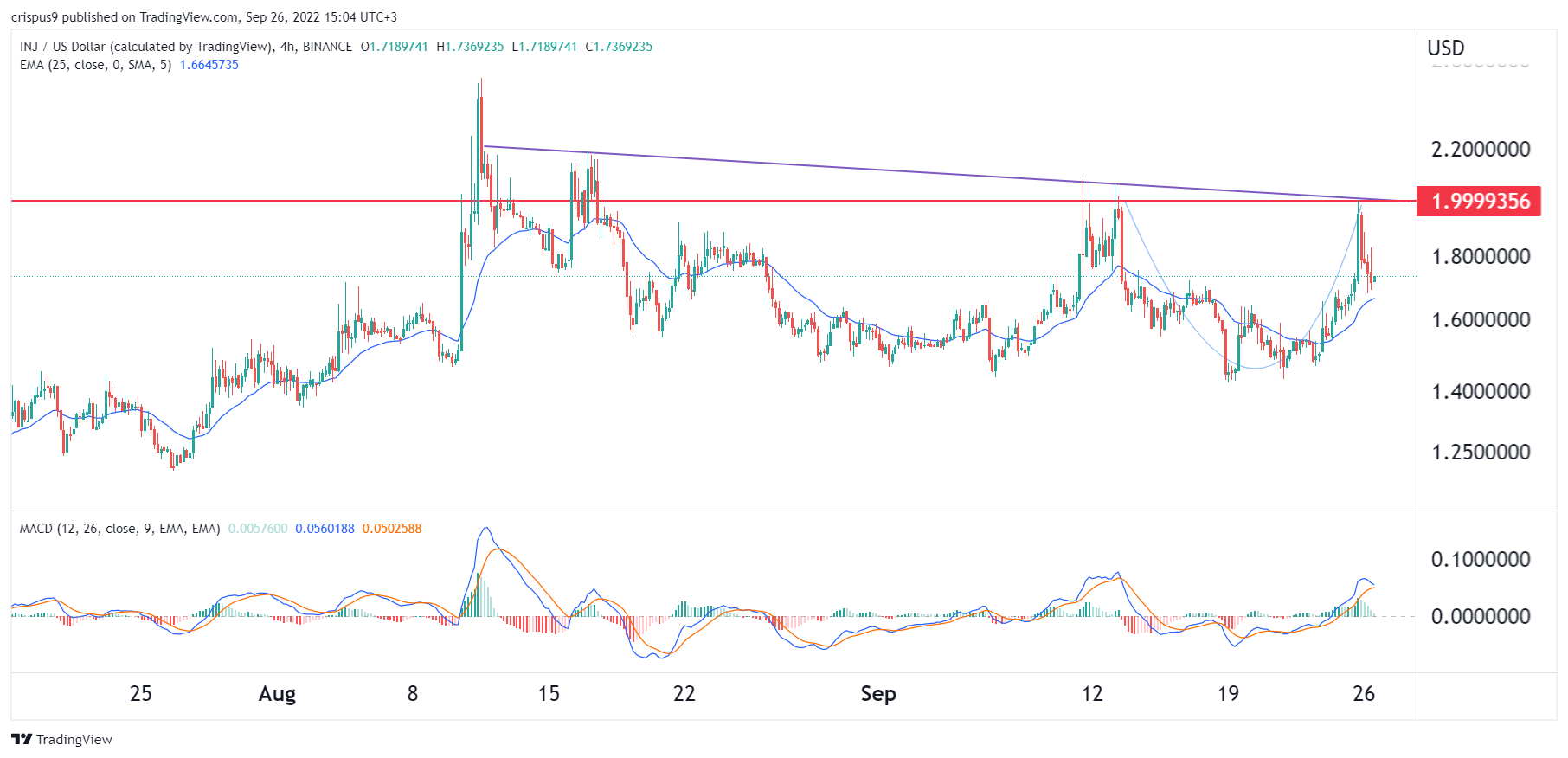
Injective Protocol price soared to the highest level since September 13 and then quickly erased these gains. The INJ price retreated to a low of $1.6977, giving it a market cap to more than $132 million. This price is about 18.50% from the lowest level this month.

What is Injective and is it a good buy?

Injective Protocol is one of the fastest-growing layer-1 blockchain projects that enable people to buy and trade digital currencies. The protocol also provides tools to help developers build decentralized applications.

It is backed by leading venture capital firms like Pantera, BlockTower, and Hashed among others. Mark Cuban is also an investor in the company. In August, the developers raised a new $40 million fund from Jump Crypto and Alan Howard’s BH Digital. 

This funding will enable developers to continue building its platform and also to increase the utility of the INJ token. In the past few weeks, the developers have also made several announcements to support the brand. For example, they added new validators while it welcomed Helix, a leading exchange that offers no gas fees and lightning-fast transactions.

INJ price rose as investors focused on the growing total value locked (TVL) in its ecosystem. According to DeFi Llama, the TVL jumped to more than $84 million, which was the highest level since May 10 of this year. This volume was much higher than the year-to-date low of $35.91 million. This is a sign that its ecosystem is expanding.

INJ price prediction

The four-hour chart shows that the Injective Protocol price jumped to a high of $2, which was the highest level since September 13. It moved above the 25-day and 50-day moving averages while the MACD has moved above the neutral point. 

The coin is slightly below the descending trendline shown in purple. It has also formed what looks like a cup and handle pattern. Therefore, there is a likelihood that the INJ price will continue rising as bulls target the key resistance level at $2.20. A drop below the support at $1.5 will invalidate the bearish view.

The post Is Injective Protocol’s INJ a good buy as TVL rebounds? appeared first on CoinJournal.

Anchor Protocol price prediction as Terra and USTC spikes

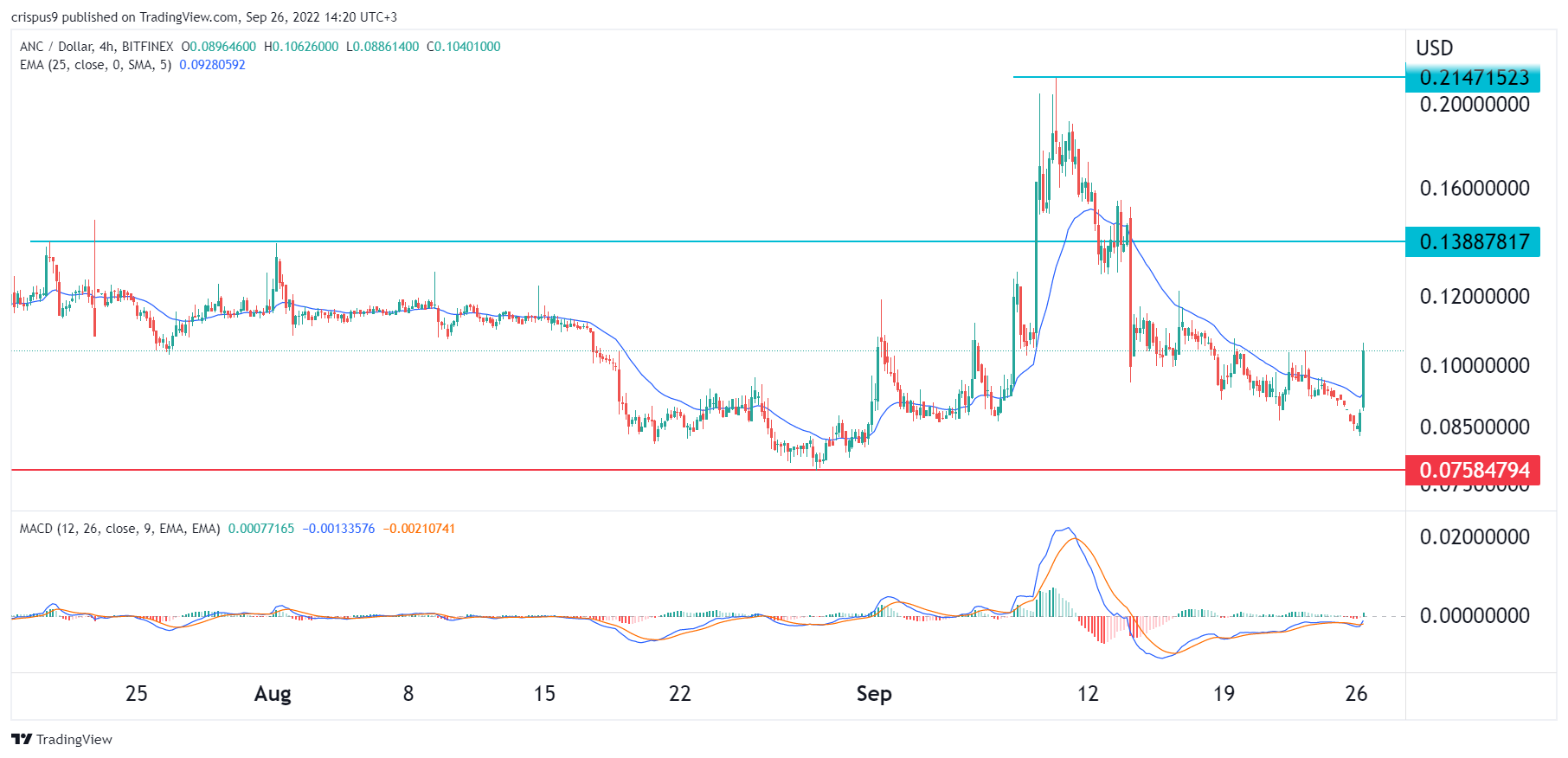
Anchor Protocol price surged to the highest level since September 23 as cryptocurrencies associated with Terra surged. ANC, which has been delisted by several exchanges, rose to a high of $0.1054, which was about 27% above the lowest level on Monday.

Terra ecosystem surges

Anchor Protocol was a pivotal platform for Terra’s ecosystem. It was a DeFi platform that acted like a bank. It allowed people to deposit funds and then earn rewards in form of interest. At its peak, the platform had over $20 billion in total value locked (TVL).

All this came crumbling down in March as Terra USD crashed. UST was an algorithmic stablecoin that powered Anchor’s ecosystem. Therefore, the network crashed when the stablecoin lost its peg.

Anchor Protocol price went parabolic on Monday as cryptocurrencies associated with Terra bounced back. For example, Terra Luna Classic jumped by more than 50% from its lowest level on Monday. Similarly, Terra Luna 2.0 rose by over 20% while Terra’s stablecoin jumped.

It is unclear why these coins rose considering that Monday was a tough day for Terra’s ecosystem. In a statement, South Korea’s prosecutors said that they had requested Interpol to issue a red alert on Do Kwon, the founder of Terra. 

These prosecutors accuse Kwon and other associates of circumstantial evidence of escape since he left Singapore a few weeks ago. Also, they took issue with his claim that he was cooperating with prosecutors in different jurisdictions. Primarily, they accused Kwon with crimes related to capital markets laws.

In the past few months, Anchor Protocol and other cryptocurrencies associated with Terra have had occasional pump and dumps. This is one of the reasons why the ANC price jumped sharply on Monday. Still, many traders will find it difficult to trade Anchor since it has been delisted in several exchanges.

Anchor Protocol price prediction

The four-hour chart shows that the ANC price has been in a bearish trend in the past few days. This saw it crash from this month’s high of $0.2147 to a low of $0.083. It then went parabolic on Monday as Terra and USTC price rebounded.

Anchor has moved above the 25-day moving average while the MACD has formed a bullish divergence pattern. Therefore, there is a likelihood that the coin will continue rising as buyers target the next key resistance point at $0.12.

The post Anchor Protocol price prediction as Terra and USTC spikes appeared first on CoinJournal.

Veritaseum Capital sues Coinbase for patent infringement

Blockchain-based software firm Veritaseum Capital has accused Coinbase of infringing on a blockchain-related patent. The firm has decided to sue the popular crypto exchange for $350 million in damages.

Speaking for Veritaseum, US law firm Brundidge & Stanger has alleged in the lawsuit that Coinbase has undermined Veritaseum’s cryptocurrency payment technology patent or the “566 patent”. The lawsuit has been filed in the U.S. District Court in Delaware.

According to Veritaseum, the patent facilitates novel devices, systems and methods which enable parties to enforce value transfer agreements with little or no trust in each other.

The firm alleges in the lawsuit that Coinbase has used this system to run many of its blockchain infrastructure services, including Coinbase Android mobile wallet, iOS mobile wallet, its Coinbase Cloud, Coinbase Commerce APIs, Query and Transact, Participate, Delegate and Validator software, Coinbase Pay, Coinbase Wallet and Coinbase Operated Public Validators.

Veritaseum has argued that the $350 million compensation is justified considering that Coinbase has gained substantial profits due to its infringement and Veritaseum Capital “sustained damages as a direct and proximate result.” 

The law firm has also pointed out that a letter warning Coinbase of the infringement was sent in June and received no favourable response: 

“Defendant had prior knowledge, should have known, or at least been willfully blind of the ‘566 Patent’. Defendant has been on notice of the ‘566 Patent’ at least as early as July 3, 2022, if not earlier from other sources or parties.”

The July letter was sent in the context of Vertiaseum’s “Coinbase: Forensic Analysis & Deep Dive” report that suggested that Coinbase was only one of the many centralized and decentralized digital asset exchanges that are employing “unlicensed patented IP” from Veritaseum.

The firm, however, has not clarified how long Coinbase has been allegedly using the patent.

Court documents confirm that Patent 566 was awarded by the U.S. Patent and Trademark Office to Vertiaseum founder Reginald ‘Reggie’ Middleton and co-inventor Mathew Bogosian in December of 2021.


The post Veritaseum Capital sues Coinbase for patent infringement appeared first on CoinJournal.

Bitcoin volatility trended downwards in Q3: report

  • Bitcoin’s average 30-day volatility in August was 60%, while it stood at 80% in June.
  • In 2022, risk asset markets (crypto included) have traded lower and Bitcoin more so like a high-beta US stock.

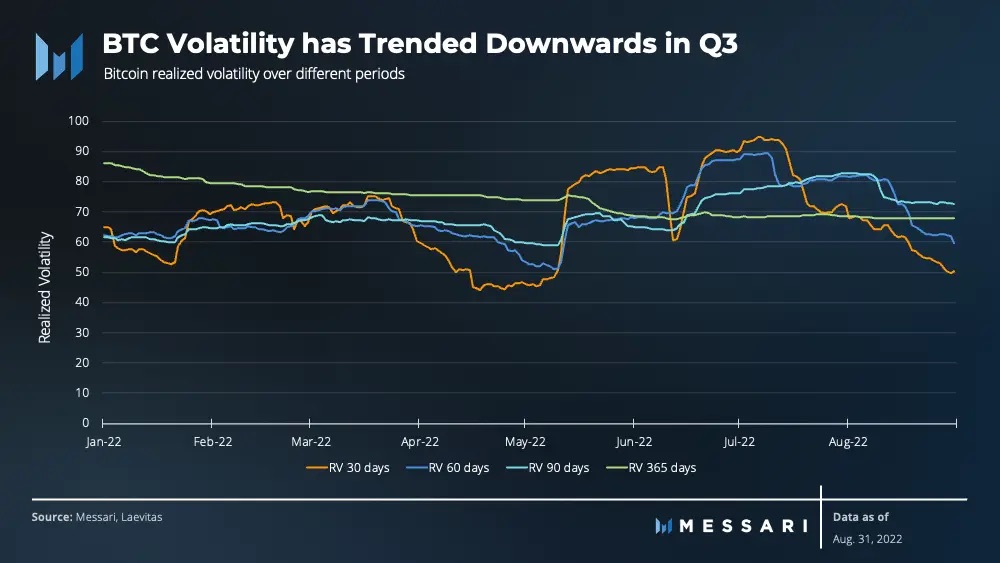
Bitcoin (BTC) realized volatility during quarter three has trended downwards, according to the latest report on the metric from crypto intelligence and research firm Messari.

Per the research platform, the benchmark cryptocurrency recorded the lower volatility as the crypto saw a slight recovery from June lows.

So while BTC has once again dipped below $20,000 in September, the recovery from the $17,600 levels in June and the retest of key resistances near $25,000 in mid-August was key.

“Bitcoin realized volatility trended downwards as it made a gradual recovery in Q3. Average 30-day volatility for August was 60% compared to over 80% for June,” Messari’s Sami Kassab and Kuna Goel wrote in the State of Bitcoin Q3 2022 report.

BTC volatility chart showing downward trend in Q3. Source: Messari

The lower volatility for the world’s largest cryptocurrency by market cap saw the broader crypto market record much lower liquidations across the period, the analysts added. For instance, total long liquidations stood at $5 billion in August, a more than 50% drop from the $10.8 billion recorded in June.

As for total short liquidations, the figure fell to $3.5 billion last month, compared to $6.6 billion total liquidations seen in June.

BTC traded like a high-beta US tech stock

As crypto prices see-sawed over the quarter, Messari notes, Bitcoin traded more like a tech stock as it tracked the Nasdaq 100 (rebased). 

This happened not just as the federal fund rates increased across the three months, but reflected the rot going back to late 2021. Prior,  availability of easy money amid institutional adoption, had helped fuel the bull market.

“For the quarter, the average correlation between Bitcoin and NASDAQ 100 was 0.6 as inflation and rate hikes dominated the narrative. Surprisingly, digital gold and physical gold are far less correlated. The average correlation for the quarter between the two assets was 0.2,” Kassab and Goel wrote.

Overall, Q3 has seen Bitcoin essentially lose two of its key narratives – as an inflation hedge and store-of-value asset – amid the bear market crash that precipitated declines of over 72% since the all-time-highs of 2021.

Bitcoin was trading around $18,910 on Sunday afternoon, about 6% and 13% down over the past 7 days and 30 days respectively.

The post Bitcoin volatility trended downwards in Q3: report appeared first on CoinJournal.