Stripe launches fiat-to-crypto payment service for Web3 apps

According to a statement released on Thursday, Dec. 1, 2022, payment processor Stripe has launched a fiat-to-crypto payment service for Web3 businesses.

KEY TAKEAWAYS

  • The fiat-to-crypto service will allow customers to instantly buy cryptocurrencies in Web3 apps.
  • The services offer an easy Fiat-to-Crypto onramp.
  • The new Stripe product is in form of a customizable widget that can be integrated into Web3 apps/platforms.

Web3 application developers will be able to customize and integrate the new Stripe widget into decentralized exchanges (DEXs), non-fungible token (NFT) platforms, crypto wallets, and other decentralized apps (DApp). This will allow customers to instantly buy cryptocurrencies in the Web3 applications.

According to Stripe, the new product offers flexible on-ramping services and manages know-your-customer (KYC) payments and compliance challenges. According to Stripe, the new product was designed to eliminate complications.

Increased Stripe partnerships

Since last year, Stripe has ramped up the number of crypto firm partnerships as more and more nations enable cryptocurrency payments.

USDC has been one of the cryptocurrencies that have received high adoption with corporations now being able to transfer USDC payments to individuals and organizations worldwide.

One of the recent Stripe partnerships is its partnership with the decentralized music discovery network Audius, making Audius one of the first companies to use Stripe’s new on-ramp. Audius announced that it accepted Stripe’s payment solution to allow users to use their credit cards to purchase their native AUDIO coin and tip their favourite musicians.

The post Stripe launches fiat-to-crypto payment service for Web3 apps appeared first on CoinJournal.

Why is Terra Classic price up today?

Terra Classic price has hit a daily high of $0.0001919 and it still has a bullish stance. At press time, LUNC was trading at $0.0001819; up 11.75% in the past 24 hours.

KEY TAKEAWAYS

  • The Terra Classic community aims to burn large amounts of LUNC tokens to reduce its circulating supply and revive its price.
  • The community has burned more than 29 billion LUNC tokens so far.
  • About 150 million LUNC tokens were burned in November.

The LUNC token has been struggling ever since the collapse of the original Terra LUNA project which resulted in the creation of the LUNC token after a hard fork. However, the team behind the Terra Classic project has been burning large quantities of LUNC tokens to reduce its circulating supply in a bid to revive its price and it seems to be working though at a slow rate.

Binance burns 6 billion LUNC tokens in a day

Earlier this year LUNC staking and a 1.2% burn tax were introduced after the implementation of the v22 upgrade with various exchanges including KuCoin and Binance adopting the LUNC burn tax. The burn tax was however reduced to 0.02% after the community passed Proposal 5234, which also included redirecting 10% to finance Terra Classic ecosystem development and contributors.

However, Binance shifted its mechanism of burning LUNC tokens to burning the tokens on a monthly basis. Yesterday (December 1, 2022) the exchange burned a whopping 6 billion tokens yesterday, in what is its burn batch since introducing the monthly burn mechanism.

Yesterday’s burn is largely the main reason why the token price has surged to today’s highs.

In October, Binance burned about 13.72 billion LUNC tokens from trading fees on LUNC margin and spot trading. The main reason behind the decrease in the burned LUNC tokens is the reduction of the burning tax from 1.2% to 0.2%.

The post Why is Terra Classic price up today? appeared first on CoinJournal.

Here is the key update causing Chainlink to rally. Is a breakout imminent?

  • Chainlink has gained by 14% in the week

  • The Chainlink team issued an update regarding its upcoming staking feature

  • The native token faces resistance at $8

December started positively for the native token of Chainlink (LINK/USD). The cryptocurrency added an intraday of 2.45%, taking the weekly gains to 14%. The gains are fueled by a positive update by Chainlink on December 1.

According to the announcement, Chainlink Staking v0.1 will launch on the Ethereum mainnet on December 6. This is an important development as staking has been touted as a game changer under Chainlink 2.0 Economics. The staking feature was at least expected this December. However, Chainlink made an update regarding the lock-up period. Rather than the 12-24-month lock-up period, the team settled for a lower 9-12 months. Why is it important?

Lock-up is crucial for a staking service. It is the main mechanism for maintaining stable collateral for blockchain networks. However, prolonged lock-up can attract backlash from users unable to withdraw their assets. The latest update is important to Chainlink users looking to earn rewards by staking their tokens on the platform.

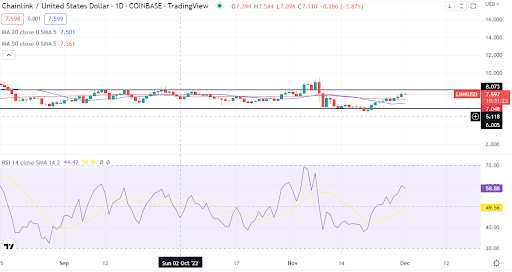
Chainlink recovery back to $8 ahead of staking launch

LINK/USD Chart by TradingView

LINK has initiated recovery along a short-term ascending trendline on the daily chart outlook. At $7.6, LINK trades slightly below a crucial resistance at $8.

LINK moved above the 20-day and 50-day MA. The area between $6 and $8 has seen flattening moving averages, indicating it is the zone where buyers and sellers match up. However, buyers are in control in the short term, as indicated by a recovery above the moving average. The RSI has also moved above the neutral zone, in line with the buyer’s strength.

Are further gains possible?

The resistance at $8 will remain crucial for LINK investors. A breakout would usher in further recoveries. The prospects of the upcoming staking feature on Chainlink will be crucial for a potential breakout.

On the flip side, the short-term rally may be cut short if bears take control of LINK price at $8. That would force a correction to the moving averages or $6 support.

Where to buy LINK

eToro

eToro is a global social investment brokerage company which offers over 75 cryptocurrencies to invest in. It offers crypto trading commission-free and users on the platform have the option to manually invest or socially invest. eToro even has a unique CopyTrader system which allows users to automatically copy the trades of popular investors.

Buy LINK with eToro today

OKX

OKX is a top cryptocurrency exchange which offers over 140 cryptocurrencies to invest in. OKX takes customer security very seriously, they store almost all of their clients‘ funds in cold storage, and the exchange is yet to be hacked. On top of this, the exchange offers very low fees and customers can even use their crypto as collateral for loans on the platform.

Buy LINK with OKX today

The post Here is the key update causing Chainlink to rally. Is a breakout imminent? appeared first on CoinJournal.

Ethereum vs. Ethereum Classic? Metacade (MCADE) Seems to Be the Better Crypto Investment

Ethereum and Ethereum Classic are two of the most well-known projects in the crypto space. But if you’re asking, “should I invest in Ethereum or Ethereum Classic?” then you might want to reconsider entirely. There’s a new project called Metacade that’s aiming to dominate one of the fastest-growing industries on the planet, and it’s looking very likely to be a much better crypto investment choice than ETH or ETC. 

This article is going to look at  why you might want to hold off on Ethereum and Ethereum Classic and why you should start thinking about investing in Metacade while it’s still in presale.

Ethereum (ETH) Falls After the Merge, Faces Stiff Competition

Despite Ethereum’s status as the second most valuable crypto token on the market, its latest price action has left investors disappointed after a recent downtrend. Following Ethereum’s run up to $2030 in mid-August, ETH has tumbled to settle around the $1300 mark. 

This was partly due to a case of “buy the rumour, sell the news” after the Ethereum merge took place on September 15th, which saw ETH fall over -26% in the following week. Less savvy investors assumed that transaction speeds and fees would suddenly improve overnight, but this hasn’t been the case, as warned by Ethereum’s developers. 

While the benefits of the Ethereum merge remaining to be seen by the average user and projects like Polygon and Solana already offering much lower fees and faster speeds, it’s looking increasingly likely that Ethereum will continue to bleed out to test the $1100 area.

ETH Classic (ETC) Lags Behind Its More Successful Sibling

Ethereum Classic is the original version of Ethereum, created after a section of the community elected not to change the core Ethereum code. One of the key differences between the two is that Ethereum Classic still uses the proof-of-work consensus mechanism, whereas Ethereum now uses proof-of-stake following the merge. 

Like Ethereum, Ethereum Classic can handle smart contracts, allowing it to run dApps. But while Ethereum boasts over 4,000 dApps, according to State of the dApps, Ethereum Classic is the foundation for just 45 dApps, as stated on the Ethereum Classic website.

Some don’t look at Ethereum Classic as a smart contract platform, but as a store of value, given its fixed supply. But when Bitcoin serves precisely the same purpose, it’s hard to find what value Ethereum Classic actually offers investors.

What is Metacade (MCADE)?

Metacade is a platform that’s aiming to be a one-stop solution for everything GameFi. It’s a place for gamers to connect, play the latest Play2Earn games, and boost their income doing what they love in a lively community setting.

To understand why Metacade could soon be your next best crypto investment, it’s important to  understand why you should consider investing in GameFi in the first place. 

GameFi gives players the chance to earn while they’re playing in a way that traditional gaming never could. 

The traditional gaming industry has shown it’s far more interested in shareholder profit than the gamers that actually play its games, leading to many titles now featuring tedious elements of Pay2Win and microtransactions that seem to take value from players without giving a whole lot back. 

For this reason, GameFi is expected to expand at 10x the rate of traditional gaming by 2025, according to Crypto.com. With Metacade positioning itself as the central hub for GameFi, its user base, and therefore the MCADE token, is likely to grow at an incredible rate as more players flock to join the gaming revolution. 

Why is Metacade (MCADE) a Better Crypto Investment?

Part of what makes Metacade so special is its community-centric vision. Metacade’s plan is to build a platform where you’ll find reviews, leaderboards, and writeups that enable anyone, regardless of background, to get started in Play2Earn gaming. Metacade will also be host to the hottest GameFi alpha that will break down exactly how you can maximise your income while playing Play2Earn games.

Those posting these reviews and best practices will be  rewarded with the MCADE token for their role in helping others get ahead. In fact, Metacade offers multiple ways to earn on its platform. There are regular prize draws and tournaments, as well as beta-testing opportunities to earn while using Metacade’s native testing environment. 

In 2024, Metacade will launch its job board, where you’ll be able to find work ranging from casual gigs to internships and salaried positions with companies leading the way in Web3 innovation. If you’re looking to start a lifelong career in GameFi, then Metacade could be your answer.

One of the most exciting features Metacade is adding is Metagrants. Metagrants are a way for gamers to take back some of the power from billion-dollar game studios by allowing them to directly fund the next Play2Earn titles they want to play. 

Game developers propose the games they would like to create to the Metacade community who vote on which games they would like to see built. These competitions will feature dozens of potential games – but with only one winner who will recieve the funding to support developing their game Down the line, Metacade plans to offer these community-backed titles in its virtual arcade for anyone to play.

Investing in Ethereum (ETH) or Ethereum Classic (ETC) vs. Metacade (MCADE)

With Ethereum facing stiff competition and a lack of demand for ETH after the merge, it’s unlikely to be the best crypto investment right now. Regarding Ethereum Classic, it’s hard to see a real use case outside of a purely speculative asset. Both tokens have their own merits, but their futures seem uncertain at this point.

Compare that to Metacade, a newly-launched project primed to be a leader in an industry that’ll grow rapidly over the next few years.  Its community-first approach to gaming and mulititude of earning opportunities  are likely to attract thousands, if not hundreds of thousands of users who are sick of the current state of the gaming industry. If Metacade can pull its vision off, it could soon become one of the best-performing tokens of 2023.

And there isn’t a better time to buy than right now. As Metacade is still only presale phase 1, you can pick up 125 MCADE tokens for $1. In the final stage of the presale, phase 8, you’ll only be able to buy 50 MCADE tokens for $1. If you’re looking to get in on the growth of the GameFi industry and Metacade as a leader in this industry, then there’s no time like the present.  

You can participate in the Metacade pre-sale here.

The post Ethereum vs. Ethereum Classic? Metacade (MCADE) Seems to Be the Better Crypto Investment appeared first on CoinJournal.

SubQuery announces support for the Flare Network

  • SubQuery has integrated with the Flare Network after receiving a grant from the Flare Ecosystem Support Programme.

  • Flare Network developers will benefit from the full SubQuery experience, including the open-source SDK and more.

  • Flare Network is accommodated by SubQuery’s managed service. 

SubQuery integrates with the Flare Network

SubQuery, announced on Thursday, December 1st, that it had extended its data indexing support to Flare Network, the blockchain that aims to connect everything.

In a press release shared with Coinjournal, SubQuery said the collaboration was possible thanks to the grant it received from the Flare Ecosystem Support Programme.

Flare is a blockchain that allows dApps to serve multiple chains through a single deployment. The blockchain supports EVM-based smart contracts and has data and interoperability infrastructure built natively into the blockchain, providing dApps with highly decentralised price feeds and secure state acquisition from other blockchains. 

While commenting on this latest cryptocurrency news, Hugo Philion, Flare Co-founder & CEO, said;

“We admire SubQuery’s decentralized data indexing solutions and are excited for them to launch on Flare mainnet. This will complete another important piece of Flare’s developer engagement strategy.”

SubQuery, meanwhile, provides decentralised data indexing infrastructure to developers building applications on multiple layer-1 blockchains, including the Cosmos ecosystem, Polkadot, Algorand and Avalanche.

Flare Network developers will benefit from SubQuery’s features

The platform allows developers to organise, store, and query on-chain data for their protocols and applications. SubQuery added that it eliminates the need for custom data processing servers, helping developers focus on product development and user experience.

Marta Adamczyk, Technology Evangelist at SubQuery, also commented that 

“We’re proud to be supporting teams building on Flare Network with our fast, flexible and universal indexing solution. We are excited to deliver another integration that enables Flare developers to index their data faster and easier, and build complex dApps with the help of SubQuery.”

According to SubQuery, Flare Network developers would benefit from its full experience. Developers would have access to SubQuery’s open-source SDK, tools, documentation, developer support, and other features.

Furthermore, Flare Network is accommodated by SubQuery’s managed service, which provides enterprise-level infrastructure hosting and handles over 400 million requests daily. 

Flare is a blockchain built to connect everything. It presents developers with a simple and coherent stack for decentralised interoperability, allowing developers to serve multiple communities and ecosystems simultaneously through a single deployment.

Meanwhile, SubQuery is a blockchain developer toolkit facilitating the construction of Web3 applications of the future. A SubQuery project is a complete API to organise and query data from Layer-1 chains. 

The post SubQuery announces support for the Flare Network appeared first on CoinJournal.