
An introduction to KYC: the most significant feature in the crypto world

The initial level of anti-money laundering (AML) reasonable care is called “know your customer,” or KYC for short. The Know Your Client (KYC) processes are initiated as soon as a new customer is accepted by a financial institution (FI). Financial institutions may determine a client’s potential for financial crime using these procedures. When doing business, cryptocurrency exchanges are required to have a “Know Your Customer” (KYC) procedure to:

  • Check the accuracy of the data they have about their clients and customers.

  • Get a better grasp on the nature of their prospective clients’ actions and make sure they’re above board.

  • Establish the likelihood that their clients pose a money laundering danger.

How do VASPs demonstrate KYC compliance?

Many VASPs use a multi-step “Know Your Customer” procedure to guard against scams. Here are the measures to take:

  • Step 1: Customers’ identifying information (such as their complete names, birthdates, and addresses) must be collected.

  • Step 2: Check the information you gave against your government-issued ID (visa, state driver’s license) and proof of address (electricity bill).

  • Step 3: Check the user’s data against government records that track politically exposed persons (PEPs) and blacklisted people.

By adhering to these protocols, banks can determine whether their customers are at risk for money laundering as well as other misappropriation of funds related to their usage of cryptocurrency. When a client’s identity and other details are verified, they are given access to a limited set of features on a bitcoin trading platform. 

How does one keep track of crypto trades? 

A cryptocurrency transfer monitoring network provides cryptocurrency marketplaces and financial institutions with assistance in spotting anomalous or questionable behavior that they are required to disclose to government regulators. Additionally, this technology assists law enforcement in their pursuit of criminals. The security of a cryptocurrency wallet may be tracked by keeping an eye on its transaction activity. Toolkits developed by firms like Bitsoft360, Crystal Blockchain, Coinfirm, etc. are used by cryptocurrency-related exchanges.

Is Know Your Customer (KYC) compliance essential for cryptocurrency wallets?

Since only custodial wallets have access to their users’ encryption keys, they are the only ones required to follow KYC procedures. The VASP document explains that the Financial Action Task Force (FATF) considers “every legitimate or natural entity who swaps, retains, safe-keeps, distributes, transforms, or somehow distributes VAs on account of some other physical or legal entity” to be a VASP. 

Since VASPs are now considered “monetary organizations,” they too must implement rigorous annual compliance requirements (FYC).   To comply with regulations, VASP-related custodial wallet providers must have a “Know Your Customer” (KYC) policy.

In what ways may cryptocurrency KYC help you?

Here are some of the reasons why cryptocurrency exchanges get a major advantage from operating in conformity with regulatory requirements, even though doing so necessitates certain alterations to their operational procedures and presents some challenges:

An increase in consumers’ faith in business

Trust in businesses and their products can only increase when their users’ identities are independently verified. Customers are more inclined to stick with a trading platform if they believe the firm is taking reasonable precautions to keep their funds secure.

Reduced instances of fraud and money laundering 

Nearly one billion dollars in cryptocurrency was reported stolen from over 46,000 customers between January and March 2022. As Fletcher predicted, identity verification procedures that are thorough and accurate could cut down on fraud and improve the market’s reputation.

Lessening potential legal trouble

Strong “Know Your Customer” (KYC) procedures can help organizations stay ahead of changing regulations. By demanding government-issued credentials and tracking payment situations and holdings, KYC approaches allow VASPs to detect and limit false identity cases, avoid financial fraud, and evaluate client risk. 

By taking these measures, companies may lessen their exposure to legal and governmental concerns, freeing up resources that can be used toward other goals, such as improving exchange rates, speeding up processes, and ensuring compliance.

Improved market conditions 

Speculative, anonymous transactions are a major driver of the bitcoin market’s instability. The industry as a whole benefits from the greater stability and value development enabled by KYC procedures with enhanced identity verification.

Is Know Your Customer (KYC) mandatory to purchase cryptocurrency? 

You may buy VAs without completing a “Know Your Customer” check. Examples of non-KYC services are cryptocurrency ATMs and DEXs. Unlike DEXs, which are decentralized, blockchain-based P2P exchanges that allow for large-scale crypto asset trading, crypto ATMs allow customers to acquire bitcoin using cash or debit cards. Instead of serving as financial intermediaries, DEXs rely on algorithmic automation to carry out these functions.

What dangers exist while purchasing cryptocurrency without KYC?

It’s quite risky from a regulatory perspective to purchase virtual currencies without first undergoing KYC. Financial authorities, including the Office of Foreign Assets Control (OFAC), have fined cryptocurrency exchanges for alleged sanctions violations. Black market accounts, which pose a risk to assets, may be flagged as false by a platform.

Lack of “Know Your Customer” in exchanges

Popular DEXs like Uniswap and Bisq does not require KYC procedures from their users. These marketplaces connect sellers and purchasers of digital money by matching orders according to price and quantity. In the world of cryptocurrencies, a “liquidity pool” is a collection of commodities that can be quickly and easily converted into cash to settle incoming buy and sell orders. Assets are provided not by banks or other institutions but rather by end users. 

How does “Know Your Customer” (KYC) connect to the ‘Crypto Travel Rule? 

When discussing cyber safety, “Know Your Customer” and the “Crypto Travel Rule” are both essential concepts to grasp. While the Travel Rule mandates that FIs and VASPs obtain and communicate opponent information, KYC gathers and transmits data about the persons and institutions that utilize the FI or VASP.

The distinction between “Know Your Customer” and the “Travel Rule” 

Before enabling a consumer to use their system, a VASP must do know-your-customer (KYC) checks to ensure that they comply with international rules. The Travel Rule goes even further by requiring that personally identifiable information of consumers be shared and stored when purchases between two VASPs that have already done KYC on their clients exceed a certain level.

How come Anti-Money Laundering and Know-Your-Customer measures are so vital to the cryptocurrency sector?

Customers and VASPs alike benefit from strict observance of AML and KYC rules. Virtual currencies, unlike fiat cash, lack a robust regulatory structure. 

Criminals are increasingly capitalizing on the ability to send money while concealing its origin and destination. The risks of money laundering, terrorism funding, and other forms of illegal financing may be reduced by standardizing regulatory standards and conducting Know Your Customer and Anti-Money Laundering inspections.

Final thoughts 

Cryptocurrency transactions are far more secure when KYC is used. To prevent fraudulent fraud and ensure the safety of financial transactions, Know Your Customer (KYC) measures are essential. Although this post does not provide insights on KYC implementation, it has given you enough details to make a wise plan.

The post An introduction to KYC: the most significant feature in the crypto world appeared first on CoinJournal.
SEC’s crypto-related penalties hit $2.6 billion in 2022

  • The SEC’s first crypto-related enforcement action was in July 2013.
  • The agency has brought 127 such actions since, with 30 of these in 2022 representing a 50% increase from 2021.
  • The monetary penalties across the settlements with the regulator reached $2.61 billion by the end of last year.

According to a recent report by Cornerstone Research, the US Securities and Exchange Commission (SEC) has overseen 127 crypto-related enforcement actions since 2013. 82 of the actions so far have been litigations and 45 of them administrative proceedings.

SEC crypto-related fines hit $2.6 billion by 2022

The US Securities and Exchange Commission (SEC) has recently come under heavy criticism after cryptocurrency exchange FTX collapsed. For the most part, many have questioned the regulatory watchdog’s tendency to swing into action after events that see the ordinary public suffer huge losses in the market.

And no doubt, the SEC swiftly charged former FTX CEO and founder Sam Bankman-Fried following his arrest. Also charged were Alameda’s Caroline Ellison and FTX’s Gary Wang. Just a few days ago, as we highlighted, the agency filed charges against crypto platforms Gemini and Genesis.

It’s a pattern that falls in line with what has been labelled as “regulation by enforcement.”

Indeed, even as the crypto market navigates the crypto winter, regulatory clarity remains a long way off. However, enforcement actions have increased rapidly since the SEC’s first such move in July 2013.

In 2022, the securities market watchdog filed 30 enforcement actions touching on 79 market participants, including the February charge against crypto lender BlockFi.

Per the Cornerstone Research report, the enforcement actions in 2022 were against 56 individuals representing 71% of the allegations and 23 were against firms (29% of the actions). The total enforcement actions over the past year was double the actions filed in 2021, the report noted.

In terms of monetary penalties, settlements with the agency hit $242 million in 2022 – with the total fines since 2013 amounting to $2.61 billion as of 31 December 2022. As CoinJournal reported in October, the SEC fines include the $1.3 million levelled against celebrity Kim Kardashian for her promotion of the crypto project EthereumMax.

The post SEC’s crypto-related penalties hit $2.6 billion in 2022 appeared first on CoinJournal.

Coinbase terminates Japan operations, why is share price still up 50% in two weeks?

Key Takeaways

  • Coinbase is halting all operations in Japan, citing “market conditions”
  • Last week it cut 20% of its workforce, having already cut 18% last June
  • Stock price is up nearly 50% on the year amid crypto rally, but is still 85% off its peak
  • Problems are aplenty at the company, while CEO Armstrong sold 2% of his stake in October


Coinbase has been in a world of pain recently.

Just last week, the exchange announced it was laying off 20% of its workforce, having already cut 18% last June. I wrote a piece analysing what this meant for the company, which was trading at a market cap below $10 billion, 90% down from the price at which it went public in April 2021.

This came after CEO Brian Armstrong unloaded 2% of his stake in the company in October, after which I wrote a deep dive analysing what it all meant for a company that has been viewed as the torch-bearer to carry crypto into mainstream circles once and for all following its high-profile floating on the Nasdaq.

But today, more bad news came. The exchange announced it is halting all operations in Japan, citing “market conditions”.

Coinbase stock price on the up

Despite the onslaught of bad news, Coinbase’s share price has been a big winner in the early weeks of 2023, up 48% in just 18 days.

This comes amid the biggest crypto rally in 9 months, which has seen prices surge across the board. While the bounceback in Coinbase’s share price is great news for investors, it also ironically sums up exactly what the problem is – Coinbase’s correlation to the crypto market.

There are few things more volatile than crypto, so it is not good news to be tied at the hip to its price action. But Coinbase’s performance is dependent on the crypto market because as the price falls, transaction volumes and interest in the industry, and by extension Coinbase, plummets.

During the pandemic, this was a great thing. The money printer was on maximum power, interest rates were low and retail investors were all aboard the FOMO train, armed with a healthy curiosity about crypto and a fat stimulus cheque.

But with the changing macro environment, the crypto industry has freefallen from $3 trillion to $800 billion, before this recent surge popped it back above $1 trillion.

Why are Japanese operations ceasing?

Despite the pleasant pump this past few weeks, zooming out tells you that Coinbase has shed 85% of its value since going public, gone through two rounds of layoffs, seen its CEO sell 2% of his stock in October and now is ceasing operations in Japan.

All Japanese Coinbase customers will have until February 16th to withdraw their holdings from the platform. If they fail to do so, the remaining assets will be converted to Japanese yen. Coinbase had worked hard during the previous crypto winter to expand into the Japanese market, so the abrupt departure is a shame.

But Coinbase is not the only exchange to make this move, with rival Kraken also announcing it was ceasing Japanese operations last month. Also like Coinbase, Kraken had cut a large chunk of its workforce, laying off 30% of employees after the FTX collapse shook the market. The plight of Coinbase’s extreme correlation with the crypto market is once facing exchanges across the industry.

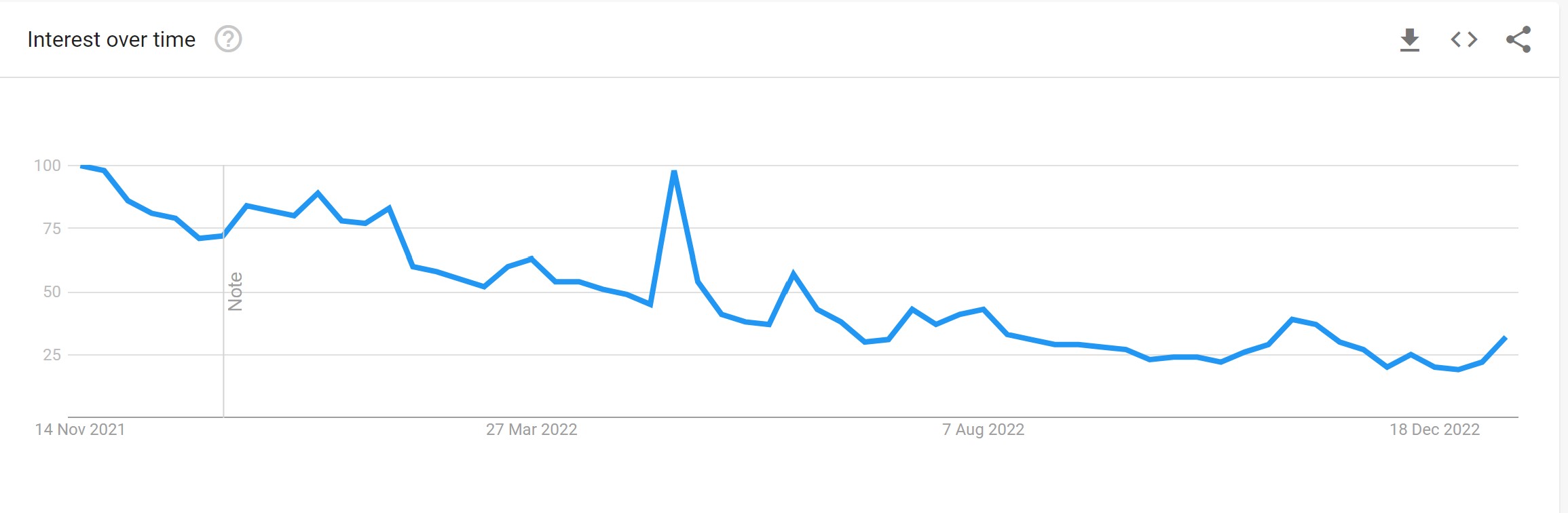
Coinbase Q3 results revealed that transaction volume fell 44% from Q2. The fall in volume and interest ultimately is what has caused the plummeting share price, layoffs, and now ceasing of Japanese operations, with a glance at Google Trends all you need to see the scale of the dropoff in the public’s attention to the exchange.

For $COIN investors, they will hope that the last few weeks of softer macro data and a crypto bounceback are an omen of things to come, otherwise this share price rally will be short-lived.
The post Coinbase terminates Japan operations, why is share price still up 50% in two weeks? appeared first on CoinJournal.

Shiba Inu price prediction ahead of Shibarium launch

  • Shiba Inu price went parabolic on Wednesday as it reached a high of November.

  • The developers wrote about the upcoming Shibarium launch.

Shiba Inu (SHIB/USD) price went parabolic as investors reacted to the latest developments on Shibarium launch. The SHIB token jumped by more than 20% in the past 24 hours. It has soared by over 57% from the lowest level in December 2022. Other top-performing cryptocurrencies are STEEM, LOKA, and HIVE. 

Shibarium launch ahead

Shiba Inu is a leading cryptocurrency that was started as a joke in 2021 during the crypto mania. It was created to be a better alternative to Dogecoin, which was having its best time as its price surged. But the two are different. Dogecoin is a coin that is similar to Bitcoin while Shiba Inu is an Ethereum token.

Shiba Inu price has done well in the past few days as investors wait for the upcoming Shibarium launch. Shibarum is a layer-2 network that will solve some of the existing challenges in the network. Some of these challenges are on speed, scalability, and costs.

Shibarium will join other popular layer-2 networks like Polygon, Arbitrum, and Optimism. After launch, it means that other developers will be able to build applications on top of it. In a statement, the developers said that Shibarium will mostly focus on gaming, the metaverse, and non-fungible tokens (NFT). Analysts believe that the Shibarium launch will be one of the biggest crypto news of the year.

In addition to Shiba Inu, other Shiba Inu tokens will also benefit. They include leash (LEASH) and bone (BONE). According to CoinMarketCap, the two have a combined market cap of more than $5 billion. Shibarium validators will need to lock up bone to run the Heimdall validator software.

The developers also noted that Shibarium will lead to more SHIB being burned since each transaction will lead to several tokens being burned. They added that:

“The development team is currently evaluating potential gas fee rates for the blockchain network. The network’s gas fees are expected to be lower than the current fees on the Ethereum mainnet.”

Shiba Inu price prediction

SHIB/USD chart by TradingView

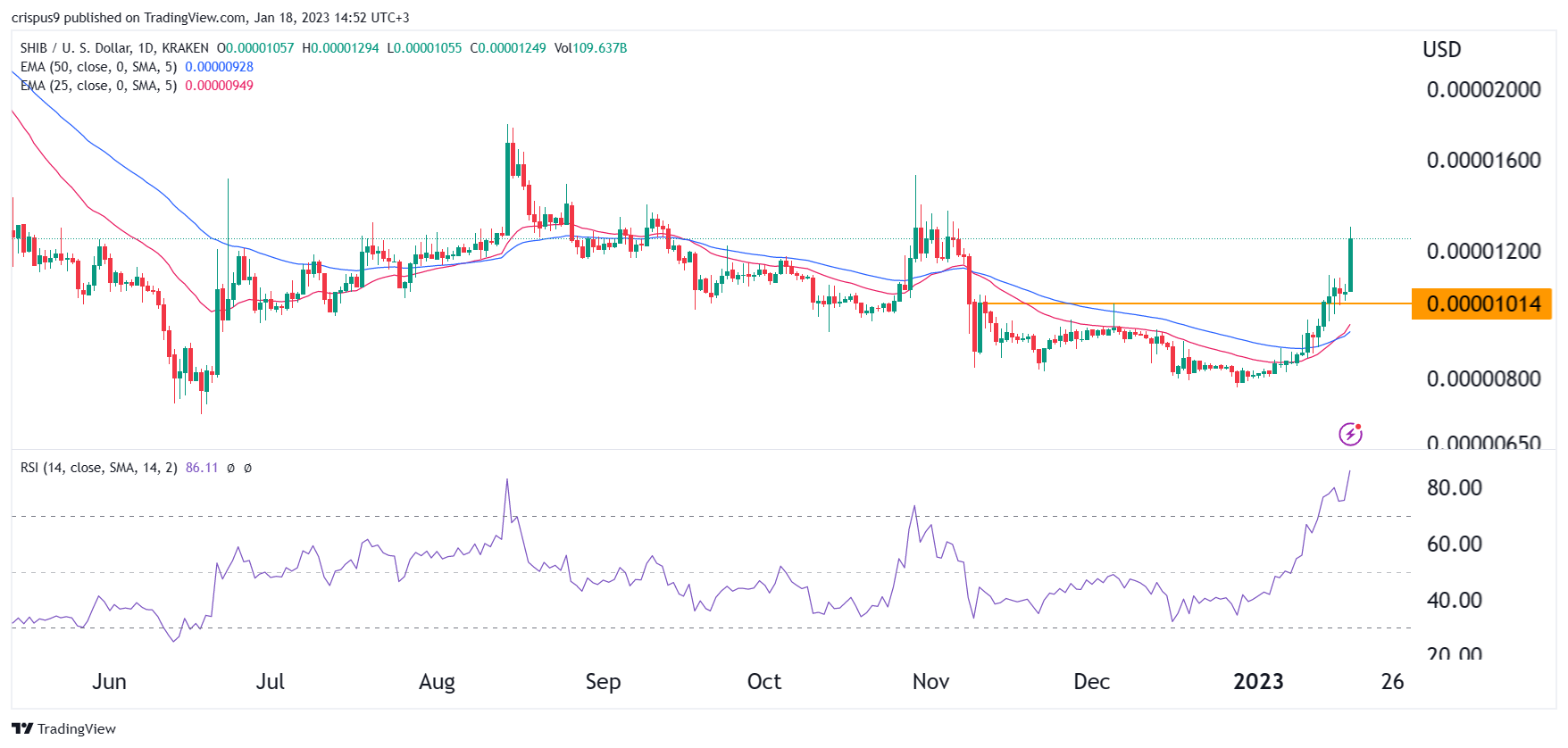
The daily chart shows that the SHIB price has been in a strong bullish trend in the past few days. It moved above the important resistance level at $0.000010, the highest point on December 6. The token has surged above the 25-day and 50-day moving averages while the Relative Strength Index (RSI) moved to the overbought level. Therefore, the SHIB crypto price will likely retreat slightly and then resume the bullish trend. If this happens, it will likely retest the key support level at $0.000010.

How to buy Shiba Inu

eToro

eToro is a global social investment brokerage company which offers over 75 cryptocurrencies to invest in. It offers crypto trading commission-free and users on the platform have the option to manually invest or socially invest. eToro even has a unique CopyTrader system which allows users to automatically copy the trades of popular investors.

Buy SHIB with eToro today

OKX

OKX is a top cryptocurrency exchange which offers over 140 cryptocurrencies to invest in. OKX takes customer security very seriously, they store almost all of their clients‘ funds in cold storage, and the exchange is yet to be hacked. On top of this, the exchange offers very low fees and customers can even use their crypto as collateral for loans on the platform.

Buy SHIB with OKX today

The post Shiba Inu price prediction ahead of Shibarium launch appeared first on CoinJournal.

Are meme coins back, as Shiba and Doge rocket upwards? Eh…no


Key Takeaways

  • 2023 has started hot in the crypto markets, with meme coins printing significant gains
  • Softer macro climate has fuelled gains
  • Shiba Inu has spiked 50% , with hype also around the launch of a Layer-2 ecosystem
  • Our Analyst warns investors that all may not be what it seems, however


It feels a little crazy to be writing this, but here we are anyway. 2023 is off to a flyer in the crypto markets, with optimism abounding that softer inflation data will lead to a loosening of monetary policy sooner than the market previously anticipated.

And one such “asset class” to benefit is that of memes. Doggy coins are printing returns that are straight out of Q1 of 2021, a time when Reddit was going to war with Wall Street over GameStop, Elon Musk was tweeting daily about fluffy dogs and, well, the money printer was firmly switched on.

The king and queen of the space, that is Dogecoin and Shiba Inu, are currently up 22% and 49% respectively this year.

Bonk the latest meme to join the party

Perhaps the curious case of Bonk sums up this bizarre resurgence best. The meme coin, inspired by Shiba Inu, was launched on Christmas Day on Solana. You know,  that same Solana which was firmly in the wars, suffering from its close ties with Sam Bankman-Fried, repeated outages shutting down the network and seeing several of its top projects flee for rival blockchains.

Objectively, launching on Solana – and in the depths of the bear market, no less – was an objectively strange decision. And yet, what is logic in the crypto meme market? The coin was up 2500% within ten days, exploding upwards past a $200 million market cap. It has since fallen back to Earth a little but is still trading at a $50 million market cap.

Why are memes doing so well?

But why are meme coins doing so well? Well, the first answer is that the entire crypto market is. When looking at even the biggest cryptos, they are all printing impressive returns. Memes don’t look so dizzying in comparison.

The surge is due to inflation data coming in below expectations. While figures are still extreme, and well north of the 2% target of the Fed, there are perceptible signs that it has peaked. Investors have taken this as a sign that the death sentence for risk assets, that is high interest rates, may peel off sooner as a result.

Shiba Inu, for its part, is surging off more than just positive macro factors. It has jumped 20% after news that it will be listed on Upbit, the most popular South Korean exchange. This comes amid hype around the upcoming and much-anticipated Shibarium Beta launch.

Shibarium Beta will be a layer-2 network built on top of Ethereum, the same way Polygon and Arbitum work.

Is this sustainable?

Personally, I can’t put too much weight into this (still mysterious) Layer-2 project from Shiba. Memes are exactly that – memes – and these were never a fundamental play. It would take a lot more than blind speculation about Sihbarium to convince me that Shiba will ever be used for anything other than trying to buy it with the hope of selling it on a greater price.

But that is the thing with memes. There has never been an argument here that there is any value. They’ve always been a sort of middle finger to prudent investing, a misbehaving younger sibling to the “responsibility” of actual investing.

However, this is all fun and games in a climate printing more cash than at any point in history. It’s all great when interest rates are zero and cheap capital is ubiquitous. And it’s amazing when a pandemic strikes the world, with millions of people locked down with nothing to spend their stimulus cheques on.

Unfortunately, that is not the world we live in any longer. I’ve said it before and I’ll say it again – the joke is over with memes. They no longer present as a chance to strike retirement gains. They were always a reckless gamble, and that is fine. But now they are no longer this novel source of endless entertainment, they’re just kind of sitting there as the world deals with the worst economy since crypto was launched when Bitcoin went live back in 2009.

Things may be more optimistic than they were a month or two ago. But inflation is still crippling, despite the fact it has slightly fallen. Rates are still high and there are a million variables that could make this volatile economy a lot worse in a very short space of time.

It’s hardly jaw-dropping to say, but be careful with the doggy tokens. When the music stops – and it always does – it’s not a fun place to be.  

The post Are meme coins back, as Shiba and Doge rocket upwards? Eh…no appeared first on CoinJournal.