Former FTX.US president raises $5 million seed round for new venture Architect

  • Former FTX president Brett Harrison has announced his new project has raised $5 million from investors.
  • Backers include Coinbase Ventures, Circle Ventures and SV Angel among others.
  • Architect is buildig new institutional-grade trading technology.

Brett Harrison, the former FTX.US president, has raised $5 million in a seed round funding for his new crypto project for institutional investors.

The new platform is a decentralised finance (DeFi) venture dubbed Architect and has been in stealth development since last September.

Architect raises $5 million in seed round

An announcement Harrison released on Friday stated that Architect had secured the $5 million investment from some of the top venture investors within the crypto space, including Coinbase Ventures and Circle Ventures. 

Other investors to back the former FTX.US president’s startup Architect are SALT Fund, Third King Venture Capital, Motivate Venture Capital and SV Angel. SkyBridge Capital’s Antony Scaramucci has also invested in the new crypto software project.

Architect is building trading software that aims at streamlining the crypto markets. According to Harrison, Architect will make it easier for large investors to enter and explore both centralised and decentralised crypto markets.  

“Architect will build institutional-grade trading technology that streamlines crypto market structure, making it easier and safer for firms and large traders to access decentralized protocols and centralized exchanges alike,” Harrison tweeted.

A report by Bloomberg noted that Architect plans to hire some of the talent that worked at FTX as they eye the launch of Architect within the next few months.

The post Former FTX.US president raises $5 million seed round for new venture Architect appeared first on CoinJournal.

Fun Over Profits: NFT Gaming Takes the Stage


Key takeaway

  • The Play to Earn model became the starting point in the NFT gaming development but created a sustainable concept – NFT games are not for fun. They are for making money only.

  • Players do not support P2E games since making money during the red market is more challenging, and these games cannot offer anything interesting. 

  • A new branch of industry is emerging that listens to users and develops games emphasising engagement and emotions. 

  • Combined with the best traditions of WEB 2.0 games, the use of NFT becomes the realisation of an exciting tool that allows players to immerse in addictive gameplay and unleash their creativity while engaging in the game.

NFT space continues to battle user attraction and retention

The NFT direction has kept the crypto industry in good shape for several years. It has evolved from funny cats into a global trend that responds to all market circumstances and user requirements.

We have all witnessed the birth of NFT gaming and its several cycles of hype. The most powerful impetus for the jump was the appearance of good Play to Earn model implementation, where enthusiasts could earn thousands of dollars by completing in-game tasks. Not surprisingly, this motivation attracted a lot of users and started a vast P2E craze, where projects claiming to develop a game received large trading volumes.

Their essence is approximately the same –  users need to buy in-game objects, resources, and various virtual items to start playing. The cost of these virtual items ranges from a few cents to hundreds of dollars, but you can buy them only with in-game currency. Then, users who have purchased the necessary characters and resources begin to compete with each other and complete tasks, receiving rewards in the form of in-game currency that can be converted into real money.

The idea of such games is excellent. It’s a win-win story for both game creators and players. However, the problem was that many of these games were not fun to play. Many of the early P2E games had rudimentary gameplay, basic graphics, and nothing more than rewards. The biggest challenge has always been user attraction and retention. And as soon as the crypto market bounced into the red zone in 2022, many P2P games focusing only on earning rewards began to lose users rapidly. When the game is not very fun, and players are kept only by receiving crypto rewards against a falling market, the attraction steadily goes to zero. 

Investors in 2023 are looking for more than clone NFT games

Thus, the current Play to Earn games are only a transitional stage, a link in the evolution of the entire gaming industry because it is impossible to exclude the NFT influence on the global gaming market. Already, unique NFT-based games are emerging that focus on gameplay and appeal to traditional players. They combine the best traditions of WEB 2.0 games and WEB 3.0 technological possibilities. 

Investors in 2023 are looking towards something other than clone NFT games with only promises and cute websites. Now everyone is thinking about the players, the gameplay, and how to keep users from getting bored, immersing them in a unique world that captivates them for a long time.

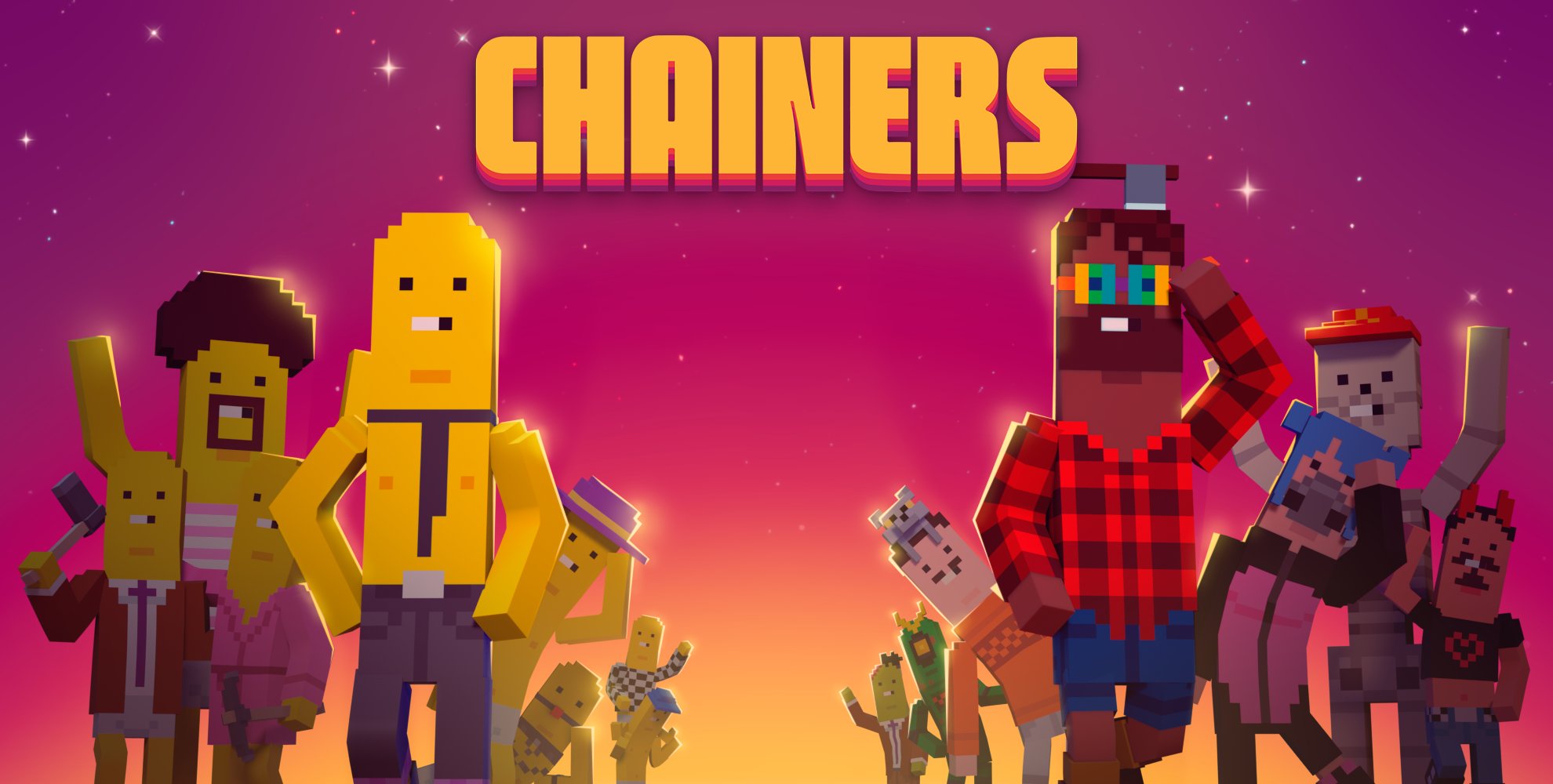
Using the example of the Chainers project, which is powered by Polygon, you can trace an improved model for creating NFT games. The team’s mission is to create a fascinating and addictive gameplay that will make Chainers stand out from other NFT games. Crypto game creators are interested in emotional connection with their players and develop strategies based on the users’ interests. In this context, NFT gives much more than just a few cents from some NFT elephant. 

Chainers is a crafting story based on the creative economy and a fancy design, which traditional players worldwide appreciate. Players don’t need to buy their first asset to explore their adventures. The free-to-start concept immediately removes the barriers and lets them into the unique world of NFT gaming, which includes full self-expression, rich design, the ability to play by your own rules and get tremendous pleasure from completing various tasks. The team is on track with their roadmap and has already implemented several features that scale the Chainers community. The developers’ task is to provide value to the players already at the first release stage and not to make them wait until the long process of developing the game is completed.

In addition to the free NFT avatar, the community is attracted by the daily NFT free giveaways that provide unique assets to upgrade the character. In the near future, players will also have an AR feature with which everyone can let out their Chainer into the real world. Of course, the NFT game will include a marketplace and its own tokens, but the main release is the Chainers MMO game. It is worth noting that Chainers already has a strong community of more than 60k members. It consists of creators, musicians, artists, and other NFT enthusiasts. They united by a joint mission – to create their new world, get unique skins for their characters, and unleash their creativity by participating in grandiose events with crypto prizes. 

Fun defeats the volatile nature of the crypto market and becomes a driver for the development of NFT gaming.  

The gaming industry has always been at the forefront of technological innovation, and NFT-enabled games are no exception. This direction is rapidly developing, growing, and changing people’s attitudes toward digital assets and creativity. The future of NFT is a world of colourful ideas. Although technology is constantly improving and is already very different from basic projects, this sector is becoming more significant.

The post Fun Over Profits: NFT Gaming Takes the Stage appeared first on CoinJournal.

SSV Network price forms 2 extremely bearish patterns

  • SSV Network is a fast-growing provider of liquid staking infrastructure.

  • The developers launched a $50 million ecosystem growth fund.

  • It has formed a rising broadening wedge and a bearish engulfing pattern.

Liquid staking is doing well as investors wait for the upcoming Ethereum’s Shanghai upgrade. Lido DAO, the biggest liquid staking provider, has grown to become the biggest DeFi provider in the world. And SSV, a leading liquid staking infrastructure provider, has seen its token grow by more than 91% this year.

SSV launches ecosystem fund

SSV Network announced that it was launching a new $50 million ecosystem fund in a bid to grow its ecosystem. For starters, SSV does not offer liquid staking itself. Instead, it partners with staking providers like Lido to offer a distributed validator technology (DLT) solution. By so doing, most developers can focus on what they do best.

SSV Network said that the fund will go to developers working on the DVT technology. It comes a year after the developers launched a $3 million fund. It has distributed some of those funds to companies like Ankr, Stader, and Moonstake. SSV also allocated $10 million in 2022 as we wrote here. In a statement, the co-lead of SSV network said:

”Distributing Ethereum’s security layer has never been more important. The protocol is currently secured by a small group of companies that, when put together, control the entire Blockchain. DVT’s aim is to distribute Ethereum’s security by offering quick and easy access to an open-source public good.”

The major catalyst for the SSV token price will be the upcoming Shanghai upgrade that will let Ethereum holders be able to withdraw their staked coins. Another catalyst for the token will be SSV’s mainnet launch which will happen in the next few months. Its testnet is already up and running. It has 763 operators and 5,307 validators with 168,824 ETH staked. At the current price, the amount is worth over $260 million.

SSV crypto price forecast

SSV chart by TradingView

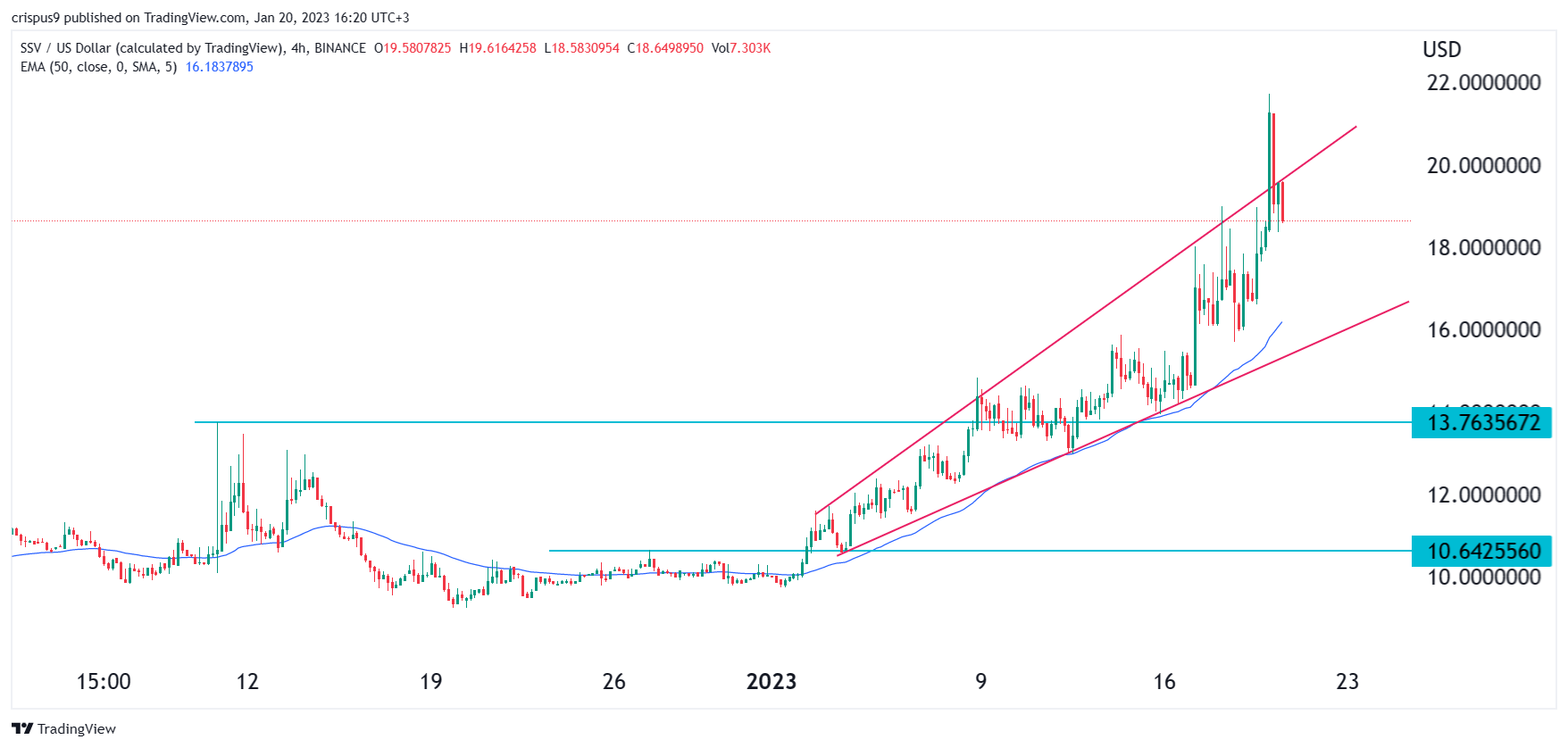
The 4H chart shows that the SSV Network price has been in a steady bullish trend in the past few months. However, a closer look shows that several bearish patterns have started forming. The token has formed a bearish engulfing pattern, which is usually a warning sign. Further, the token has formed an ascending broadening wedge pattern. In price action analysis, this pattern is also a bearish sign. 

Therefore, the outlook for SSV crypto price is bearish, with the next level to watch will be the lower side of the ascending wedge at $16. The trend invalidation point for this trade will be at this week’s high of $21.67.

How to buy SSV Network token

The post SSV Network price forms 2 extremely bearish patterns appeared first on CoinJournal.

Coin price predictions: FTX Token (FTT), NEXO, HOOK

  • Nexo price surged after the company settled with the SEC.

  • FTX’s new CEO said that the bankrupt exchange could restart.

Digital currencies had a mixed week as investors continued reflecting on the recent rally. They also reacted to important crypto news including the first interview by FTX’s new CEO on the future of the company. This article will provide the prediction of some of the top cryptocurrencies of the week.

FTX Token (FTT)

FTX Token price pared back some of its earlier losses after the current FTX CEO delivered his first interview with the WSJ. In it, he said that his team was working to reboot the collapsed company. He did not offer the timeline of when that will happen. Also, he did not answer the question about the shortfall the company has. 

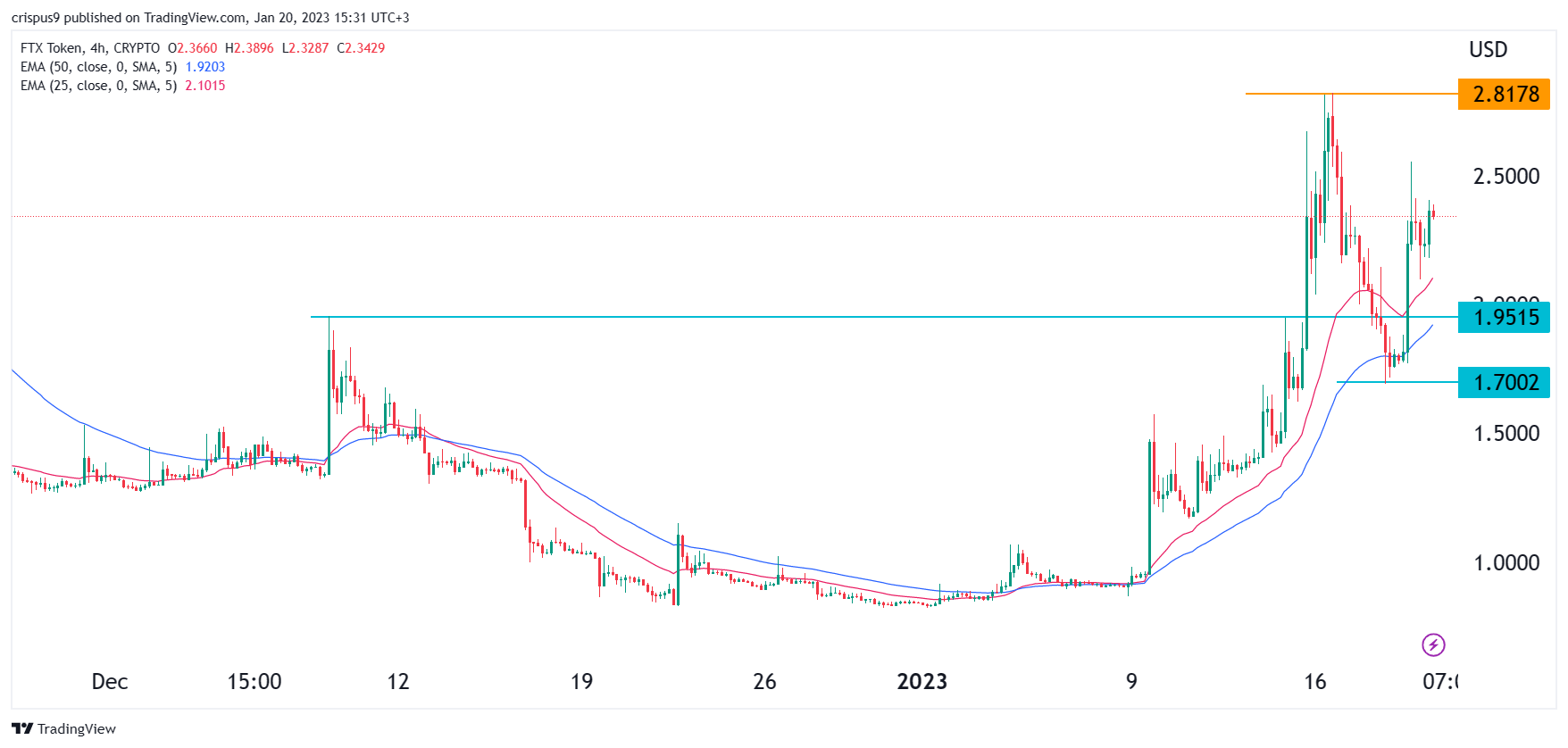
FTT price has been cruising recently after the company identified over $5 billion in liquid assets that it could sell to make customers whole. It has surged by over 181% from its lowest point in 2022, giving it a market cap of over $762 million. 

As the FTT price rose, it climbed above the important resistance level at $1.95, the highest point on December 9. It seems like it is forming a double-top pattern whose neckline is at $1.7 and the upper part is at $2.81. The price is being supported by the 50-day moving average. Therefore, the outlook for the FTT price is bullish, with the target being at $2.8, which is about 20% above the current level.

How to buy FTTX Token

Bitstamp

Bitstamp is a leading cryptocurrency exchange which offers trading in fiat currencies or popular cryptocurrencies. Bitstamp is a fully regulated company which offers users an intuitive interface, a high degree of security for your digital assets, excellent customer support and multiple withdrawal methods.

Buy FTT with Bitstamp today

Binance

Binance is one of the largest cryptocurrency exchanges in the world. It is better suited to more experienced investors and it offers a large number of cryptocurrencies to choose from, at over 600. Binance is also known for having low trading fees and a multiple of trading options that its users can benefit from, such as; peer-to-peer trading, margin trading and spot trading.

Buy FTT with Binance today

Nexo (NEXO)

Nexo has been a survivor during the ongoing crypto winter. While its peers like Genesis, Celsius, and BlockFi have filed for bankruptcy, the company has thrived. The Nexo token price jumped this week after the company settled with the SEC and states for failing to register its lending products. It paid $45 million and avoided admitting any crime.

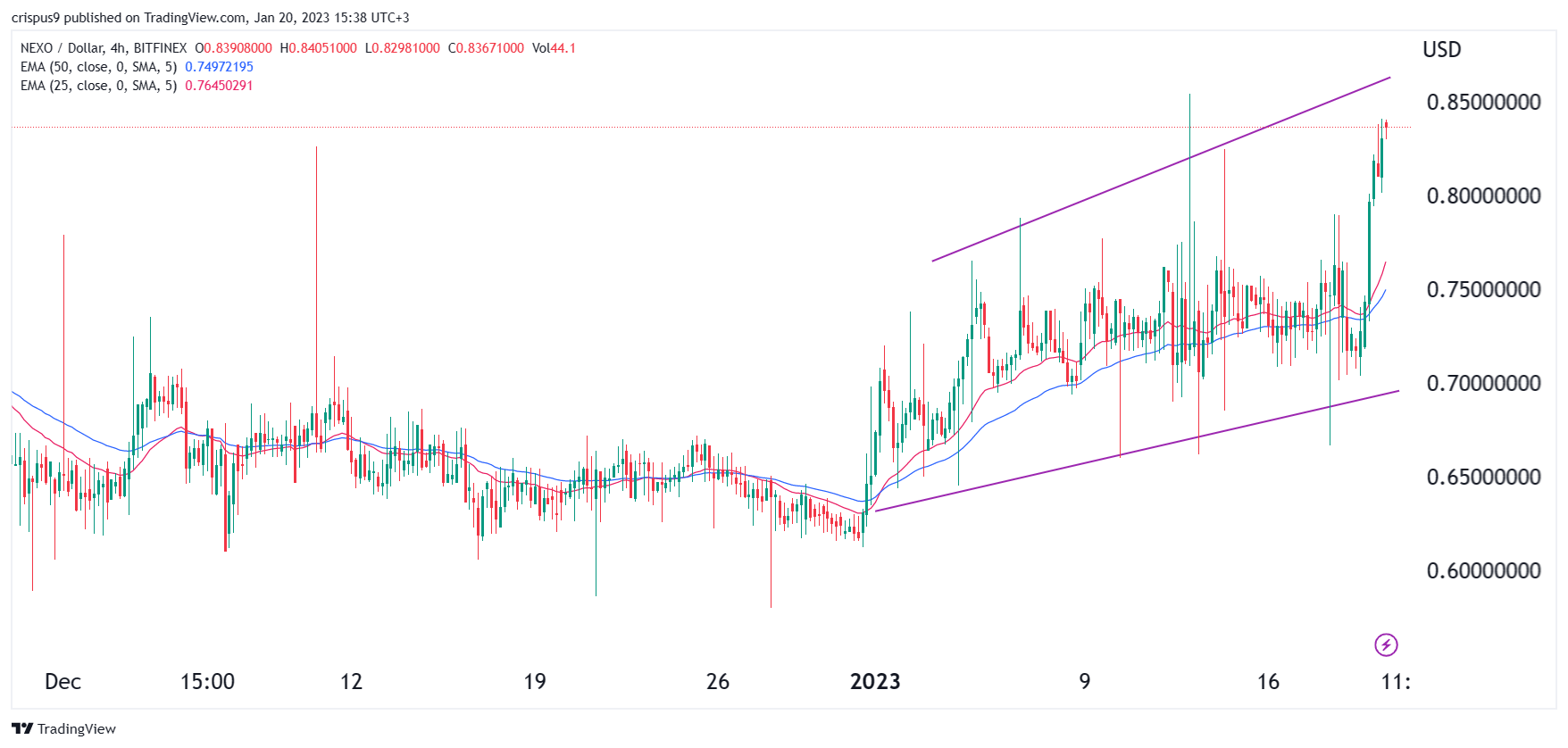
Nexo crypto price jumped to a high of $0.8363, the highest point since January 13. As it rose, the coin moved along the upper side of the Bollinger Bands and the 50-day moving average. It has formed an ascending channel and is nearing its upper side. Therefore, the NEXO token will likely resume the bearish trend during the weekend and retest the support at $0.75.

How to buy NEXO 

Bitfinex

Bitfinex is a bitcoin exchange platform that provides advanced services for digital currency traders and liquidity providers.

Buy NEXO with Bitfinex today

Coingate

CoinGate is a Lithuanian-based fintech company founded in 2014. The payment gateway offers cryptocurrency payment processing services for businesses of any sizes. Permission-based account management, fiat payouts to the bank account and brand new email billing feature are just a few reasons why CoinGate has become a go-to payment processor for many.

Buy NEXO with Coingate today

Hooked Protocol (HOOK)

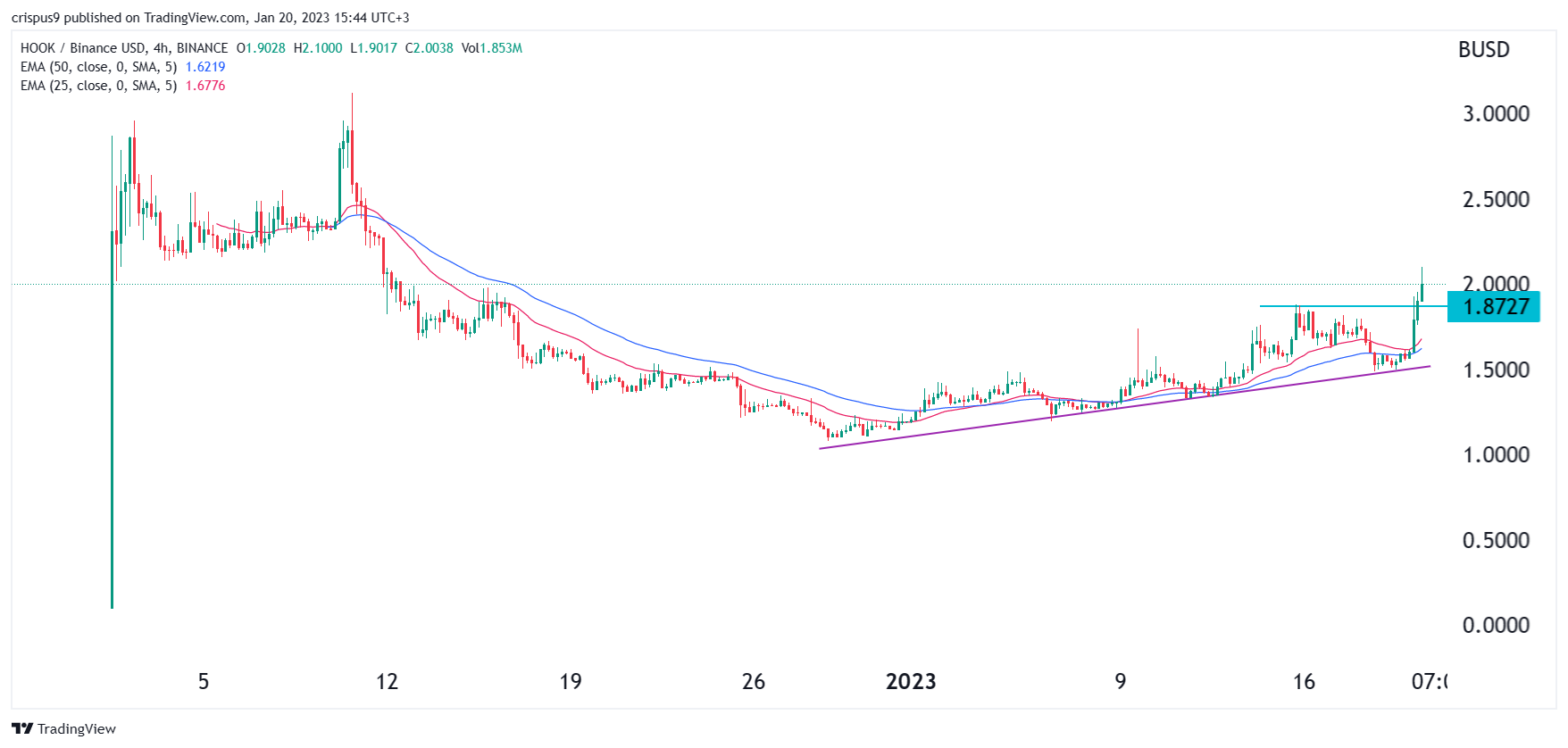
HOOK price surged to the highest point since December as gaming tokens surged. The token has moved above the key resistance point at $1.87, the highest level in January. It has continued moving above the 25-day moving average and the ascending trendline shown in purple. It seems like bulls are now in control, which will see the coin’s price surge to $2.5. This outlook is about 22% above the current level.

How to buy Hooked Protocol

The post Coin price predictions: FTX Token (FTT), NEXO, HOOK appeared first on CoinJournal.

Genesis files for bankruptcy, what does it mean for crypto?


Key Takeaways

  • Genesis has over $3 billion in debt and 100,000 creditors
  • Gemini, the exchange founded by the Winklevoss twins, has threatened legal action over an unpaid $900 million loan
  • The SEC has also filed a suit against Genesis for unregistered securities trading
  • Genesis’ parent company is DCG, the same company which runs the Grayscale Bitcoin Trust, the world’s biggest Bitcoin fund
  • Contagion continues to ripple through the industry, with investors hoping that the washout is nearly complete
  • DCG has stakes in over 200 crypto companies, including Circle, Kraken and the media company CoinDesk, which is now seeking a sale


In the move that precisely everybody saw coming, the lending arm of crypto platform Genesis has finally filed for bankruptcy.

It’s another victim on the list for Sam Bankman-Fried, as Genesis becomes the latest firm to succumb to the contagion triggered by the FTX collapse. But crypto investors are now concerned about the subsequent damage that could ripple out from this filing, as Genesis’ parent company is Digital Currency Group (DCG) – the same company which owns the Grayscale Bitcoin Trust, the biggest Bitcoin fund in the world.

Let’s analyse what it all means.

Enormous bankruptcy filing

Looking at bankruptcy documents, Genesis listed over 100,000 creditors. It reportedly has debt greater than $3 billion.

The filing had long been mooted. It suspended withdrawals on November 16th, in the aftermath of the stunning FTX collapse. However, it affirmed that it had “no plans” to file for bankruptcy and would seek to resolve the situation “consensually”.

It then scrambled to raise funds to stave off the inevitable. It reportedly sought investment from Binance, which declined due to a conflict of interests. It also approached several private equity firms but has ultimately filed for Chapter 11 bankruptcy protection.

What happens Gemini?

The filing comes in the same week that the SEC filed a suit against Genesis and its former partner, Gemini, over unregistered dealings with securities.

Gemini is a crypto exchange founded by the Winklevoss twins and offered a similar “Earn” product to a lot of these crypto lenders. The problem was, it was in partnership with Genesis. Under the terms of Earn, customers sent crypto to Gemini in the hopes of earning a yield. Gemini, in order to capture yield to pay to these customers, transferred the deposits to Genesis, who invested those deposits.

The Winklevoss twins say that Gemini owes it $900 million through the Earn product. Withdrawals from the Gemini Earn product are currently suspended.  

Cameron Winklevoss responded to news of the Genesis bankruptcy filing on Twitter, threatening legal action unless “a fair offer to creditors” was made by DCG and CEO Barry Silbert. He has accused Silbert of “fraud” and demanded he step down as CEO.

DCG in the thick of it

For the wider market, it is the involvement of DCG that is the real concern.

The digital assets company has a stake in over 200 crypto companies, including the crypto exchange Kraken and stablecoin issuer Circle. Most high-profile is the fact is the parent of the Grayscale Bitcoin Trust, which is the largest Bitcoin fund in the world. It has come under increasing scrutiny over the safety of its reserves following the FTX collapse and the turmoil facing DCG.

The fund has been trading at a steep discount to its net asset value, with the divergence spiking to 50% post-FTX. I wrote an analysis of the trend two weeks ago after it bounced back, at that point trading at a 37% discount.  The discount is currently 40%.

DCG also own CoinDesk, the crypto news publication. It is currently exploring a potential sale. Ironically, it was the news site that initially published the scoop on FTX, which triggered the hardship for DCG.

“Over the last few months, we have received numerous inbound indications of interest in CoinDesk”, CEO Kevin Worth said this week.

As for Silbert, the embattled CEO wrote on Twitter last week that “it has been challenging to have my integrity and good intentions questioned after spending a decade pouring everything into this company (DCG and the space with an unrelenting focus on doing things the right way”.

DCG responded to the chaos by cutting its dividend, telling shareholders it is focusing on strnegthening its own balance sheet. 

“In response to the current market environment, DCG has been focused on strengthening our balance sheet by reducing operating expenses and preserving liquidity. As such, we have made the decision to suspend DCG’s quarterly dividend distribution until further notice,” DCG announced on Tuesday. 

What does this mean for crypto?

As for the market at large, this is a continuation of the disaster that was the FTX collapse. Contagion was always inevitable, given an $8 billion hole on FTX’s balance sheet. In truth, it is somewhat surprising how well the crypto industry has held up through this.

Bitcoin is up 25% on the year, ETH is up 27%, with both trading at around the same level they were prior to the insolvency. The macro climate is looking a little more optimistic than a couple of months ago, as softer inflation readings have led investors to bet that central banks will pivot off their high interest policy sooner than previously anticipated.

Going back to the thick of the crisis, Bitcoin wobbled but held firm above $15,000.

Perhaps the biggest fallout here is the continued hammering of crypto’s reputation.  The pullback of institutional adoption will likely be severe, the mending process ahead long.

The world economy is teetering on the brink of a recession, as the burden of high interest rates continues to suck liquidity out of markets. In addition to this, inflation remains elevated with a cost-of-living crisis worldwide, despite the picture looking more positive over the last couple of months. Then there is the small matter of a war in Europe.

These are massive challenges for markets and suppressing prices across the board. Uncertainty is as high as it has been since the Great Financial Crash of 2008. And yet, in addition to these huge headwinds, crypto keeps hurting itself, adding to the mess.

Investors will hope that the washout from the scandals of 2022 will throw up no more surprises. With how dire the macro situation is, it doesn’t need any more self-inflicted wounds.

The post Genesis files for bankruptcy, what does it mean for crypto? appeared first on CoinJournal.