Bitcoin miners lament falling fees, but debt ceiling negotiations cut 30% tax


Key Takeaways

  • A proposed 30% tax on crypto mining appears to have been cut as part of US debt ceiling negotiations 
  • Decision a win for crypto miners, who are struggling amid rising hash rate and increased electricity costs 
  • Miners also held onto Bitcoin reserves through pandemic bull market, a mistake which proved fateful

When you break down the Bitcoin mining business into simple terms, like any business, you get revenue and costs. Revenue comes in the form of Bitcoin, earned via the block subsidy reward and transaction fees. Costs, on the other hand, are mainly derived from electricity. 

Firstly, revenue: in the last couple of years, the Bitcoin price has fallen precipitously, thus hitting miners where it hurts. While 2023 has seen a bounceback, with Bitcoin currently trading up 68% on the year at $28,000, the asset remains 60% off its peak in late 2021. 

This spike in revenue also led a lot of miners to increase their investments across the space, scaling up their operations and adding new equipment. With the surge in demand, hardware prices spiked. Since then, demand has fallen off in line with the Bitcoin price, meaning not only is the revenue down, but many miners are in the red on their hardware investments. This is particularly painful for mining companies who levered up through increased debt in order to make these investments, getting hit twice as hard as interest rates have also been hiked. 

The other side of the equation has also gone against miners: cost. Russia invading Ukraine triggered an energy crisis, while inflation is rampant globally, even if it has come down since the peak last year. This has sent miners’ biggest expense, electricity, vertical – at the same time that the price of Bitcoin has fallen. 

Exacerbating this effect is the increase in hash power, which refers to the computing power on the Bitcoin network. This increases as more miners join the network, meaning there is greater competition and greater dollar outlay required of miners to fight for revenue. The hash rate is currently at all-time highs, putting a further squeeze on miners. 

The below chart shows how miners’s reserves jumped significantly during the bull market in USD terms, yet in BTC terms, not much was sold. In other words, miners were betting on Bitcoin continuing to rise – a fateful mistake given their ongoing revenue was already so tightly tied to the volatile asset. 

Ordinals protocol sees Bitcoin fees jump

Things picked up for miners this month when the emergence of the Ordinals protocol put Bitcoin block space at a premium, with Bitcoin fees jumping up as a result. The increased activity as a result of BRC-20 tokens launched within the Ordinals protocol, as discussed last week, was a welcome result for miners. 

Since then, however, fees have fallen back down. 

It wasn’t all bad news for miners, however. While fees were falling back down the earth, debt ceiling negotiations were ongoing in the US – and miners have been an unexpected benefactor. The US debt ceiling is an arbitrary number which limits US borrowing. If the ceiling is not raised, a default could be on the cards. In order to raise it, Democrats and Republicans must strike a deal, which means give and take on both sides. In other words, it has become a political game. As part of the continued negotiations, it appears that the proposed 30% tax on mining will be dropped. 

“One of the victories is blocking proposed taxes”, Republican Representative Warren Davidson tweeted in response to a question over whether the mining tax would be chopped. 

Earlier this month, the US administration proposed a tax on electricity used by crypto miners called the Digital Assets Mining Energy (DAME) excise act. A 10% tax on miners’ electricity usage would be introduced next year, slated to step up to 30% by 2026. The move came amid mainstream concern around the prohibitive energy use of mining and its impact on the environment.

It also came as the US continues to clamp down on the crypto industry as a whole, with an aggressive line taken by lawmakers since the start of 2023. High profile cases since the start of the year include Coinbase getting served with a Wells notice, the Binance-branded BUSD stablecoin being shut down, and Binance getting charged by the CFTC for a raft of allegations, including a failure to implement money laundering and anti-terrorist financing laws. 

Thus, the removal of the mining tax represents a small win for crypto amid what has been a raging storm, both within regulation and elsewhere. However, the road ahead remains perilous for miners. Bitcoin prices are still 60% off their highs, fees have normalised and hash power is at an all-time high.

The post Bitcoin miners lament falling fees, but debt ceiling negotiations cut 30% tax appeared first on CoinJournal.
Optimism price prediction ahead of the token unlock

Optimism, the fast-growing layer-2 network, is bracing for a major event that could hit its price. The developers will carry out a token unlock event that will release tokens worth millions of dollars to the market.

According to TokenUnlocks, the total number of OP tokens in circulation stands at over 335 million tokens. With the OP price trading at $1.53, this gives it a total market cap of over $515 million.

The developers will next release more tokens that are about 9% of the total supply to the market. These tokens will be unlocked to core contributors and investors.

Data shows that over 1.5 billion OP tokens are still locked and the unlocking event will happen for two mpre years. The last token unlock will happen in 2027.

Token unlocks are usually seen as bearish for cryptocurrencies since they increase their volume in circulation and dilute existing investors. Earlier this year, we saw dYdX postpone its token unlock event fearing more weakness in the token.

Optimism is a layer-2 network that seeks to optimise the performance of Ethereum transactions. It has a total value locked (TVL) of more than $907 million, making it the 6th biggest chain in the world after Ethereum, Tron, BNB Chain, Arbitrum, and Polygon.

Optimism powers some of the best-known platforms in the industry like Uniswap, AAVE, Curve, and Synthetix among others. It will also power Worldcoin, the upcoming cryptocurrency that was create by the founder of OpenAI. Also, Coinbase is using its technology to launch Base. 

In anticipation of the token unlock, Optimism OP price plunged to $1.53, the lowest point since January 23rd.

How to buy Optimism

The post Optimism price prediction ahead of the token unlock appeared first on CoinJournal.

XRP/USD regains the $0.5 level as the greenback is sold

  • The US dollar trades with a bearish tone following the debt ceiling agreement
  • Ripple gained more than 8% in one week
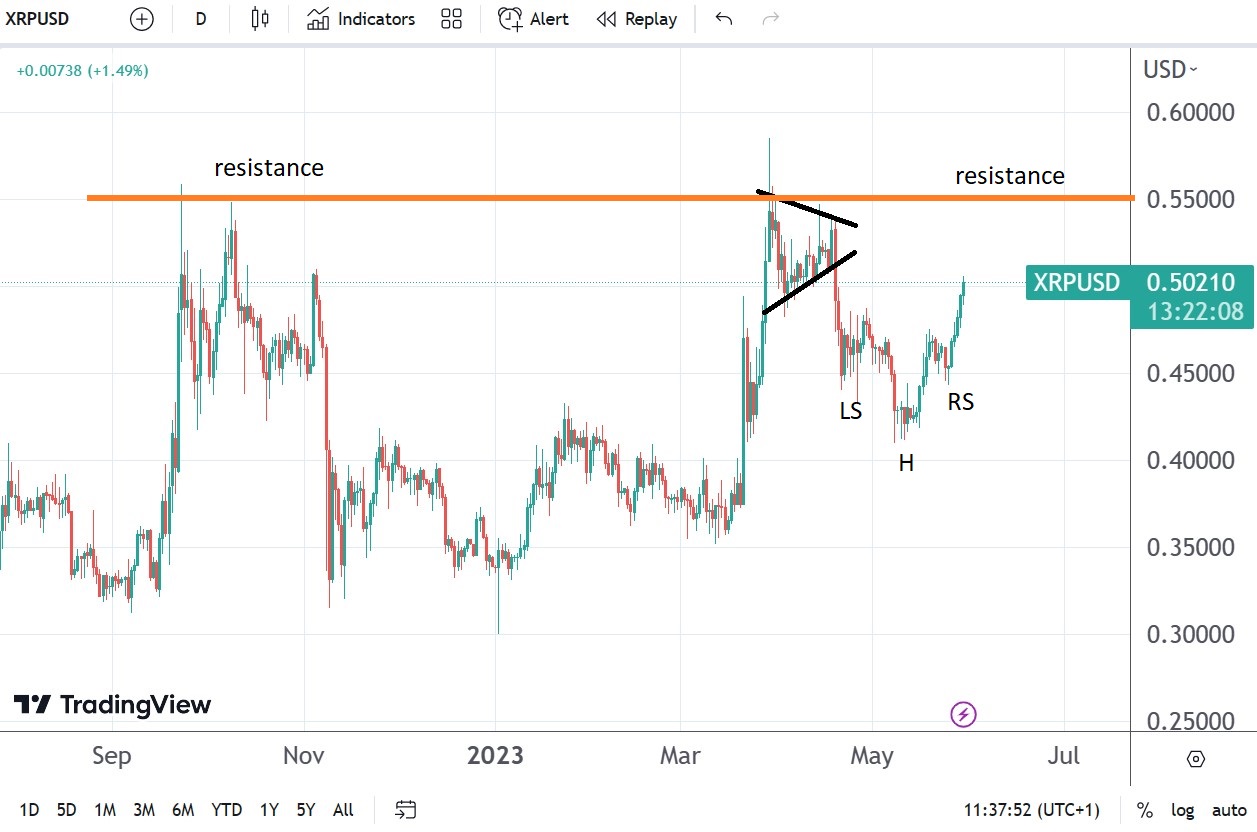
  • The technical picture looks bullish as the $0.55 resistance level looms large

The dollar is under pressure after the over-the-weekend announcement that a debt ceiling agreement has been reached. The decline is visible not only in the traditional financial markets, but also in the cryptocurrency one. 

Ripple, in particular, trades with a bid tone. It gained over 8% in one week and recovered the $0.5 level. 

With only one full trading day left in the month, can Ripple gain some more? 

Ripple chart by TradingView

However, this time might be different. 

An inverse head and shoulders pattern is a bullish reversal pattern formed just before the current market rally. It is not unusual for the market to make a new higher high after such a pattern appears, and so, a break above the resistance level should not surprise anyone. 

That is particularly possible if the economic data out of the United States disappoints. On Friday, the NFP report is key for interpreting what the Federal Reserve will do next with the interest rate level. A weakening job market might put the Fed on pause and thus trigger another leg lower for the US dollar. 

The post XRP/USD regains the $0.5 level as the greenback is sold appeared first on CoinJournal.

MicroStrategy is better than Coinbase for crypto exposure: Berenberg

  • Berenberg analysts sees upside in MicroStrategy to $340.
  • They explain their bullish view in a recent research note.
  • Coinbase stock has a “hold” rating only at Berenberg.

MicroStrategy Inc is a better pick for exposure to cryptocurrencies than Coinbase Global Inc, as per the Berenberg analysts.

MicroStrategy stock has upside to $340

Mark Palmer and Hassan Saleem see upside in the technology company to $340 a share – up another 20% from here. In a recent research note, they said:

MicroStrategy which features a unique business model focused on the acquisition and holding of bitcoins, represents an attractive alternative to Coinbase in the current environment.

At writing, the Nasdaq-listed firm owns about 140,000 BTC in total. Earlier in May, MicroStrategy said it took an impairment charge of $170 million on its bitcoin holdings in the first quarter.

Its stock price has already nearly doubled since the start of the year.

Why is Berenberg dovish on Coinbase stock?

On Coinbase, Berenberg analysts have a “hold” rating with a price objective of $55 a share – roughly in line with where it’s currently trading.

They’re dovish primarily due to the ongoing regulatory scrutiny. In March, the crypto exchange received a “Wells Notice” from the U.S. Securities and Exchange Commission (SEC).

Coinbase’s revenue is at risk in the event of an enforcement action are disproportionately profitable relative to its total revenue.

In comparison, MicroStrategy focuses on bitcoin that’s already been classified as a commodity and not a security thereby insulating it from such risks. The correlation between MSTR and COIN currently stands at about 0.96.

The post MicroStrategy is better than Coinbase for crypto exposure: Berenberg appeared first on CoinJournal.

DOT/USD technical analysis – will the bottom hold?

  • Polkadot hodlers are underwater
  • A bullish scenario remains valid if the lows hold
  • A move above $7 should lead to more gains

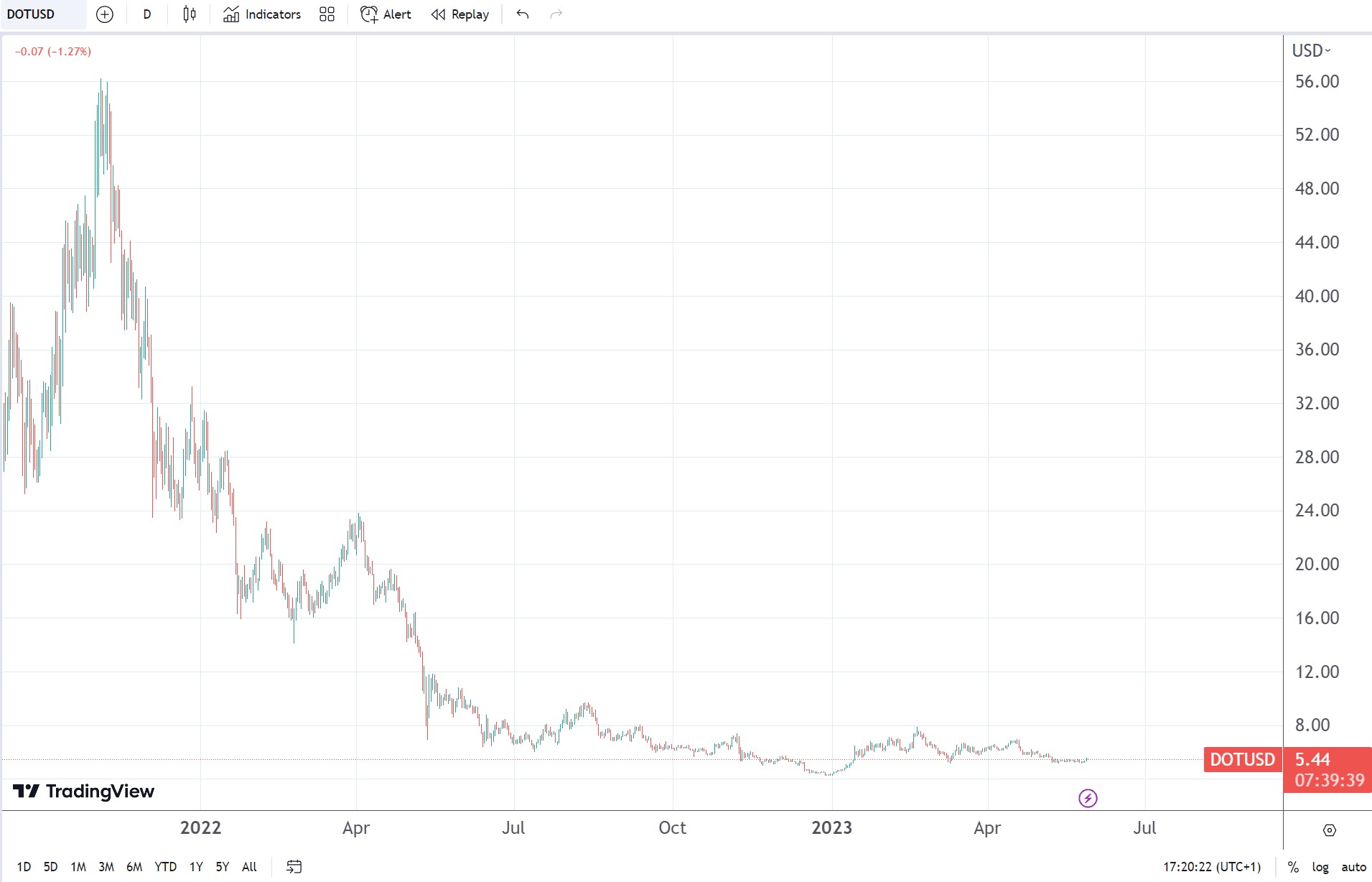
It has been a tough period for long-term holders of Polkadot. The DOT/USD exchange rate has moved South relentlessly after peaking at $56 in late 2021.

From $56 to $5, it was a straight decline. It took only one year for Polkadot to frustrate bulls.

And even now, as cryptocurrencies have rallied in 2023, one should be scared looking at the daily chart. After all, the bounce from the lows looks so small when interpreting the bigger picture that it is difficult to find a bullish argument.

Polkadot chart by TradingView

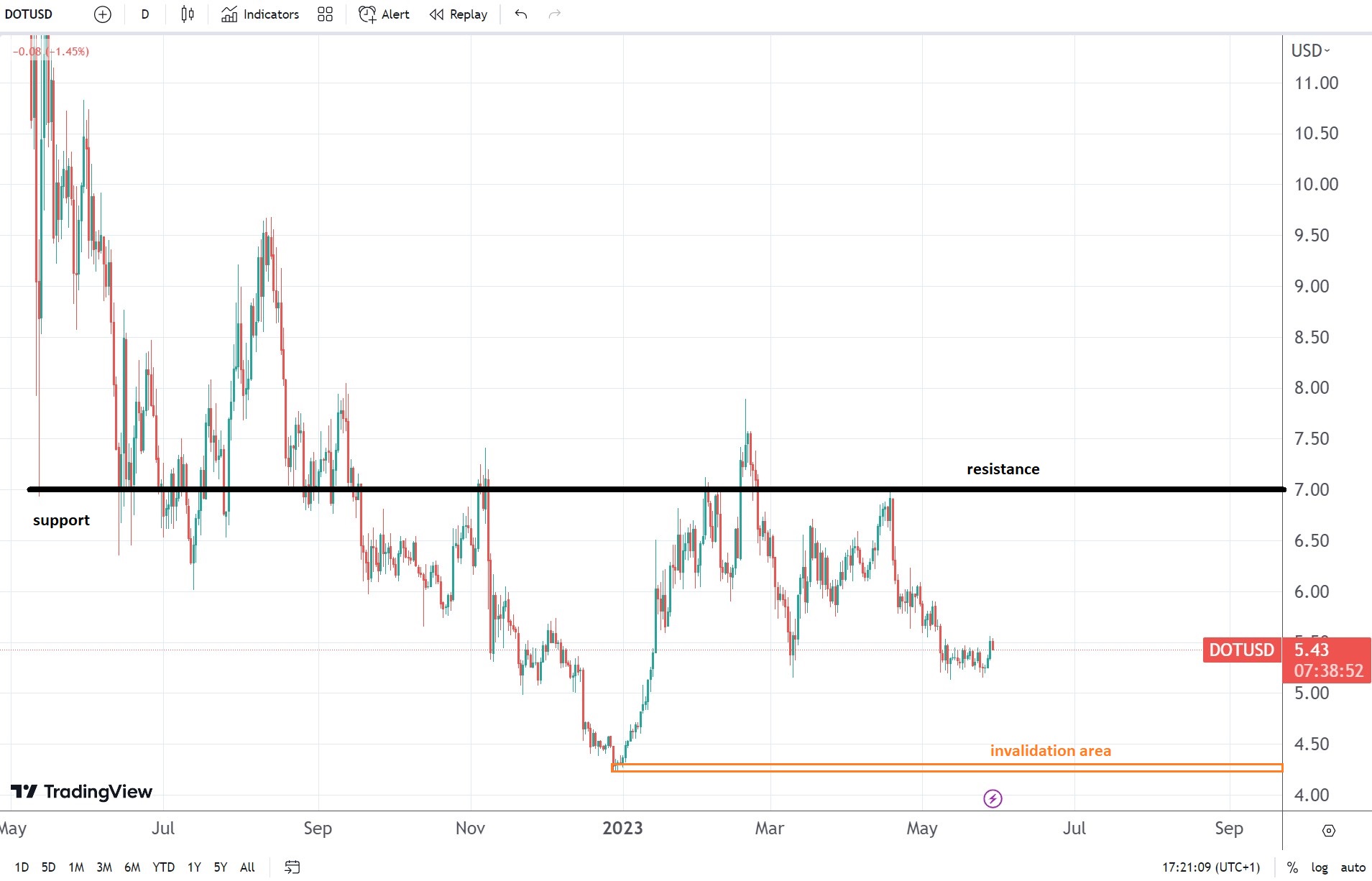
Polkadot should overcome $7 resistance area for bulls to be in control

Zooming in, one may see the 2023 rally that brought back optimism in the cryptocurrency market. Sure enough, Polkadot already gave back more than half of its YTD gains.

But the invalidation level for a bullish scenario still holds. Effectively, it means that the recent price action might be nothing but a correction part of a bigger-degree bullish trend.

Polkadot chart by TradingView

The Elliott Waves theory states that an impulsive move (i.e., the one that began at the start of the year) is followed by a corrective structure, an a-b-c.

This a-b-c that corrects a bullish trend should have two waves moving in the opposite direction (i.e., waves a and c), and one that moves in the main trend’s direction.

It means that one may easily say that the move from the 2022 lows is an impulsive structure, and the decline from the 2023 highs is the a-b-c. In this case, the implications are bullish for Polkadot and bearish for the US dollar.

However, only a move above the pivotal $7 level would cement the bullish Elliott Waves scenario. Until then, bulls might wish for the price action to hold above the invalidation area shown on the chart above.

The post DOT/USD technical analysis – will the bottom hold? appeared first on CoinJournal.