Cryptocurrencies face more slump, but Shiba Memu shines on presale

  • Shiba Memu presale has raised over $2.2 million

  • Increasing risk-off sentiment is hurting the rest of the sector

  • Shiba Memu could return by up to 1,000%

The past week has been a bloody period for cryptocurrencies. A more than 10% loss takes Bitcoin to slightly above $26,000, while Ethereum is back to below $1,700. The losses reflect an increasing risk-off mood, with the US dollar gaining strengths. But does that mean investors are giving up on the sector? Shiba Memu (SHMU), an upcoming meme cryptocurrency, has witnessed high demand. With over $2.2 million raised, the presale illustrates interest in high-potential crypto projects.

Risk-off sentiment and what it means for crypto

Appetite for high-risk appetite has cooled off lately, thanks to sector concerns and macro developments. Sector risks have been underlined by falling Bitcoin volume on exchanges. This follows reports that Elon Musk’s SpaceX has sold its Bitcoin holdings.

Meanwhile, the US dollar, which has an inverse relationship with Bitcoin, has been gaining. The most notable contributor is expectations that the Fed will hold its hawkish monetary policy. Ahead of this week’s annual Jackson Hole meeting, analysts have been sounding higher rates.

The expectations of hawkish policy reflect elevated inflation rates. Although the July consumer price index eased to 3.2%, it remains outside the band Fed considers appropriate. The US central bank has a 2% inflation target, with July readings above it. As such, the projection of a hawkish stance has spooked crypto markets ahead of the meeting. 

Shiba Memu defies the risk-off mood

Shiba Memu is a new crypto project that aims to be self-sustainable in the meme space. This has attracted demand as the native token, SHMU, carries a use case that outwits its meme peers. In particular, investors may be attracted to Shiba Memu’s AI angle. The project utilises AI capabilities such as machine learning and predictive analytics to self-market itself. 

Shiba Memu can also engage with its users through an AI-led application. A robotistic dashboard lets users ask the robot questions, give feedback, and provide suggestions. The use cases are expected to make Shiba Memu a unique user-led platform. In the future, there is no limit on what Shiba Memu can achieve with its AI application.

As investors shun risky holdings like Bitcoin, they could shift attention to Shiba Memu. A project of its nature is yet to unlock value, explaining the high demand. SHMU doesn’t rank on the same risk profile as the greenback. However, it gives investors an excellent alternative to mainstream assets. This could explain the fast-selling presale.

Shiba Memu carries a meme vibe

Whenever meme cryptocurrencies are mentioned, eyebrows are raised. They are assets that have shown huge promise to deliver up to 10 times due on pure online chatter. Shiba Memu is a meme cryptocurrency and reawakens similar thoughts. Investors expect huge gains once the value of this token is unlocked after listing on exchanges.

The meme vibe is also brought out in Shiba Memu’s price dynamics. The price of the cryptocurrency increases every day at 6 PM GMT.

For example, the price of the token is $0.022150. That compares to a price of $0.011125 when the presale was launched. The presale ends after eight weeks at a SHMU price of $0.0244. It means investors that bought the token at the initial stage will see the value of their holding double. The trend gives investors a meme vibe as these tokens are known to be always on the move.

Should you invest in Shiba Memu now?

Obviously, Shiba Memu’s presale is near its conclusion. Investors that missed a chance to buy at the initial stages can still do so now as the price is low. The value of SHMU could increase exponentially after listing. It means investing now allows investors to benefit from potential price increases.

Predictably, Shiba Memu could return up to 1,000% once listed. Highly subscribed projects have risen by more than the prediction. This gives Shiba Memu a realistic chance to rise by similar margins.

The post Cryptocurrencies face more slump, but Shiba Memu shines on presale appeared first on CoinJournal.
Long-term holders weather brief volatility surge


Key Takeaways

  • Long-term holders now hold 75% of the total circulating supply of Bitcoin
  • The cohort has been growing steadily over the last eighteen months
  • Enthusiasts hope the growth in the number of coins hoarded by long-term holders will cause a supply shortage and squeeze the price upward in the long-term

The last eighteen months have been challenging for Bitcoin investors. While the asset has bounced back strongly thus far in 2023, it remains over 60% off its all-time high set in November 2021. 

The scale of the damage in 2022 can be seen when glancing at a price chart, portraying the extent of the fall. 

The asset careened downwards as the Federal Reserve transitioned to a tight monetary policy approach in response to spiralling inflation. From years of low interest rates, hikes came thick and fast as policymakers scrambled to get a lid on an overheating economy. 

With Bitcoin residing so far out on the risk curve, capital fled the asset amid the great tightening of global liquidity. However, while price charts don’t make pretty reading, there has been one notable bright spot when looking at on-chain data. 

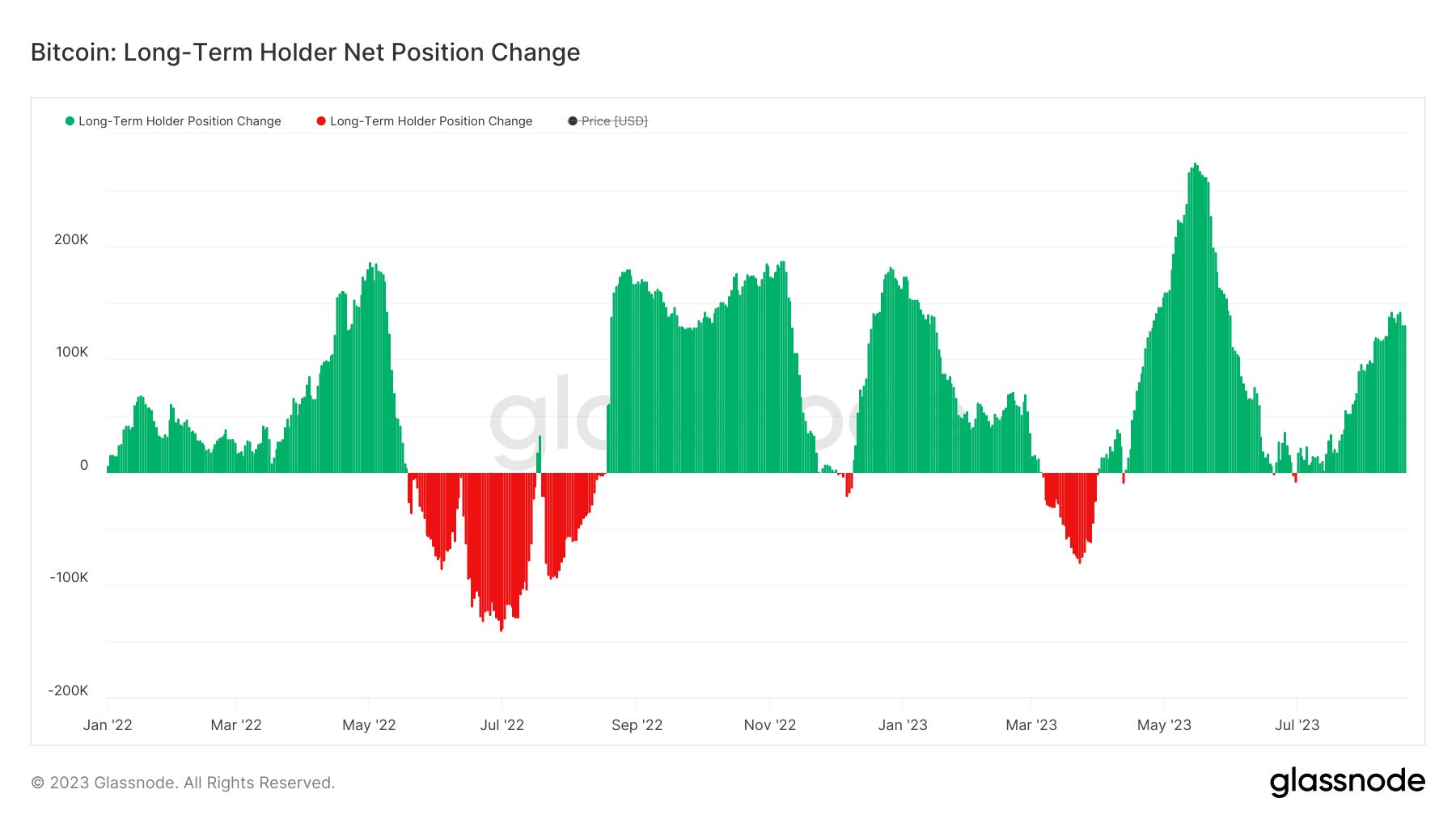
That is the proportion of long-term holders, which has shown impressive growth throughout the turbulence. As the next chart from Glassnode shows, the cohort has grown since the start of 2022 aside from three periods (with one of those extremely short).

(As a note, Glassnode defines long and short-term holders via a logistic function centered at an age of 155 days and a transition width of 10 days). 
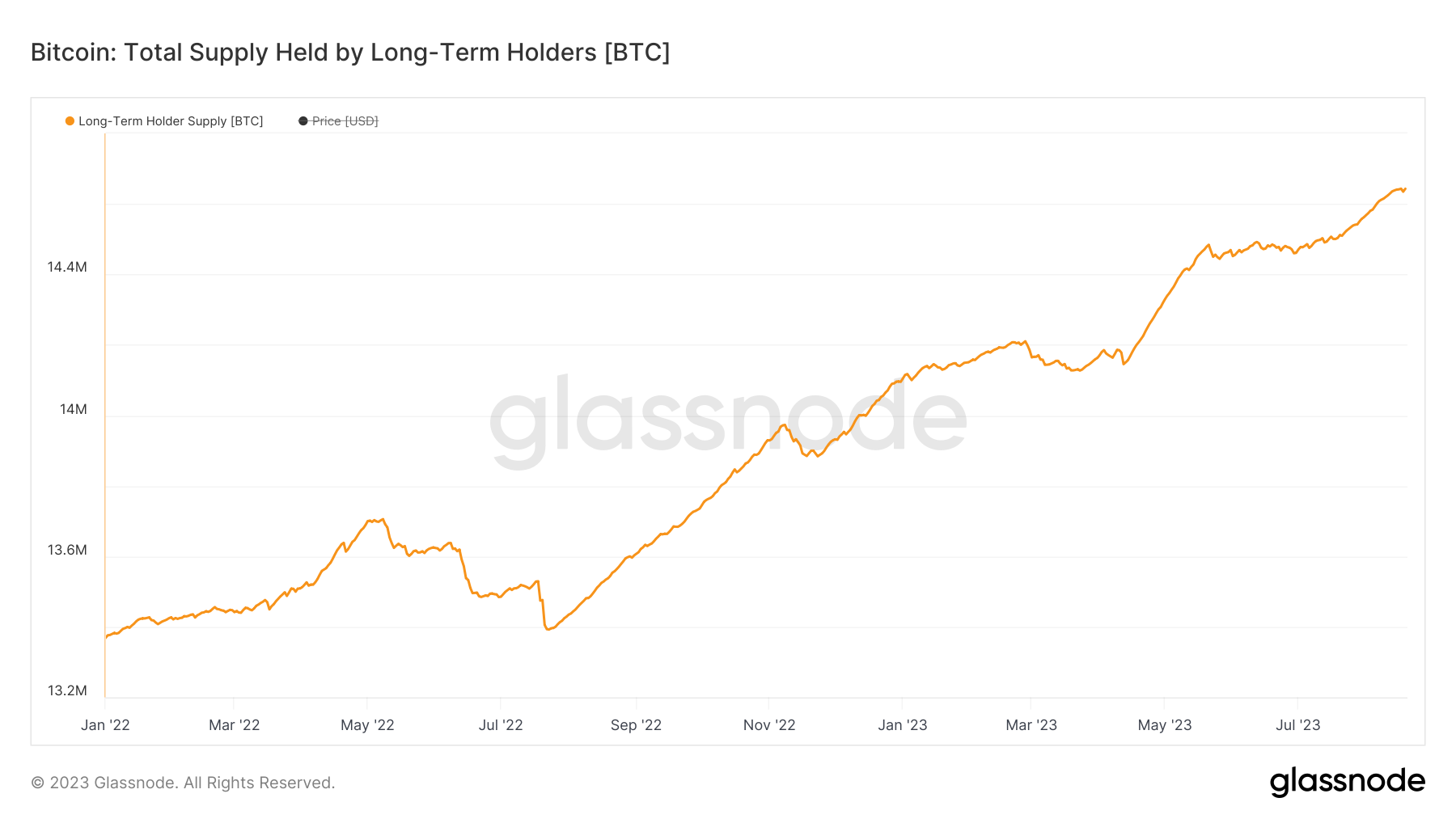
The first period was between May and August 2022, when the crypto world was thrown into disarray. Already fighting a glum macro picture with newly-rising rates and rampant inflation, digital assets got hammered further with the startling death spiral of the UST stablecoin, leading to the collapse of all things Terra. This in turn sparked contagion across the sector, the summer filled with bankruptcies. 

The second period which saw long-term holders waver was very brief, following the FTX collapse last November. The third was then March of this year, which saw apparent profit-taking as Bitcoin increased off the back of more dovish forecasts around the future path of interest rate rises following the regional bank crisis. 

This has led to a position today whereby 14.6 million Bitcoin are held by long-term holders, equivalent to 75% of the total circulating supply. 


The portion of the supply claimed by long-term holders is interesting to track as it is an oft-referenced point by Bitcoin enthusiasts when forecasting the long-term price of the asset. With the overall supply capped at 21 million coins and the rate of increase in supply halving every fours years, they argue that a supply-side squeeze will push the price of Bitcoin up. As long-term holders hoard greater amounts of the supply, there will only be less Bitcoin to go around. 

Obviously, the demand side of the equation needs to hold up its end of the bargain for this to be true. But amid an extremely challenging eighteen months for Bitcoin, the apparent resilience of long-term holders is certainly a silver lining, and may become more and more relevant as time goes on.

The post Long-term holders weather brief volatility surge appeared first on CoinJournal.

Filecoin price prediction: is it safe to buy the FIL dip?

  • Filecoin price remained under intense pressure this week.

  • The coin has plunged to the lowest level since June 10th.

  • The developers introduced slasher and lotus disputer.

Filecoin price remained under intense pressure following last week’s crash. The token was trading at $3.37 on Tuesday, lower than last month’s high of $4.93. Its market cap has slipped to more than $1.5 billion.

Latest Filecoin news

Filecoin, the giant blockchain network for the storage industry, introduced two important features on Monday. In a statement, they launched Lotus Slasher, a feature that will improve network security and integrity.

Lotus slasher look for consensus faults where block producers engage in malicious activities. When the network detects these activities, it will fine the producer by reducing the offender and rewarding the reporter.

The other product was Lotus Disputer, where disputers will be able to challenge and verify proof of storage and slash providers who submitted invalid WindowPosts in the network.

The goal of these products is to strengthen the ecosystem by aligning incentives and allowing the community to self-police.

For starters, Filecoin is a leading project that is in the storage and cloud computing industry. The network makes it possible for users to provide storage to other people and companies in a decentralized way.

Filecoin has also introduced new features that help them do computing. These features aim to position it as the best alternative to Amazon’s AWS and Microsoft Azure. Also, Filecoin launched FVM, a platform that makes it possible for developers to launch dApps in its ecosystem.

Filecoin price prediction

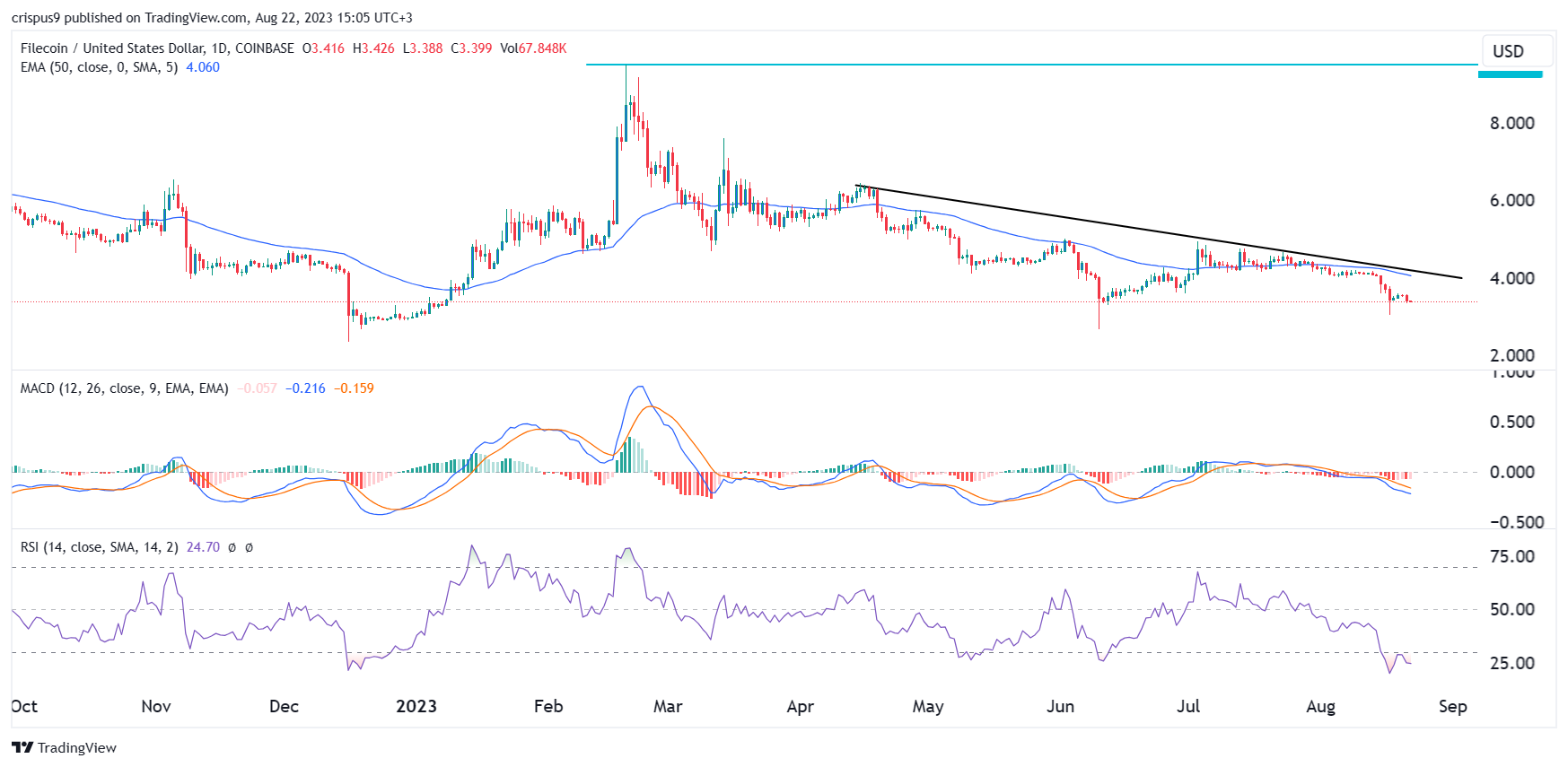
The daily chart shows that the FIL price has been in a bearish trend after peaking at $9.49 earlier this year. The decline gained steam after last week’s crypto crash, which pushed it to the lowest level since June 10th. Filecoin has dropped below the descending trendline shown in black.

It has also moved below the 50-day moving average while the Relative Strength Index (RSI) and the MACD have drifted downwards. Therefore, the coin will likely have a bearish breakout, as sellers target the key support at $2.80, the lowest level on June 10th.

How to buy Filecoin

eToro

eToro is a multi-asset investment platform with more than 2000 assets, including stocks, ETF’s, indices, commodities and Cryptoassets. eToro offers over 60+ Cryptoassets to invest or invest in their CryptoPortfolio where investors can benefit from the accumulated growth of Bitcoin, Ethereum, XRP, Litecoin and other leading cryptocurrencies. eToro users can connect with, learn from, and copy or get copied by other users.

Binance

Binance has grown exponentially since it was founded in 2017 and is now one of, if not the biggest cryptocurrency exchanges on the market.

The post Filecoin price prediction: is it safe to buy the FIL dip? appeared first on CoinJournal.

Shiba Memu token is thriving despite the painful crypto sell-off

  • Bitcoin and other cryptocurrencies plunged hard last week.

  • This decline happened amid a sense of fear in the financial market.

  • Shiba Memu token sale has gained steam as the developers raised over $2.1 million.

Cryptocurrency prices had their worst performance this year as Bitcoin plunged from $29,000 to below $26,000. Most coins and tokens were deeply in the red as demand waned and a sense of fear spread in the market. Despite this retreat, Shiba Memu’s token sale continued, with the developers raising over $2.18 billion.

Why did cryptocurrencies slip?

There are several reasons why most cryptocurrencies plunged last week. First, the coins dropped because of a potential shakeout. A shakeout refers to a situation where a financuial asset dips sharply and then resumes the bullish trend. 

The most recent shakeout happened when Bitcoin fell from $25,000 to $19,000 and then resumed the bullish comeback to the year-to-date high of $32,000. It is still unclear whether the current decline was a shakeout or the start of a new bear run.

Second, Bitcoin dropped because of technical reasons. Bitcoin formed a double-top pattern at $32,000. In price action analysis, this pattern is usually a bearish sign. Therefore, from these technicals, there is a likelihood that the coin will continue falling.

Third, a sense of fear spread in the market as evidenced by the stock and bond market sell-off. Bond yields in most developed countries jumped, with US 10-year rising to 2012 highs and the 30-year reaching the 2007 highs. Bond yields move inversely to prices.

Further, cryptocurrency prices dropped because of the Chinese economy, which is going through the deepest slowdown in years. Data published last week showed that most parts of the economy like retail, industrial production, and fixed asset investments are slowing at a fast pace. China is still an integral part in the crypto industry, accounting for 20% of Binance volume.

Shiba Memu is still thriving

Shiba Memu, an upcoming cryptocurrency that combines aspects of meme coins and artificial intelligence, is thriving. Data available in its website shows that the developers have raised over $2.1 million from investors around the world. They have done that by raising over 68.1 million tokens in the past two months.

Shiba Memu’s token sale is unique because the price of the token is raised every days. This means that investors who bought the token on the first day have seen their value jump sharply even without doing anything. 

Shiba Memu is thriving because of the industries that the developers are targeting. AI has become the fastest-growing industry this year, helping to push Nvidia’s market cap to over $1 trillion. Similarly, meme coins have thrived, with some tokens like Pepe transforming some people into instant millionaires.

With the rising hype, there is a likelihood that the Shiba Memu price will also jump when it debuts in centralized and decentralized exchanges soon. You can buy the Shiba Memu token here.

The post Shiba Memu token is thriving despite the painful crypto sell-off appeared first on CoinJournal.

Over a billion dollars liquidated in crypto’s worst day since FTX


Key Takeaways

  • Last week saw crypto suffered its worst 24 hours since FTX as over one billion dollars in derivatives were liquidated on Thursday
  • Derivative volume outstrips the extremely low spot volume, with cascading liquidations having the potential to exacerbate price moves
  • Volatility was sparked by sell-off in the bond market
  • Developments re-affirm how vulnerable Bitcoin is in the short-term to the highly unusual macro climate 

Following an extended period of rest in the crypto markets, the beast re-awakened last week. Crypto markets plummeted late Thursday and early Friday, led as always by Bitcoin. The world’s largest cryptocurrency shed 7% in what amounted to the largest one-day drop since the spectacular collapse of FTX last November. 

The year 2023 has been characterised thus far by the unusual fact that crypto’s rise has been slow and steady. Aside from a jump in March amid the regional bank crisis, Bitcoin has been perceptively devoid of the usual spikes and freefalls. 

The Bitcoin price displays this clearly in the next chart, as well as Friday’s trip south.

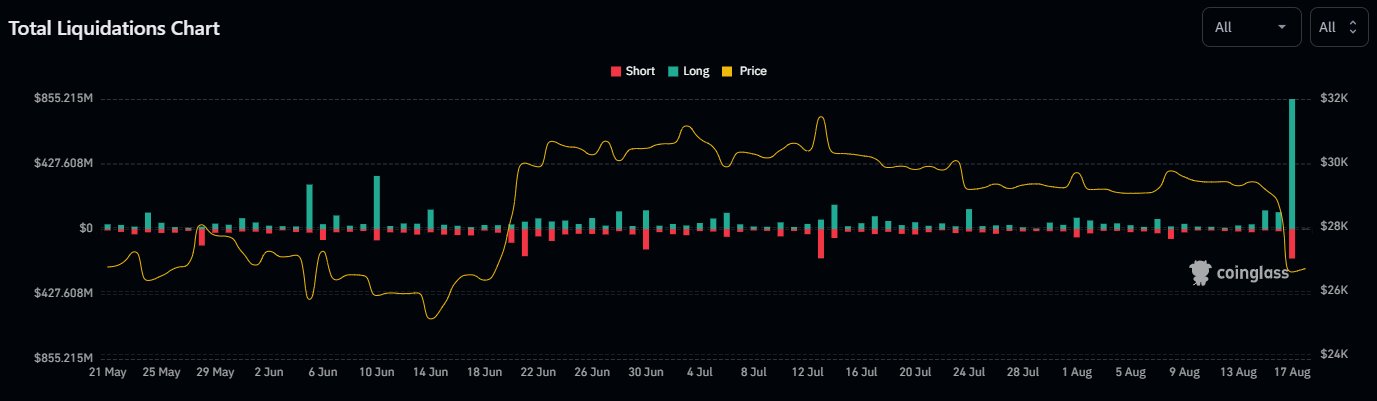
Digging further into last week’s price drop shows that, remarkably, Bitcoin fell 8% in just ten minutes from 9:35 PM GMT on Thursday evening. Looking at data from Coinglass, this contributed to a surge of liquidations. All in all, over one billion dollars was liquidated in what amounted to the biggest day of liquidations since the FTX demise (anytime the phrase “since FTX” is used in crypto, it rarely spells good news). 

The flood of liquidations highlights how much greater the volume was in derivatives markets than spot, with the latter remaining extremely thin. Order books have been perceptibly shallow ever since Alameda evaporated amid the FTX debacle (liquidity was thin even before then). 

What caused the sell off?

The underlying cause of the volatility was a sell-off in the bond market, with yields spiking to multi-year highs. Yields on long-term US government debt neared their highest level since 2007, UK 10-year gilts rose to their highest yield since 2008, and Germany’s 10-year bund reached its highest yield since 2011. 

Higher yields spell trouble for risk assets, as we are well aware by now, with Bitcoin sent tumbling amid the tightening monetary environment last year. The recent move was borne out of investors betting that high interest rates will persist for longer than previously anticipated, or further hikes may not be as improbable as previously expected. 

The inverse relationship between Bitcoin and yields has been strong, demonstrated in the below chart. Hence, Bitcoin’s drop is not surprising in the context of the developments in the bond market last week. 

The sell-off reaffirms how vulnerable Bitcoin is to a macro situation that continues to perplex – high but falling inflation, while high interest rates contrast with record-low unemployment and relatively resilient economic data. 

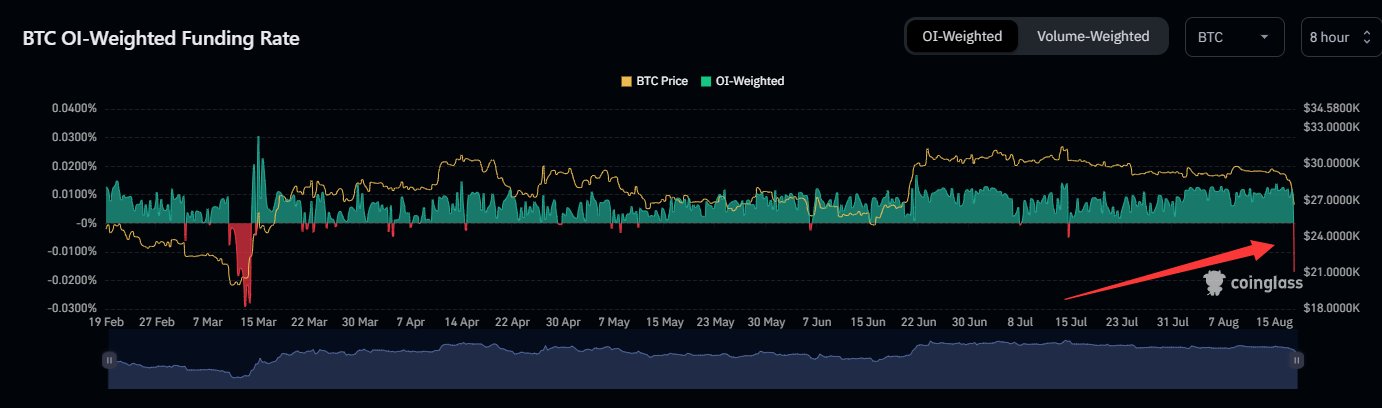
Getting back to the derivatives market, the shift was further evident by looking at funding rates, with the Bitcoin OI-weighted funding rate dipping below -0.01% for the first time since March. 

Finally, negative funding rates and freefaling open interest returned. It took a while, but volatility has returned.

What next for crypto?

What this spells going forward is up for debate. Some analysts affirm this is a mere blip, a drop sparked by complacent overleverage following a period of calm that felt like forever. A slight increase in hawkish sentiment going forward won’t ultimately change much, they argue, for an economy which seems increasingly ambitious about achieving a soft landing. 

On the other hand, some fear there could be a return to 2022-like conditions. While that may seem extreme, there is every change there is a recalibration away from the borderline-celebratory stance that interest rate hikes were complete and the soft landing was already guaranteed. 

If that were the case, this could mark the end of the bear market rally for crypto. Few assets are as sensitive to global liquidity as Bitcoin is, meaning a reversion towards the tightening seen last year would undoubtedly spell red candles on price charts.

This would be getting ahead of oneself, however. The macro climate remains largely unprecedented and very challenging to predict. Even the Federal Reserve’s language betrays this, with some notable see-sawing in recent meetings. 

Last Wednesday, meeting minutes said that there are “significant upside risks to inflation, which could require further tightening of monetary policy”. Going back to the meeting in July, minutes say that the Fed believed inflation was falling and risks “titled to the downside”, with Jerome Powell asserting that “given the resilience of the economy recently, (the Fed is) no longer forecasting a recession”. 

While these are not necessarily conflicting – one can have inflation and tightening without a recession, it is just quite difficult (but where we have been living for the last eighteen months) – it does highlight how uncertain the whole climate is. 

Bitcoin is again caught in the crossfire, a risk asset subject to the whims of the wider market as it grapples with this fast-changing environment. 

The post Over a billion dollars liquidated in crypto’s worst day since FTX appeared first on CoinJournal.