
Riot, MARA, Argo Blockchain stocks at risk as BTC forms death cross

  • Bitcoin mining stocks have dropped sharply from their highest levels this year.

  • Bitcoin price is about to form a death cross pattern on the daily chart.

  • The US dollar index is forming a golden cross pattern.

Riot Platforms and Marathon Digital stock price remained under pressure as Bitcoin and other cryptocurrencies retreated. The RIOT shares were trading at $11.13 on Thursday, ~45% below the highest level this year. Similarly, MARA shares retreated to a low of $12.14, ~38% below the YTD high.

Bitcoin mining stocks have been in a downward trend in the past few days as concerns about cryptocurrencies continued. Precisely, they have dropped sharply as Bitcoin has dropped from the year-to-date high of $31,000 to $26,000.

Sadly, the situation could get worse since Bitcoin is about to form a death cross pattern. This pattern happens when an asset’s 200-day and 50-day exponential moving averages (EMA) are about to make a crossover. In most periods, the death cross is usually followed by more downsides.

Notably, the US dollar index (DXY) is also about to form a golden cross pattern, pointing to more upside in the near term. If this happens, it means that the dollar index will rise to over $106. Historically, Bitcoin has an inverse relationship with the US dollar.

The dollar index has jumped as investors predict a more hawkish Federal Reserve in the coming months. That’s because economic data from the US have been better than expected. For example, the services PMI figure rose at a faster pace in August.

Further, as shown below, Bitcoin has formed what looks like a bearish flag pattern. In price action analysis, this pattern is also a bearish one. It is characterized by a long line followed by some consolidation.
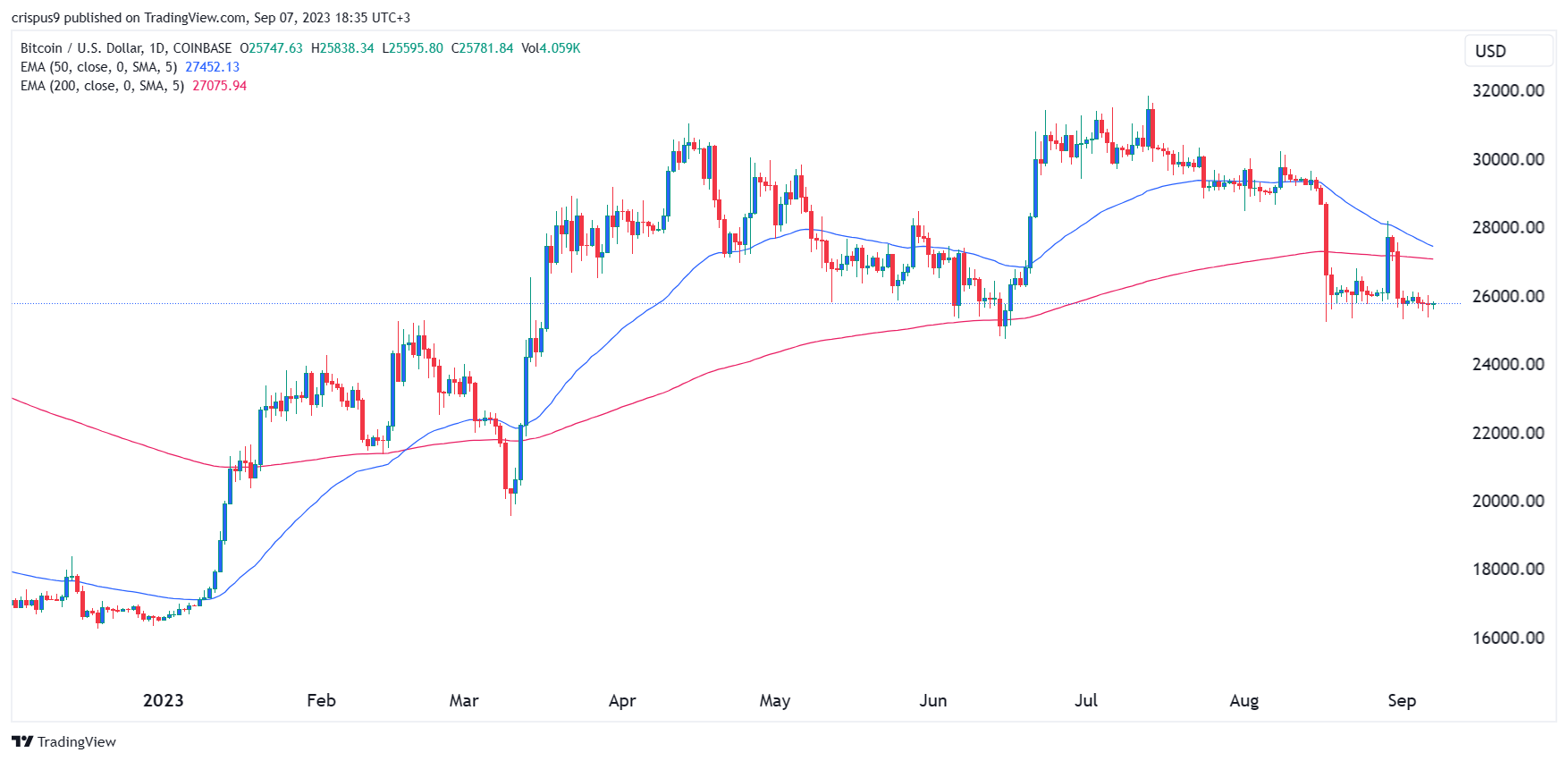
Therefore, there is a high possibility that Bitcoin will soon have a bearish breakout. If it happens, the next level to watch will be $20,000. If this happens, mining stocks like Riot Platforms, Marathon Digital, and Argo Blockchain will likely continue falling.

The likely catalyst for Bitcoin price will be a decision by the SEC to provide a greenlight for a spot Bitcoin ETF.

How to buy Bitcoin

eToro

eToro is a multi-asset investment platform with more than 2000 assets, including stocks, ETF’s, indices, commodities and Cryptoassets. eToro offers over 60+ Cryptoassets to invest or invest in their CryptoPortfolio where investors can benefit from the accumulated growth of Bitcoin, Ethereum, XRP, Litecoin and other leading cryptocurrencies. eToro users can connect with, learn from, and copy or get copied by other users.

Binance

Binance has grown exponentially since it was founded in 2017 and is now one of, if not the biggest cryptocurrency exchanges on the market.

The post Riot, MARA, Argo Blockchain stocks at risk as BTC forms death cross appeared first on CoinJournal.
ETF season continues as Ether application lodged while markets plod along


Key Takeaways

  • The crypto market has seen increased volatility off the back of ETF developments in the last couple of weeks
  • Grayscale secured a positive ruling in its case against the SEC regarding its ETF application
  • Markets subsequently fell as the regulator pushed out the approval date of all ETF applications
  • Cathie Wood’s ARK Invest has now filed for a spot Ether ETF
  • Market is largely anticipating the approval of a futures-based Ether ETF before mid-October
  • ETFs are inevitable, and while the headlines may be repetitive, there is little volatility coming from anywhere else these days

The crypto markets are still enduring uncharacteristically low volatility, but there has been at least a little pickup in recent weeks. 

Most of it is due to ETFs, whether one way or another. Last week saw Grayscale secure a landmark decision against the SEC, with a federal court ruling that the SEC was wrong to reject an application from Grayscale Investments to convert its trust into an ETF. The judge said the regulator failed to “offer any explanation” following its decision. 

This sparked a fresh wave of optimism that not only would Grayscale secure ETF approval, but the slew of other applications currently on the waitlist would also be successful. 

However, markets gave back most of those gains when the SEC announced shortly thereafter that it was pushing out the decision on all ETFs until October. 

This delay aside, however, the regulatory picture is brightening significantly for crypto. Only a few months ago, the future of the entire industry seemed to be under threat in the US. While there remains serious concern over large swathes of the space (the myriad allegations against Binance alone could prove seismic), it is beginning to feel inevitable that ETFs are simply a matter of time. 

Not only that, but hope is now swelling that Bitcoin may not be the only asset to achieve the ultimate stamp of approval. Cathie Wood’s Ark Invest and 21Shares have filed for a spot Ethereum ETF, the first attempt to list such a fund in the US. 

While this represents the first spot ETF attempt, there have been several applications on the futures side for Ether. Bloomberg reported in August that the regulator would likely approve these products, which number nearly a dozen – an expectation that most around the industry are in line with. 

The SEC’s hesitance regarding spot ETFs has centred around the fact that there is not a regulated crypto market of sufficient size to prevent market manipulation. While many decry this refusal to approve the ETFs as unjustified, it is easy to see their hesitance when looking at the state of liquidity. Spot volumes have been decimated this year, while futures and derivatives have fared far better.

In truth, when the approval does come, it should bolster liquidity itself, in somewhat of a chicken and egg problem. And with demand increasing for these products, there is only so long that the SEC can resist approving these products. 

The macro situation may also play a role here. Interest rates have been hiked from near-zero to north of 5% in the US in what amounts to one of the swiftest tightening cycles in modern history. Accordingly, investors have retreated along the risk curve. Crypto is about as risky as it gets, with prices crashing as a result. Despite Bitcoin rising 55% thus far this year as inflation softened quicker than anticipated and expectations around the future path of interest rates became more optimistic, it is still over 60% off its high from Q4 of 2021. 

Yet the market is now anticipating only one more (if even) rate hike still to come, something which may spur more investors to move back into the space and liquidity to bounce back. There is also the matter of the halvening in April 2024, although it remains too soon to declare with confidence what the effect of that event will be. 

We will likely look back upon these days as low-level, bureaucracy-driven table setting for what lies ahead. Even already, the various ETF news is not having quite the same effect as some of the earlier stories this year – the Ethereum ETF application barely moved markets an inch. But it’s all necessary for this nascent asset class. And in recent times, it has been about the only source of volatility at all.

The post ETF season continues as Ether application lodged while markets plod along appeared first on CoinJournal.

Bitcoin volatility increases but remains far off historic levels


Key Takeaways

  • The last two weeks have seen increased volatility in the crypto markets
  • Bitcoin fell from $29,000 to $26,000 two weeks ago before bouncing back briefly, only to fall again
  • Thin liquidity means the market is ripe for big moves, but trading volume remains suppressed
  • The future should see a return to the volatility the market has come to expect

The year 2023 has been a strange one for crypto. The extreme volatility the sector has become so well known for has been lacking. 

This is despite the price of Bitcoin being up 55% thus far this year. Yet rather than the usual spikes and freefalls, it has been a slow and gradual increase. 

In the last couple of weeks, however, volatility has picked up. It is not quite at the levels we are accustomed to seeing, but it is no longer at all-time lows, either. Two weeks ago, Bitcoin fell from $29,000 to $26,000, including a 7% fall in a ten-minute span. 

Last Thursday, it then jumped 6%, back up to $27,700. Two days later, it had given up those gains, trading at $25,900. 

While the price action of the last two weeks is not dramatic by Bitcoin’s standards, it at least represents a closer picture to what we have come to expect from the asset. 

The boost last week was led by a positive court ruling regarding the Grayscale Bitcoin Trust. A three-judge panel of the District of Columbia Court of Appeals in Washington ruled that the SEC was wrong to reject Grayscale’s proposed Bitcoin ETF without explaining its reasoning. 

However, those gains have since been given up. The SEC said late Thursday in a series of filings that more time was needed to consider the slew of ETF applications which have been lodged in recent months. 

As we said, rampant volatility has been one of the calling cards of this asset since it was launched fourteen years ago – and even this recent bout is relatively minor and seems to be driven by the ETF news. That is why 2023 has been unusual- it was the absence of volatility before the last couple of weeks that is more surprising than its recent abrupt increase. 

Volatility should return to prior levels

Again, however, this bout of volatility is hardly anything to write home about by Bitcoin’s standards. Furthermore, studying the market structure suggests that we should not expect subdued activity for too long. 

One of the prime reasons for this is liquidity. Order books are as thin as they have been in quite some time on Bitcoin markets. This means less capital is required to move prices, amplifying moves to both the upside and downside. 

Looking across the space shows that while prices have rebounded this year, volumes remain at multi-year lows and capital continues to flow out of the space. 

Trading volume and volatility come hand in hand. It makes sense, therefore, that we have seen the latter drop as investors have pulled capital, retreating on the risk curve amid tough macro conditions. 

However, the liquidity situation, combined with the inherent nature of the crypto markets – and the fact that volatility has never gone away for long – means that it would not be a surprise to see the subdued markets ramp back up. The last two weeks have seen a move in this direction, but in the grand scheme of things, it is nothing compared to what we have seen in the past, nor what we may see once more in the future. 

The post Bitcoin volatility increases but remains far off historic levels appeared first on CoinJournal.

Bitcoin Cash, Stacks, Neo, Solana, Stellar prices retreat as the DXY jumps

  • Bitcoin and other altcoins continued falling on Wednesday.

  • The US dollar index continued rallying as crude oil price jumped.

  • There are signs that the Fed will continue hiking rates.

Bitcoin Cash, Stacks, Neo, Solana, and Stellar lumens price drifted downwards as a sense of fear engulfed the financial market. Most of these coins dropped by more than 3% on Wednesday as demand remained significantly low.

The main catalyst for the sell-off was the recent trends in the energy market. Brent, the international benchmark, surged to over $90 per barrel. It has soared by over 25% from the lowest level in June and some analysts see it rising to $100 in the coming weeks.

The rising oil prices mean that the Federal Reserve could maintain its hawkish tone in the coming months. Economists have a mixed feeling about what to expect. Some of them expect the bank to hike rates by another 0.25% this month and push them to 5.75%.

Other analysts believe that the Fed will leave rates intact as officials wait for more details about inflation. This view was supported by Christopher Waller, one of the most hawkish Federal Reserve officials.

The rising expectation of another Fed hike has pushed many investors to the safety of the US dollar. Data shows that the dollar index has surged to more than $104, the highest level in more than five months.

As I wrote in this article on Tuesday, cryptocurrencies tend to have an inverse relationship with the US dollar. In most periods, coins like Bitcoin and Ethereum tend to retreat when the DXY index is soaring.

Solana and Stellar prices retreated even after a dose of good news from Visa, the biggest fintech company in the world. In a statement on Tuesday, the company said that it would expand its USDC expansion to Solana’s ecosystem. Solana is known for its fast speeds and low transaction costs.

Visa hopes to use this technology in its business of processing billions of dollars every day. This news impacted Stellar because USDC is built using its technology.

The outlook of Bitcoin and other altcoins is relatively bearish for now since there is no major catalyst in the near term. A likely catalyst will be the eventual acceptance of a Bitcoin ETF by the SEC. This is highly likely now that GreyScale won a major lawsuit last week.

How to buy Bitcoin Cash

eToro

eToro is a multi-asset investment platform with more than 2000 assets, including stocks, ETF’s, indices, commodities and Cryptoassets. eToro offers over 60+ Cryptoassets to invest or invest in their CryptoPortfolio where investors can benefit from the accumulated growth of Bitcoin, Ethereum, XRP, Litecoin and other leading cryptocurrencies. eToro users can connect with, learn from, and copy or get copied by other users.

Skilling

Skilling is a regulated Forex and CFD broker that allows traders to access 800+ financial instruments, including 10 popular cryptocurrency CFDs with competitive pricing and fast execution time. Skilling offers a selection of trading platforms, including the proprietary Skilling Trader and popular, industry renown cTrader and MetaTrader 4 platforms, which can suit the needs of customers with different levels of trading experience.

The post Bitcoin Cash, Stacks, Neo, Solana, Stellar prices retreat as the DXY jumps appeared first on CoinJournal.

Falling US Treasury returns might help the cryptocurrency market

  • US deficits keep rising despite the economy growing
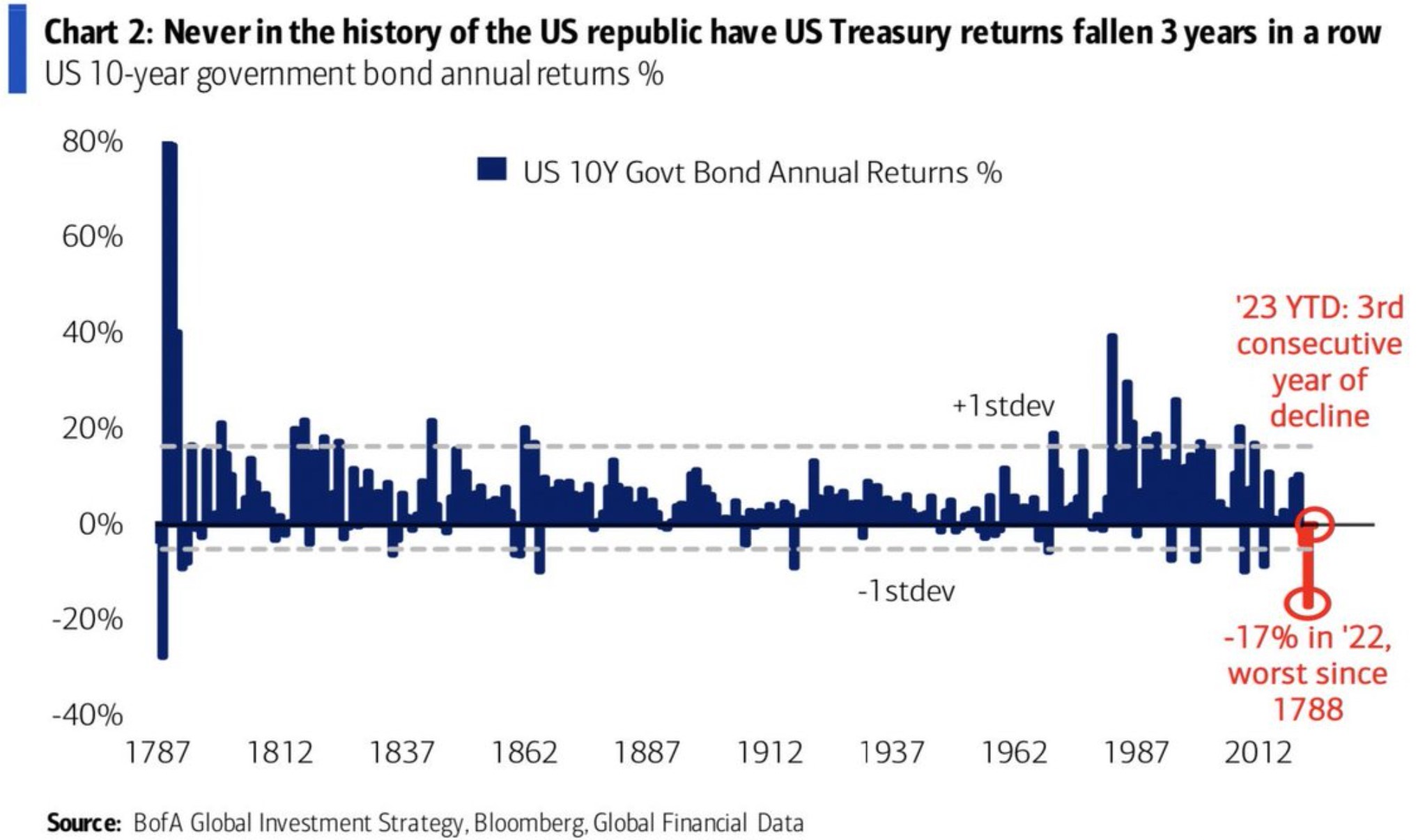
  • US Treasury returns dropped for the past three years in a row
  • A weakening dollar might cause cryptocurrencies’ next step higher

In previous articles published here, I’ve argued that the next move in the cryptocurrency market will likely be driven by the US dollar rather than crypto-related news. Given the current interest rate levels, the surging deficit makes raising money difficult for the US government.

Hence, one way to make it easier is to lower the rates.

The Federal Reserve will never tell market participants that rates cannot move much higher. The moment it does that, inflation expectations are not anchored anymore.

However, one might take time to understand what the bond market tells. For the first time in the history of the United States, US Treasury returns dropped three years in a row.

A vicious circle could spark the US dollar’s weakness

The price of a bond is inversely related to its yield. Lower bond prices mean higher yields and one way for bond prices to bounce back is for yields (i.e., interest rates) to decline.

But the deficit poses a huge problem. Deficit spending is one of the reasons why bonds underperform.

Because deficits surged even as the economy grew, more bonds are issued to pay for it. However, issuing more bonds means issuing more debt, but interest rates are not low anymore as they were in the past years.

Therefore, interest rate expenses would increase, offsetting the revenue collected from selling the bonds.

One way to solve this problem is to let the dollar slip. The starting point might be a signal that the Fed has already reached the terminal rate.

If the dollar starts weakening, its decline should be generalized and also have ramifications for the cryptocurrency market. Therefore, if Bitcoin is about to make a move higher, one should keep an eye on the US deficit and the dollar.

The post Falling US Treasury returns might help the cryptocurrency market appeared first on CoinJournal.