
Der Präsidentschaftskandidat Robert F. Kennedy Jr. will sich verstärkt um eine Förderung der Kryptobranche bemühen und wirbt damit um Stimmen für seine Wahl zum US-Präsidenten.

Krypto minen, NFT minten, Gold schürfen und Geld drucken
Der Präsidentschaftskandidat Robert F. Kennedy Jr. will sich verstärkt um eine Förderung der Kryptobranche bemühen und wirbt damit um Stimmen für seine Wahl zum US-Präsidenten.
Meme coins have outperformed mainstream cryptocurrencies this year.
These tokens have attracted substantial hype from investors and traders.
Piggy Bankster aims to be the next big name in the meme coin industry.
Meme coins have done well this year, outperforming popular cryptocurrencies like Bitcoin, Ethereum, and Cardano. Pepe, launched in 2023, has soared to a record high, giving it a market cap of over $6 billion.
Other meme tokens like dogwifhat (WIF), Bonk, Book of Meme (BOME), and Dog Go to The Moon (DOG) have also done well this year. WIF’s market cap has soared to over $3.3 billion while Bonk, BOME, and DOG are valued at over $2 billion.
Altogether, all meme coins tracked by CoinMarketCap have a market cap of over $63 billion. This makes them bigger than many well-known companies like FedEx, Spotify, Workday, and Monster Beverage among others.
There are several reasons why meme coins have done well this year. First, their performance was driven by key news in the crypto industry. The Securities and Exchange Commission (SEC) approved Bitcoin ETFs in January. Since then, these ETFs hold over $60 billion worth of assets, helped by strong institutional demand.
Second, the agency has recently approved Ethereum ETFs and analysts expect that they will attract billions of dollars in assets when they start trading. This approval means that the SEC could approve other ETFs like Solana, Cardano, and Ripple.
Third, they rose because of April’s Bitcoin halving, which reduces the number of Bitcoin rewards offered to miners. In most cases, Bitcoin tends to rally ahead and after halving.
Finally, there is hope that the Federal Reserve will start cutting interest rates later this year if inflation continues dropping. Cryptocurrencies and other risk assets do well when the Fed turns dovish.
Meme coins do better than other cryptocurrencies because of their lower notional value, increased whale activity, and their potential for huge gains.

Analysts believe that more meme coins will be launched in the coming months as developers seek to benefit from this demand.
One of the most anticipated meme coins will be Piggy Bankster, whose presale will start on June 4th of this year.
$PIG will be launched on the Solana network, which has become popular among developers because of its top speeds and low transaction costs. Some of the top Solana meme tokens are Bonk, Book of Meme, and Cat in a Dogs World.
Piggy Bankster also aims to disrupt the world of animal-themed tokens. This is an industry that started with dogs (Shiba Inu and Dogecoin), cats (Popcat), frogs (Pepe), and chickens (Coq Inu).
History shows that most animal-themed token pioneers tend to do well as they attract traders’ attention. Therefore, there is a likelihood that the Piggy Bankster token will do well in its token sale and when it starts trading.
Piggy Bankster will have a total supply of 100 million and an initial liquidity of 12,000. The starting price of its presale will be $0.00012. You can learn more about the token on the Piggy Bankster website and follow the updates on X.
The post Missed PEPE and PopCat? Piggy Bankster may be the next big thing appeared first on CoinJournal.
In a groundbreaking move, the EOS Network Foundation, under the leadership of CEO Yves La Rose, has approved a community proposal to cap the total supply of EOS tokens at 2.1 billion.
This decision marks a significant shift in the network’s tokenomics, aiming to stabilize and enhance the economic model of the EOS ecosystem.
The proposal, which gained approval from at least 15 of the 21 EOS block producers, involves burning nearly 80% of the current total EOS token supply.
This drastic reduction is primarily sourced from future emissions, effectively decreasing the maximum supply from 10 billion to 2.1 billion tokens.
Yves La Rose confirmed the community’s consensus on the proposal through a post on X, emphasizing the foundation’s commitment to a fixed token supply and reduced inflation.
Currently, the circulating supply of EOS stands at 1.15 billion tokens, accounting for 54% of the newly established cap.
To support ongoing and future ecosystem growth, the proposal also includes minting an additional 950 million EOS tokens.
The minted tokens will be allocated to various ecosystem activities, such as rewarding stakers and block producers, ensuring continued incentivization and support for network participants.
Besides the trasition to a fixed token supply and reduction of the fully diluted valuation (FDV), La Rose highlighted several other key aspects of the proposal, including scheduled halvings every four years, and enhanced RAM market support.
In general, these changes aim to foster a more predictable and sustainable economic environment for the EOS network, positioning it for long-term success and stability.
It is important to note that EOS was originally the creation of Block.one and the EOS token was introduced to investors through an initial coin offering (ICO) conducted between 2017 to 2018 raising $4 billion.
However, following some allegation of Block.one not reinvesting the funds raised during the ICO back in the EOS Network development, La Rose founded the EOS Network Foundation as a non-profit organization to support the EOS Network.
By capping the token supply and implementing a series of economic reforms, the EOS Network Foundation aims to create a more robust and investor-friendly ecosystem.
The planned changes are expected to be rolled out over the coming months, ushering in what La Rose describes as a “new era for EOS.”
The post EOS Network Foundation implements major overhaul caps token supply at 2.1B appeared first on CoinJournal.
Franklin Templeton has filed its amended S-1 form for spot Ethereum ETF following SEC’s directive that all spot Ethereum ETF issuers should send in their amended S-1 forms by Friday.
In the amended S-1, Franklin Templeton plans to charge a competitive 0.19% sponsor fee for the ETF, which is could be the lowest among its peers.
Franklin Templeton was among the eleven firms whose spot Bitcoin ETFs were approved by the SEC at the start of the year.
The firm’s foray into the Ethereum ETF space is buoyed by the success of its spot Bitcoin ETF, which currently manages approximately $350 million in assets. This strong performance of the Bitcoin ETF underscores the firm’s capability in managing cryptocurrency investment products and sets a promising precedent for its upcoming Ethereum ETF.
Its spot ether ETF application positions it among a growing number of financial institutions seeking to offer investors exposure to Ethereum, the second-largest cryptocurrency by market capitalization, without the need to directly purchase the digital asset.
Franklin Templeton’s proposed 0.19% fee mirrors the fee structure of its spot Bitcoin ETF (EZBC), which is also set at 0.19%, making it the lowest among similar financial products currently available.
Initially, Franklin Templeton did not charge any fee for investing in its spot Bitcoin ETF, a strategy likely designed to attract initial investors and build momentum.
Eric Balchunas, Bloomberg’s Senior ETF Analyst, commented on Franklin Templeton’s aggressive fee structure in a post on X saying, “The opening shot in the Eth ETF fee war has been fired from Franklin, 19bps.”
Balchunas’ comment highlights the competitive nature of the burgeoning Ethereum ETF market, where cost efficiency is a critical factor for attracting investors.
As firms rush against time to beat the Friday deadline, the stage is set for a new wave of Ethereum-based financial products to enter the market.
Although it may take a few weeks for these filings to become effective, the expectations that the ETFs could begin trading in a month’s time if not in a few weeks’ time.
The post Franklin Templeton proposes a 0.19% fee in its amended Spot Ethereum ETF S-1 appeared first on CoinJournal.
The Uniswap Foundation has postponed the governance vote on a proposal aimed at activating a new fee mechanism for the protocol. This proposal would have initiated a fee switch for Uniswap, providing for rewards to UNI token holders who stake and delegate their tokens.
As the market reacted to the news, the price of UNI fell by nearly 9% to touch lows of $10.17 across major exchanges.
Uniswap announced the fee switch proposal last week, with an on-chain deployment and vote set for today, Friday. However, this will now not go ahead as planned as per a new update.
In an update today, the Uniswap Foundation stated that the delay relates to an issue a stakeholder raised following the proposal. This has necessitated “additional diligence” on the part of the Foundation.
“Due to the immutable nature and sensitivity of our proposed upgrade, we have made the difficult decision to postpone posting this vote. This was unexpected, and we apologize for the postponement. We will keep the community apprised of any material changes and will update you all once we feel more certain about future timeframes,” the Uniswap Foundation noted via its official X account.
The UNI token traded to highs of $11.04 on Friday before the announcement saw the token’s value tumble.
UNI price has moved lower since hitting highs of $11.79 on May 26. The RSI on the daily chart suggests bears might yet target prices around the $10 level.
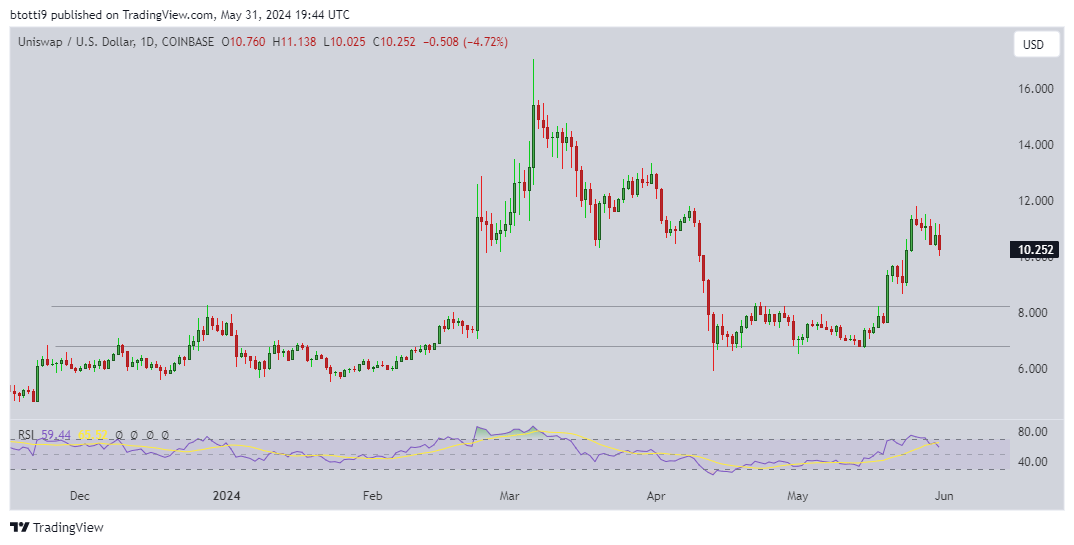
With Unswap price currently changing hands around $10.26, a breakdown below the psychological level could push it to support near $8.00.
As can be seen in the chart above, UNI price fluctuated within the $6.80-$8.22 range for several days before the breakout on May 20.
The post Uniswap delays protocol upgrade vote; UNI price falls 9% appeared first on CoinJournal.