
Base Network Pushes for Stage 1 Decentralisation

  • Coinbase’s layer 2 chain, Base, begins the journey to Stage 1 Decentralisation by deploying fault proofs on the Base Sepolia testnet.
  • The Base network is centralised as only the operator can propose the network’s state to the Ethereum mainnet.
  • Fault proofs will enable anyone to propose Base’s state, and begin its transition into a decentralised rollup.

on July 23rd 2024, the Base network operator announced the deployment of fault proofs to the Base Sepolia testnet, a staging environment for running and testing applications and code before deploying on the mainnet.

According to Base’s social media post on Mirror, a Web3 social media platform, “the launch paves the way for bringing fault proofs to securely to mainnet, and completing other milestones to reach Stage 1 Decentralisation”.

Fault proofs will allow anyone to propose the root state of Base. This technical term describes submitting a summary of the Base chain, including smart contracts, account balances, and other relevant data, to the Ethereum mainnet to ensure that it is recognised.

The Journey to Stage 1 Decentralisation

According to Vitalik Buterin, Ethereum’s co-founder, Layer 2 rollups must undergo three major milestones before they can be said to be sufficiently decentralised or “take their training wheels off”.

The first stage (Stage 0 or the full training wheels stage) is when layer 2 rollups launch their mainnet. At this stage, users should be able to post transactions without cooperation from the operator, i.e., chain operators cannot freeze users’ assets. However, there does not need to be any fraud proof.

The next stage is Stage 1 Decentralisation, the limited training wheels stage, and must involve fraud proof. There can be a multi-sig override mechanism (called a security council) that can override the fraud proof in cases where the proof system code has bugs; however, it must have a 6-of-8 or stricter threshold, i.e. at least 8 participants and at least 75% agreement to override.

Also, enough participants in the multi-sig override system must be outside the organization running the rollup, in this case, Base (and Coinbase by association).

The final stage, Stage 2 or no training wheels, requires that no actor or group of actors can override the fraud proofs to post a state other than the output of the network’s code. However, this is only advisable when it is ascertained that the fraud proof code has no bugs.

Base’s Journey

Base is currently the second largest Layer 2 rollup with a TVL of $1.76 billion according to Defillama, a leading blockchain data provider. The network has grown tremendously in 2024, leveraging its affiliation with Coinbase to create a network effect that has propelled its growth.

Base’s journey to Stage 1 Decentralisation will help cement its position in the league of other networks within that stage, some being Arbitrum, OP Mainnet, and dYdX v3.

Other chains that have reached this level have issued governance tokens, however, as of writing, Base maintains that it does not intend to issue a token in the future.

The post Base Network Pushes for Stage 1 Decentralisation appeared first on CoinJournal.
Franklin Templeton Endorses Solana Following Launch of its Ethereum ETF

  • Franklin Templeton has said that Solana has shown “major adoption and continues to mature”
  • The asset manager launched its second digital asset-backed ETF, the Franklin Ethereum ETF (EZET)
  • Franklin Templeton has agreed to fully waive its fees until January 2025 for the first $10bn in fund assets

Franklin Templeton has indicated it’s confident in the development of crypto exchange-traded funds (ETFs) claiming “there are other exciting and major developments” that will drive the crypto industry forward.

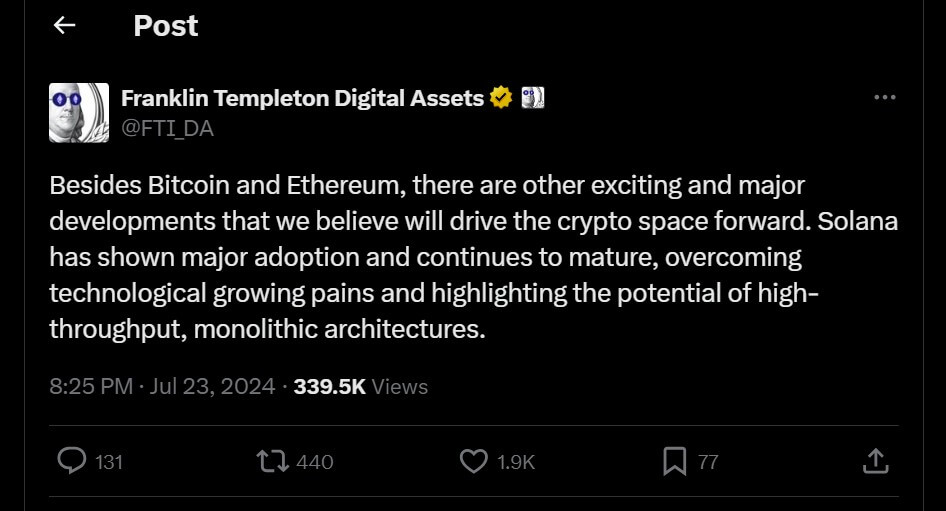
In a post of X, the asset manager wrote: “Besides Bitcoin and Ethereum, there are other exciting and major developments that we believe will drive the crypto space forward.”

Franklin Templeton X post

Showing enthusiasm for a Solana ETF, Franklin Templeton added:

“Solana has shown major adoption and continues to mature, overcoming technological growing pains and highlighting the potential of high-throughput, monolithic architectures.”

Ethereum ETF Launch

The announcement from Franklin Templeton comes after the asset manager launched its second digital asset-backed ETF, the Franklin Ethereum ETF (EZET), which is available on the Chicago Board Options Exchange (Cboe).

Speaking of the launch, Patrick O’Connor, head of Global ETFs for Franklin Templeton, said: “After the success of our spot bitcoin ETF (EZBC) launch in January, we are proud to add EZET to our growing lineup of digital asset ETFs.”

O’Connor added that the company was “thrilled” to provide its clients more access to the digital asset industry in a “regulated fund structure that integrates seamlessly into traditional portfolios.”

As part of its launch, Franklin Templeton has agreed to fully waive fees until January 2025 for the first $10bn in fund assets.

Earlier this week, Cboe announced listing five ether ETFs following the US Securities and Exchange Commission’s (SEC) approval. Franklin Templeton was one of those, the others are 21Shares Core Ethereum ETF, Fidelity Ethereum Fund, Invesco Galaxy Ethereum ETF, and VanEck Ethereum ETF.

Data shows that investors traded over $1bn worth of shares from the ether ETF issuers on the first day of availability, with a net inflow of $106.7m.

Solana ETFs

In July, Cboe also submitted two applications to list spot Solana ETFs on its platform: 21Shares and VanEck. Filing two 19b-4 form applications on July 8, the SEC has until March 2025 to make a decision.

According to the Cboe, a potential Solana ETF is similar to spot Bitcoin and spot Ethereum funds, adding “much like bitcoin and ETH, the Exchange believes that SOL is resistant to price manipulation and that “other means to prevent fraudulent and manipulative acts and practices” exist to justify dispensing with the requisite surveillance sharing agreement.”

The post Franklin Templeton Endorses Solana Following Launch of its Ethereum ETF appeared first on CoinJournal.

Bitstamp to distribute Mt. Gox BTC from July 25

  • Bitstamp plans to distribute Mt. Gox Bitcoin and Bitcoin Cash as from Thursday, July 25.
  • The exchange will have a separate distribution plan for customers in the UK.

Bitstamp announced on Wednesday that the crypto exchange had received Bitcoin (BTC) from Mt. Gox and that it would begin distribution to creditors on Thursday.

The exchange also has Bitcoin Cash from the Mt. Gox trustee, with this coming a decade since the Bitcoin exchange collapsed following a major hacking incident. After a ten-year wait, customers of the defunct crypto exchange can now have their digital assets back.

Bitstamp receives Mt. Gox BTC

Bitstamp said in an announcement that it would begin the distribution process on July 25, 2024. However, it also urged customers to be patient as the process of verification continues.

“We’re pleased to announce that we’ve received the Mt. Gox assets. We’re working diligently to distribute them to our Bitstamp customers who are Mt. Gox creditors. Please allow up to one week for security checks. We’ll inform you when the transfer is finalized,” the exchange notified users via X.

Bitstamp has also told its users in the UK that distribution for this group will be undertaken through a separate plan.

“Rest assured, we’ll keep you updated on the process and ensure you receive your assets as soon as possible,” its post on X reads.

Bitcoin price holds above $66k

Mt. Gox repayments began this month and continues to provide notable downward pressure for BTC price. A significant number of users however have not sold amid the distribution. For instance, CryptoQuant analysts pointed to the increase in BTC outflows from Kraken as the exchange distributed Mt. Gox bitcoin to its customers.

According to analysts, this scenario could bolster Bitcoin’s potential price rebound.

The flagship cryptocurrency currently hovers above $66k, with bulls showing strength since recovering from the recent dump to under $64k.

The post Bitstamp to distribute Mt. Gox BTC from July 25 appeared first on CoinJournal.